































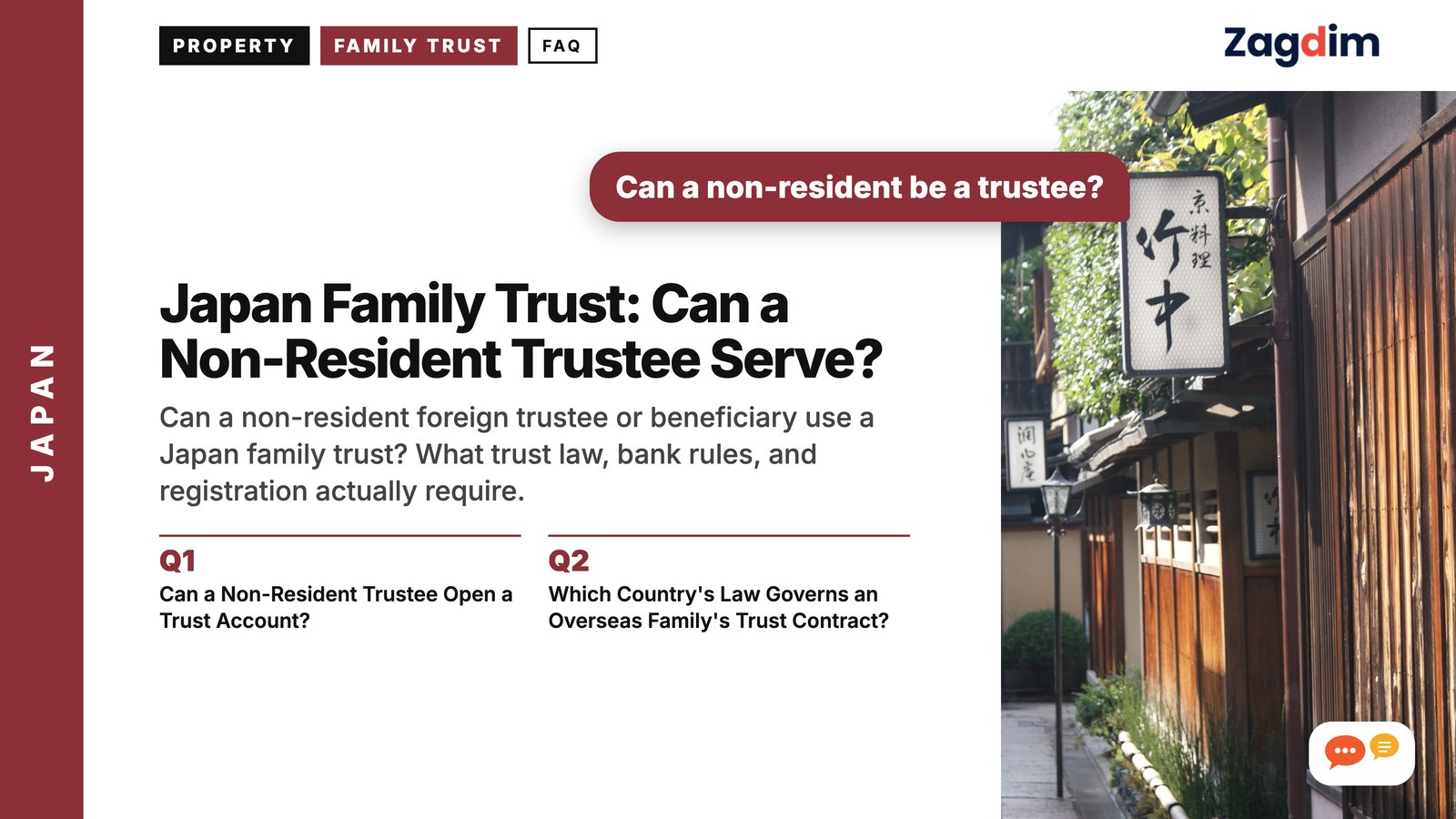
This article is part of Zagdim’s Japan property wiki series on family trusts. It sets out the limits that apply when a foreign national or an overseas resident takes part in a Japan family trust — around law, bank account opening, registration, and government reporting — for readers who hold property or savings in Japan while they or their children live outside the country. The basic structure of a family trust, and the roles of the three parties involved, is covered in Zagdim’s main guide to family trusts for overseas families; this article focuses only on the foreign-national and non-resident parts.
Can a Non-Resident Trustee Open a Trust Account?
Japan’s Trust Act places no restriction on a trustee’s nationality or place of residence; the only express bar is that a minor cannot serve as trustee. That said, this is inferred from the absence of a restriction in the statute — the law does not directly state that someone living overseas can serve as trustee, and other rules, together with bank account-opening practice, impose limits of their own.
Managing rent and cash through a family trust requires a trust-only bank account, and the three financial institutions checked for this article all publish account-opening conditions built around the parties being based in Japan or within the bank’s own service area. Some of these banks also require the settlor (the person who establishes the trust and hands over the property) to live in Japan or within the bank’s service area.
| Financial Institution | Residency and Other Conditions (as publicly disclosed, checked October 2026) |
|---|---|
| Keiyo Bank | In principle, all parties must reside within Chiba Prefecture or a neighboring area; combined trust-related deposits must reach at least JPY 5 million; the bank conducts its own review, and an account cannot be opened on the day of application. |
| Orix Bank | In principle, every party to the trust contract resides in Japan; the contract must be drafted by a professional such as a judicial scrivener, and the settlor must also be the initial beneficiary. |
| Tama Shinkin Bank | In principle, both the settlor and the trustee must reside within the bank’s own service area; the trust must be a self-benefit trust, with the contract drafted by a professional such as a lawyer or judicial scrivener, and a notarized version of the contract must be available. |
In other words, among the three institutions checked for this article, residence in Japan is the general rule. No publicly available information was found describing conditions for a trustee living overseas; whether such a trustee can open an account needs to be confirmed individually with the institution. Conditions can change at any time, so confirm the bank’s current published terms before signing.
Which Country’s Law Governs an Overseas Family’s Trust Contract?
The transfer and registration of ownership of Japan property follows Japanese law, because rights in rem over real property and other registrable rights are governed by the law of the place where the property is located.
The trust contract itself is a different question. Japan’s Act on General Rules for the Application of Laws has no provision written specifically for trusts. The general contract rule applies instead: the law chosen by the parties governs, and if no law is chosen, the law of the place most closely connected to the contract applies; for a legal act concerning real property, the location of the property is presumed to be the place most closely connected. Which country’s law actually governs a given family trust is not directly addressed in official guidance, so this should be confirmed with a qualified professional before signing.
If a parent holds a nationality other than Japan’s, the eventual inheritance and any will may also be governed by that country’s own private-international-law and succession rules, separately from the trust contract itself. As a general pattern across many countries’ succession statutes, inheritance follows the deceased’s home-country law at the time of death, though some countries let their own nationals have property located in that country distributed under that country’s law; the formal validity of a will commonly follows the law of the place the will was made, the testator’s domicile at death, or — for a will concerning real property — the location of the property. The specific rules vary by nationality and residence, so check your own country’s private-international-law and succession statute rather than assuming the answer.
Japan’s own law also sets out which country’s law applies to guardianship, succession, and wills: guardianship generally follows the ward’s home-country law, but if the person has a residence or domicile in Japan, or holds Japanese nationality, a Japanese court may commence guardianship under Japanese law (subject to certain exceptions); succession follows the deceased’s home-country law; and a will’s formation and effect follow the testator’s home-country law at the time the will was made.
What Documents Does an Overseas Trustee Need for Japan Property Registration?
A trust registration must be filed together with the registration of the preservation, creation, transfer, or change of the rights connected to that trust — commonly filed alongside an ownership-transfer registration when a property is placed into the trust. The trustee can file this alone, and the beneficiary or settlor may also file it on the trustee’s behalf. For the content of the registration, the registration license tax, and how a later sale is handled, see Zagdim’s guide to registering Japan property into a trust and the tax on a later sale.
Japan’s real estate registration procedure sometimes requires a seal certificate. If you live overseas and cannot obtain one, a signature certification issued by a Japanese consulate can substitute for it — but a consulate’s signature certification is issued only to Japanese nationals. For a foreign national, the signature certification is generally obtained from a notary public in the place of residence, in a format specified by the judicial scrivener handling the registration.
A foreign national living overseas who is applying to become the registered titleholder of a property can use a sworn affidavit, certified by a notary of their home country or country of residence, as proof of address. An overseas trustee’s trust registration documents should be checked directly with the judicial scrivener handling the filing.
Must Non-Residents Report a Japan Property Acquisition to the Government?
Yes. Under the Foreign Exchange and Foreign Trade Act, a non-resident who acquires real property or a related right in Japan must submit a report to the Minister of Finance through the Bank of Japan within 20 days of the acquisition, regardless of the amount involved or the size of the property, and this includes property acquired by inheritance or bequest. A resident agent may file the report on the non-resident’s behalf. Failing to report, or filing a false report, can carry a penalty of up to six months’ imprisonment or a fine of up to JPY 500,000. For property-related rights acquired on or after April 1, 2026, three categories are exempt from filing, but the real property itself must still be reported.
Whether setting up a family trust, or acquiring a beneficial interest in one, counts as “acquiring real property or a related right” for this reporting requirement is not directly addressed in official materials. Whether a trustee or beneficiary living overseas must file should be confirmed with the Ministry of Finance or the Bank of Japan beforehand.
Separately, a trustee must file a beneficiary report with the tax office when a trust takes effect or its beneficiaries change. By statute, this filing obligation is premised on the trustee having a place of business, domicile, or residence in Japan for handling the trust’s affairs, and there are also exemptions set out in Ministry of Finance ordinances. Whether this applies to a trustee living overseas, or to a self-benefit trust, should be confirmed with a certified tax accountant. For the taxes that apply to a family trust at each stage, see Zagdim’s guide to family trust taxes at setup, during rental income, and on the settlor’s death.
Every family’s nationality, residence, and mix of assets is different, and whether it makes sense for a child living overseas to serve as trustee needs case-by-case professional judgment.
FAQ
If my child lives overseas, will a Japanese bank automatically refuse to open a trust account for them as trustee?
Not automatically, but it depends on the institution. The three financial institutions checked for this article all treat residence in Japan as their general rule, and conditions follow each institution’s current published terms; whether an account can be opened needs to be confirmed individually with that institution.
If my property in Japan belongs to a parent of a different nationality, does inheritance follow that country’s law or Japan’s law?
The transfer and registration of ownership of Japan property follows Japanese law. Inheritance itself, however, generally follows the deceased’s home-country law at the time of death, and that country’s own private-international-law statute may contain further rules — for example, allowing its own nationals to have property located in that country distributed under that country’s law. The rules of both countries can potentially apply at the same time, so a case-by-case consultation with a qualified professional is advisable.
If the trustee lives overseas, does a filing still need to go to the Japan tax office every year?
The obligation to file a beneficiary report is premised, by statute, on the trustee having a place of business, domicile, or residence in Japan for handling the trust’s affairs, with further exemptions set by Ministry of Finance ordinance. Whether this applies to a trustee living overseas, or to a self-benefit trust, should be confirmed with a certified tax accountant.
Glossary
- Trustee: The person who manages and disposes of the trust property under the trust contract.
- Settlor: The person who establishes the trust and hands the property over to the trustee.
- Beneficiary: The person who holds the beneficial interest in the trust.
- Trust account: A bank account dedicated to a family trust, used to manage the cash flowing in and out of the trust property.
- Signature certification: A document that can substitute for a seal certificate when the person is living overseas and unable to obtain one.
- Sworn affidavit: A document in which the person becoming the registered titleholder swears to their name and address, signs it, and has it certified by a notary public, used as proof of address.
- Foreign Exchange and Foreign Trade Act (FEFTA): The law governing foreign exchange and external transactions; a non-resident acquiring Japan real estate must report under its provisions.
- Beneficiary report: The document a trustee files with the Japan tax office when a trust takes effect or its beneficiaries change.
About This Research
This article’s information was checked as of October 20, 2026. The following conclusions are inferred from the official texts reviewed, which do not state them directly: first, the Trust Act only bars a minor from serving as trustee, with no provision on nationality or residence; second, the Act on General Rules for the Application of Laws has no provision written specifically for trusts; third, the private-international-law statute of a parent’s home country, as checked for this article, likewise contained no provision written specifically for trusts; and fourth, the three financial institutions checked for this article all build their trust-account conditions around residence, but only three institutions were checked, and this does not represent every financial institution. In addition, whether setting up a family trust or acquiring a beneficial interest in one requires a report under the Foreign Exchange and Foreign Trade Act, and how the beneficiary-report obligation applies to a trustee living overseas, are not directly addressed in official materials and need case-by-case confirmation. The rule on proof-of-address for a foreign national living overseas applies to someone applying to become a registered titleholder; an overseas trustee’s trust registration documents should be checked with the judicial scrivener handling the filing. Financial institutions’ account-opening conditions can change at any time; confirm each institution’s current published terms.
Have a question about this guide? Leave a comment below, or ask Zagdim directly.
Your first stop for international property and global living.
Research and insights. Know what’s changing. Understand what matters.
Sources
- e-Gov — Trust Act (信託法)
- e-Gov — Real Property Registration Act (不動産登記法)
- e-Gov — Act on General Rules for the Application of Laws (法の適用に関する通則法)
- Laws & Regulations Database of the Republic of China (Taiwan) — Act Governing the Choice of Law in Civil Matters Involving Foreign Elements (涉外民事法律適用法)
- Keiyo Bank — Family Trusts
- Orix Bank — Trust Accounts
- Tama Shinkin Bank — Dedicated Family Trust Accounts
- Ministry of Justice — Handling of Cases Where a Seal Certificate Cannot Be Obtained Because the Person Resides Overseas
- Ministry of Justice — Proof of Address Information for Overseas-Resident Foreign Nationals or Foreign Corporations Applying to Become a Registered Titleholder
- Ministry of Finance — Real Property Acquisition Reporting Under the Foreign Exchange and Foreign Trade Act
- e-Gov — Inheritance Tax Act (相続税法)
- Ministry of Foreign Affairs — Certification Services at Overseas Diplomatic Missions
Important Notice
This article is a general information summary and does not constitute tax or legal advice for an individual case. Information was checked as of October 20, 2026. Rules in Japan, and in your own country of nationality or residence, may be updated; follow the current published guidance of the relevant authorities in each place, and consult a qualified professional for your own case.