































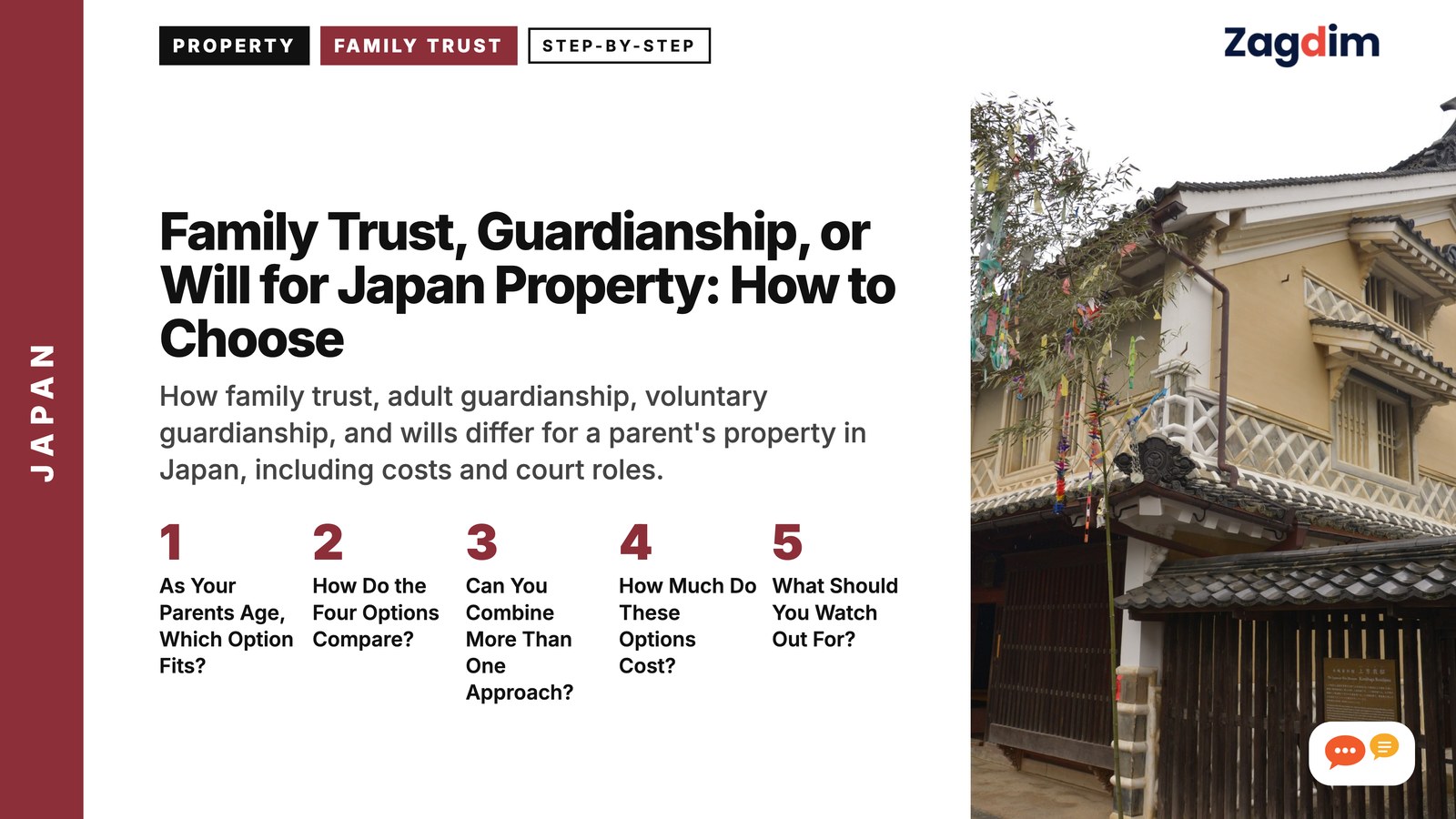
This article is part of Zagdim’s wiki series on Japan property. It sets out the differences between four ways to plan for an aging parent’s property or savings in Japan — family trust, adult guardianship, voluntary guardianship, and a will — written for readers whose parents own property or hold savings in Japan while the reader lives abroad.
As Your Parents Age, Which Option Fits?
The four approaches solve different problems, and none of them is automatically the best choice. A family trust and voluntary guardianship are both arranged while a parent’s judgment capacity is still intact. Adult guardianship, by contrast, is triggered by the family court only after judgment capacity has already declined. A will must be made in one of the forms set out in the Civil Code — generally a self-written will, a notarized will, or a sealed will. Which option fits depends on your parent’s current judgment capacity, the type of assets involved, and whether you need to handle property matters or day-to-day living and care matters.
How Do the Four Options Compare?
Start with a side-by-side comparison:
| Comparison Point | Family Trust | Adult Guardianship (Statutory Guardianship) | Voluntary Guardianship | Will |
|---|---|---|---|---|
| When it starts | When the trust agreement is signed | After the family court opens guardianship proceedings | After the family court appoints a voluntary guardianship supervisor | — |
| Who manages | The trustee | The adult guardian | The voluntary guardian | — |
| Court involvement | No court appointment required | Requires a family court ruling and appointment; selling the ward’s residence requires court approval; the guardian’s compensation is set by the court | Requires appointment of a voluntary guardianship supervisor | — |
| Selling the property | The trustee manages or disposes of it according to the trust’s purpose | Can act on the ward’s behalf, but selling the ward’s residence requires family court approval | Can cover property management matters | — |
| Type of costs | Notarization fee | Application fee, revenue stamp, postage, and sometimes an assessment fee; the guardian’s compensation is set by the court | Notarization fee, revenue stamp, registration commission fee | — |
| Other | — | — | — | Three forms: self-written, notarized, or sealed; a self-written will can be kept at the Legal Affairs Bureau |
The trustee (受託者) is the person who manages or disposes of trust assets under the terms of the trust. The adult guardian is appointed by the family court. The voluntary guardianship supervisor oversees the voluntary guardian. The will column only lists the form and how it is kept — details such as when a will takes effect and who executes it depend on the individual case.
What’s the Key Difference Between a Family Trust and Adult Guardianship?
In a family trust, the settlor (委託者, the person who sets up the trust) transfers assets to a trustee (受託者), who manages or disposes of them for the trust’s stated purpose. A trust created by contract generally takes effect when the contract is signed. A parent’s dementia does not, by itself, end the trust — unless the trust agreement specifies otherwise, the trust continues to operate under its terms. Adult guardianship, by contrast, begins only after a parent’s judgment capacity has declined: the family court opens guardianship proceedings on application and appoints an adult guardian. The adult guardian can generally act on the parent’s behalf for property-related legal matters, but selling or renting out the home where the parent lives, or its land, requires prior approval from the family court.
How Is Voluntary Guardianship Different From a Family Trust?
Voluntary guardianship lets a person, while still of sound judgment, designate someone else to handle their daily living, medical and nursing care, and property management once their judgment capacity declines. The agreement must be made as a notarized deed (公正証書, a document drawn up by a notary) and registered, and it only takes effect once the family court appoints a voluntary guardianship supervisor. A family trust covers the management or disposal of property; arrangements for care, hospitalization, or moving into a care facility require voluntary guardianship or a similar arrangement instead.
Can You Combine More Than One Approach?
A trust can also be set up through a will — the two are not mutually exclusive. A trust and voluntary guardianship cover different ground: a trust manages or disposes of property, while voluntary guardianship can cover daily living, medical and nursing care, and property management matters. Exactly how to combine them depends on individual circumstances.
How Much Do These Options Cost?
For a family trust made as a notarized deed, the notary’s fee is calculated the same way as for general legal transactions, based on the value of the assets involved, plus JPY 13,000 — except that this additional JPY 13,000 does not apply once the trust assets exceed JPY 100 million. A voluntary guardianship contract costs JPY 13,000 per notarized deed, plus JPY 300 for each page beyond three; on top of that, a JPY 2,600 revenue stamp and a JPY 1,600 registration commission fee apply. For statutory (adult) guardianship, the application fee is an JPY 800 revenue stamp, plus a JPY 2,600 revenue stamp for registration, plus postage for court correspondence (the amount varies by court). A psychiatric assessment of the parent’s mental state is sometimes required, and the applicant may have to bear that cost. The guardian’s compensation is decided by the family court based on factors such as the guardian’s and the ward’s financial means, and is paid from the ward’s own assets.
What Should You Watch Out For?
A trust agreement must be signed while the settlor still has judgment capacity; an agreement signed after capacity has already declined may be invalid. A parent’s dementia does not by itself end a trust, but if the trust agreement sets a specific condition as the end of the trust, that condition governs. An adult guardian needs family court approval to sell the ward’s home. Guidance from Japan’s banking industry states that when a parent’s judgment capacity has declined and the adult guardianship system has not been used, a relative withdrawing funds without authority is treated as an “extremely limited” accommodation — in practice, the situations where a family member can withdraw funds on the parent’s behalf are very narrow.
What Should Non-Japanese Nationals Know?
Guardianship generally follows the law of the ward’s own home country, with some exceptions: if the person has a residence or domicile in Japan, or holds Japanese nationality, Japanese courts can open guardianship proceedings under Japanese law. Inheritance follows the law of the deceased’s home country, and the validity of a will follows the law of the testator’s home country at the time the will was made. Many countries have their own private-international-law statutes that set out similar rules for succession and wills — check your own country’s succession law to see which country’s law would govern your parent’s estate.
How to Decide What Comes Next
If a parent’s judgment capacity is still intact, a family trust and voluntary guardianship cover different ground, so the choice can be based on whether you need to handle property matters or daily living matters. If a parent already has dementia, statutory guardianship can be opened by application. Because a trust agreement signed after judgment capacity has already declined may be invalid, it is worth confirming that a parent still has decision-making capacity before signing one. Which option fits depends on a parent’s current judgment capacity, the type of assets involved, and what you need to handle.
Frequently Asked Questions
Which Is Better for My Parents Right Now, a Family Trust or Voluntary Guardianship?
It depends on whether you need to handle property matters or daily living matters. A family trust manages or disposes of property; voluntary guardianship can cover daily living, medical and nursing care, and property management. The two cover different ground.
Can You Still Set Up a Family Trust After a Parent Already Has Dementia?
A trust agreement must be signed while the settlor still has judgment capacity; an agreement signed after capacity has already declined may be invalid. At that point, statutory guardianship can be opened by application instead.
Roughly How Much Do the Four Options Cost?
A family trust’s notarization fee is calculated like a general legal transaction based on asset value, plus JPY 13,000 (not added once trust assets exceed JPY 100 million). A voluntary guardianship contract costs JPY 13,000 per notarized deed, plus a JPY 2,600 revenue stamp and a JPY 1,600 registration commission fee. Statutory guardianship’s application fee is an JPY 800 revenue stamp plus a JPY 2,600 registration revenue stamp, plus postage. The guardian’s compensation is decided separately by the court.
Glossary
- Family Trust (家族信託): A trust arrangement, set up under the Trust Act, used to manage or dispose of a family’s assets.
- Settlor (委託者): The person who establishes the trust.
- Trustee (受託者): The person who manages or disposes of trust assets under the terms of the trust.
- Beneficiary (受益者): The person entitled to the benefit of the trust.
- Adult Guardian (成年後見人): A person appointed by the family court to act on the ward’s behalf for property-related legal matters.
- Voluntary Guardianship Supervisor (任意後見監督人): A person appointed by the family court to oversee the voluntary guardian.
- Family Court (家庭裁判所): The court that handles family matters such as the opening of guardianship.
- Notarized Deed (公正証書): A document drawn up by a notary.
- Self-Written Will (自筆証書遺言): A will that the person writes entirely by hand, dates, signs, and seals themselves.
- Legal Affairs Bureau (法務局): The government office that can keep a self-written will in custody.
Notes on This Article
Facts were verified as of October 20, 2026. The following conclusions are drawn from official documents but are not stated explicitly by any official source: a settlor’s dementia, by itself, is not among the statutory grounds for ending a trust listed in Article 163 of the Trust Act; a trust’s scope is limited to the management or disposal of property, and arrangements for care or medical decisions fall outside the definition of a trust; and Taiwan’s Act Governing the Choice of Law in Civil Matters Involving Foreign Elements (涉外民事法律適用法) contains no provision specific to trusts. The guidance on relatives withdrawing funds for a parent with dementia comes from a Japanese banking-industry policy statement, not from a law. How a Hong Kong resident’s home-country law would be determined was not researched for this article.
Have a question about this guide? Leave a comment below, or ask Zagdim directly.
Your first stop for international property and global living.
Research and insights. Know what’s changing. Understand what matters.
Sources
- e-Gov – Trust Act
- e-Gov – Civil Code
- Courts of Japan – Opening of Guardianship
- Courts of Japan – Grant of Compensation
- e-Gov – Act on Voluntary Guardianship Contracts
- Japanese Bankers Association – Views on Representation in Financial Transactions (published version, 2021-02-18)
- e-Gov – Act on General Rules for Application of Laws
- Laws & Regulations Database of Taiwan – Act Governing the Choice of Law in Civil Matters Involving Foreign Elements
- e-Gov – Notary Fee Order, Article 22-2
- Japan Federation of Notaries Public Associations – Q22: Costs of Making a Voluntary Guardianship Contract as a Notarized Deed
Important Notice
This article is general informational content and does not constitute tax or legal advice for any individual case. Facts were verified as of October 20, 2026. Japanese regulations, and the regulations of your own country, may change; please check current official announcements from the relevant authorities, and consult a qualified professional for your individual circumstances.