































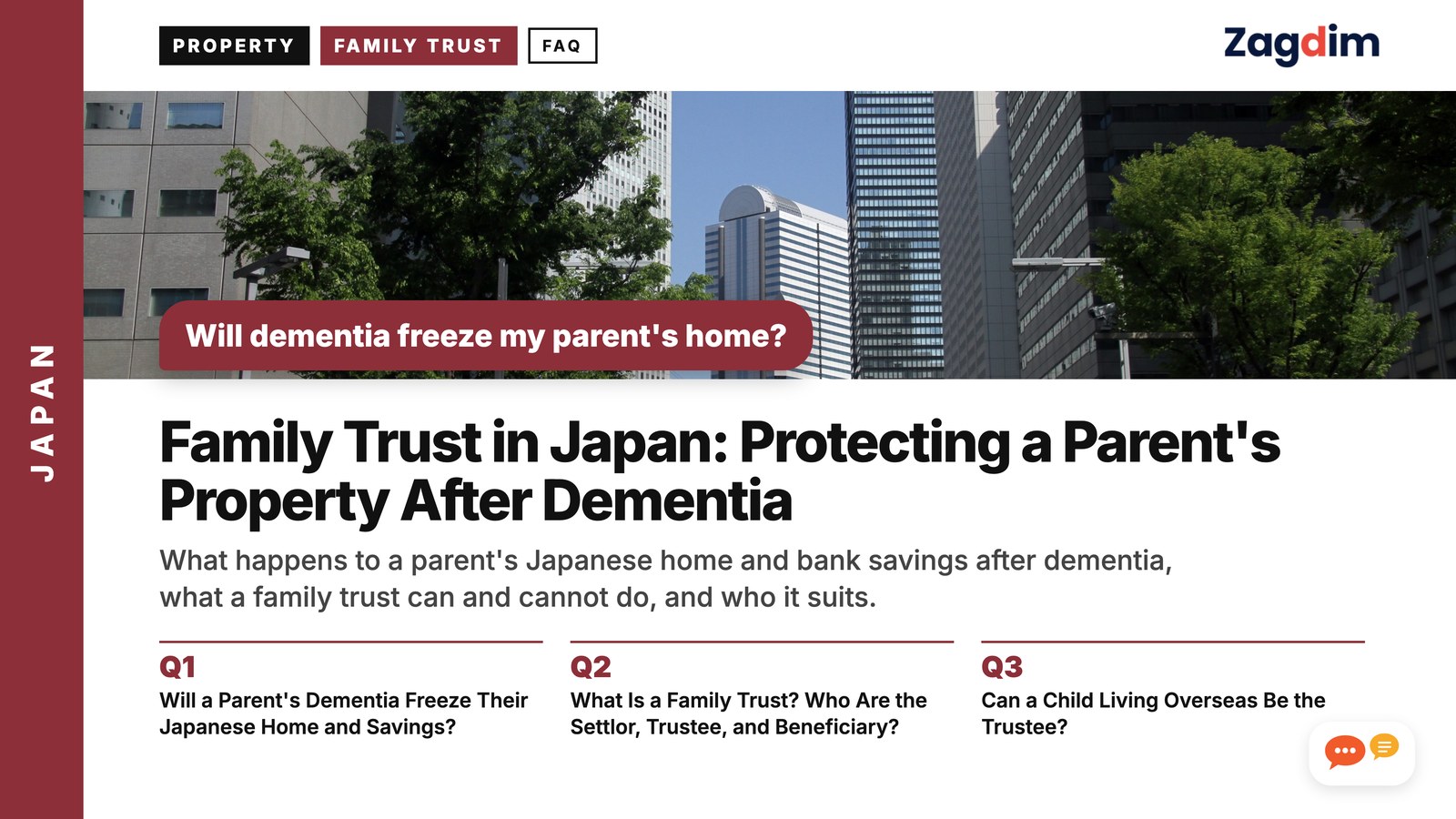
This article is part of Zagdim’s wiki series on Japan property. It covers what happens to a parent’s Japanese home and bank savings after dementia, what a family trust (家族信託, kazoku shintaku) can and cannot do, who it suits, and what it costs. It is written for people whose parents own property or hold savings in Japan while they themselves live abroad. Information in this article was checked as of October 20, 2026.
Will a Parent’s Dementia Freeze Their Japanese Home and Savings?
A family member’s ability to withdraw money from a parent’s Japanese bank account after the parent develops dementia is very limited. Guidance published by the Japanese Bankers Association (全国銀行協会) in February 2021 states that when a person’s judgment capacity has declined and the adult guardianship system has not been used, a relative withdrawing funds without authority is an “extremely limited” response. Banks generally require the adult guardianship system to be used, and once a guardian has been appointed, they will in principle only accept withdrawal instructions from the guardian. Banks may consider a relative’s request only when it is clearly in the account holder’s own interest, for example to pay for that person’s medical expenses.
For property, if a parent develops dementia without having made arrangements in advance, the family must apply to the Family Court (家庭裁判所, katei saibansho) in the parent’s place of residence to open guardianship proceedings, and the court appoints an adult guardian (成年後見人, seinen koken-nin), a legal representative who manages the person’s assets. The adult guardian can act on the parent’s behalf in essentially all legal matters involving property, but selling or leasing the home the parent actually lives in, or its land, or placing a mortgage on it, requires prior approval from the Family Court.
In other words, once dementia has already set in without any prior arrangement, both using the savings and selling the property generally have to go through this Family Court guardianship process, and children cannot decide on their own. Bank trust accounts and advance arrangements for a designated agent are covered in a related Zagdim article on opening a trust account in Japan and the bank rules that apply after dementia.
What Is a Family Trust? Who Are the Settlor, Trustee, and Beneficiary?
A family trust is a type of trust. Under Japan’s Trust Act (信託法), a trust is an arrangement in which a specific person manages or disposes of property for a defined purpose. The three roles are the settlor (委託者, itakusha, the person who sets up the trust, for example a parent), the trustee (受託者, jutakusha, the person who manages and disposes of the trust property under the trust agreement, for example a child), and the beneficiary (受益者, juekisha, the person entitled to the benefit). The trust property (信託財産, shintaku zaisan) is held in the trustee’s name but must be managed and disposed of according to the trust agreement.
A trust can be set up in three ways: by a trust agreement signed with the trustee, by will, or by a written self-declaration such as a notarized deed. A trust set up by agreement generally takes effect when the settlor and trustee sign the contract. Registrable property, such as real estate, is managed separately through trust registration; the trustee must keep trust property separate from their own property, and this registration duty cannot be waived by contract.
If a Parent Develops Dementia After a Trust Is Signed, Is It Still Valid?
Yes. Article 163 of the Trust Act lists the events that bring a trust to a legal end, and “the settlor losing decision-making capacity” is not one of them. In other words, as of October 2026, a parent developing dementia after a trust has already been set up does not, by itself, end the trust. Unless the trust agreement specifically names some other situation as a termination condition, the trust continues to operate under its terms.
There is a catch, though: a trust agreement is a legal act, and the settlor must have decision-making capacity (意思能力, ishi noryoku) at the time of signing. A contract signed after that capacity has already become insufficient may be invalid. This is why a family trust has to be signed while a parent still has the capacity to decide, not after. If a parent is already clearly affected by dementia, setting up a trust this way is too late, and the family would instead need to consider applying to the Family Court for adult guardianship.
Can the Trustee Sell the Japanese Property? What Are the Trustee’s Responsibilities?
Yes. The trustee has the authority to manage or dispose of trust property, including selling it, in order to achieve the purpose of the trust, but the trust agreement can limit that authority.
The trustee must handle trust affairs in line with the purpose of the trust and with the care of a prudent manager. The trustee must keep accounting records for the trust property, prepare a balance sheet, profit-and-loss statement, and related documents once a year at a set time, and report to the beneficiary. The settlor or beneficiary can also ask the trustee to report on trust affairs and the state of the property at any time. To guard against a trustee misusing funds, the trust agreement can name a trust supervisor (信託監督人, shintaku kantokunin) to monitor the trustee on the beneficiary’s behalf, and can also name a beneficiary’s agent (受益者代理人, juekisha dairinin) to exercise rights on the beneficiary’s behalf.
If the child acting as trustee runs into trouble themselves, the trustee’s role ends if the trustee dies, or if a court ruling opens guardianship (後見) or curatorship (保佐) over the trustee. If the trustee’s position is left vacant and no new trustee takes over within one year, that is itself one of the grounds for the trust to terminate.
Can a Child Living Overseas Be the Trustee?
The Trust Act only excludes minors from serving as trustee; the law itself sets no restriction based on nationality or place of residence. Opening a trust bank account, however, has separate residency conditions attached to it. Among the three financial institutions checked for this article, Keiyo Bank, ORIX Bank, and Tama Shinkin Bank, the published conditions for a trust account generally require the account holder to live in Japan or within the bank’s service area. Whether a trustee living overseas can open an account depends on the individual institution’s own rules, and this needs to be confirmed directly with the bank.
There is also a separate layer of rules for foreign nationals: guardianship generally follows the ward’s home-country law, but if the person has a residence or domicile in Japan, or holds Japanese nationality, a Japanese court can open guardianship under Japanese law (with some exceptions); inheritance follows the deceased’s home-country law; and a will’s validity follows the testator’s home-country law at the time the will was made. Whether an overseas settlor or trustee can act in those roles is covered in a related Zagdim article on foreign nationals and non-resident trustees in a Japanese family trust.
Family Trust, Adult Guardianship, Voluntary Guardianship, or Will: How Do They Differ?
A family trust covers the management or disposal of property; procedures for care, hospitalization, or admission to a care facility fall outside the definition of a trust and need a separate arrangement such as voluntary guardianship.
A voluntary guardianship agreement (任意後見契約, nin’i koken keiyaku) is set up while a person still has decision-making capacity, appointing someone to handle their daily life, care, and asset management if that capacity later becomes insufficient. The agreement must be made as a notarized deed and registered, and it only takes effect once the Family Court appoints a voluntary guardianship supervisor. Adult guardianship (statutory guardianship) applies only after a person has already developed dementia, with the Family Court appointing the guardian directly; the guardian is paid from the person’s own assets, with the amount decided by the Family Court. A will governs how property is distributed after death and generally takes one of three forms: self-written, notarized, or sealed and deposited. A fuller comparison of when each option takes effect, who manages it, and whether it allows a property sale is covered in a related Zagdim article comparing family trust, adult guardianship, voluntary guardianship, and wills for Japan property.
What Tax and Setup Costs Apply to Putting a Property Into a Trust?
When real estate is placed into a trust, the transfer of ownership itself is not subject to registration and license tax (登録免許税, torokumenkyozei), but the trust registration of ownership is taxed: four parts per thousand of the property’s assessed value for a building, with a reduced rate of three parts per thousand for land where the registration is completed by March 31, 2029. Besides the usual items in a rights registration, a trust registration must also record the names and addresses of the settlor, trustee, and beneficiary, the purpose of the trust, how the trust property is to be managed, and the events that would end the trust (when conditions for designating a beneficiary or a beneficiary’s agent are registered instead, the beneficiary’s own name and address do not need to be recorded). A related Zagdim article covers the registration process in full, along with what happens on a later sale or when the trust ends.
On the tax side: when a trust takes effect, anyone who becomes a beneficiary without paying fair consideration is treated as having received the rights under the trust as a gift from the settlor, which can trigger gift tax. For a trust where the parent is the sole beneficiary (自益信託, jieki shintaku, a self-benefit trust), no one receives anything from the parent at the time of setup, so under the relevant provision no gift tax arises; it is still worth confirming the specifics with a tax accountant (税理士, zeirishi) case by case. One point worth flagging: according to the National Tax Agency, a trust set up with no beneficiary named, where a relative of the parent later becomes the beneficiary, triggers gift tax on the trustee instead. After the settlor’s death, an heir living overseas is generally taxed under Japanese inheritance tax only on the portion of the inherited property located in Japan, but anyone who meets the conditions for a non-resident unlimited taxpayer is taxed on worldwide assets instead; property located in Japan falls within scope either way. A related Zagdim article covers how that scope is determined by residence, nationality, and years of residence.
On cost: when a trust is set up as a notarized deed, the notary’s fee is the standard amount for a general legal act calculated from the value of the property, plus 13,000 yen (this extra amount does not apply once the trust property’s value exceeds 100 million yen). For comparison, a notarized voluntary guardianship agreement costs 13,000 yen per document, plus a 2,600 yen revenue stamp fee and a 1,600 yen registration commission fee paid to the Legal Affairs Bureau; applying for statutory guardianship costs an 800 yen revenue stamp plus a 2,600 yen registration fee. Professional fees charged by advisers and other registration costs were not checked for this article. The tax treatment at three separate points, setup, rental income, and the settlor’s death, is covered in a related Zagdim article on family trust taxes in Japan.
Frequently Asked Questions
My parent already shows some signs of dementia and declining judgment. Is it still possible to set up a family trust? The settlor must have decision-making capacity at the time of signing a trust agreement; a contract signed after that capacity has already become insufficient may be invalid. If a parent’s dementia is already clearly apparent, setting up a trust this way is too late, and the family can instead consider applying to the Family Court for adult guardianship.
Once a family trust is in place, does it also cover a parent’s hospitalization or admission to a care facility? No. A family trust covers the management or disposal of property; procedures for care, hospitalization, or admission to a facility fall outside the definition of a trust and need a separate arrangement such as voluntary guardianship.
If a child living overseas is the trustee, can they open a trust account at a Japanese bank? The Trust Act itself places no restriction based on nationality or residence, but the three financial institutions checked for this article generally require the account holder to live in Japan. Whether a trustee living overseas can open an account needs to be confirmed individually with the institution.
If my parent puts their Japanese property into a trust and names me as beneficiary, do I owe Japanese gift tax? When a trust takes effect, anyone who becomes a beneficiary without paying fair consideration is treated as having received the rights under the trust as a gift from the settlor, which can trigger gift tax. If the parent is the sole beneficiary (a self-benefit trust), no gift tax arises under the relevant provision at the time of setup; individual cases should still be confirmed with a tax accountant.
Glossary
- Settlor (委託者): The person who sets up the trust and hands property to the trustee, for example a parent.
- Trustee (受託者): The person who manages and disposes of trust property under the trust agreement, for example a child.
- Beneficiary (受益者): The person entitled to the benefit of the trust.
- Trust Property (信託財産): Property placed into the trust; it is held in the trustee’s name but must be managed according to the trust agreement.
- Adult Guardian (成年後見人): A legal representative appointed by the Family Court to manage a person’s assets after that person develops dementia.
- Voluntary Guardianship Agreement (任意後見契約): An agreement signed in advance, while a person still has decision-making capacity, under which an appointed person later handles daily life, care, and asset management once that capacity becomes insufficient.
- Trust Supervisor (信託監督人): A person named in the trust agreement to monitor the trustee on the beneficiary’s behalf.
- Registration and License Tax (登録免許税): A tax paid when registering real estate.
- Self-Benefit Trust (自益信託): A trust in which the settlor is also the beneficiary.
About This Information
Information in this article was checked as of October 20, 2026. The following conclusions are inferred from official statutes and are not stated explicitly by the authorities themselves: the Trust Act places no nationality or residence restriction on trustees; a settlor’s dementia is not a ground for ending a trust; a trust does not cover daily life and care arrangements; the trust-account conditions of the three financial institutions checked generally require residency (only these three were checked); and a self-benefit trust does not trigger a deemed gift at the time it is set up. The bank-withdrawal guidance is based on a policy statement from the Japanese Bankers Association, not on a law. The reduced registration and license tax rate for land has an end date (March 31, 2029). The tax treatment of rental income earned inside a trust and of a later sale, along with the amount of professional advisers’ fees, were not checked for this article.
Have a question about this guide? Leave a comment below, or ask Zagdim directly.
Your first stop for international property and global living.
Research and insights. Know what’s changing. Understand what matters.
Sources
- e-Gov – Trust Act
- e-Gov – Civil Code
- e-Gov – Act on Voluntary Guardianship Contracts
- Hiroshima Legal Affairs Bureau – What Is Adult Guardianship Registration?
- e-Gov – Act on General Rules for Application of Laws
- e-Gov – Real Property Registration Act
- e-Gov – Registration and License Tax Act
- e-Gov – Act on Special Measures Concerning Taxation
- National Tax Agency – No. 4427, Cases of Newly Setting Up a Trust (国税庁-No.4427 新たに信託の設定等を行った場合)
- e-Gov – Inheritance Tax Act
- National Tax Agency – No. 4138, When an Heir Lives Abroad (国税庁-No.4138 相続人が外国に居住しているとき)
- e-Gov – Notary Fee Order
- Japan Federation of Notaries Public Associations – Q4: Specific Examples of Notarized Document Fees
- Japan Federation of Notaries Public Associations – Q22: Costs of Making a Voluntary Guardianship Contract as a Notarized Deed
- Courts of Japan – Opening of Guardianship
- Courts of Japan – Grant of Compensation
- Japanese Bankers Association – Views on Representation in Financial Transactions (published version, 2021-02-18)
- Keiyo Bank – Family Trust
- ORIX Bank – Trust Account
- Tama Shinkin Bank – Dedicated Family Trust Account
Important Notice
This article is a general information summary and does not constitute tax or legal advice for any individual case. Information was checked as of October 20, 2026. Japanese regulations, and the regulations of your own country, may be updated; please refer to current official announcements from the relevant authorities, and consult a qualified professional for your individual circumstances.