





























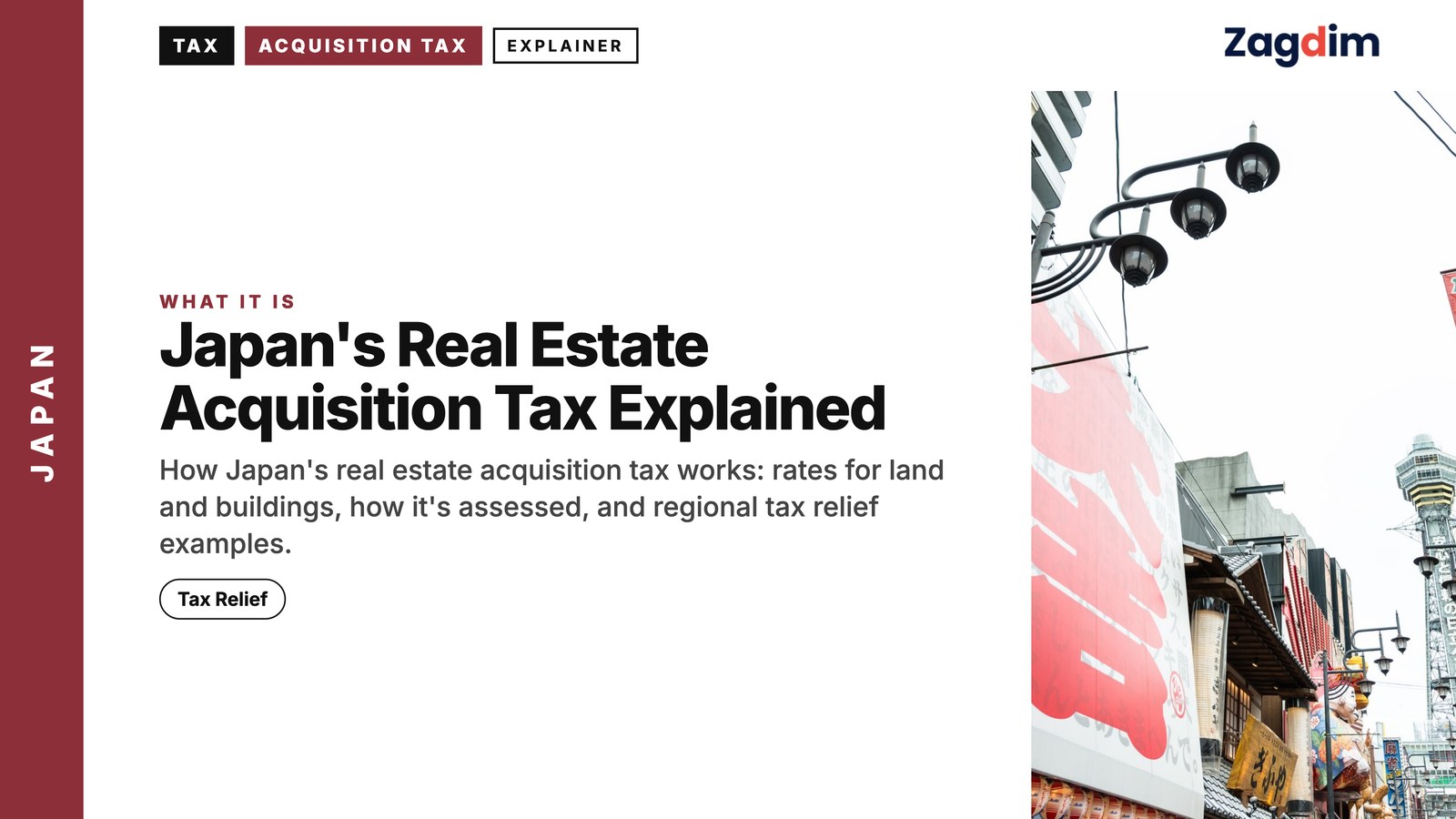
Real estate acquisition tax is one of the three major taxes involved in a Japanese property transaction. Unlike the registration license tax, it applies whenever a person acquires ownership of real estate, regardless of whether the acquisition is registered with the Japanese government, and regardless of whether it is paid or unpaid, or whatever the reason for the acquisition. For example, registering a transfer of ownership of land and a building both fall within the scope of this tax.
Real Estate Acquisition Tax Is a Local Tax
Real estate acquisition tax is collected by prefectural governments from property owners, so there is no single nationwide rate — it is set according to where the property is located. Each region also has its own various relief measures, though these are, in most cases, only available to local residents. The most common rates are 3% of the assessed value for “land,” 3% of the assessed value for residential “buildings,” and 4% of the assessed value for non-residential “buildings.” Under the current “residential land special measure” (takuchi tokurei sochi), the “land” rate for residential land carries a 50% tax reduction.
Fixed Asset Tax Assessed Value
The tax base for real estate acquisition tax is not the transaction price, but the “fixed asset tax assessed value.” This value is set by the local government and differs by area. It can be obtained by applying for a “Fixed Asset Valuation Certificate” (koteishisan hyouka shoumei) at the tax office of the relevant prefecture, city or town (an agent can also be asked to check it on your behalf). Real estate acquisition tax is calculated separately for “land” and “building.” Below are the reference rates from the Osaka Prefectural and Fukuoka Prefectural governments:
Osaka Prefectural Government rate:
| Acquisition Date | Land | Building — Residential | Building — Non-Residential |
|---|---|---|---|
| April 1, Heisei 20 to March 31, Reiwa 9 | 3%/2 (i.e. halved assessed value x 3%) | 3% | 4% |
Fukuoka Prefectural Government rate:
| Acquisition Date | Land | Building — Residential | Building — Non-Residential |
|---|---|---|---|
| April 1, Heisei 20 to March 31, Reiwa 9 | 3%/2 (i.e. halved assessed value x 3%) | 3% | 4% |
This nationwide special measure has been repeatedly extended; the deadline above reflects the current extension. The building and land amounts together make up the real estate acquisition tax owed on the property.
Tax Relief
Because the Japanese national government hands collection of real estate acquisition tax to local governments, different prefectural and municipal governments apply different relief measures. Fukuoka Prefecture, for example, offers different exemption amounts depending on the building’s year of construction:
| Year Built | Deduction |
|---|---|
| January 1, Showa 57 – June 30, Showa 60 | JPY 4.2 million |
| July 1, Showa 60 – March 31, Heisei 1 | JPY 4.5 million |
| April 1, Heisei 1 – March 31, Heisei 9 | JPY 10 million |
| April 1, Heisei 9 – present | JPY 12 million |
Summary
It can be seen that although Japanese real estate transactions involve a fair number of taxes, the amounts actually payable are not large, and tax relief is common — overall, the various costs of buying property in Japan generally come to around 7%–8% of the property price.
Have a question about this guide? Leave a comment below, or ask Zagdim directly.
Your first stop for international property and global living.
Research and insights. Know what’s changing. Understand what matters.