































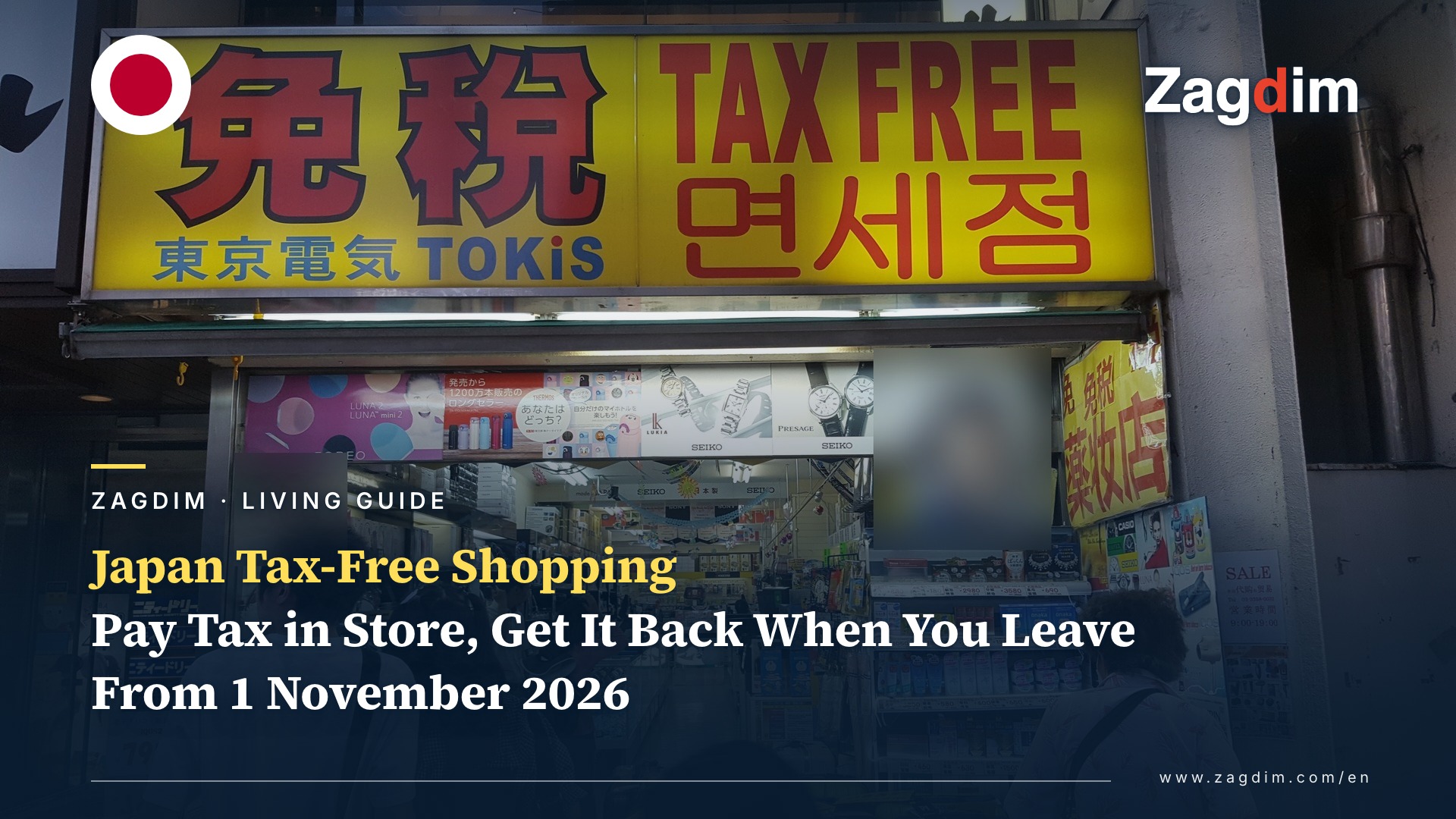
From 1 November 2026, Japan Tax-Free Shopping Means Paying the Tax First and Getting It Back When You Leave
Under the National Tax Agency’s new rules, Japan tax-free shopping switches to a “refund method” (リファンド方式) from 1 November 2026: visitors pay the tax-inclusive price in store, and once customs confirms the goods are leaving Japan within 90 days of purchase, the shop or its refund agent pays back the consumption tax.
On 22 October 2026, NHK explained the change in a social media post: from November, “tax-free” goods at tax-free shops will be sold at tax-inclusive prices. Japan’s Ministry of Finance states in its FY2025 tax reform guide that the change is meant to tackle abuse such as reselling tax-free goods inside Japan.
This guide uses that news as a starting point to explain how foreign visitors claim the tax back on purchases in Japan, how the new process works step by step, who qualifies and who does not, and where people most often get stuck at the airport.
Key Points
- Who should pay attention: people visiting Japan for holidays or family trips, Japanese nationals who have lived abroad for 2 years or more, and overseas owners who travel to Japan to view or manage property; foreign residents living in Japan should note that they were never covered.
- The core change: for purchases from 1 November, you pay the full price including tax in store and only get the tax back after customs confirms your departure; leaving Japan within 90 days of purchase is the deadline that decides whether you are refunded.
- Rules changing at the same time: general goods and consumables are no longer split, and the ¥500,000 consumables cap and sealed packaging go; the minimum of ¥5,000 before tax per shop per day stays.
- The most common risks: checking in your bags before the customs check, missing one item from a receipt, and using up goods in Japan can all cost you the refund.
Japan Tax-Free Shopping, Old System vs New System
The points below are drawn from the National Tax Agency’s April 2025 overview of the new system and the Japan Tourism Agency’s page for travellers:
| Item | Bought by 31 October 2026 | Bought from 1 November 2026 |
|---|---|---|
| Price at the till | Tax-free price (no consumption tax) | Tax-inclusive price, refunded later |
| When you get the tax back | Not charged at purchase | After customs confirms your departure, paid by the shop or refund agent |
| General goods vs consumables | Counted separately | No distinction |
| Consumables cap | ¥500,000 | Abolished |
| Sealed packaging for consumables | Required | Abolished |
| Minimum spend | ¥5,000 or more before tax | ¥5,000 or more before tax per shop per day (no categories) |
| Departure deadline | Under the old rules | Leave within 90 days of purchase and pass the customs check |
The new system follows the purchase date: anything bought at a tax-free shop from 1 November goes through the new process.
How to Claim the Tax Back: Buy, Pass the Customs Check, Receive the Refund
Step 1: Buy at a Tax-Free Shop and Pay the Tax-Inclusive Price
Show your passport at the till. Once the shop confirms you are eligible, it sells to you at the tax-inclusive price and sends the purchase record to the National Tax Agency’s system. The Japan Tourism Agency says you register how you want to be refunded (bank transfer, credit card, app and so on) at the time of purchase, and methods differ between shops, so ask at the till.

The minimum is ¥5,000 before tax in total at the same shop on the same day. Because general goods and consumables are no longer split, skincare and snacks can now be added together with clothes or electronics. Gold and platinum bullion, gold and platinum coins, and goods that are exempt from consumption tax anyway are excluded.
Step 2: Leave Japan Within 90 Days and Pass the Customs Check Before Checking In Bags
The National Tax Agency says “within 90 days of purchase” runs from the day after purchase to the 90th day: goods bought on 1 November must be confirmed on departure by 30 January the following year.
On the day you leave, go to a tax-free procedure kiosk in the international departure lobby before you check in your bags and scan your passport. According to the Japan Tourism Agency, a green screen means you are done; a red screen means you must take the goods to customs for inspection. At 7 airports (Narita, Haneda, Kansai, Chubu, Fukuoka, New Chitose and Naha) you can also complete it online with Visit Japan Web, within the dedicated Wi-Fi zone before security.
If you connect from a domestic flight to an international one, do it at the last airport you leave Japan from.
Step 3: After Customs Confirms, the Shop or Refund Agent Pays Back the Tax
Customs sends the confirmation back to the shop, which (directly or through a refund agent) refunds the amount of consumption tax. The National Tax Agency notes that the Consumption Tax Act does not prescribe how refunds are paid; possible methods include bank transfer, credit card, app transfer and cash at the port of departure after the customs check.
The Japan Tourism Agency’s FAQ for shops says there is no rule on whether the traveller or the shop pays the fee charged by a refund agent, and that the government itself charges no refund fee. How much you actually receive therefore depends on the shop and its agent. The refund is the consumption tax: 10% at the standard rate and 8% on food and drink other than alcohol and eating out (see Zagdim’s guide to Japan’s consumption tax rates in the references).
Who Can Claim a Tax Refund in Japan: Visitors, Japanese Nationals and Foreign Residents
Eligible buyers must be “non-residents” under Japan’s Foreign Exchange Act and fall into one of the groups below. The groups are taken from Question 3 of the National Tax Agency’s Q&A on the refund method (overview):
| Status | Eligible? | What to show at the till |
|---|---|---|
| Foreign national who entered as a Temporary Visitor | Yes | Passport with landing stamp |
| Foreign national with Diplomat or Official status | Yes | Passport |
| Foreign national on a port-of-call, cruise, transit or crew landing permit | Yes | Passport and landing permit |
| Japanese national who has lived abroad for 2 years or more | Yes | Passport plus a certificate of residence abroad, a copy of the family register attachment or a My Number Card recording the move abroad |
| Foreign resident in Japan holding a residence card for work, study or long-term stay | No | — |
For foreigners living in Japan this is not new: eligible residence statuses are limited to Temporary Visitor, Diplomat and Official, so work, student, dependant and permanent resident statuses were never covered. The new system changes the refund process, not who qualifies.
Where People Get Stuck: Six Issues Backed by Official Sources
1. Checking in bags first. The National Tax Agency’s leaflet for visitors says customs cannot check your goods after you check in luggage. The Japan Tourism Agency adds that checked bags cannot be retrieved for the procedure, stopping halfway does not count, and neither airlines nor customs compensate you if you miss your flight. Do the check first, then check in.
2. One item missing from a receipt. Customs confirms purchases receipt by receipt. If even one item from a receipt is not with you, nothing on that receipt can be confirmed, so none of it is refunded.
3. Goods used up in Japan. Food, drink and cosmetics consumed in Japan are not refunded. The Japan Tourism Agency says that if you have used up some consumables, skip the kiosk and tell the customs counter instead.
4. Buying more than you can carry. The ¥500,000 consumables cap is gone, but the National Tax Agency says you may only buy as much as you can take out of Japan yourself when you leave.
5. Posting goods home. Separate shipment of tax-free goods by post ended on 31 March 2025; whether a shop can ship overseas directly at the point of sale depends on the shop.
6. Documents for expensive items. For items priced at ¥1 million or more before tax, customs may ask to see a certificate of authenticity or warranty, so keep them.
Goods confirmed by customs that are then not taken out of Japan are charged the equivalent consumption tax, and penalties may apply.
Common Misconceptions About the New Japan Tax-Free Shopping Rules
- Misconception: tax-free shopping is ending. It continues; the tax is simply charged at the till and refunded after the customs check. Tip: a tax-inclusive price at the till is normal, so keep the receipt and register a refund method.
- Misconception: foreigners working or studying in Japan can use it too. Eligible statuses are Temporary Visitor, Diplomat, Official and similar; residence card holders are not covered. Tip: if you live in Japan, you pay the normal price.
- Misconception: the 90 days run from your arrival date. The National Tax Agency counts from the day after each purchase to the 90th day. Tip: on long trips, goods bought early in the trip hit the deadline first.
- Misconception: a refund counter in a hotel or shopping district gives you the tax back. Under the new system, the refund depends on the customs check at departure. Tip: expect the money after you leave, by the method the shop offers.
- Misconception: with the cap gone, there is no limit. You can still only buy what you can carry out yourself. Tip: plan how you will get large purchases on the plane.
Scenarios: How Three Kinds of Shoppers Should Prepare
Scenario 1: a five-day self-guided trip to Osaka from Singapore. Entering as a Temporary Visitor, you spend ¥8,000 before tax on skincare and snacks at a drugstore on day two. Show your passport, pay the tax-inclusive price and register a credit card refund. On the way home, use Visit Japan Web or a kiosk at Kansai Airport before checking in bags. If you have eaten one bag of snacks, skip the kiosk and tell the customs counter.
Scenario 2: a Japanese national who has lived in Canada for years, visiting family in Tokyo. Having lived abroad for 2 years or more, you can qualify, but besides your passport you must show a certificate of residence abroad, a copy of the family register attachment or a My Number Card recording the move abroad. If you stay longer than 90 days, goods bought in the first week must be confirmed on departure within their own deadline or you lose the refund.
Scenario 3: an overseas owner based in Hong Kong who visits Fukuoka each quarter to check on a flat. Each visit is as a Temporary Visitor, so appliances or household goods taken back to Hong Kong follow the new process. Anything bought for the Japanese flat and left in Japan was never eligible, so count it at the tax-inclusive price.
Japan Tax-Free Shopping for Foreign Visitors: Frequently Asked Questions
When does the new Japan tax-free shopping system start?
It applies to purchases from 1 November 2026. The National Tax Agency says the new rules apply to sales from that date with no overlap period; anything bought by 31 October follows the old system.
How long do I have to leave Japan after tax-free shopping?
You must leave within 90 days of purchase and pass the customs check on departure. The National Tax Agency counts from the day after purchase to the 90th day, so goods bought on 1 November must be confirmed by 30 January the following year.
When and how do I receive my Japan tax-free shopping refund?
After customs confirms your departure, the shop or its refund agent pays you. Methods vary by shop and may include bank transfer, credit card, app transfer or cash at the port of departure; you register the method when you buy. There is no official standard for how long payment takes.
Will a fee be deducted from my refund?
Possibly. The Japan Tourism Agency’s FAQ for shops says there is no rule on whether the traveller or the shop pays a refund agent’s fee, and that the government charges no refund fee. Ask the shop what it deducts.
Can foreigners who work or study in Japan use tax-free shopping?
No. Eligible buyers must be non-residents under the Foreign Exchange Act; foreign nationals must be staying as Temporary Visitors, Diplomats, Officials or on certain landing permits. Residence card holders who work, study or live long-term in Japan are not covered, and the new system does not change that.
Do I have to use a kiosk, or can I do the customs check online?
At Narita, Haneda, Kansai, Chubu, Fukuoka, New Chitose and Naha you can use Visit Japan Web within the dedicated Wi-Fi zone before security; elsewhere use the tax-free kiosks in the departure lobby. Either way, finish before checking in your bags.
Shopping in Japan or Managing Property There? Ask Zagdim
If you have questions about shopping, tax or property while travelling to or spending time in Japan, tell us about your situation through Ask Zagdim.
Life abroad? Ask Zagdim.
Your first stop for international property and global living.
Research and insights. Know what’s changing. Understand what matters.
Newsletter for overseas updatesSubscribe →
Important Disclaimer
This article is general information and is not legal, tax or financial advice. It is based mainly on 2025–2026 guidance and Q&As from Japan’s National Tax Agency, Japan Tourism Agency and Ministry of Finance, together with media coverage from October 2026. Refund methods, fees and how the system works in practice depend on each tax-free shop and refund agent; rely on the latest notices from the authorities and the shop, and consult a qualified professional where needed.
The tax-free and refund rules in this article are current as of 22 October 2026; the latest notices from the National Tax Agency and Japan Tourism Agency take precedence.
References
National Tax Agency – 輸出物品販売場制度のリファンド方式への見直し / National Tax Agency – Tax-Free Shopping System will be shifted to the Refund Method from November 2026 (April 2025) / National Tax Agency – 輸出物品販売場制度に関するQ&A(リファンド方式・概要編) (revised April 2026) / National Tax Agency – Attention Foreign Tourists: Please Read This Carefully / Japan Tourism Agency – 旅行者向け新制度情報 / Japan Tourism Agency – 旅行者向け よくある質問(リファンド方式) / Japan Tourism Agency – 免税店向け よくある質問(リファンド方式) / Ministry of Finance – 令和7年度税制改正 3消費課税 / National Tax Agency – 軽減税率制度の概要 / NHK – Post on X: tax-free goods to be sold at tax-inclusive prices (22 October 2026) / Zagdim – Japan Consumption Tax: 8%, 10% and the Proposed 1% Food Rate Explained (19 October 2026)