






























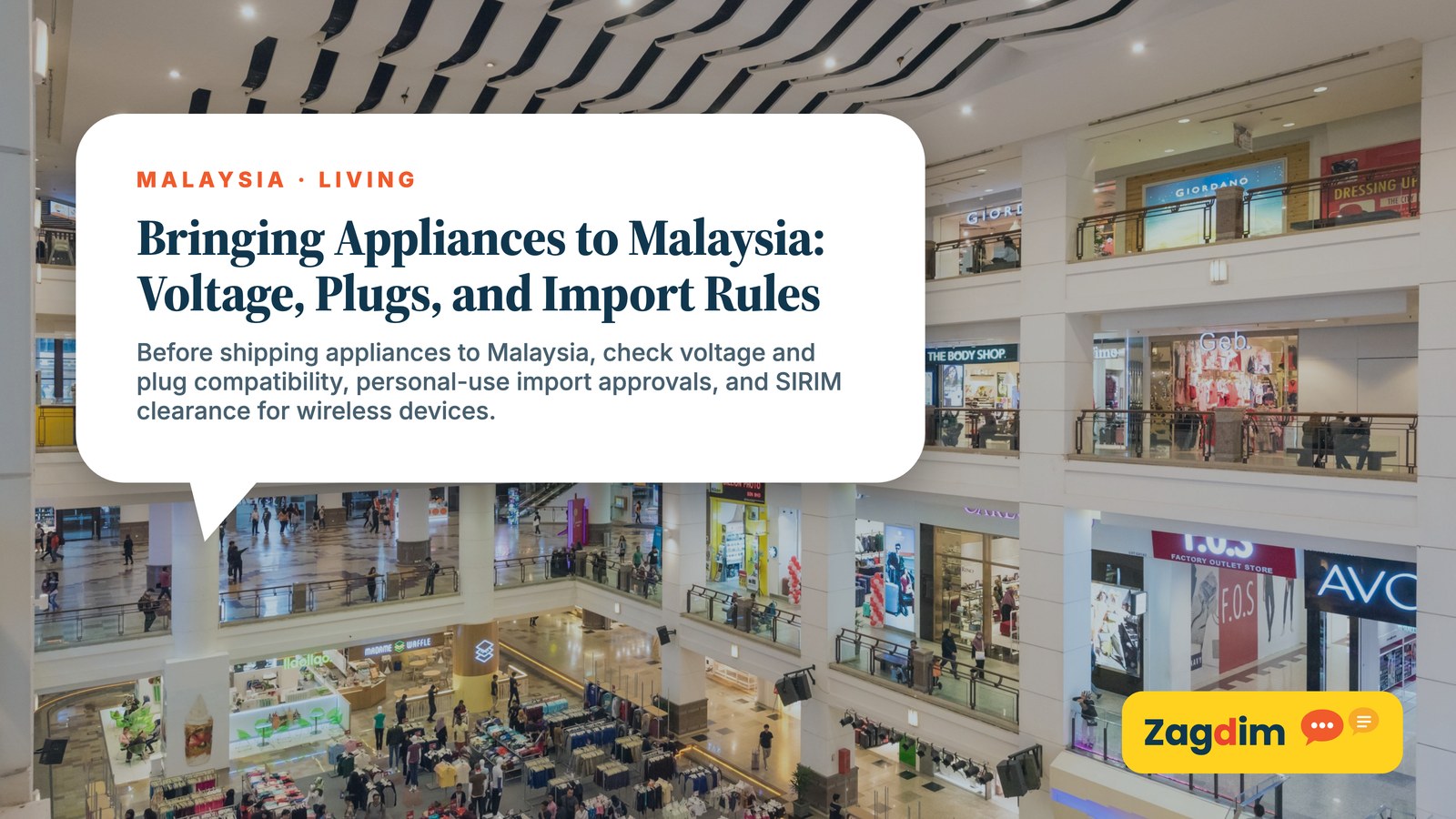
Moving to Malaysia and wondering whether your appliances will even work there, or whether you can legally bring them in at all? Fitting a plug adapter is only the first question. Voltage, frequency, and import approval are separate issues, and getting one right does not mean the others are settled.
Fitting the Plug Does Not Mean It Is Safe to Use
Before moving, check the rated voltage, frequency, and power listed on the appliance body or its charger. Standard single-phase residential power in Malaysia is 230V at 50Hz. Equipment designed for a different voltage or frequency standard cannot simply be switched over by changing the plug.
A plug adapter only changes the shape of the connector; it does not change the voltage. Whether a device is actually safe to connect, and whether it needs further adjustment, should be confirmed with the manufacturer or a qualified electrician, especially for high-power appliances or anything that requires fixed installation.
Personal Use Can Still Require an Import Approval
Some regulated appliances fall under a personal-use application arrangement administered by the Energy Commission. Qualifying for personal-use clearance does not mean every appliance is automatically exempt, and the current personal-use arrangement also limits the quantity allowed per device type. This should be confirmed before anything is packed.
Devices with Wi-Fi, Bluetooth, or other communication functions may also need an import approval from SIRIM. Electrical safety and wireless-communication requirements are separate matters, and completing one does not mean the other has also been cleared.
Gather the Specs Before Deciding What to Ship
| Information | Purpose |
|---|---|
| Brand, model, and serial number | Identifying the device and any applications |
| Photo of the spec label | Checking voltage, frequency, and power |
| Purchase and usage records | Showing age, personal use, and declared value |
| Wireless functions | Determining which approvals apply |
| Batteries or other accessories | Checking carrier restrictions |
Do not substitute removing the packaging or simply labeling an item “used” for accurate usage records. Newly purchased items should be listed as such; tax treatment and permit requirements are confirmed separately.
Compare the Full Landed Cost Before Deciding
Beyond shipping, costs can include packing, insurance, customs clearance, installation, and possible repairs. Whether an overseas warranty applies, and whether local parts and service are available, also affects how worthwhile it is to bring an appliance along.
If a refrigerator or washing machine is already included at the new home, that removes the need to ship a duplicate. Appliances that need repair soon, or that are close to the end of their typical replacement cycle, may also not be worth the shipping volume.
Common Misunderstandings
“If I Have a Voltage Converter, I Can Import and Use It Freely”
A voltage converter does not substitute for an import approval, and it does not guarantee that the appliance’s frequency, power rating, and installation requirements have been met.
“It’s Only for Personal Use, So I Don’t Need to Declare It”
It should still be listed accurately on the inventory, and the requirements for any regulated appliance should be checked regardless of whether it is for personal use.
What to Do Next
Photograph the specification label of each appliance, confirm tax treatment, permit requirements, and shipping method with a relocation agent at the destination, and compare the result against the cost of replacing the item locally. For questions about an appliance’s electrical safety, check with the manufacturer or a qualified professional.
Frequently Asked Questions
Q1: Can a Plug Adapter Change 110V to 230V?
No. A plug adapter does not change the voltage. Check the appliance’s supported voltage range first.
Q2: Are Older Appliances Automatically Exempt From Approval?
No. Some regulated appliances still require the relevant clearance or approval even when they are for personal use.
Q3: Do Wireless Home Appliances Need a SIRIM Check Too?
They may. This depends on the specific model, its functions, and how it is being imported.
Disclaimer
This article is based on official and service-provider information available as of October 9, 2026, and is provided for general relocation planning purposes. Fees, eligibility, contractual terms, and import or local requirements may change. Actual arrangements should follow the latest information from the relevant authorities, formal quotes, and contracts.
References
Energy Commission — Electrical Equipment for Personal Use; Energy Commission — Guidelines for Domestic Electrical Wiring; SIRIM QAS — Special Approval and Clearance Letter for Personal Application; Royal Malaysian Customs — Prohibition of Import and Export
Have a question about this guide? Leave a comment below, or ask Zagdim directly.
Your first stop for international property and global living.
Research and insights. Know what’s changing. Understand what matters.