































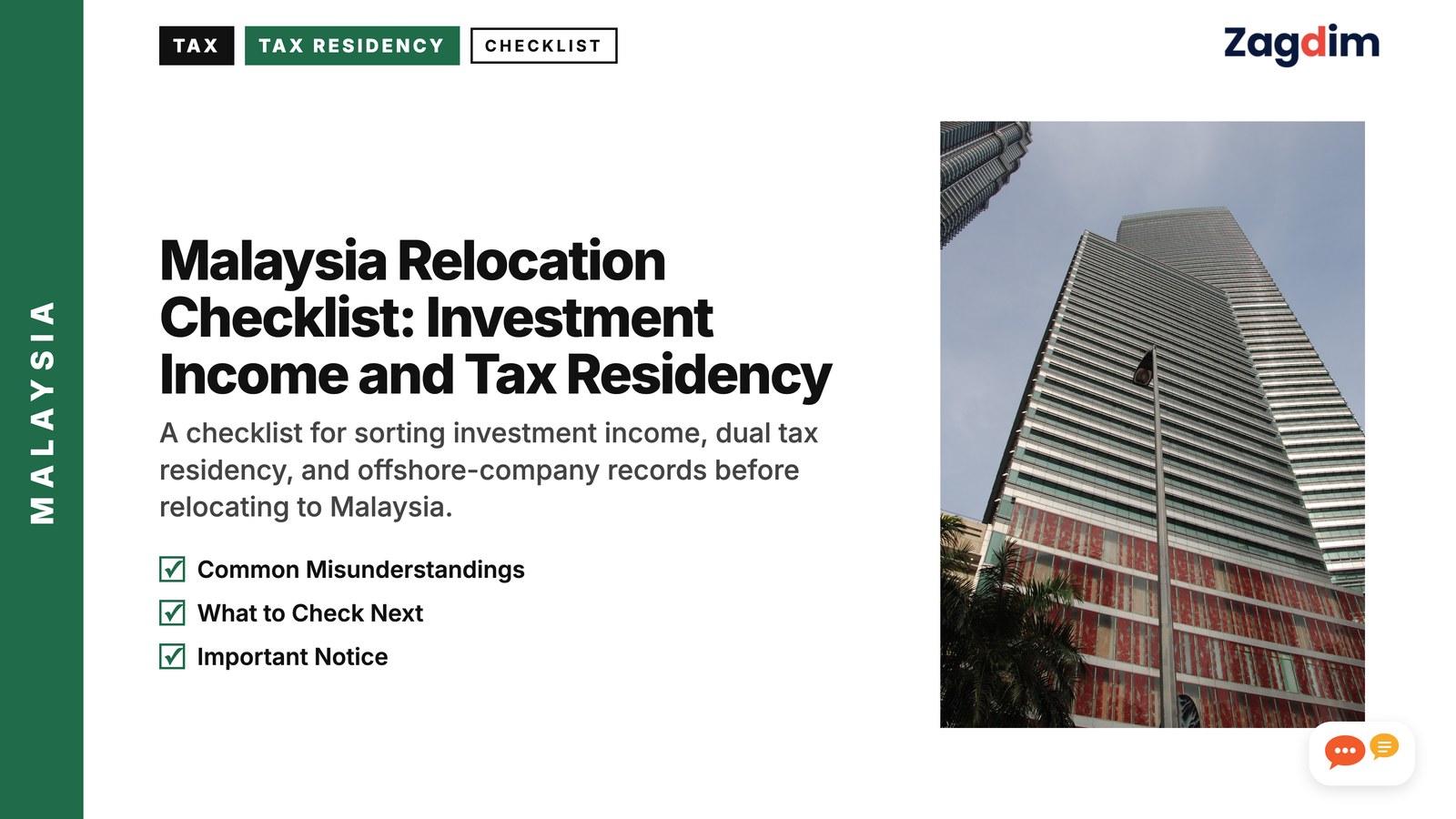
Moving to Malaysia takes more than a permit and a place to live. It also means working out where your investment income comes from, which account it sits in, and which country it should be reported to before and after the move. A long-stay permit, Malaysia tax residency, and tax residency in your home country are three separate questions. Getting the permit does not automatically end your filing obligations at home, and it does not guarantee that all your foreign income becomes tax-free.
Map Your Calendar in Both Countries, Not Just the Move Date
Lay out the actual entry and exit dates before and after the move, together with records of work, family residence, and anything else that might be relevant. Malaysia’s commonly cited 182-day test is only one of several statutory residency tests that may apply.
How your home country determines residency, how a departure-year return is filed there, and whether income from assets held there keeps being taxed on an ongoing basis all depend on that country’s own rules. Even if both countries treat you as a resident, you cannot simply choose which one applies; where relevant, check the applicable tax treaty and its tie-breaker provisions for dual residents.
Set your relocation plan first, then have it checked by a tax professional familiar with the relevant jurisdictions, rather than assuming everything is resolved just because you have hit a particular day count.
Separate the Income Types Inside One Investment Account
| Category | What to Download and Keep Before You Relocate |
|---|---|
| Original principal | Deposit, bank transfer, and source-of-funds records |
| Sale of shares or other assets | Purchase cost, corporate-action adjustments, contract notes, and sale costs |
| Dividends and fund distributions | Payment notices, product information, source country, and withholding-tax certificates |
| Interest | Account type, interest calculation details, and withholding information |
| Rental income | Lease agreement, rent-collection records, and holding and letting expenses |
| Assets held through a company | Ownership chart, financial statements, board resolutions, and fund-flow records |
Keeping only the year-end account balance is not enough, because a balance alone does not show how much of the money came from principal, gains, or accumulated dividends. Some platforms are hard to retrieve old records from once you change address or close an account, so download everything early.
Work Out What Kind of Payment It Is Before Asking About Exemptions
Genuine capital gains on personal investments cannot be lumped together with dividends, interest, rent, and similar income; each follows its own rules. The extension of the exemption on resident individuals’ foreign-source income through 2036 has been gazetted, but it still comes with conditions, including that the income must have been taxed at source, and there is an exception for partnership businesses.
Locally sourced income does not become foreign income simply because the payer uses an overseas bank. Anyone who expects to keep working as a consultant, as an employee, or in trading activity after relocating should check this together with where that work or activity actually takes place.
Different kinds of “interest” and “distributions” do not necessarily get the same tax treatment either. Bank deposits, bonds, funds, and private loans each need to be assessed against the relevant product rules and legislation. Malaysia’s threshold for individual dividend tax is also a separate matter and cannot substitute for an analysis of foreign-source income.
If There’s an Offshore Company, Check Who Decides Where
If a family holds investments through an offshore company, that company’s key decisions, board meetings, and actual management may shift once the individual behind it relocates to Malaysia.
A company’s tax residency turns on management and control, not simply on where it is registered or where its bank account is held. Before relocating, settle how future decisions will be made, what the directors’ responsibilities are, and how meetings will be recorded, then confirm the implications in both countries.
Company money and personal living expenses should also be kept separate. Whether a payment from the company counts as salary, a dividend, expense reimbursement, or loan repayment needs a genuine basis and matching records.
Budget on After-Tax Cash, Not Paper Returns
Start by estimating how much you need to bring in each year for living expenses, then plan transfers by category, whether from dividends, interest, rent, or asset sales. Leave room for applicable tax, remittance fees, and exchange-rate movements, and avoid treating unrealized investment gains as if they were cash income.
Update this once a year before filing taxes. Do a separate check before selling a large asset, restructuring how you hold it, or relocating again.
Common Misunderstandings
“I got my MM2H, so I don’t need to worry about tax back home anymore.”
An immigration permit does not substitute for a determination of your tax residency and departure filing obligations in your home country.
“My brokerage statement shows a total balance, which is enough to explain every transfer.”
A total balance does not show how much is principal, gains, dividends, or withheld tax. You still need the underlying transaction detail.
What to Check Next
Start with one page mapping your relocation timeline and one table of assets and income, then list what is still unresolved: residency status in both countries, the source of each income stream, the basis for any exemption, and filing deadlines. Working from the same set of documents makes it easier to avoid advisors in each country working from different assumptions.
FAQ
What should I organize first before I relocate?
Start by listing the dates you spend in each country, who holds each asset, and the income categories involved, then gather the cost, transaction, and withholding-tax documents to go with them.
If I spend 182 days in Malaysia, does that mean I no longer need to file in my home country?
No, that cannot be assumed. Malaysia and your home country each make their own determination, and the applicable tax treaty is used where necessary.
My offshore company isn’t moving. Does it still need to be checked?
Yes. If key decisions and actual management shift to take place in Malaysia, that can affect how the company’s tax residency is assessed.
Important Notice
This article is compiled from information available as of October 8, 2026, for general information purposes only, and does not constitute tax, legal, or investment advice. The nature of income, tax residency status, exemptions, and filing obligations must be confirmed against actual transactions and the applicable law.
Have a question about this guide? Leave a comment below, or ask Zagdim directly.
Your first stop for international property and global living.
Research and insights. Know what’s changing. Understand what matters.
Sources
- LHDN — Public Ruling 11/2017: Residence Status of Individuals
- LHDN — Tax Treatment in Relation to Income Received from Abroad, 2024 amendment (for the exemption period, refer to later amendments)
- Parliament of Malaysia — P.U.(A) 451/2024, extending the individual foreign-source income exemption to 2036
- LHDN — Public Ruling 9/2019: Residence Status of Companies (residence status section)
- LHDN — Questions and Answers from the 2025 Budget Tax Seminar (October 23, 2024), Individual Dividend Tax
- LHDN — Guidelines on Capital Gains Tax for Unlisted Shares (September 21, 2026 edition)