There are conversations we instinctively put off, and making a will is one of them. We may understand why it matters, yet still feel it is too early, or not know how to begin.
For anyone who owns property abroad, though, it is a conversation you can’t put off. Passing a home on to family involves more than expressing a wish: local laws and procedures shape what happens next. Wherever the home is, it is a question every overseas owner should think through early.
We are starting with Dubai. Zagdim interviewed a Dubai lawyer on how foreign owners can plan their wills, and why registering a will, obtaining court authority to carry it out and transferring ownership at the land department are three separate steps. This is the first article in our series on the conversations you can’t put off, and we will look at other countries in the same way.
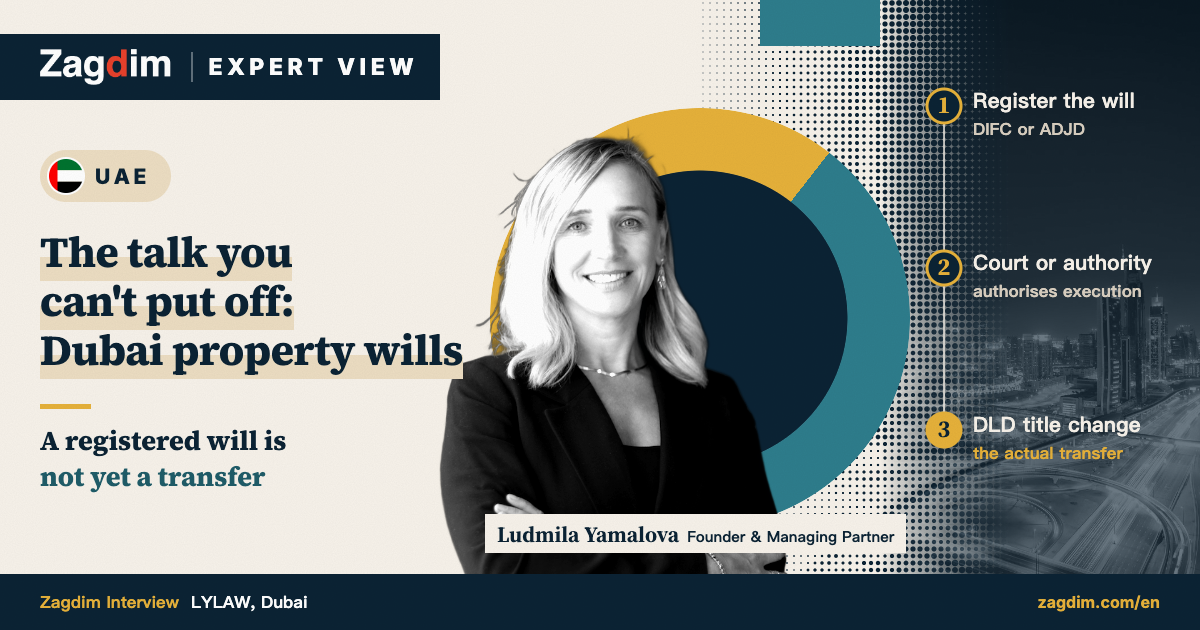
Many foreign owners of property in Dubai assume that if the title deed carries both spouses’ names, or if they already have a will at home, their family will simply take over the Dubai property if something happens. In practice, registering a will, having it executed by a court and changing ownership at the Dubai Land Department (DLD) are three separate processes.
Zagdim interviewed Ludmila Yamalova, Founder and Managing Partner of HPL Yamalova & Plewka FZCO (LYLAW) in Dubai. Her view: there is no single option that is best for every owner. For international property owners, she suggests considering the Dubai International Financial Centre (DIFC) Courts and the Abu Dhabi Judicial Department (ADJD) first as places to register a will, and any UAE will should be coordinated with existing wills in other countries.
Key Points
- No will does not mean the spouse automatically takes everything: under Article 11 of Federal Decree-Law No. 41 of 2022, where that law applies and the person who has passed away leaves a spouse and children, the spouse receives half of the estate and the children share the other half equally. Ludmila Yamalova notes that this is only one possible outcome.
- Joint ownership is not automatic inheritance: she says joint ownership alone does not mean the surviving spouse automatically inherits the share of the spouse who has passed away.
- A registered will is not a completed transfer: she points out that even a UAE-registered will must first be authorised for execution by the relevant court or authority before ownership can be changed at the DLD.
- Choosing a route: she describes DIFC as more established and conducted in English, and ADJD as more affordable; the two differ in how wills are amended and what that costs.
- If you already have a will at home: the two wills should be coordinated, so that their provisions do not overlap or unintentionally revoke each other.
Who Should Pay Attention
- Owners of one or two properties in Dubai who live outside the UAE
- Families who own property jointly with a spouse, or who have minor children
- Owners whose property is still mortgaged, or who bought off-plan (Oqood)
- People who have a will only in their home country and have never registered one in the UAE
1. What Happens to the Property If There Is No UAE Will?
What the law says. Federal Decree-Law No. 41 of 2022 applies to non-Muslim UAE citizens and to non-Muslim foreigners residing in the UAE, with exceptions such as the right to invoke one’s home-country law. Article 11 provides that where there is no will and the person who has passed away leaves a spouse and children, the spouse receives half of the estate and the children share the other half equally, regardless of gender. This is a share of the estate of the person who has passed away, not of the couple’s combined assets. Situations such as having no children, mixed nationalities, non-resident investors, joint ownership, mortgages or company ownership cannot simply be fitted into this split.
Ludmila Yamalova’s view. She explains that for non-Muslims, the half-and-half split under Article 11 is only one possible outcome. The law also allows heirs to seek the application of another inheritance law. For example, Article 17 of the Civil Transactions Law provides for succession to be governed by the law of their nationality, subject to the relevant legal requirements. Abu Dhabi also has its own civil personal status framework.
She also notes that joint ownership alone does not mean the surviving spouse automatically inherits the share of the spouse who has passed away.
If you only have a will from your home country. Ludmila Yamalova points out that a foreign will confirmed by a court judgment or probate order may be recognised through a simplified UAE court procedure, an order on petition, under Article 222 of Federal Decree-Law No. 42 of 2022 (the Civil Procedure Law). The law requires the judge to decide within five working days of submission, but this does not mean the whole inheritance and property-transfer process is completed in that time. A foreign will that has not been confirmed in this way requires separate proceedings in the UAE courts.
What this means for readers. Without a will, or with only a will from home, the law still provides ways to distribute the estate and recognise a foreign will, but the family faces more court procedures and a less predictable outcome. If you own property in Dubai, first establish which rules apply to you, then decide whether to register a will in the UAE.
2. DIFC, ADJD or Dubai Courts: How to Choose
Published routes and fees.
| Route | Published fee | Notes |
|---|---|---|
| DIFC Full Will | AED 10,000 single; AED 15,000 mirror wills for spouses | Can cover movable and immovable assets owned when someone passes away, including assets acquired after registration |
| DIFC Property Will | AED 7,500 single; AED 10,000 for spouses | Lists up to five UAE real estate interests; a title deed or Oqood is required |
| DIFC amendment | AED 550 per will | |
| ADJD standard will | AED 950 | The official page says non-UAE nationals can register regardless of religion |
| ADJD special will | AED 2,500 | The official page does not clearly define what makes a will “special” |
| Dubai Courts attestation of non-Muslim wills | Base fee AED 2,000 | Under the schedule to Executive Council Resolution No. 72 of 2025; whether a data-entry fee also applies must be confirmed for each transaction |
Table: compiled from the DIFC Courts, ADJD and official Dubai legislation. These are published registration or attestation fees only. They exclude legal drafting, translation, later court proceedings and DLD transfer fees.
The DIFC Courts’ official FAQ states that registration can be completed by video call, and the testator and two witnesses can take part from outside the UAE.
Ludmila Yamalova’s view. She says there is no single option that is best for every owner. For international property owners, she suggests considering DIFC and ADJD first, rather than Dubai Courts, although Dubai has legislation on non-Muslim wills, including Dubai Law No. 15 of 2017. She describes DIFC as more established and conducted in English, and ADJD as more affordable.
The registration fees she lists match the published figures: DIFC Full Will AED 10,000 (AED 15,000 for spouses), DIFC Property Will AED 7,500 (AED 10,000 for spouses) and a DIFC amendment fee of AED 550; ADJD standard will AED 950 and special will AED 2,500, all excluding drafting and translation fees. She notes that substantive changes to an ADJD will generally require a replacement will and payment of the registration fee again.
Property Will or Full Will. Ludmila Yamalova explains that a DIFC Property Will uses a standardised online template and does not necessarily need a lawyer; properties acquired later must be added by formal modification, at AED 550. A Full Will generally covers the relevant assets owned when someone passes away.

“Importantly, any UAE will should be coordinated with existing wills in other countries. Otherwise, overlapping provisions or unintended revocation clauses can create precisely the complications that the will was intended to avoid.”
Do not assume the minimum age. The current DIFC FAQ lists a minimum age of 18, but Article 9 of Dubai Law No. 15 of 2017 and the ADJD’s published will template still refer to 21. This article does not decide whether all routes now apply the same threshold; check the current rule with your chosen authority before registering.
What this means for readers. Comparing registration fees alone is not enough. Whether your assets will grow, whether your family situation may change, and what later amendments will cost all affect which route makes more sense.
3. Once There Is a Will, Does the Property Transfer Automatically?
No. Official sources show that registering a will, court execution and the change of ownership at the DLD are separate processes.
What the rules say. The DLD’s official page lists the documents for an inheritance title transfer: the legal inheritance documents; the heirs’ Emirates ID (residents or citizens) or passport (non-residents); a no-objection certificate (NOC) from the lender if the property is mortgaged, or from the developer for an off-plan contract; and an official letter from Dubai Courts, another UAE court or Awqaf asking the DLD to transfer ownership to the heirs. Fees are AED 1,000 per property, AED 250 for the title deed and AED 100 to 250 for the map depending on its type, plus a knowledge and innovation fee and service partner fees. They depend on the actual property and documents and are not a single all-in price. These fees are separate from the fees for registering a will during one’s lifetime.
Ludmila Yamalova’s view. She points out that even a UAE-registered will cannot simply be presented to the Dubai Land Department to transfer ownership; the relevant court or authority must first authorise its execution.
What this means for readers. Neither being the spouse nor holding a will replaces the court documents and the title registration process. If the property is mortgaged or off-plan, also find out the lender’s or developer’s inheritance procedure in advance.
4. The Most Common Misunderstandings About Wills
Ludmila Yamalova says the most common mistake is not considering succession planning at all when investing in property abroad. The common misunderstandings she lists include:
- Assuming a will from one’s home country is enough: even with a foreign will, the heirs still have to go through UAE court and transfer procedures.
- Assuming a foreign trust will be recognised in the same way: she notes that recognising and enforcing a foreign trust in the UAE can be particularly complex, depending on its structure, its governing law and how the property is held.
- Waiting until all property and assets have been bought before making a will: a Full Will can cover the assets owned when someone passes away, including those acquired after registration; the exception is a tool such as the DIFC Property Will, which lists specific properties.
- Assuming a will must list every asset item by item: she says the level of detail depends on the testator’s wishes, the type of will and the complexity of the assets.
- Worrying that the will’s contents will be disclosed: she notes that wills registered with the DIFC Courts or ADJD are handled by a dedicated judicial body under established procedures and confidentiality safeguards. Registration does not, by itself, make the contents of a will publicly accessible, although disclosure may occur where required by applicable legal or probate procedures.
- Assuming a self-signed will is as effective as a registered one: she says a privately prepared and signed will may still be legally valid and recognised by a UAE court, but it does not benefit from the established registration and enforcement procedures. Its validity and enforceability may need to be established through the applicable court procedures, potentially resulting in additional time, cost and legal uncertainty.
What Readers Can Do Now
1. Establish how your property is held. Sole ownership, a 50/50 split with a spouse, a mortgage, an off-plan purchase or company ownership are each handled differently.
2. List your assets and tell your family where to find the list. Include Dubai property, UAE bank accounts, investments and assets elsewhere.
3. Decide who inherits and who acts as executor. Name beneficiaries and an adult executor; families with minor children should also consider guardianship arrangements.
4. When comparing routes, include later costs. The registration fee is only one item. Ask separately about legal drafting, translation, later amendments, court procedures and DLD transfer fees.
5. If you already have a will at home, ask a lawyer to coordinate the two wills.
6. If the property is mortgaged or off-plan, check the lender’s or developer’s inheritance procedure first.
Life abroad? Ask Zagdim.
Your first stop for international property and global living.
Research and insights. Know what’s changing. Understand what matters.
Glossary
- DIFC (Dubai International Financial Centre) Courts Wills Service: registers Full Wills, Property Wills and other wills; registration can be done by video call.
- ADJD (Abu Dhabi Judicial Department): offers civil will registration.
- DLD (Dubai Land Department): the authority that registers Dubai real estate and changes of ownership.
- Oqood: the pre-registration contract for off-plan property.
- Mirror wills: two corresponding wills registered at the same time by a married couple.
- Grant of Probate: a court order confirming a will and authorising the executor to administer the estate.
- NOC: a no-objection certificate, for example from a lender or developer agreeing to a transfer of ownership.
About This Article
This is a Zagdim interview: Zagdim received Ludmila Yamalova’s written answers on 3 November 2026. The quotation and the summaries of her views in this article were confirmed in writing by her and her firm on 6 and 11 November 2026.
Laws, fees and procedures are taken from official sources read on 26 October 2026; the fees on the DIFC Courts fee schedule and the DLD inheritance title transfer page were checked again on 18 November 2026. Federal Decree-Law No. 41 of 2022 was read through the official search index; its implementing regulations were not downloaded in full, and later amendments were not fully traced. The Dubai Courts online service page could not be accessed, so its current filing forms and document details are unconfirmed.
The suggestions on which route suits whom, and on how foreign wills are recognised, are Ludmila Yamalova’s views based on her practice, not official conclusions. This article is general information and not legal advice for any individual case. For your own situation, rely on the competent authority’s review and officially published rules, and consult a qualified professional.
Experts interviewed
Ludmila Yamalova|Founder and Managing Partner, HPL Yamalova & Plewka FZCO (LYLAW), Dubai
References
UAE Legislation, Federal Decree-Law 41/2022 / Abu Dhabi Judicial Department, Abu Dhabi Law No. 14 of 2021 (as amended) and Regulation 8 of 2022 / DIFC Courts, “Wills FAQ” / DIFC Courts, “Property Will” / DIFC Courts, “Fees” / Abu Dhabi Judicial Department, “Civil Family Court” / Dubai Legislation Portal, “Dubai Law No. 15 of 2017” / Dubai Legislation Portal, “Executive Council Resolution No. 72 of 2025” / Dubai Land Department, “Inheritance Title Transfer”