This article is for people working in Japan who are considering Highly Skilled Professional status, and for current Highly Skilled Professional (i) holders who plan to renew, move to status (ii) or apply for permanent residence.
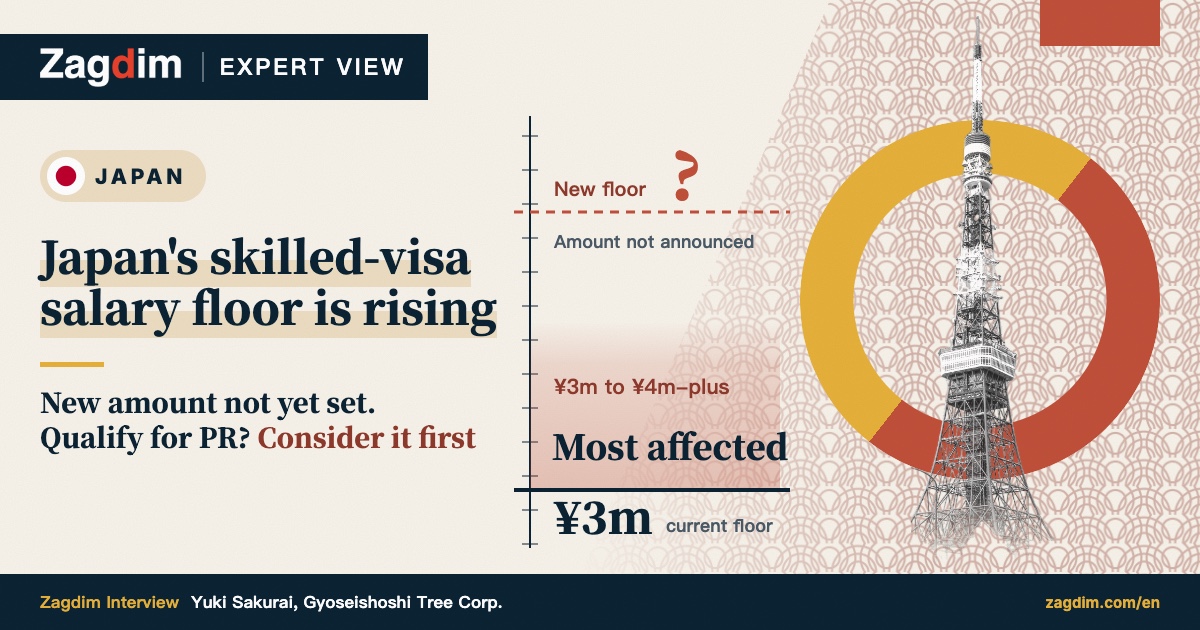
According to a Jiji Press report on 18 October 2026, the Immigration Services Agency of Japan (ISA) has decided to raise the minimum annual salary (currently 3 million yen) for the “specialised/technical” and “business management” categories of Highly Skilled Professional status, aiming to revise the ministerial ordinance within this fiscal year, that is, by 31 March 2027. As of 18 November 2026, the ISA had not published the new amount, a start date or any transitional arrangements, and no draft amendment to the Highly Skilled Professional criteria appeared among the ISA’s public comment cases on the government’s e-Gov website.
How the status works and how points are calculated are covered in our explainer, Japan’s Highly Skilled Professional Visa Salary Floor Is Rising. Here we asked Yuki Sakurai, Representative and Administrative Scrivener at Gyoseishoshi Tree Corp. (行政書士法人Tree), how people in different situations can think and prepare before the new amount is published.
Key points
- Who should read this: people earning in the 3 million to 4 million yen range who are considering Highly Skilled Professional status, and status (i) holders facing renewal or a change to status (ii).
- Where things stand: the salary increase is a reported policy; the new amount, start date and transitional arrangements have not been published. Until then, applications are examined under the current ordinance.
- The expert’s advice: Mr Sakurai believes people who already meet the requirements for permanent residence should consider applying for it first, and that current holders should think ahead to renewals and a change to status (ii).
- Who should pay most attention: people whose salary is close to the current floor, in the 3 million to 4 million yen range.
- What to prepare now: documents that clearly support your income and points. People who have just started or changed jobs should be able to explain last year’s actual income separately from their current pay terms.
1. The rules are not out yet. Should people already in Japan pay attention?
Changes to criteria do not necessarily affect only new applicants. When the ISA revised the criteria for “Business Manager” status, the new rules took effect on 16 October 2025; people already holding that status have transitional treatment for renewals within three years, after which renewals must meet the new criteria. In other words, people who already hold a status can face new criteria when they renew.

“For the Highly Skilled Professional status as well, it is necessary to think not only about new applications but also ahead to renewals after obtaining it and changes to No. 2.” (translated from Japanese)
A change from status (i) to status (ii) also requires meeting the points and salary conditions. There is no official word yet on whether the new floor will apply to current holders’ renewals or changes to status (ii), or whether there will be a transition period.
2. If you already qualify for permanent residence, consider it first
Mr Sakurai’s advice is direct: “I believe those who already meet the requirements for permanent residence should first consider applying for permanent residence.” (translated from Japanese)
The standards for permanent residence are changing too. Under the ISA’s revised Permanent Residence Guidelines published on 1 October 2026, the revised guidelines apply in principle to applications made on or after 1 April 2027. However, the income item and the item on not becoming a public burden also apply to applications made on or after the date six months before the revision (that is, 1 April 2026) that were still under review on the revision date. Anyone heading for permanent residence should check the income, tax, pension and health insurance requirements in these guidelines.
Not meeting the Highly Skilled Professional criteria in future would not mean having to leave Japan. Mr Sakurai notes: “A change in the Highly Skilled Professional criteria does not immediately mean that you will no longer be able to stay in Japan.” (translated from Japanese) People who meet the conditions of another work status, such as Engineer/Specialist in Humanities/International Services, can apply to change their status under the rules.
| Situation | Direction to consider | What to check |
|---|---|---|
| Already eligible for permanent residence | Mr Sakurai advises considering permanent residence first | Income, tax, pension and health insurance requirements in the guidelines |
| Status (i) holder facing renewal or change to (ii) | Think ahead to renewals and status (ii) | When the new rules apply and any transitional measures, once published |
| May not meet Highly Skilled Professional criteria in future | Does not mean leaving Japan immediately | Whether you meet the conditions of another work status |
Table: based on Mr Sakurai’s answers and ISA materials; subject to the ordinance and notices the ISA publishes
3. Who should pay most attention, and what can they prepare?
People with salaries close to the current floor. Mr Sakurai says: “Those who need to be especially careful are people whose annual income is in the 3 to 4 million yen range, close to the current minimum.” (translated from Japanese) How far the change reaches will depend on the new amount; until then, young professionals and people who have just moved from student status into work are often in this range.
Under the current system, the minimum salary for the “specialised/technical” and “business management” categories must be met in addition to a points total of 70; however high the points, an applicant below 3 million yen cannot qualify.
Preparation means being able to document income clearly. Mr Sakurai stresses: “Because income for the Highly Skilled Professional status is in principle assessed on expected annual income, being able to explain last year’s actual income and your current salary terms separately is a key practical point, especially for those who have just started or changed jobs.” (translated from Japanese)
Common income documents include withholding tax certificates (gensen choshuhyo), residence tax certificates and employment contracts stating annual salary and pay terms. For points, it helps to gather degree certificates, employment history and proof of Japanese ability, and to know how many points each item earns; with reports that some evaluation items may change, it is worth knowing where your points come from, not just the total. People aiming for permanent residence should also confirm that tax, pension and health insurance have all been paid on time.
For example, consider a 28-year-old engineer with a master’s degree from a Japanese graduate school, in her second year of work in Tokyo, earning 3.8 million yen, and assume her points total has reached 70. She meets the current criteria; if the new floor is set above 3.8 million yen and takes effect before she applies, she may no longer qualify. In a case like this, organising this year’s pay terms and last year’s actual income separately, and then weighing the timing of an application, leaves more room than waiting for the new amount before starting to prepare.
Conclusion
The rise in the Highly Skilled Professional salary floor is so far only a policy direction; the new amount and transitional arrangements have not been published. Mr Sakurai’s advice: people who already qualify for permanent residence should consider applying for it first; current holders should think ahead to renewals and status (ii); and those with salaries near the floor should organise their income evidence now. How the rules apply will depend on the ordinance and transitional measures the ISA publishes.
If you work in Japan and want to know whether Highly Skilled Professional status or permanent residence suits you better, tell the Zagdim reader desk about your situation. The reader desk will understand your needs and identify suitable professionals.
Life abroad? Ask Zagdim.
Your first stop for international property and global living.
Research and insights. Know what’s changing. Understand what matters.
Glossary
- Highly Skilled Professional (高度専門職): a Japanese residence status granted under a points system, often called the “highly skilled visa”; it has status (i) and status (ii).
- Immigration Services Agency of Japan (出入国在留管理庁, ISA): the agency under the Ministry of Justice that handles immigration and residence.
- Ministerial ordinance (省令): an order made by a ministry; the Highly Skilled Professional criteria are set by a Ministry of Justice ordinance.
- Expected annual income: the income expected to be paid over the next year at the time of application.
- Gyoseishoshi (行政書士): a licensed administrative scrivener who prepares applications to government offices, including immigration applications.
- e-Gov public comment: the Japanese government website where draft ordinances are usually published for comment.
About this article
Information in this article was checked on 18 November 2026. The salary policy is based on a Jiji Press report of 18 October 2026. On the check date, the ISA’s public comment cases on e-Gov were for other changes, such as the arrival record form and the “Designated Activities” notice, with no draft amendment to the Highly Skilled Professional criteria, and the ISA had not announced a new amount. The timing of the permanent residence guidelines is taken from Section 6 of the ISA’s Guidelines for Permission for Permanent Residence (revised 1 October 2026); the “Business Manager” transition is from the ISA’s 2025 explanation. The example in Section 3 is simplified.
Expert views are personal professional opinions. The quotes were confirmed by Mr Sakurai in Japanese and translated into English by Zagdim. This article is not individual legal advice; how the rules apply to a specific case depends on the official amendments and transitional measures, and you should consult a professional.
Experts interviewed
Yuki Sakurai, Representative and Administrative Scrivener, Gyoseishoshi Tree Corp.

References
Zagdim, “Japan’s Highly Skilled Professional Visa Salary Floor Is Rising: How the Points Work Now, What Is Decided, and What Current Holders Should Watch” / Immigration Services Agency, Guidelines for Permission for Permanent Residence (revised 1 October 2026, Japanese) / Immigration Services Agency, Points-based system for highly skilled foreign professionals (Japanese) / Immigration Services Agency, Revision of the criteria for “Business Manager” (effective 16 October 2025, PDF, Japanese) / e-Gov public comment, Immigration Services Agency cases (Japanese)