

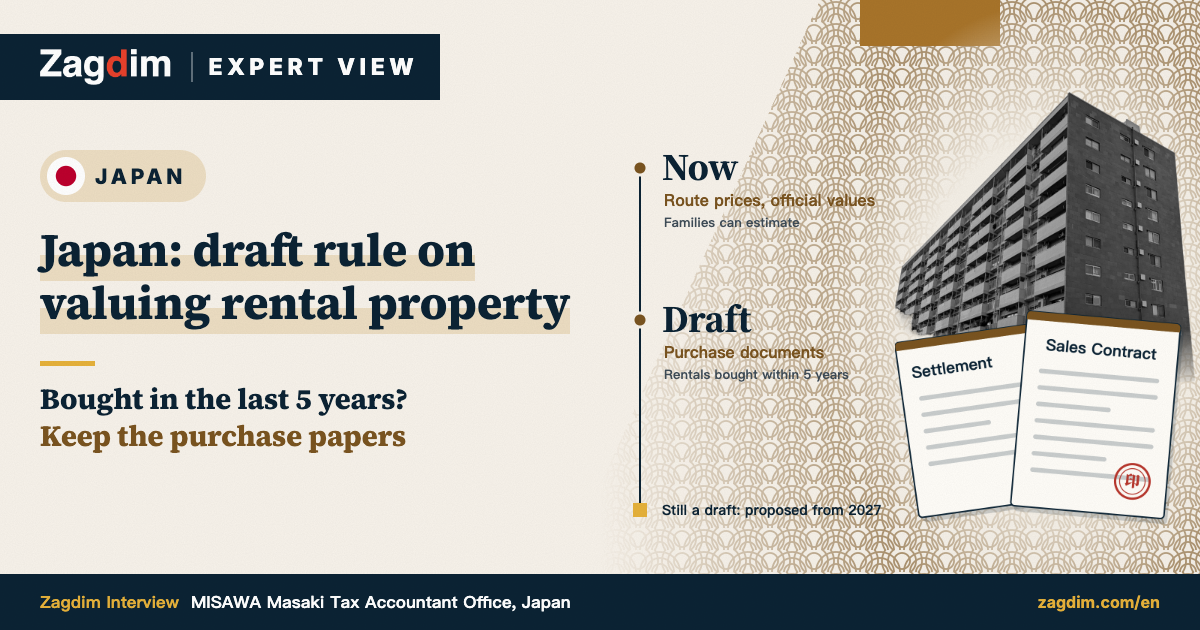
On 18 September 2026, Japan’s National Tax Agency (NTA) published a draft interpretive circular, “Valuation of Rental Property” (貸付用不動産の評価について). Under the draft, rental property acquired for consideration or newly built within five years before an inheritance, bequest or gift would be valued at its normal transaction value; where certain conditions are met, it could instead be valued at 80% of an amount calculated from the acquisition price. The draft states that it would apply to property acquired by inheritance, bequest or gift on or after 1 January 2027. Public comments closed on 18 October. As of 25 November 2026, Zagdim had not found a final version in the NTA’s index of circulars. The circular is still a draft, and its content and start date may change.
Zagdim interviewed MISAWA Masaki, Representative Tax Accountant at MISAWA Masaki Tax Accountant Office, about what this means. He noted first that the circular was still at the draft stage in late November 2026, and that his answers are general views based on the content of the draft. His key point: for the properties covered, the basis of the calculation shifts from official valuations to the acquisition documents kept by the taxpayer.
“For the properties covered, the calculation shifts from one based on official valuations such as the current route prices (rosenka) to one based on the acquisition documents kept by the taxpayer.”
Key Points
- Still a draft: The NTA published the draft in September 2026 and public comments closed on 18 October. As of 25 November, Zagdim had not found a final circular. The draft would apply to inheritances, bequests and gifts on or after 1 January 2027.
- What would change: Rental property acquired for consideration or newly built within five years before the inheritance or similar event would in principle be valued at its normal transaction value. Where the acquisition price matched the market at the time, 80% of an adjusted acquisition price could be used instead.
- Misawa’s view: The 80% method depends on documents such as the sales contract and the settlement statement from the purchase. A separate market valuation may be needed where the price was out of line with the market, land prices have moved sharply, or the documents have not been properly kept.
- The difficulty for families abroad: He points out that Japanese real estate falls within Japanese inheritance tax even if the heir lives abroad or is not a Japanese national, that the filing and payment deadline is 10 months, and that the tax filing and the registration rely on overlapping documents.
- What can be done now: He recommends not waiting for the final version, and starting today to gather the acquisition documents in one place and tell family members abroad where they are.
Who Should Pay Attention
- Owners of rental property in Japan who live outside Japan
- Anyone who bought or built rental property in Japan within the past five years
- Families whose parents or relatives own rental property in Japan and who may one day handle the inheritance from abroad
- Anyone planning to give Japanese rental property to family members
1. What the Draft Would Change
What the official rules say. Under the current approach, as explained by the NTA, land is valued by the route price method or the multiplier method, and buildings at their fixed asset tax assessment value multiplied by 1.0. For land and buildings that are let, the value is then adjusted according to the rights involved.
Item 1 of the draft provides that land and buildings that are rental property and were “acquired or newly built through a transaction for consideration” within five years before the valuation date are to be valued at an amount equivalent to their normal transaction value on that date. However, if the acquisition price is recognised as equivalent to the normal transaction value at the time of acquisition, the property may be valued at 80% of the following:
- Land: the acquisition price multiplied by a land price change rate
- Buildings: the acquisition price less depreciation or loss in value from acquisition to the valuation date
The draft also sets out a separate method for specified fractional real estate products, which this article does not cover.
According to the NTA’s summary, the direction of this change was set out in the FY2026 tax reform outline approved by the Cabinet on 26 December 2025. The outline sets the policy direction, but as of 25 November 2026 the circular itself remains a draft, and the “date of issue of the circular” in the draft text is still blank.
Misawa’s view. In his view, for the properties covered, the basis of the calculation shifts from official valuations such as route prices to the acquisition documents kept by the taxpayer (see the quote above).
What this means for readers. Zagdim’s reading: until now, families could estimate the value of a rental property from route price maps and fixed asset tax notices. For rental property bought within the past five years, the key information would instead be the documents from the original purchase, which usually only the buyer holds.
2. The Documents Behind the 80% Method
What the official rules say. The notes to the draft state that the time of acquisition is in principle the time of handover (hikiwatashi); that the “acquisition price” is the amount spent on the acquisition plus improvement and equipment costs; that the land price change rate is calculated from the valuation benchmark (in principle the route price) for the valuation year and the acquisition year; and that building depreciation uses the straight-line method and statutory useful lives, with any part-year counted as a full year.
Misawa’s view. Misawa explains that under the draft, rental property acquired or newly built within five years before an inheritance or similar event is in principle valued at market value, although a method based on 80% of the acquisition price can also be chosen. He said: “To use this method, you need to have kept the documents that establish the acquisition price, such as the sales contract from the purchase and the settlement statement.”
What this means for readers. The 80% method is not an automatic discount: the family first has to be able to show what was originally paid. Zagdim’s reading: because the draft includes improvement and equipment costs in the acquisition price, invoices and contracts for renovation work or added equipment are also worth keeping alongside the sales contract and settlement statement.
3. When a Separate Market Valuation May Be Needed
What the official rules say. The draft’s principle is valuation at normal transaction value. The 80% method assumes that the acquisition price is recognised as equivalent to the normal transaction value at the time of acquisition. Note 6 of the draft adds that where land prices have changed markedly, or there are other circumstances that make the 80% method hard to apply, those circumstances are to be taken into account.
Misawa’s view. He lists the cases in which a separate market valuation may be needed:
“Cases where a separate market valuation would be needed include, for example: (1) where the acquisition price was out of line with the market at the time of acquisition; (2) where land prices have changed significantly since the acquisition; and (3) where the documents establishing the acquisition price have not been properly kept.”
Zagdim note: points (1) and (2) correspond to the draft’s precondition and to Note 6 respectively. Point (3) is Misawa’s practical judgement; the draft does not say this in so many words, but because the 80% method is calculated from the acquisition price, it is hard to establish that price when the documents are incomplete.
What this means for readers. Where a property was bought well above or below the market, land prices have moved sharply since the purchase, or the documents can no longer be found, the family may later need a separate valuation, which adds time and cost. Point (3) is the one owners can check today: are the documents still there, and are they complete?
4. Heirs Abroad: Deadlines, Registration and Documents
What the official rules say. According to the NTA, a person who lives abroad and has no address in Japan at the time of inheritance is, in principle, taxed on the property in Japan that they acquire. Real estate is located where it sits, so a home in Japan counts as property in Japan. Whether property outside Japan is also taxed depends on the heir’s nationality and past residence and on the status of the deceased, under separate categories set by the NTA. The inheritance tax return is in principle due within 10 months from the day after the heir learns of the death, with payment due by the same date; no return or payment is needed if the total value acquired does not exceed the basic exemption.
Misawa’s view. He points out that when Japanese real estate is inherited, it falls within the scope of Japanese inheritance tax even if the heir lives abroad or is not a Japanese national, and that the deadline for filing and payment is 10 months from the day after the heir learns of the inheritance. He says that once an inheritance begins, the heirs have to handle the Japanese inheritance tax filing, the inheritance registration (the work of a judicial scrivener) and any procedures required in their country of residence in parallel, each with its own deadline.
In his view: “Because the tax filing and the registration use overlapping documents, I think it is best to engage a tax accountant and a judicial scrivener who work together.” He also advises: “I think it is wise for people who own property in Japan not to wait for the circular to be finalised, but to keep documents such as the certificate of registered matters and the acquisition contract, line up the professionals while they are still alive, and pass this on to those who will become their heirs.”
Zagdim note: whether any tax is actually payable also depends on whether the estate exceeds the basic exemption and other rules; this article does not calculate any individual case.
What this means for readers. Family members abroad often have to deal with Japanese tax, Japanese registration and the procedures in their own country within the same 10 months. Zagdim’s reading: if the documents are organised and suitable professionals identified during the owner’s lifetime, the family will not have to start the search from scratch.
What Readers Can Do Now
Misawa’s advice to readers: “If you own Japanese rental property that you acquired or built within the past five years, gather the acquisition documents in one place now, and tell your family members living abroad where they are kept.” He added: “Whether you use the 80% method or a market valuation, you need the same documents. Once an inheritance has occurred, it is not easy for family members living abroad to track them down.” And: “I recommend starting today, without waiting for the final version.”
Zagdim has turned his answers and the draft into a checklist:
- Check which properties fall within five years. List your rental properties in Japan and note the handover date of each (the draft in principle treats handover as the time of acquisition).
- Gather the acquisition documents. The sales contract and settlement statement; for new builds, the construction contract and payment records.
- Keep receipts for improvements and equipment. The draft counts improvement and equipment costs as part of the acquisition price.
- Keep the certificate of registered matters. It is one of the documents Misawa mentions keeping during the owner’s lifetime.
- Tell your family where everything is. Keep the documents in one place and make sure family members abroad know where.
- Watch for the final version. The circular is still a draft; when it is finalised, its content or dates may change, so check your properties against it again.
If you own rental property in Japan and are unsure what documents your family would need, you can tell the Zagdim reader desk about your situation. The reader desk will understand your needs and shortlist suitable professionals.
Glossary
- Circular (interpretive circular, tsutatsu): The NTA’s instructions on how tax law is interpreted and applied; property valuation is mainly governed by circulars.
- Normal transaction value (tsujo no torihiki kagaku): The price at which a property would ordinarily change hands, broadly its market value.
- Route price (rosenka): The value per square metre of a standard residential plot facing a road, published annually by the NTA and used to value land.
- Acquisition price: The amount spent to acquire a property; the draft includes improvement and equipment costs.
- Certificate of registered matters (toki jiko shomeisho): A certificate showing what is recorded in the property register (owner, rights, etc.), issued by the Legal Affairs Bureau.
- Tax accountant (zeirishi): A Japanese national qualification for preparing tax returns and giving tax advice.
- Judicial scrivener (shiho shoshi): A Japanese national qualification for handling property registration and similar procedures.
About This Article
This article is based on a Zagdim interview: Zagdim received MISAWA Masaki’s written answers on 23 November 2026 (in Japanese, translated into English by Zagdim). The quotes and paraphrases in this article were confirmed in writing by him on 25 November 2026.
The content of the draft circular, the comment period and the proposed start date are based on the e-Gov public comment page (case no. 410080055) and the draft text and summary published by the NTA, read on 25 November 2026 (the draft file is identical to the version read on 1 November). That no final circular has been issued reflects Zagdim’s check of the NTA’s index of property valuation circulars and its news page on 25 November 2026; it does not mean the NTA will not publish one later. The current valuation methods, the tax scope for heirs abroad and the filing deadline are based on NTA Tax Answers No.4602, No.4138 and No.4205, read on the same day.
The “What this means for readers” passages and the checklist under “What Readers Can Do Now” are Zagdim’s own summary and interpretation, not the interviewee’s statements. This article is general information and does not constitute individual tax or legal advice. The circular is still a draft; how it applies to any individual case will depend on the final text and on the authorities’ assessment, and you should consult a professional.
Experts interviewed
MISAWA Masaki, Representative Tax Accountant, MISAWA Masaki Tax Accountant Office
References
e-Gov Public Comment, “Implementation of the public comment procedure on the draft interpretive circular ‘Valuation of Rental Property'” (case no. 410080055) / National Tax Agency, draft text “Valuation of Rental Property (draft)” / National Tax Agency, summary of the draft circular / Ministry of Finance, FY2026 Tax Reform Outline (asset taxation) / National Tax Agency, index of individual circulars on property valuation / National Tax Agency, Tax Answer No.4602 (valuation of land and buildings) / National Tax Agency, Tax Answer No.4138 (when an heir lives abroad) / National Tax Agency, Tax Answer No.4205 (filing and paying inheritance tax)