

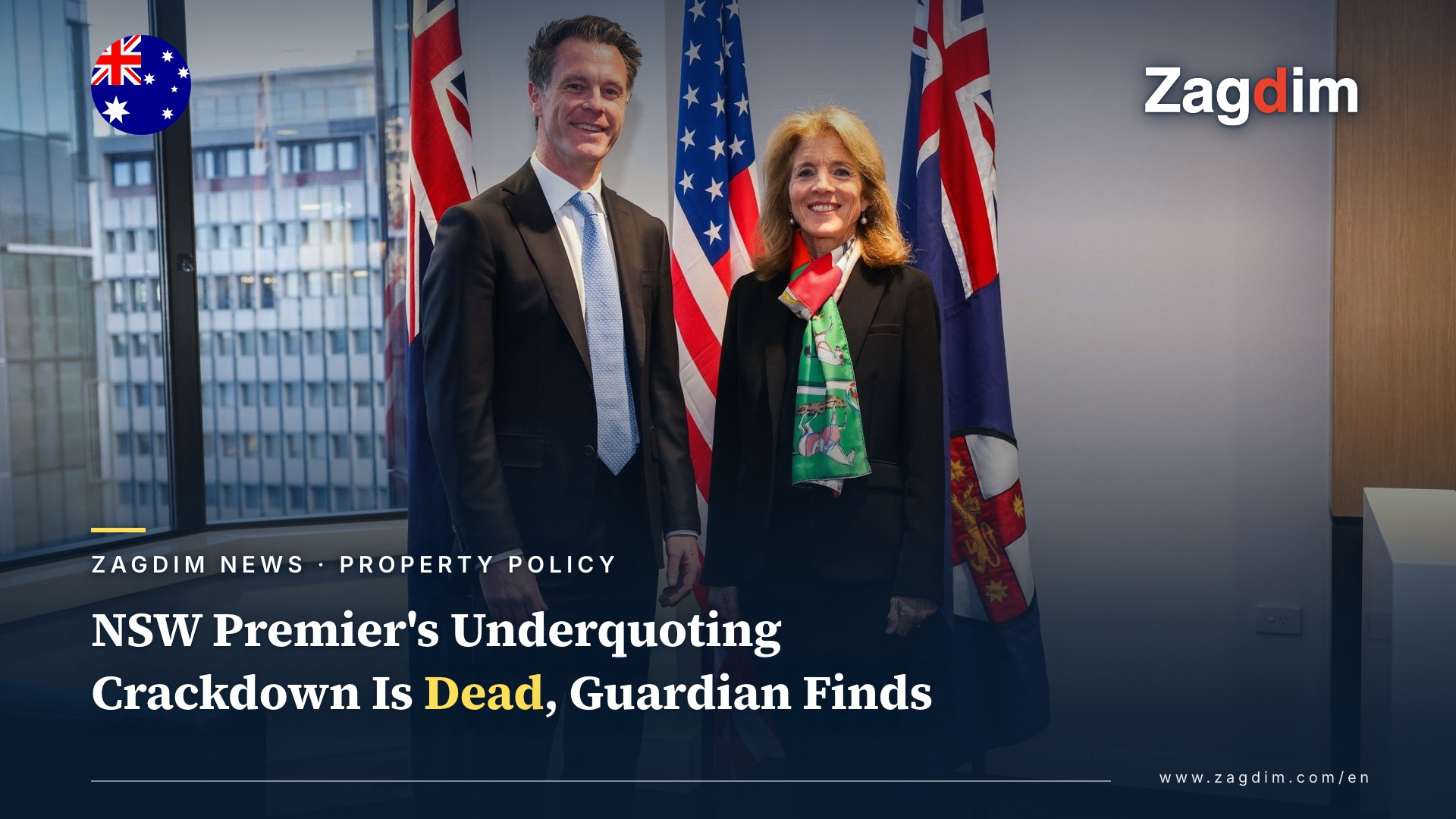
Zagdim reported earlier this month that the New South Wales government pulled its underquoting reform package just hours before it was due to take effect on 16 November 2026 (see: NSW Pauses New Law Cracking Down on Underquoting Just Before It Took Effect). A follow-up analysis published by The Guardian Australia on 22 November frames that move as more than a delay: its headline describes Premier Chris Minns as having “surrendered in the war on underquoting,” with no reinstatement of the package announced since. Minns said at the time he acted after real-estate agents in his own electorate told him the rules would make selling harder.
Home buyers bidding at auction in Sydney and other NSW markets are the group left without the stronger protections the scrapped package promised — it would have raised fines for underquoting and required a price guide on all property advertisements. The package was abandoned over a single element: a proposed ban on agents cutting the advertised price guide below either their private estimate or a previously rejected offer, which Minns argued could leave sellers who had overvalued their property unable to meet the market. Auctions account for roughly two in five home sales in Sydney and Melbourne, and underquoting — advertising a price guide well below what a seller will actually accept, to draw more bidders and inflate the final price — is most common in that sales method, according to the Guardian’s reporting.
The comparison case is Victoria, where a different underquoting reform took effect last month: sellers must now publish their genuine reserve price at least a week before auction, and agents must disclose nearby comparable sale prices. The Real Estate Institute of Victoria has already called for that law to be reviewed and potentially scrapped, warning it could cause more failed auctions, inflated reserves and riskier sales.
On whether Victoria’s law is working, the sourced evidence is mixed and attributed. Cotality head of research Gerard Burg said transparency “should make the market move a bit more smoothly” in theory, but that Melbourne’s auction clearance rate has fallen since the reform while Sydney’s — which has no equivalent law — has fallen further, which he said points to broader factors such as five Reserve Bank rate rises this year taking rates to an 18-year high; he said it is “not entirely clear” how much of the change is down to the reform itself. Cotality data cited in the report also shows fewer Melbourne auctions than a year ago, with sellers shifting toward private sales since the law arrived. Property data app Homer, analysing 2,164 Victorian sales in the past month, found homes where the published reserve matched the advertised price guide sold 59% of the time, versus 50.4% for the roughly one-in-six homes that disclosed a higher reserve. Homer chief executive Henry Pedersen said the law has not ended underquoting but has “shifted and exposed it,” with buyers now seeing the gap a week before auction instead of on the day. Sydney buyers’ agent Kimberley Ackerman said the scrapped NSW element was “poorly designed” but that the rest of the reform — requiring agents to advertise the price they would actually accept — “could have been salvaged.”