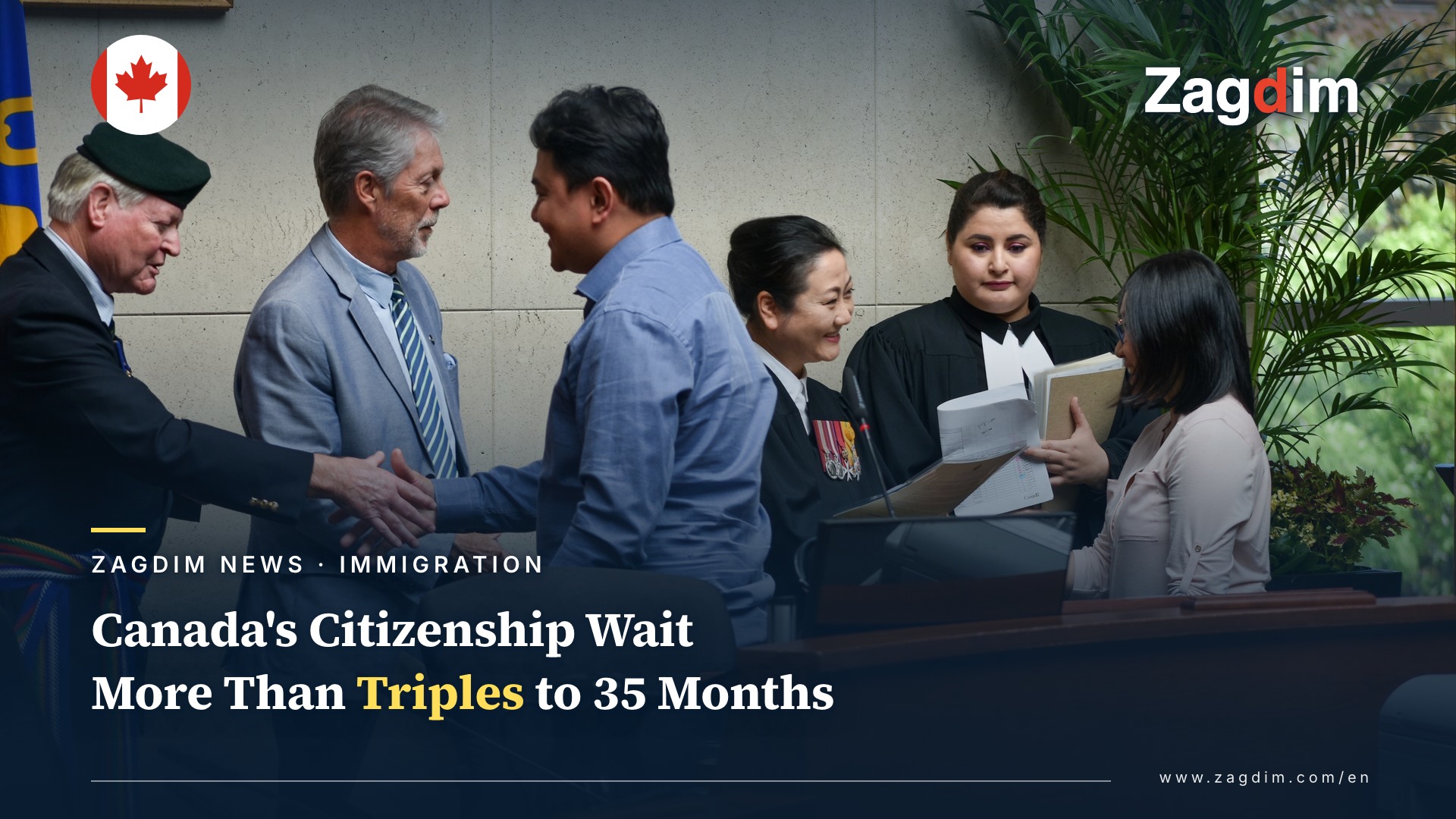
Canada’s estimated processing time for proof-of-citizenship applications has jumped from 10 months in January 2026 to 35 months today, according to Immigration, Refugees and Citizenship Canada’s (IRCC) November 17 update — more than tripling in under a year, CIC News reported.
The surge traces back to Bill C-3, which took effect on December 15, 2025, and removed the “first-generation limit” that had previously cut off citizenship for people born abroad to a Canadian parent who was also born abroad. Under the new rule, many people who can trace a direct line of descent to a Canadian grandparent or great-grandparent are citizens too. According to IRCC data, about 42,400 people were waiting on a proof-of-citizenship decision in January 2026, the first full month the law was in force; by IRCC’s November 17 update, that queue had grown to about 139,200. Taous Ait, spokesperson for Immigration Minister Lena Metlege Diab, confirmed to CBC News that the rise in applications had a direct impact on the growing processing times.
Output was also affected by a review IRCC carried out in June 2026, when the department asked some recent certificate recipients to return certificates issued over concerns about supporting documents drawn from open or secondary sources; about 6,500 certificates were checked and 100 were flagged for possibly weak documentation. IRCC’s own finalization numbers show average monthly output fell from about 5,800 proof-of-citizenship decisions (January–May) to 3,040 in June and 2,420 in July, before climbing back to 5,700 in September — though IRCC has not said the review caused the slowdown. Volume aside, IRCC senior communications advisor Briannah Dale told CBC News in September that the “complexity of many applications,” which “often require substantial documentary evidence and additional verification,” is also a factor: a claim through a great-grandparent requires documenting every link in the chain, and since June those records must come from the original source authority. Most citizenship-by-descent claims still have to be filed on paper, adding a manual scanning step once they reach IRCC.
IRCC says it is taking four steps to bring the backlog down: triaging applications, enhancing intake processes, training and onboarding additional staff, and refining workload management practices, Dale said. New staff typically take time to become productive, so the effect may not show up immediately. IRCC describes the 35-month figure as a projection that “can rise or fall” depending on how many applications arrive and how quickly the department processes them.
References
CIC News – Why Canadian citizenship by descent wait times more than tripled in 2026