
































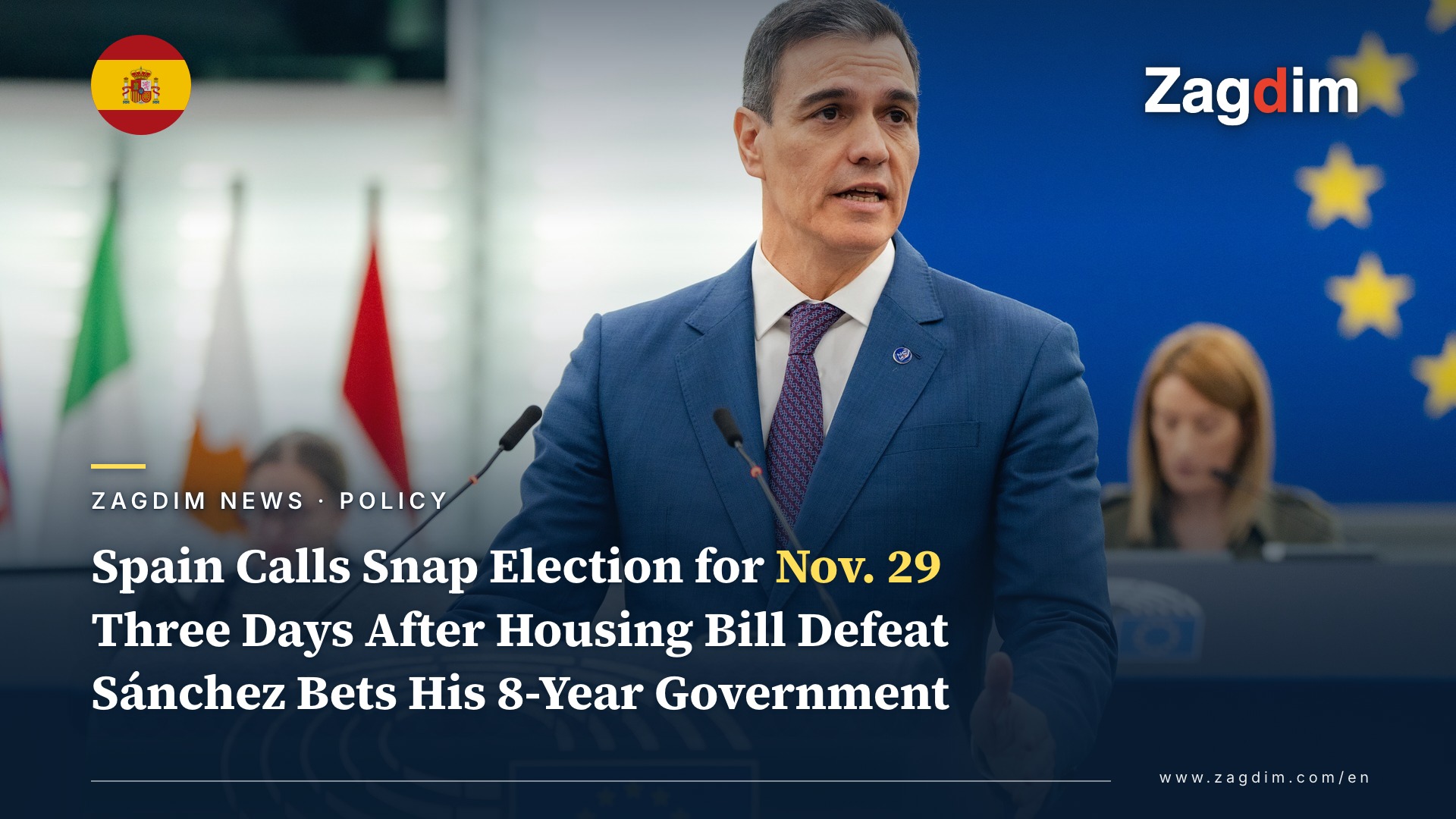
Spanish Prime Minister Pedro Sánchez called an early general election for November 29, 2026, in a televised address on Monday, three days after a fragmented Congress rejected his government’s two emergency housing decrees and tens of thousands of protesters took to the streets of roughly 50 Spanish cities, according to Reuters and the Financial Times. The vote comes nearly eight months before the end of Sánchez’s constitutional four-year term and will test whether his Socialist-led coalition can survive a housing crisis that both energized its base and exposed the fragility of the multi-party alliance that has kept him in office for three successive terms since 2018.
The election affects anyone with a stake in Spain’s near-term housing and immigration policy direction — prospective foreign property buyers, people planning to relocate to Spain, and the broader electorate Sánchez is asking to “mobilise and win a much larger progressive majority.” Opinion polls taken before Friday’s housing-decree defeat already suggested the conservative People’s Party (PP) and the far-right Vox could combine for enough seats to oust Sánchez, which would make Vox the first far-right party in Spain’s central government since the end of the Franco dictatorship, per Reuters. PP leader Alberto Núñez Feijóo welcomed the announcement as a choice “between corruption and decency, between decline and prosperity,” while Vox leader Santiago Abascal cautioned on Antena 3 that polls had also favored Sánchez’s opponents in 2023, when he nonetheless assembled a governing majority.
The immediate trigger was Congress’s October 2 rejection of two decrees — Real Decreto-ley 26/2026 and 27/2026 — that Sánchez’s government had enacted on September 30 to cap rent increases on existing contracts, suspend evictions of vulnerable households, and restrict investment-fund purchases of discounted residential property, among other measures this outlet reported on October 1 and October 4. The Popular Party, Vox and the Catalan separatist party Junts combined to vote the package down for a second time (an earlier version failed the same way on April 28, 2026), and the defeat was followed by demonstrations in roughly 50 cities over the weekend of October 3–4, in part triggered by the September 23 eviction of 87-year-old Madrid tenant María del Carmen “Maricarmen” Abascal. Sánchez’s current term has also been marked by a failure to pass a national budget since 2023, persistent corruption allegations against people close to him — including his wife, Begoña Gómez, who is set to stand trial and denies wrongdoing — and a sharp rise in Spain’s immigrant population that officials credit for much of the country’s recent growth but that the Financial Times reports has also “stoked housing strains and other social tensions,” including an unauthorized migrant influx into the Ceuta exclave.
Economist Lorenzo Bernaldo de Quiros of Freemarket Corporate Intelligence told Reuters the housing defeat gave Sánchez “a window of opportunity” to call the vote before less favorable issues, such as the Ceuta migrant crisis and the corruption cases, return to the center of the campaign. Universidad Carlos III politics professor Pablo Simón told the Financial Times the snap election is designed to “minimise the risk of…a more than foreseeable defeat” implied by current polling. For anyone with a pending or planned Spain property purchase or relocation, two things are now explicitly on hold rather than resolved by this announcement: the rent-cap and investment-fund restrictions Congress struck down on October 2 are not being replaced by any new measure before the vote, and a separate, long-stalled bill proposing a tax of “up to 100%” on property purchases by non-EU, non-resident buyers — submitted to Congress in June 2025 but never part of the rejected decrees — remains stalled and will not advance before a new Congress is seated after November 29. Both Reuters and the Financial Times note Spain’s blue-chip IBEX index and government bonds held steady immediately after the announcement, suggesting investors are not yet pricing in near-term disruption to an economy the FT describes as the world’s fastest-growing large, advanced economy over the past two years.
References
Reuters – Spanish PM Sanchez Gambles on November 29 Snap Election to End Parliament Deadlock / Financial Times – Spanish Prime Minister Pedro Sánchez Calls Snap Election