

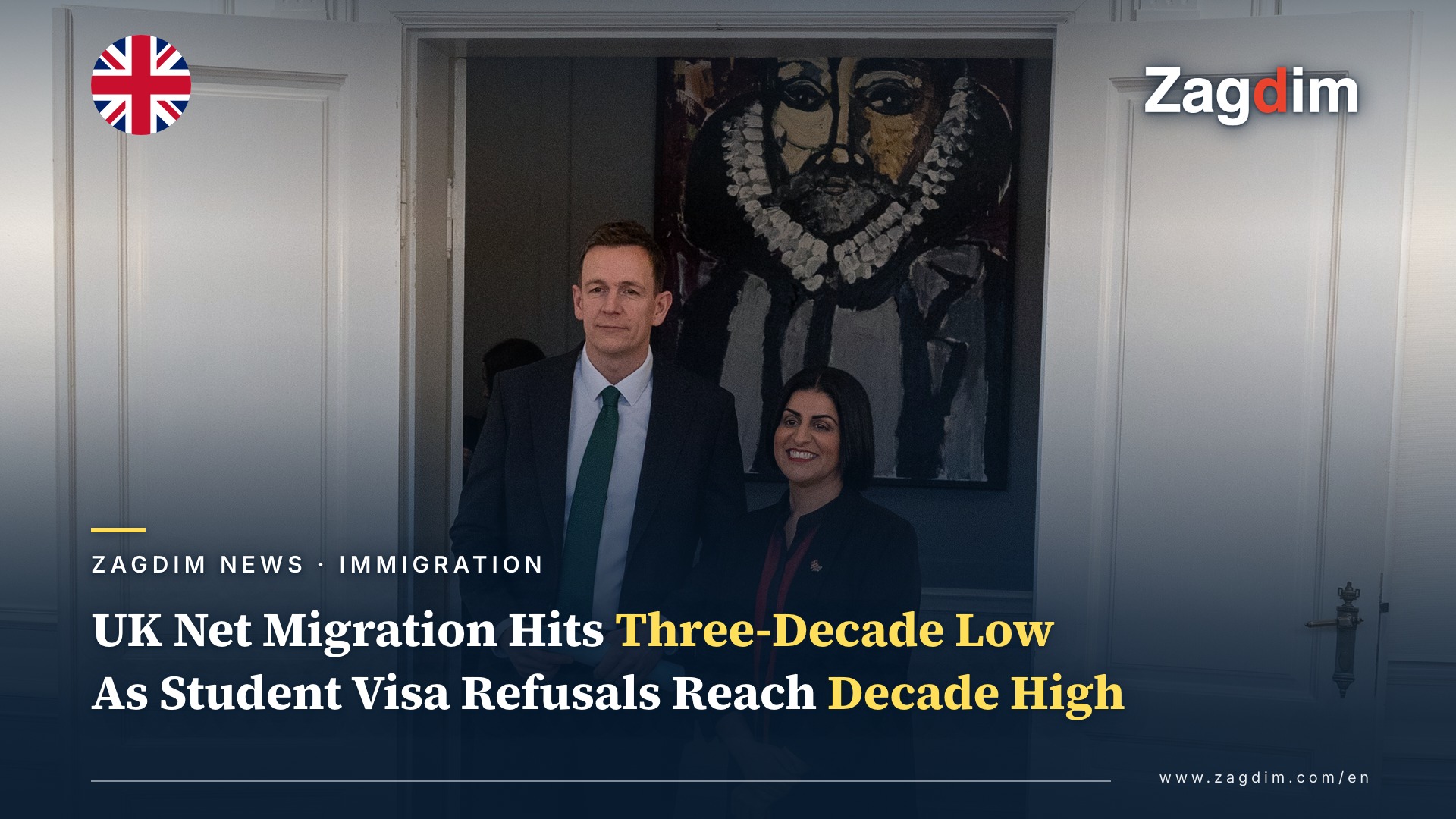
The UK’s Office for National Statistics (ONS) said on 26 November that provisional long-term net migration fell to 77,000 in the year ending June 2026, more than halving from a revised 204,000 a year earlier. Excluding the COVID-19 pandemic period, it is the lowest net migration estimate since 1997. Non-EU+ net migration fell to 258,000 from 379,000, driven mainly by a drop in non-EU+ immigration of more than 100,000, including a 33,000 fall in study-related arrivals. Total long-term immigration came in at 738,000, down 17% from 893,000 and down sharply from the record peak of 1,469,000 in the year ending March 2023. Home Secretary Shabana Mahmood said the government had “regained control” of the immigration system and added, “We won’t stop here.”
On the same day, the Home Office published its own quarterly immigration statistics for the year ending September 2026, showing a parallel tightening on the study-visa side. Sponsored study visa grants fell 23% year-on-year to 335,801 — down 49% from the peak in the year ending June 2023. Grants to Indian main applicants fell 29% to 69,855, while Pakistani and Nigerian applicants saw falls of 72% and 34% respectively; China remained the largest source nationality at 80,932 grants (25% of the total). Masters-level grants fell 29% to 181,920, now 58% of all study grants versus 63% a year earlier. Since June 2026, UK universities have had to meet stricter Basic Compliance Assessment thresholds — a visa refusal rate below 5%, an enrolment rate of at least 95% and a course completion rate of at least 85% (rising to 90% in June 2027) — in order to keep sponsoring international students.
Separately, specialist outlet The PIE News reported on 26 November, citing analysis of Home Office data by consultancies Higher Insights and Admit, that the rolling refusal rate for UK sponsored study visas reached 6.4% in the year ending September 2026 — the highest level since the year ending September 2015, and more than double the 3.1% recorded a year earlier. The rate has risen every quarter over the past year, from 3.8% in December 2025 to 4.4% in March 2026, 4.9% in June 2026 and 6.4% in September 2026; excluding Chinese applicants, the rolling rate rises to 8.2%. Withdrawn applications — cases pulled before a decision was made — surged to 3,682 in the July-to-September 2026 quarter, up from 779 in the same quarter of 2025. Applications from main applicants in that quarter fell 16% year-on-year to 230,300, while visas issued fell 17% to 227,668.
Reacting to the refusal-rate data, Russell Group policy manager Zaid Kadhum said the group was “watching the sudden rise in visa refusal rates closely,” adding: “A robust immigration system is in everyone’s interests, but decisions must be fair and transparent, and we should be careful not to deter genuine students in the process.” On the broader migration numbers, Oxford Economics estimated in April that if net migration stayed at zero over the long term, the UK economy could end up more than 15% smaller by 2060 than its baseline forecast, warning of lower tax revenue and higher government borrowing even after accounting for reduced demand on public services.
References
Office for National Statistics – Long-term international migration, provisional: year ending June 2026 / Home Office / GOV.UK – Why do people come to the UK? Study (Immigration system statistics, year ending September 2026) / The PIE News – UK study visa refusals hit highest rate in over a decade as withdrawals soar