






























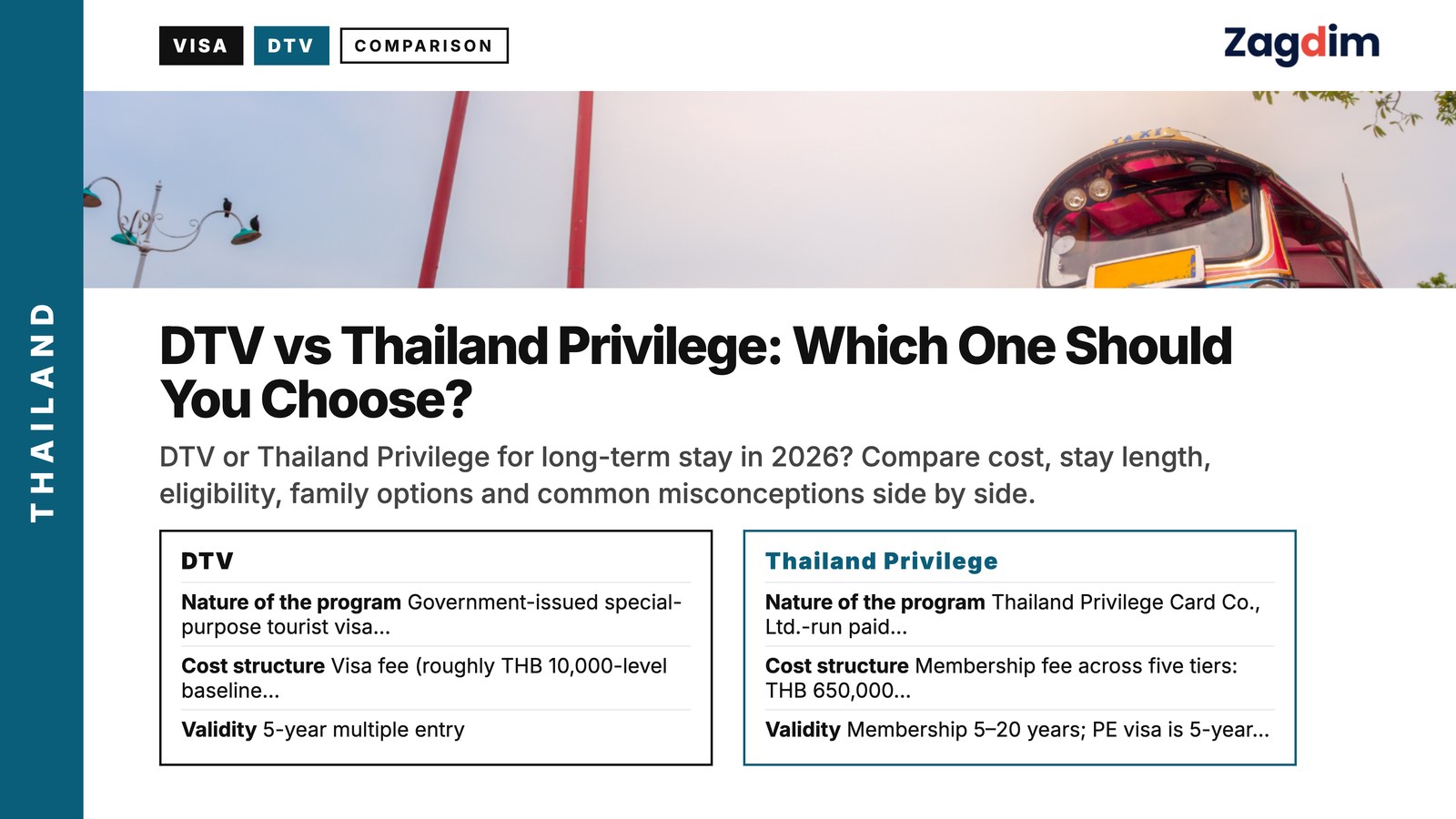
DTV (Destination Thailand Visa) and Thailand Privilege (Thailand Elite) are the two main routes for long-term stay in Thailand in 2026 — two structurally different systems. DTV is a special-purpose tourist-category visa (with a stated purpose and a financial threshold); Privilege is a company-run paid membership (negative-list eligibility plus a membership fee). Which one suits you depends on your stay pattern, budget level, eligibility, and family arrangements — there’s no single answer that fits everyone. This article lays out both structures side by side based on official sources and multiple cross-checked references, and gives a decision-checklist framework.
Full Comparison Table
| Comparison Point | DTV | Thailand Privilege |
|---|---|---|
| Nature of the program | Government-issued special-purpose tourist visa (launched July 2024) | Thailand Privilege Card Co., Ltd.-run paid membership + PE visa |
| Cost structure | Visa fee (roughly THB 10,000-level baseline; each mission charges in local currency — confirm with the accepting mission) | Membership fee across five tiers: THB 650,000 to 5,000,000 |
| Validity | 5-year multiple entry | Membership 5–20 years; PE visa is 5-year multiple entry |
| Stay per entry | Up to 180 days, extendable once (each entry capped at 180 days); must exit and re-enter once used up | Can stay 1 year per entry, extendable |
| Application requirements | Proof of purpose (remote work or Soft Power activity) + financial proof of at least THB 500,000 | Negative-list eligibility + membership fee + company written approval |
| Family | Dependent category: spouse and children under 20 each apply for their own DTV | Next Member limited to Platinum tier and above (standard price 1M/1.5M/2M); Bronze/Gold have no equivalent mechanism |
| Work permit | Not included (Workcation = remote work for an overseas employer/client) | Not included |
| Privilege member services | (DTV is a special-purpose tourist visa) | All tiers include airport VIP service (including fast-track), a dedicated contact, and 24/7 support; points redemption limited to Gold and above |
When comparing cost side by side, note the difference in what you’re actually paying: DTV is a visa fee, Privilege is a membership fee (the PE visa itself allows a 1-year stay per entry, extendable) — the two figures are different in nature, so don’t judge purely by the multiple.
What Is DTV
DTV is a 5-year multiple-entry visa: each entry allows a stay of up to 180 days, extendable once; once both periods are used up, the holder must exit and re-enter. There are three application categories:
- Workcation: digital nomads, remote workers, foreign talent, freelancers — submit an employment contract, portfolio, or similar proof of purpose;
- Soft Power activities: such as Muay Thai, Thai cooking training, or medical treatment — submit activity confirmation documents (note: Thai-language schools do not qualify as an eligible activity; anyone whose main purpose is learning Thai should instead check the Non-Immigrant ED visa);
- Dependents: the spouse and children under 20 of a DTV holder, each submitting their own application along with proof of relationship.
Financial threshold: at least THB 500,000, proven via bank statements or similar; common practice is to submit the most recent 3 months of statements showing a balance that meets the threshold.
Documents (lists vary by mission — confirm with the accepting mission): passport information page, recent photo, proof of habitual residence, statements showing the required balance, a police clearance certificate issued within the last 6 months, and category-specific purpose documents.
Accepting-mission rules: from August 31, 2026, DTV applications must be submitted through a mission that accepts the applicant — you cannot simply choose any Thai embassy or consulate. Each mission sets its own criteria for who it will accept and what it requires: this is not one uniform global rule, but varies significantly by mission. For example, Singapore’s mission accepts only citizens and permanent residents; London’s mission requires proof of permanent residence (such as ILR) plus a police certificate, from August 31, 2026. Always confirm the specific requirements with the mission you intend to apply through, rather than assuming a single nationality-or-residence rule applies everywhere.
Work boundary: DTV does not come with a Thai work permit; the Workcation category is meant for remote work for an overseas employer or client — being locally employed in Thailand while on a DTV still requires a separate work permit under labor law.
If your remote work, Soft Power activity, or family situation looks like it could initially fit DTV, ask Zagdim to help check eligibility, documents, and the requirements of the mission you’d apply through.
What Is Thailand Privilege
Thailand Privilege is a paid membership system: five membership tiers (from Bronze at THB 650,000/5 years, up to Reserve at 5,000,000/20 years, by invitation only), which come with a PE visa — 5-year multiple entry, with each entry allowing a stay of 1 year, extendable. Eligibility is negative-list based (generally no unified income, asset, or age threshold, but with exclusions such as imprisonment — excluding minor or negligence offenses — an arrest warrant, deportation, bankruptcy liquidation, money laundering, or overstaying more than once within three years, plus a company written-approval process). On the benefits side, all tiers include airport VIP service (including fast-track), a dedicated contact, and 24/7 support; Gold and above also get points and services such as hotels and health checks (Bronze has no points). Bronze is a time-limited offer (the authorized agent has published a deadline of September 30, 2026, which has previously been extended — confirm the current status on the day you apply).
If a paid membership in exchange for a longer per-entry stay structure and member services suits you better, ask Zagdim about the Thailand Privilege (Elite) visa application.
Five Decision Questions
1. What budget level are you working with?
DTV’s direct cost is a low-tens-of-thousands-baht visa fee plus maintaining THB 500,000 in demonstrable financial capacity; Privilege is a membership fee starting at THB 650,000. First confirm which budget level you’re willing to commit to a long-term stay arrangement, then compare the rest.
2. What’s your stay pattern?
DTV works in 180-day units (extendable once, then requiring exit and re-entry); Privilege’s PE visa allows a 1-year stay per entry, extendable. For anyone planning to stay in Thailand continuously long-term, the difference in entry/exit rhythm between the two is a real, practical thing to check.
3. Which set of requirements can you actually meet?
DTV requires proof of purpose (a remote-work contract/portfolio, or activity confirmation) plus a financial threshold — suited to people with a clear remote-work or activity scenario; Privilege generally has no unified income, asset, or age threshold, using negative-list eligibility plus a membership fee and company written approval — a fundamentally different eligibility structure from DTV’s proof-of-purpose-plus-financial-threshold model.
4. How will you handle your family?
DTV’s spouse and children under 20 can each apply as dependents with proof of relationship (other documents follow the accepting mission’s current list); Privilege’s family add-on (Next Member) is only available from Platinum tier upward, with standard pricing starting at THB 1,000,000 (Platinum/Diamond/Reserve at 1,000,000/1,500,000/2,000,000 respectively) — for a family scenario, the cost-structure difference between the two is magnified, so calculate it per family member.
5. Will you actually use Privilege’s member services and points?
All Privilege tiers include airport VIP service (including fast-track), a dedicated contact, and 24/7 support, with Gold and above also getting points and services like hotels and health checks. If these services have real practical value for you, factor your actual usage honestly into the comparison, rather than treating the services as a mere bonus.
A Few Misconceptions About the Two Visas
Misconception One: “DTV is Much Cheaper, and the Elite/Privilege Visa Costs a Lot”
The two figures aren’t comparable on their own terms: DTV is a visa fee, requiring you to meet a purpose and financial threshold, with each entry capped at a maximum of 180 days and extendable once; Privilege is a membership fee, using negative-list eligibility plus company written approval, with the PE visa allowing a 1-year stay per entry, extendable. Compare based on your actual needs, not a straight price comparison.
Misconception Two: “You Can Extend DTV Indefinitely and Stay for the Full 5 Years Continuously”
Each entry is capped at a maximum of 180 days, and the extension is limited to one time; after that, you must exit and re-enter. The 5 years is the visa’s validity period, not a continuous stay period.
Misconception Three: “Both Visas Let You Work in Thailand”
Neither comes with a Thai work permit. DTV’s Workcation category is meant for remote work for an overseas employer/client; being locally employed in Thailand requires a separate work permit under labor law.
Misconception Four: “Getting Either Visa Automatically Sorts Out Your Tax Situation”
Neither visa determines your tax residency status — whether you become a Thai tax resident is determined under Thai tax law based on rules such as the number of days you stay, and arranging your international income is a separate task altogether.
Misconception Five: “You Can Apply for DTV at Just Any Embassy”
From August 31, 2026, DTV must be submitted through the mission that accepts the applicant based on nationality or place of legal residence, with proof of habitual residence — but exactly which applicants each mission accepts, and what additional documents it requires, varies by mission; always check the specific accepting mission’s current published requirements rather than assuming one uniform rule applies everywhere.
Three Scenarios
Scenario One: A Remote Worker Staying in Thailand a Few Months a Year, on a Limited Budget
DTV’s structure fits well here: prepare remote-work proof and THB 500,000 in financial proof, and plan around the stay structure of up to 180 days per entry, extendable once. Pay attention to the accepting-mission rule (the mission tied to your nationality or place of legal residence, and check that mission’s specific requirements).
Scenario Two: You Want a 1-Year-Per-Entry Stay Structure and Can Accept a Paid Membership
Privilege may be worth checking: negative-list eligibility, plus a membership fee and company written approval, with the PE visa allowing a 1-year stay per entry, extendable. Bronze (650,000/5 years) is a time-limited offer — confirm whether it’s still open on the day you apply.
Scenario Three: A Long-Term Stay for the Whole Family
Calculate the full family cost for each option separately: DTV dependents (spouse plus children under 20) each apply individually with their own documents; Privilege’s family add-on is limited to Platinum tier and above, with Next Member standard pricing starting at THB 1,000,000. The more family members involved, the more worth it is to compare the cost and document structure of the two routes item by item.
Frequently Asked Questions
Q1: How much do DTV and Thailand Privilege each cost?
DTV: the visa fee is set by the accepting mission (a baseline in the low tens of thousands of baht, charged by each mission in local currency); you also need to demonstrate at least THB 500,000 in financial capacity. Privilege: a five-tier membership fee ranging from THB 650,000 to 5,000,000.
Q2: Which one lets you stay longer?
Per entry: DTV allows up to 180 days, extendable once; Privilege’s PE visa allows 1 year per entry, extendable. Both have a 5-year multiple-entry validity period (Privilege also has membership tiers running 5–20 years).
Q3: Can neither of them be used to work?
Neither comes with a Thai work permit. DTV’s Workcation category is for remote work performed overseas; being locally employed in Thailand requires separate handling under labor law.
Q4: How do you bring family members?
DTV: spouse and children under 20 each apply as dependents. Privilege: Next Member is limited to Platinum/Diamond/Reserve (standard pricing 1M/1.5M/2M); Bronze and Gold have no equivalent mechanism.
Q5: Do I need to keep DTV’s financial proof in place the whole time?
The official threshold is at least THB 500,000; common practice is to submit the most recent 3 months of statements showing a balance that meets this level — specific requirements follow the accepting mission’s current published list.
Q6: I qualify for both — how do I decide?
Go through the five decision questions one by one: budget level, stay pattern, eligibility structure, family arrangements, and service needs — both systems stand on their own; choose based on your own parameters, not someone else’s answer.
Disclaimer
*This article provides general information and does not constitute immigration, legal, or tax advice. DTV’s conditions, fees, and documents are subject to the current published announcements of the accepting Thai embassy/consulate (requirements and fees vary by mission); Thailand Privilege’s plans, pricing, and terms are subject to the current official version published by Thailand Privilege Card Co., Ltd.; tax matters are subject to the current rules of the Thai tax authorities. Consult official channels or a qualified professional for your individual case. Information current as of September 2026.*
Have a question about this guide? Leave a comment below, or ask Zagdim directly.
Your first stop for international property and global living.
Research and insights. Know what’s changing. Understand what matters.
Sources
- *Official websites of Thai embassies/consulates abroad — Destination Thailand Visa pages (validity, stay, fees, the three categories, and document lists; lists vary by mission — confirm with the accepting mission)
- Siam Legal and other professional sources — cross-checked background on DTV’s launch, baseline fees, accepting-mission rules, and work boundaries
- This site’s “2026 Thailand Elite Visa Complete Guide” (five membership tiers, PE visa, eligibility, and Next Member — original official anchors: thailandprivilege.co.th and official application documents)
- This site’s “Is the Thailand Elite Visa Worth Buying” (a breakdown of what Bronze includes)*