





























I. Introduction
In recent years, Thailand has continued to adjust and refine its long-term residency system. Beyond the well-known LTR, DTV and Elite programs, a new route has also emerged that connects long-term residency directly to property investment. This option is built around a THB 3 million property purchase as its core threshold: by buying a freehold condo unit, or a qualifying long-term leasehold, applicants can obtain a renewable long-term residency status — the LSV, or Long Stay Visa — under the current immigration framework. Unlike traditional visas that require proof of substantial assets, annual income, or membership fees, this route turns the act of buying property itself into a valid basis for long-term residency, giving people and families who were already planning to buy property in Thailand a more direct and efficient way to align their asset allocation with their residency plans.
II. Your Income, Assets and Property Plans Determine Which Thailand Long-Term Option Suits You
Among Thailand’s many long-term residency options, what really matters is never which visa is “the best,” but which one best fits your actual circumstances and life plans. Each visa reflects a different underlying logic — some center on assets and professional status, some on remote income, some trade a membership fee for convenience, and some turn property investment directly into a long-term residency right. Only by first taking a clear look at your own income pattern, asset arrangements, and whether you plan to buy property can you find the most suitable and cost-efficient path among LTR, DTV, Elite, and the property-investment LSV visa.
Thailand Long-Term Resident Visa – LTR
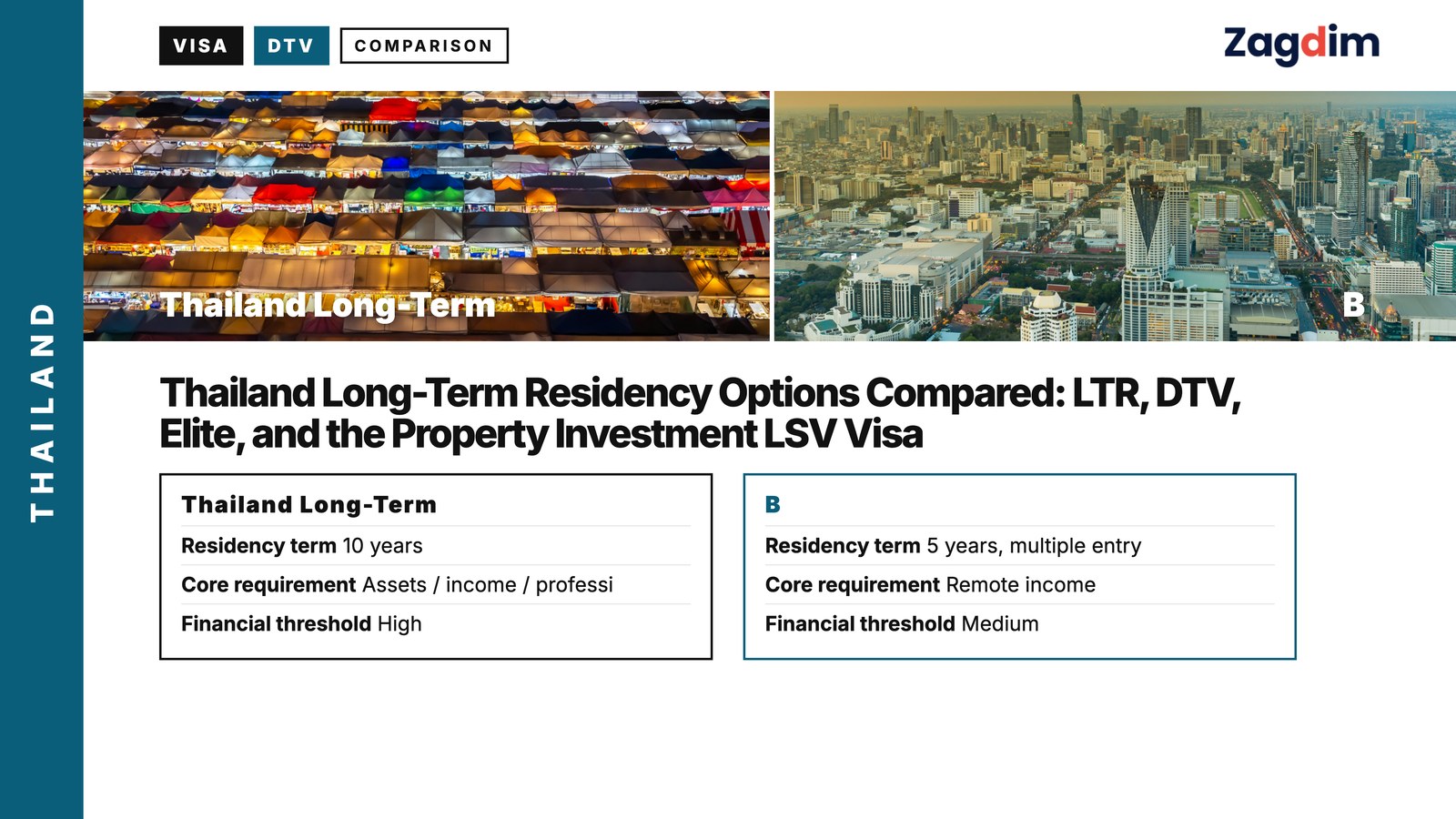
LTR is a 10-year long-term residency program designed to attract high-net-worth individuals, retirees, multinational executives, and professionals. Applicants must meet asset or annual income thresholds and submit medical insurance and complete background documents, with requirements varying by category (such as wealthy individuals, retirees, remote workers, or highly skilled professionals). Once approved, applicants receive 10 years of residency in one go, during which they can work, bring dependents, and travel in and out long-term — the program is stable and holds the highest official standing among the four. In terms of cost, the main expenses are the visa application fee plus related documentation, insurance, and certification costs; overall, it’s a high-threshold but highly stable long-term residency option.
Destination Thailand Visa – DTV
DTV is a long-term, multiple-entry visa designed for remote workers and freelancers. Its core requirement is proving a stable source of overseas or remote income, rather than local employment in Thailand. Applicants need to provide proof of funds, a description of their work or business, and basic documents; the bar is relatively lower than LTR, and the process is simpler. Once approved, applicants typically receive 5 years of multiple-entry validity, with long stays allowed per entry, and can apply for dependents for a spouse and children. Overall costs are mainly the visa application fee and document preparation; it’s a flexible long-term residency option that trades “proof of income capacity” for long-term legal stay in Thailand.
Thailand Elite Visa
Elite is a membership-based long-term residency program: applicants pay a one-time membership fee to receive multiple-entry validity ranging from 5 to 20 years, with almost no requirement to prove assets, income, or work background. The program’s focus is on convenience and privileges, including fast-track airport clearance, dedicated reception, and visa-related assistance. It particularly suits people and families who want to live in Thailand long-term but don’t want to deal with complex paperwork or investment arrangements; the main cost is the membership fee, making it a long-term residency option built around “paying for convenience and stable status.”
Long Stay Visa (LSV) – Property Investment Route
Under the current immigration framework, the LSV lets an applicant purchase a single residential unit with a freehold transaction value of at least THB 3 million, or sign a leasehold of at least 3 years with a total value of at least THB 3,060,000, and submit the purchase/lease contract, proof of payment, title documents, and photos of the property, to first receive a 90-day temporary visa. Within that period, the applicant applies for an extension, after which they receive 12–15 months of long-term residency, renewable annually thereafter. A spouse, children under 20, and parents aged 50 or over can be included as dependents. Overall, this is an investment-based long-term residency route that turns the act of buying property directly into a renewable, dependent-eligible long-term residency status.
| Item | LTR | DTV | Elite | Property Investment LSV Visa |
|---|---|---|---|---|
| Residency term | 10 years | 5 years, multiple entry | 5–20 years | Renewed annually (first year 12–15 months) |
| Core requirement | Assets / income / professional status | Remote income | Membership fee | Property investment |
| Financial threshold | High | Medium | Low | Must meet investment amount |
| Document complexity | High | Medium | Low | Medium |
| Property purchase required | No | No | No | Yes / long lease |
| Dependents | Yes (spouse, children) | Yes (spouse, children) | Yes (add-on membership) | Yes (spouse, children, parents) |
| Nature | Institutional status | Work-based stay | Convenience-based stay | Investment-based long-term residency |
III. Core Advantages of the Property Investment LSV Visa
Low Application Threshold
This visa no longer centers on proof of financial capacity, income background, employment type, or a membership fee — instead, it’s based directly on physical property investment as the basis for residency, through three main application routes.
Freehold
- Single-unit transaction value of at least THB 3 million (approximately USD 95,000 / HKD 740,000 / TWD 3,000,000 — actual amounts fluctuate with the exchange rate)
Leasehold
- Lease term of at least 3 years
- Total lease value of at least THB 3,060,000
All investments and documents must be genuine and verifiable, and must correspond to a specific property and the applicant’s identity.
Renting (reference only — as of publication, this option has not yet been formally implemented)
- Monthly rent of at least THB 85,000
- At least 3 months’ rent prepaid
For the first immigration application (the 90-day visa), at least 3 months must be prepaid; for the second immigration application (the long-term residency visa), at least 12 months must be prepaid.
Worry-Free, Unlimited Renewal
This visa follows a two-stage “temporary first, then long-term” process:
- First approval: issued as a 90-day temporary visa
- Within 90 days: submit an extension application
- Once the extension is approved: receive 12–15 months of long-term residency
For property buyers or those with a leasehold of 3 years or more:
- First year of residency: 15 months
- Each year after: 12 months
- Can be renewed annually, without needing to exit the country frequently to reapply
(For lease-based applicants, the first-year term is either 12 or 15 months, depending on the lease term and proof of payment.)
One Application, the Whole Family Benefits
This visa allows a wide range of dependents to apply alongside the main applicant, including:
- Spouse (with both a legally recognized marriage and an actual shared household)
- Children (biological / adopted / stepchildren; unmarried; under 20 years old)
- Parents (the applicant’s father or mother; aged 50 or over)
IV. Summary
For someone who was already planning to buy or long-term lease property in Thailand, the property-investment LSV route isn’t “doing something extra just to get a visa” — it’s converting an asset arrangement you were already going to make into a legal, renewable, dependent-eligible long-term residency status; residency stops being an extra cost and instead connects naturally with your life and asset planning. That’s exactly what makes it stand out among the four options for cost-efficiency and practical feasibility.
Have a question about this guide? Leave a comment below, or ask Zagdim directly.
Your first stop for international property and global living.
Research and insights. Know what’s changing. Understand what matters.