

































This guide is part of Zagdim’s series on UK property, covering how rent arrears, property damage and repossession are handled in England, Scotland, Wales and Northern Ireland.
How a landlord should respond to a tenant who is not paying rent or who has damaged the property depends on where in the UK the property is located. Get the procedure wrong, and a landlord can end up facing penalties instead. For the basics of day-to-day management, maintenance, compliance and the landlord-tenant relationship, see Rental property management for overseas landlords in the UK.
Consider a landlord living outside the UK who rents out two flats, one in England and one in Scotland, both let on a monthly basis. The examples below use this hypothetical case to show how the same situation is handled differently depending on where the property is. They assume the England tenancy is covered by the Renters’ Rights Act reforms, and the Scotland tenancy is a Private Residential Tenancy.
What Can a Landlord Do First About Rent Arrears?
What happens next depends on where the property is and how long the rent has been unpaid.
If the property is in Scotland, a private landlord should contact the tenant as soon as possible and:
- Provide a breakdown of the arrears and when they fell due
- Give information on the tenancy’s rent terms, how the tenancy can be ended, and where to get help
- Make reasonable efforts to agree a payment plan with the tenant for the arrears and future rent
If the case later goes to a tribunal, the Tribunal (the body that decides these disputes) will want evidence that the landlord followed the pre-action protocols, the steps that must be completed before an application can be made. If a managing agent is used, check the agreement for what it says about notifying tenants of arrears and keeping records of recovery efforts.
If the property is in England, landlords need to know about the Renters’ Rights Act reforms. These reforms cover assured tenancies, a type of private tenancy, and the main changes to renting take effect from 1 May 2026:
- Existing Assured Shorthold Tenancies (ASTs) generally convert to Assured Periodic Tenancies (APTs) on that date. APTs roll on a periodic basis, such as monthly, with no fixed end date.
- New tenancies are also APTs from the start.
- Where a valid old-style possession notice was already served before 1 May 2026, the tenancy does not convert to an APT until that notice expires or the court proceedings conclude.
How Much Rent Arrears Is Needed Before Possession Proceedings Can Start?
Whether a landlord can start possession proceedings depends on the local arrears threshold, and the threshold differs by nation. England and Scotland both look at 3 months; Wales treats serious rent arrears, for example at least 2 months unpaid on a monthly tenancy, as the threshold. Even once the threshold is met, a landlord cannot repossess the property directly: notice and then a court or tribunal process still has to be followed.
| Nation | Threshold or Notice Rule | What Happens Next |
|---|---|---|
| England | Ground 8: tenants paying monthly must be at least 3 months in arrears; tenants paying weekly or fortnightly, at least 13 weeks. The threshold must be met on both the date the notice is served and the date of the hearing (the court date where both sides are heard) | A 4-week notice must be given before applying to court for possession |
| Scotland | Under a Private Residential Tenancy, the tenant must be in continuous arrears for at least 3 months before the landlord can try to end the tenancy on arrears grounds. This is about how long the arrears have continued, not reaching 3 months’ worth of rent owed | Strict termination rules, notice requirements and a tribunal process still apply |
| Wales | For example, at least 2 months’ rent unpaid on a monthly tenancy counts as serious rent arrears; the court must confirm the arrears were serious on both the notice date and the hearing date | Once met, the court can make a possession order on this ground |
| Northern Ireland | The landlord’s Notice to Quit must be in writing: at least 4 weeks for tenancies of up to 12 months; at least 8 weeks for tenancies over 12 months but up to 10 years; at least 12 weeks for tenancies over 10 years | If the tenant refuses to leave, the landlord can only repossess through the courts |
A possession ground is a reason set out in law that lets a landlord apply to get the property back. England has a few further details:
- Repayment before the hearing: if the tenant clears the arrears, or brings them below the threshold, the landlord cannot evict under Ground 8.
- Universal Credit exception: where a tenant is lawfully entitled to the housing element of Universal Credit, a UK welfare payment, arrears caused only by a delay in receiving that award must be excluded from the calculation.
- Arrears below 3 months: Ground 10 can still be used, but it is discretionary, meaning the court decides case by case. The court will only grant a possession order if it considers it reasonable to do so.
- Persistent late payment: Ground 11 is also available and is likewise discretionary.
If the property is in Scotland and is managed by a letting agent, the agent should give written notice of late rent, following its own written procedure or its agreement with the landlord. When managing arrears, the agent needs to be able to show it has taken all reasonable steps to recover rent owed to the landlord.
In the hypothetical case above, if the England tenant falls 3 months behind, the threshold must be met on both the date the notice is served and the hearing date; the Scotland tenant must be in continuous arrears of at least 3 months before the landlord can attempt to end the tenancy.
Who Is Responsible When a Tenant Damages the Property?
Start by working out who caused the damage and which part of the property is affected. Tenants are responsible for damage caused by themselves, their family or their guests. Landlords are usually responsible for the items in the table below. Normal wear and tear should not automatically be treated as tenant damage.
| Responsible Party | Items |
|---|---|
| Tenant | Damage caused by the tenant, their family or guests, which they must repair or pay to repair |
| Landlord (usually) | The structure of the property; sanitary fittings such as basins, sinks and baths; heating and hot water systems; damage caused by the landlord’s own repair attempts |
The landlord row reflects the general position; Scotland and Northern Ireland each have additional rules.
If the property is in Scotland, the inventory taken at move-in is used when damage is discussed at the end of the tenancy:
- At move-in: if the agent is responsible for the check-in, it must prepare an inventory, unless the landlord has a separate written agreement saying otherwise. The inventory must list the contents and condition of the property and can include photographs.
- Signed confirmation: where an inventory and schedule of condition are prepared, both the agent and the tenant must sign to confirm it is accurate.
- At move-out: where damage is found, the letting agent must give the tenant clear written information about the damage and the estimated cost of repair, which can be supported by photographs; where a move-in inventory and schedule of condition exist, that record must also be referred to.
Scotland’s deposit rules also connect to damage deductions: a private landlord can take a deposit of up to 2 months’ rent, most cases must use an approved deposit scheme, and a deposit cannot be used to replace items damaged or worn through normal wear and tear.
Damp and mould in Scotland carry separate deadlines from 6 October 2026, applying to housing covered by the Right to Repair Scheme or the Repairing Standard where the landlord is responsible for repairs:
| Deadline | What Must Happen |
|---|---|
| Within 10 working days of being told about damp or mould | Investigation by a competent person |
| Within 3 working days of the investigation ending | A written summary must be provided |
| Where the investigation confirms substantial damp or mould, within 5 working days of the investigation ending | Work must start (start, not finish) |
| Completion | A private landlord must complete the work as soon as reasonably practicable; the 20-working-day completion deadline that applies to social landlords does not apply |
Where a deadline cannot be met for reasons outside the landlord’s control, the landlord must say which obligation was missed, why, and the new deadline, and take reasonable mitigating steps where practical. Where another regulation sets a shorter deadline, the shorter one still applies.
In the hypothetical case above, if the Scotland flat develops the damp problem described and falls within this type of housing, a competent person must investigate within 10 working days of being told about it.
What Is the Correct Procedure for Repossessing a Property?
Repossession follows a fixed order. In England, Scotland and Northern Ireland, notice must be given first, and only once the tenant fails to leave by the deadline can the landlord apply to court or tribunal. A notice expiring does not mean the landlord can repossess the property directly.
In England, since 1 May 2026, reform-covered assured tenancies can no longer use the old possession route under the Housing Act 1988; landlords must use a possession notice to end the tenancy instead (see the Notes section below for the specific provisions). Two further situations are treated separately:
- Non-assured tenancies, and cases where notice was already served before 1 May 2026, follow separate guidance.
- Non-social-housing assured tenancies let by Private Registered Providers (PRPs) follow the grounds-for-possession guidance; these providers’ social housing assured tenancies are not covered by the reform until 2027.
England’s basic procedure is as follows:
| Step | What Must Happen |
|---|---|
| 1 | Serve a possession notice citing the relevant ground, giving the correct notice period |
| 2 | If the tenant has not left by the deadline, apply to the court for a possession order |
| 3 | Provide the court with evidence for the ground relied on. Depending on the ground, this can include an arrears statement, witness statements on antisocial behavior, documents on a crime or breach of a court order, proof of intent to sell, or evidence of a tenancy breach such as a subletting advertisement |
| 4 | If the court grants a conditional, suspended possession order, an order letting the tenant stay if they meet certain conditions, the tenant cannot be evicted while they meet those conditions; if they do not, the landlord can apply for a warrant for possession, which a bailiff, the official who carries out evictions, will enforce |
Notice periods differ by ground:
| Ground | When It Applies | Notice Period |
|---|---|---|
| Ground 8 | Arrears reach the threshold | 4 weeks |
| Ground 10 | Arrears below 3 months, discretionary | 4 weeks |
| Ground 11 | Persistent late payment, discretionary | 4 weeks |
| Ground 13 | Tenant has let the property’s condition deteriorate, discretionary | 2 weeks |
Where the ground used is moving in or selling, the landlord cannot use that ground to evict a tenant within the first 12 months of the tenancy.
In Scotland, applying for an eviction order requires all three of the following:
- The landlord or tenant has already given a notice to end the tenancy
- The tenant has not moved out by the end of the notice period
- Fewer than 6 months have passed since the end of the notice period
The landlord then applies to the First-Tier Tribunal for Scotland, Housing and Property Chamber, which weighs both sides and decides whether eviction is reasonable. There is no fee to apply.
Landlords cannot take matters into their own hands: in England, harassing or attempting to remove a tenant without following the correct procedure is a criminal offense; evicting a tenant without giving the notice required by law, changing the locks, or acting without a court order can all amount to illegal eviction. Neither rent arrears nor property damage is grounds for changing the locks without going through the proper process.
In the hypothetical case above, even once the England tenant’s arrears reach the threshold, the landlord cannot simply have the locks changed; the landlord has to follow the steps above, giving 4 weeks’ notice before applying to court.
How Much Do Court Fees Cost for Arrears or Damage Cases?
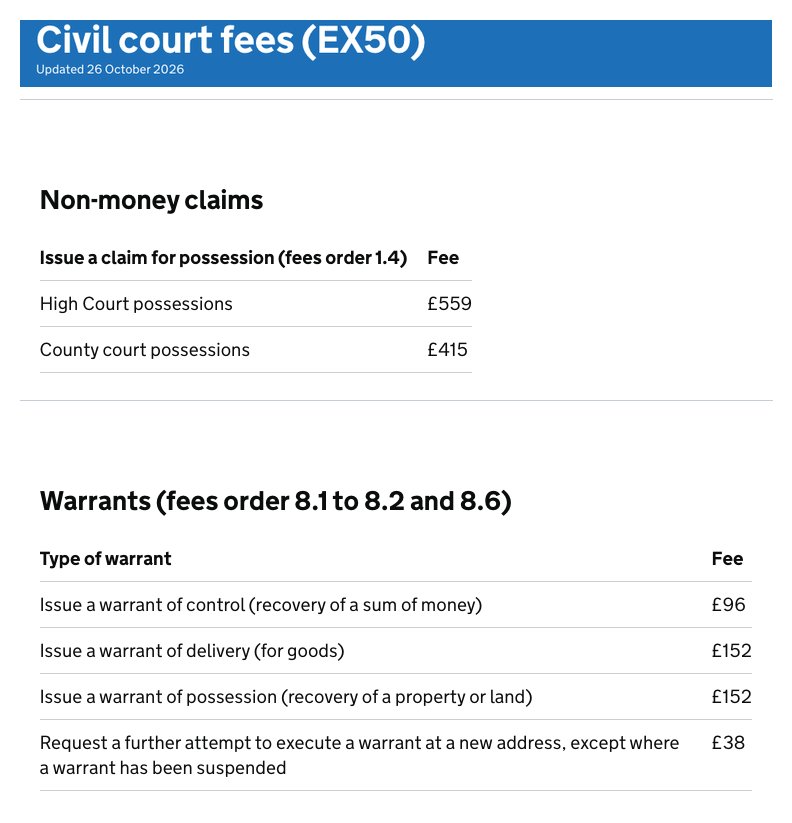
Before going to court, it helps to know two fixed fees. According to the Civil Court Fees schedule (EX50) published by HM Courts and Tribunals Service, updated 26 October 2026 and checked 2 November 2026, the fee to issue a County Court possession claim is £415, and the fee to issue a warrant for possession is £152.
| Item | Fee |
|---|---|
| Issuing a County Court possession claim | £415 |
| Issuing a warrant for possession to repossess a property or land | £152 |
| Applying to the tribunal for an eviction order in Scotland | Free |
These two court fees are not the full cost: the £415 fee does not include legal services, enforcement or other costs, and the £152 fee is not the full cost of enforcement either.
Repossessing the property does not mean recovering the money owed. Taking England as an example:
- A County Court bailiff enforcing a possession order cannot also collect unpaid rent or damage compensation on the landlord’s behalf.
- To recover money, a separate money claim, a court claim asking the other party to pay, is needed; the court can also attach a money judgment to a possession order.
- If the tenant’s address is unknown, a tracing service may be needed.
In England and Wales, a money claim against an individual or business can be made to the County Court, online or by post; Scotland and Northern Ireland have their own separate procedures.
In the hypothetical case above, even once the England landlord gets the property back, the arrears are not automatically recovered; the landlord still has to pursue a separate money claim, or have the court attach a money judgment to the possession order.
How Are Deposit Disputes Handled?
A deposit dispute starts with whether both sides have agreed on the amount. For tenancies in England covered by Tenancy Deposit Protection (TDP), once the landlord and tenant agree on the amount to be returned, the landlord must repay the deposit within 10 days; if there is still a dispute, the deposit stays protected within the scheme until the dispute is resolved.
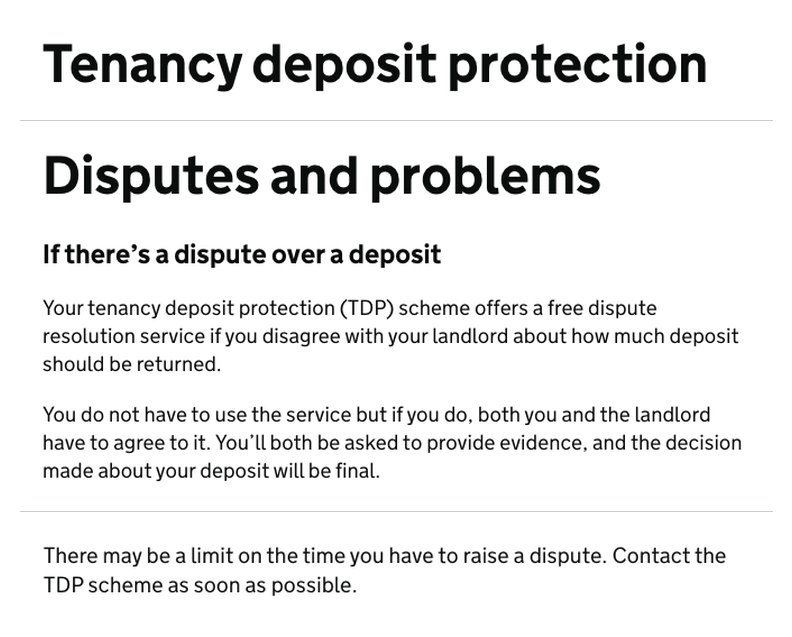
Deposit schemes offer free dispute resolution:
- Landlords and tenants do not have to use it, but using it requires both sides to agree and to provide evidence.
- The scheme’s decision on the deposit is final.
- There may be a time limit for raising a dispute; check with the scheme being used.
There is also a connection between deposits and repossession to be aware of. Where a deposit has been taken on a new-style assured tenancy in England, most possession grounds require one of the following to be satisfied first:
- Deposit protection, scheme requirements and statutory information have all been complied with
- The deposit has been returned in full, or with an agreed deduction
- Any case the tenant has brought over deposit compliance has been decided, settled or withdrawn
Grounds 7A and 14, which cover antisocial behavior, are not subject to this restriction; a non-money deposit, an item held as security instead of cash, must still be returned before the landlord can obtain possession on any ground. So reaching the arrears threshold does not by itself mean every condition for a possession order has been met.
What Risks Do Landlords Face If They Get the Process Wrong?
The rules do not only limit how a landlord can repossess a property; there are consequences attached too. Depending on the breach, a landlord who gets it wrong can commit a criminal offense, be ordered to repay rent, or face a fine.
Rent repayment orders: taking England as an example, if a tenant believes the landlord has committed a specified offense, or the landlord has already been convicted of one, the tenant can apply to the First-tier Tribunal for a rent repayment order (RRO), which requires the landlord to repay rent to the tenant. If the tribunal finds the offense proven, it can order rent to be repaid.
- The 2026 reform raised the maximum amount from 1 year’s rent to 2 years’ rent.
- This change does not apply to offenses committed before 1 May 2026.
- Where a continuing offense defined in law spans that date, the portion before 1 May 2026 is also not covered.
- Whether the old or new rules apply depends on when the offense occurred and over what period, not simply the date the application is made.
Penalties for reletting: where a landlord in England uses Ground 1 or Ground 1A to repossess the property, there is a 12-month no-relet or no-remarketing restricted period. Reletting or remarketing the property during that period, unless the landlord has taken all reasonable steps to avoid it or an exception applies, can lead to a fine of up to £40,000 as an alternative to prosecution. The restriction may also not apply, or may end early, in circumstances such as the landlord or a close relative actually moving in as their only or main home, or the court granting a possession order on other grounds; the exact start and end dates and exceptions need to be checked case by case.
Dissatisfaction with a managing agent: in England and Wales, letting agents and property managers must belong to a redress scheme, a mechanism for handling customer complaints. A service complaint that you and the agent cannot resolve yourselves can be submitted to this scheme.
Frequently Asked Questions
If a tenant is three months behind on rent, can they be evicted straight away?
No. Taking England as an example, even once arrears reach the Ground 8 threshold, the landlord must still give 4 weeks’ notice before applying to court for a possession order; the landlord cannot change the locks or evict the tenant directly.
If a tenant damages the property, can the tenancy be ended immediately?
No. In England, a tenant letting the property’s condition deteriorate can be addressed under Ground 13, but the landlord must still give 2 weeks’ notice before applying to court, and whether possession is granted is at the court’s discretion.
Must the deposit be returned in full within 10 days of the tenancy ending?
Not exactly. For tenancies in England covered by TDP, the 10-day period runs from when both sides agree on the amount to be returned; if there is a dispute, the deposit stays in the scheme until it is resolved.
When a bailiff repossesses a property, do they also recover the unpaid rent?
No. Taking England as an example, a bailiff cannot collect arrears or damage compensation on the landlord’s behalf; recovering money requires a separate money claim, or a money judgment attached to the possession order by the court.
Glossary of Key Terms
- Assured Periodic Tenancy (APT): the tenancy type used from 1 May 2026 for assured tenancies covered by England’s Renters’ Rights Act reforms. It rolls on a periodic basis, such as monthly, and the tenancy agreement cannot set a fixed end date.
- Possession notice (Section 8 notice): the notice an England landlord serves citing a possession ground, with a notice period that varies by ground.
- Possession order: a court order granting the landlord the right to repossess the rented property; it is issued by the court, not by the landlord.
- Warrant for possession: a court order instructing a bailiff to enforce repossession of the property.
- Tenancy Deposit Protection (TDP): England’s deposit protection scheme system; where the two sides dispute the amount to be returned, the deposit remains protected within the scheme until the dispute is resolved.
Notes on This Guide
Facts in this article were checked as of 2 November 2026.
The summary of England’s 2026 tenancy reforms and repossession procedure is Zagdim’s synthesis of multiple UK government guidance documents and pieces of legislation.
In this article, “the old possession route” refers to Section 21 of the Housing Act 1988; “possession notice” refers to a Section 8 notice; “old-style possession notice” refers to an old Section 8 or Section 21 notice served before 1 May 2026.
Scotland, Wales and Northern Ireland each have their own independent rules; this article only summarizes the specific items listed and does not cover every tenancy type or exception. For Wales, only the serious-arrears threshold is covered; notice formats, periods and defenses are not fully summarized. For Northern Ireland, only the Notice to Quit and court process are covered.
This article has not confirmed the application time limit or the period of rent that can be claimed for England’s rent repayment orders, nor whether overseas landlords meet all the eligibility requirements for the County Court’s online system.
The warrant-for-possession fee uses the EX50 schedule updated 26 October 2026, not the older amount listed in the July 2026 repossession guidance. Some fees and rules may change over time; check the relevant authority’s latest published information. This article does not cover matters that have not yet been announced.
Need help with this? Talk to the Zagdim reader desk
Rent arrears and property damage rules differ across England, Scotland, Wales and Northern Ireland, and getting the process wrong can expose a landlord to real penalties.
Message the Zagdim reader desk on WhatsApp Message the Zagdim reader desk on LINE
Have a question about this guide? Leave a comment below, or ask Zagdim directly.
Your first stop for international property and global living.
Research and insights. Know what’s changing. Understand what matters.
Sources
- UK Government
- Ministry of Housing, Communities and Local Government – Renting out your property: Making repairs
- UK Government
- Ministry of Housing, Communities and Local Government – Registering with a redress scheme as a property agent
- Scottish Government – Management and maintenance: Letting agent code of practice
- Scottish Government – Taking a deposit as a private landlord
- UK Ministry of Housing, Communities and Local Government – Renters’ Rights Act: an overview for landlords
- UK Ministry of Housing, Communities and Local Government
- HM Courts and Tribunals Service – Repossessing your privately rented property after 1 May 2026
- UK Ministry of Housing, Communities and Local Government – Grounds for possession: guidance for landlords and letting agents
- UK Government
- Ministry of Housing, Communities and Local Government – Private renting for tenants: evictions in England: Harassment and illegal evictions
- UK Government
- Ministry of Housing, Communities and Local Government – Private renting: Your rights and responsibilities
- UK Government
- Ministry of Housing, Communities and Local Government – Tenancy deposit protection: Overview
- UK Government
- Ministry of Housing, Communities and Local Government – Tenancy deposit protection: Disputes and problems
- HM Courts and Tribunals Service – Civil court fees (EX50)
- HM Courts and Tribunals Service – Make a court claim for money: What a court claim is
- Scottish Government – Dealing with rent arrears as a private landlord
- Scottish Government – Applying for an eviction order if the tenant does not move out
- Northern Ireland Executive
- Department for Communities – Protection against eviction
- Welsh Government – Standard occupation contracts: guidance
- UK Ministry of Housing, Communities and Local Government – Enforcement measures for landlords: Renters’ Rights Act 2025
- Scottish Parliament
- The National Archives – The Letting Agent Code of Practice (Scotland) Regulations 2016
- Scottish Government – Awaab’s Law: guidance for landlords in Scotland
Important Notice
This article is a general information summary and does not constitute tax or legal advice for any individual case. Facts were checked as of 2 November 2026. UK rules may be updated; check the relevant authority’s current published guidance, and consult a qualified professional for individual cases.