































Introduction
In the UK, a postcode is essential whenever you fill in an address. The UK’s postcode system is precise enough to identify an individual house. Once someone knows your postcode, and if they know the area well, they can often make a rough guess about your social standing. Look closely at Britain’s old working-class and aristocratic classes, and you’ll find that both hold a deep attachment to certain historic postcodes tied to centuries-old houses.
So whether you’re here to study, work or settle down, understanding where London’s postcodes come from — and knowing the key postal districts — is an important step in integrating into British society. This article walks through the UK postcode system and London’s key postal districts in detail.
Understanding the UK Postal System
The UK’s postal system dates back to the early 19th century, when many streets shared the same name and addresses were often unclear, prompting the post office to set up a more comprehensive postal division system. London’s system is centered on St Paul’s Cathedral, with a 12-mile radius divided into 10 separate postal districts, marked with compass-direction letters — originally E (East), W (West), S (South), N (North), SE (Southeast), SW (Southwest), NE (Northeast), NW (Northwest), plus EC (East Central) and WC (West Central). After several reforms, NE was merged into E, and S was abolished and absorbed into SE and SW, while other UK cities use letters that are simply an abbreviation of the city’s name. These large postal zones were then further subdivided, with numbers added after the letters to create new sub-districts. By the Second World War, as mail volumes surged, machine sorting was introduced to improve efficiency, and the postcode system was updated and formally rolled out across the UK in 1974, adding the final three characters that identify a specific street — this is the postcode system still in use today.
A postcode, as mentioned, is a marker of social standing. If you’re planning to live in or invest in London, here are some key London postcode districts worth knowing:
WC & EC
WC and EC are hugely important postal districts in central London. This is the heart of London, home to many of the city’s — and the country’s — most important cultural, educational, business and financial institutions. WC stands for Western Central, representing the western part of the city center. It began developing rapidly from the 17th century and underwent further urban renewal in the 19th century. Today it has numerous shopping and business districts and top universities, including the world-famous British Museum, the leading institution University College London, the arts-and-culture favorite Covent Garden, and countless theatres.
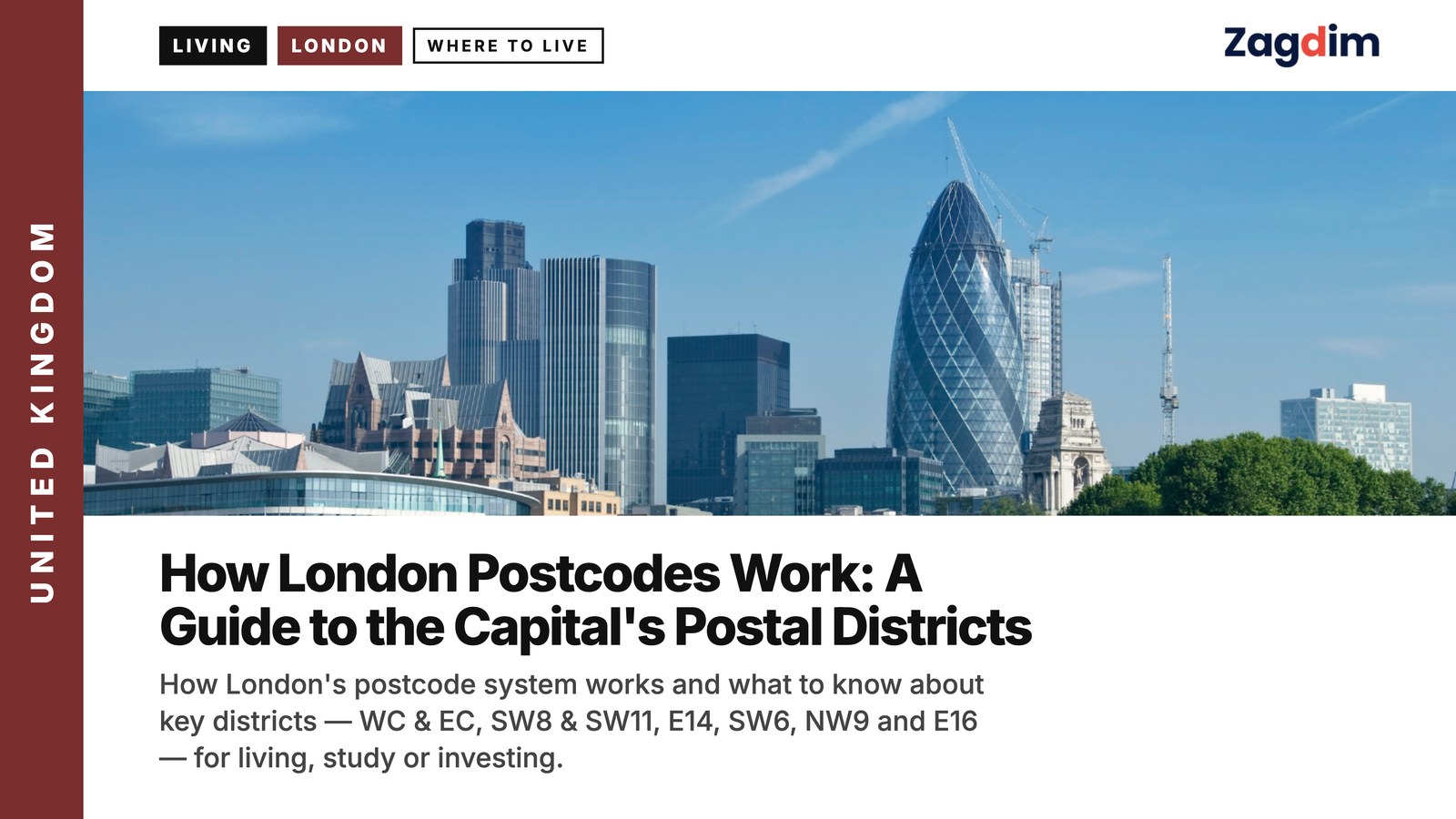
EC stands for Eastern Central, representing the eastern part of the city center, covering most of the City of London. This is London’s vibrant hub, home to numerous cultural centers as well as London’s skyscraper cluster, with major global banks and fintech companies based here. The growth of the fintech and lifestyle industries has also brought many high-end apartments, offering London’s urban professionals an excellent standard of living.
SW8 & SW11
London’s booming economy and culture, and its status as one of the world’s best cities, owes much to centuries of industrial development. If you’ve heard of Battersea Power Station, then SW8 and SW11 are the two postcode districts to know. SW8 and SW11 are adjacent, originally an industrial area, and Battersea Power Station is the most famous landmark within it. This 1930s building is a London icon — it once supplied a fifth of London’s electricity, including to Buckingham Palace and Parliament. The London government has now committed £40 billion to redevelop 227 hectares of land centered on this area into a mix of residential and commercial use. It has become one of the most eye-catching new investment sites on the south bank of the Thames in Zone 1, and is currently the largest urban regeneration project in Europe.
E14
Speaking of London’s regeneration projects, E14 has to be mentioned — a textbook example of urban transformation. E14 is a postal district in East London that includes Canary Wharf and the surrounding area. This area grew out of the shipbuilding industry from the 15th century, making an important contribution to Britain’s former naval and maritime power. It was bombed during the Second World War, and the dock system was out of use for a long time afterward. An urban regeneration project launched here in 1981 attracted many global investors, and it was gradually shaped into today’s cluster of skyscrapers. Canary Wharf’s importance as a global financial hub has drawn major property developers to build around it, and its premium, comfortable living environment makes it a top choice for senior professionals and international students alike.
SW6
Having looked at two skyscraper clusters, let’s turn to SW6, a wealthy postcode with a long history and rich cultural heritage. This postcode district falls within the London Borough of Hammersmith and Fulham, and is very popular with London’s elite and upper-middle-class families. The area’s wealth was built on 19th-century industrial development, and after post-war restoration it became one of London’s most expensive and sought-after places to live. The neighboring SW10 and W6 are also excellent places to live, filled with luxury homes, and a haven for sports enthusiasts.
NW9
London’s important postcodes aren’t limited to the city center, the skyscraper clusters and the wealthy districts. Head northwest from central London and you’ll find NW9, a postcode very popular with the Chinese community. NW9 falls within the London Borough of Barnet, which has the largest Chinese population in London. This area historically retained a rural character, and began developing more rapidly from the 1920s as the London Underground network expanded; it was once an important site for police training and an air force base.
Today NW9 is almost entirely residential, and is also home to London’s largest Asian food hall — Bang Bang Oriental. Thanks to its convenient living and excellent school catchment areas, it’s a favorite of London’s “tiger parents.”
E16
Another postcode district popular with younger members of the Chinese community is E16, which borders E14. It’s home to the Royal Albert Dock — which has fostered numerous China–UK business partnerships — and London City Airport, and it’s set to become a world-class business hub to rival both the old and new financial districts. More than a century ago, E16 was made up of numerous docks providing berths for large vessels, and it became one of London’s major dockland areas in the first half of the 20th century, achieving considerable commercial success.
Conclusion
Overall, understanding London’s key postcode districts doesn’t just help you integrate better into the city — it also helps you make more informed choices in your studies, career and daily life. London’s postcodes aren’t just a marker of geographic location; they’re also a symbol of history, culture and social standing. From the bustling city-center WC and EC districts, to the dynamic SW8 and SW11, to the high-finance E14 and wealthy SW6 — every postcode district has its own distinct character and backstory. NW9 and E16, meanwhile, showcase London’s cultural diversity and its thriving emerging economic zones.
Whether you’re looking for somewhere to live, considering a property investment, or simply exploring the culture, every postcode district is worth getting to know in detail. We hope this article helps you understand London a little better, and find the corner of the city that suits you best. Wishing you a life in London full of surprises and good things.
If you have any questions, feel free to register below to get in touch with us.
Angie Chang MARLA
Founder, One Move Group
A licensed UK agent with 20 years in the UK and 15 years’ experience in London and Manchester real estate, having managed over £100 million in property.
If you have any questions, please fill out the form below and an expert will answer them.
Have a question about this guide? Leave a comment below, or ask Zagdim directly.
Your first stop for international property and global living.
Research and insights. Know what’s changing. Understand what matters.