
































This article is part of Zagdim’s Vietnam wiki series. It sets out the basic rules that foreign investors run into when setting up a limited liability company (LLC) in Vietnam: company naming, shareholder structure, the legal representative, charter capital and the registration process. It is written for international readers who are considering setting up a company, working or living long-term in Vietnam, including people who are not currently based there. For a fuller look at foreign-invested company structures, charter capital and operating responsibilities, see “Before Foreigners Set Up an LLC in Vietnam: Foreign-Invested Companies, Charter Capital and Operating Responsibilities.”
How Many Shareholders Does a Vietnam LLC Need?
Vietnam recognizes two kinds of limited liability company. A single-member LLC (công ty trách nhiệm hữu hạn một thành viên) is owned by one organization or one individual. A multi-member LLC (công ty trách nhiệm hữu hạn hai thành viên trở lên) can have 2 to 50 organizations or individuals as members.
Members of a multi-member LLC are, in principle, liable only up to the amount of capital they have contributed. The owner of a single-member LLC is, in principle, liable up to the registered charter capital, but an owner who has not paid in the full amount is still liable under the relevant rules, and in some circumstances a single-member LLC owner may be liable with all of their assets. The full scope of this liability is covered in “Before Foreigners Set Up an LLC in Vietnam: Foreign-Invested Companies, Charter Capital and Operating Responsibilities.”
Transfers of capital contributions must follow Articles 51 to 53 of Vietnam’s Enterprise Law (Luật Doanh nghiệp).
What Are the Rules for Naming a Vietnam Company?
The Vietnamese-language name of a Vietnam LLC must include, in order, the type of enterprise and the company’s proper name, and must avoid duplicate names, names that cause confusion, and names that are legally prohibited.
The entity type must state “limited liability company” (công ty trách nhiệm hữu hạn) or its abbreviation “công ty TNHH.” The proper name may use Vietnamese letters, the letters F, J, Z and W, numbers and symbols. Meeting these character rules does not guarantee the name will be approved.
A company name cannot duplicate an already-registered enterprise, or create the kind of confusion defined in Article 41 of the Enterprise Law. Without the consent of the relevant agency, unit or organization, a company cannot use the name of a state body, an armed forces unit, or a political, social or professional organization named in the law as all or part of its proper name. A name also cannot use words or symbols that go against national history, culture, ethics or good customs. This restriction targets the specific names set out in the law, not every ordinary word.
Can Charter Capital Be Paid With Assets Other Than Cash?
Yes. Capital contributions to a Vietnam LLC are not limited to cash; they can also include assets such as gold, land use rights and technology.
An LLC’s charter capital (vốn điều lệ) is the total value of the assets that members or the owner have already contributed, or have committed to contribute, when setting up the company. Assets that can be used to make capital contributions include:
- Vietnamese dong (Đồng Việt Nam)
- Freely convertible foreign currency
- Gold
- Land use rights
- Intellectual property, technology and know-how
- Other assets that can be valued in Vietnamese dong
It is worth noting that only an individual or organization that lawfully owns an asset, or has the lawful right to use it, can contribute it as capital under the relevant rules. Not every asset someone holds can simply be registered as a capital contribution.
For more on how to decide the amount of charter capital to register, and its effect on banking, tax and day-to-day operations, see “How Much Charter Capital Should a Vietnam Company Register? Banking, Tax and Operating Effects.”
When Does the Deadline to Pay In Capital Start?
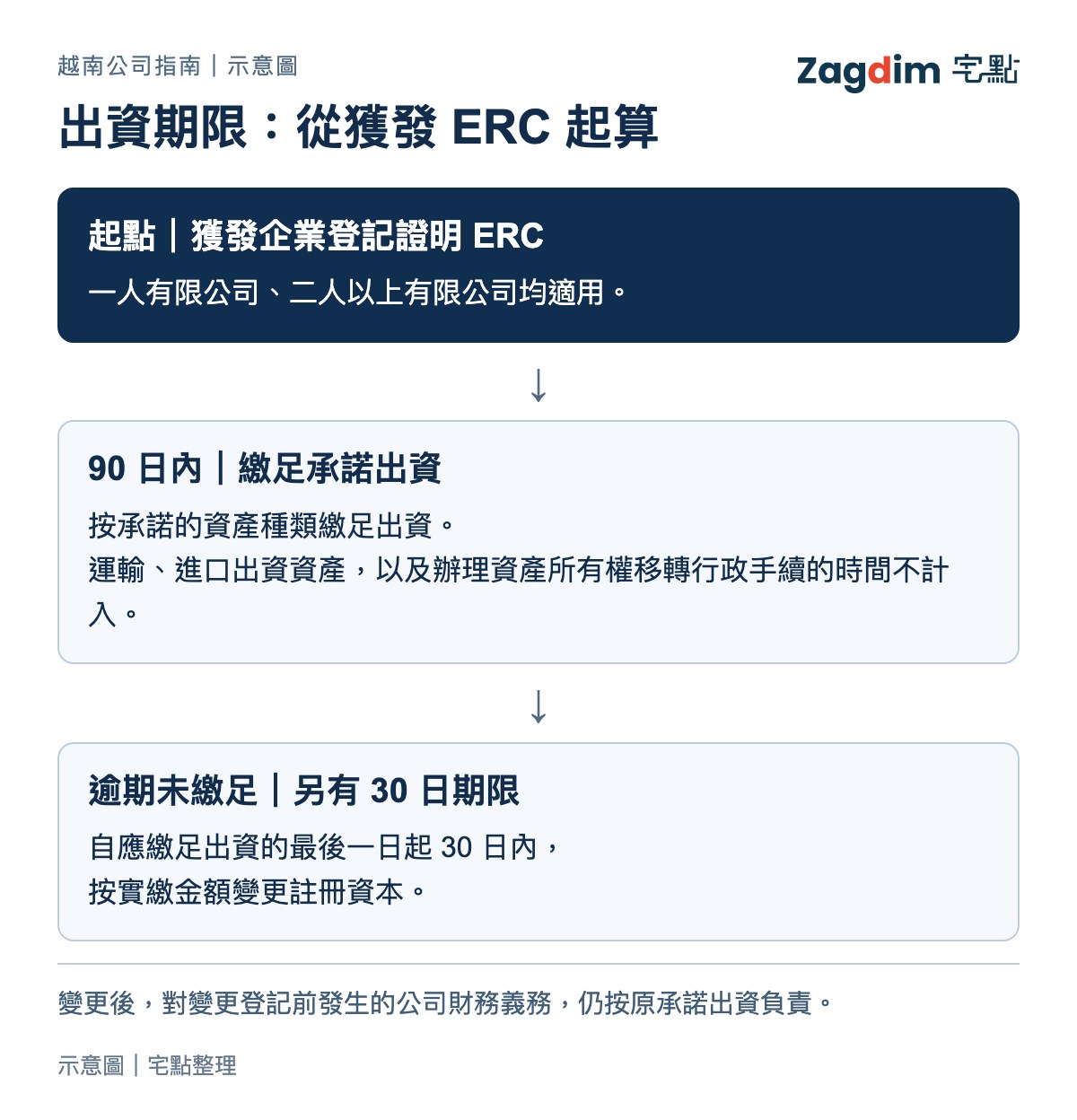
For both single-member and multi-member LLCs, members or the owner must pay in the committed capital contribution, in the asset type promised, within 90 days of the date the Enterprise Registration Certificate (Giấy chứng nhận đăng ký doanh nghiệp, ERC) is issued. Time spent transporting or importing the contributed assets, and completing the administrative procedures to transfer ownership of those assets, is not counted within the 90 days.
If the capital is not paid in full by the deadline, the company must register a change to its charter capital, based on the amount actually paid in, within 30 days of the last day the contribution was due. After that change is registered, the company remains liable for financial obligations that arose before the change, based on the originally committed contribution. Further detail is covered in “Before Foreigners Set Up an LLC in Vietnam: Foreign-Invested Companies, Charter Capital and Operating Responsibilities.”
What Are the Basic Requirements for the Company Address and Legal Representative?
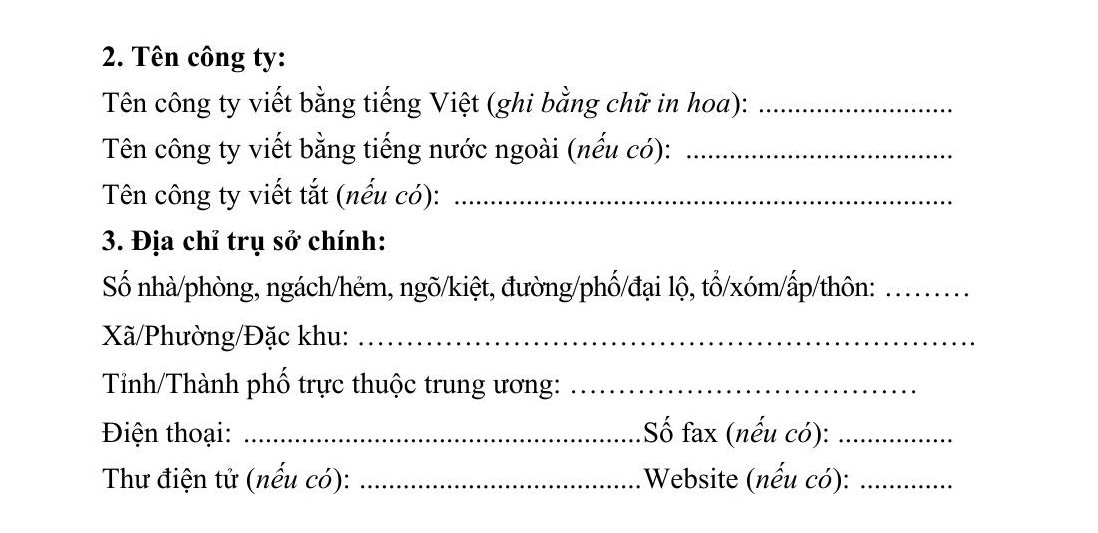
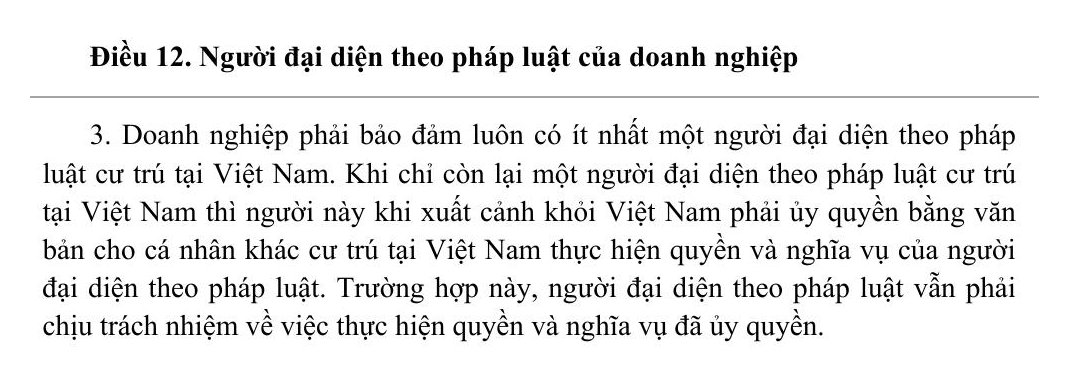
A Vietnam company’s head office must be located inside Vietnam, and the enterprise must always have at least one legal representative who resides in Vietnam.
The head office (trụ sở chính) must serve as the enterprise’s contact address, defined by administrative area, and must have a phone number; a fax number and email address, if the company has them, should also be listed. Meeting these conditions does not mean that any Vietnamese residential address, virtual office or lease can automatically be used as the registered address.
The Housing Law (Luật Nhà ở) prohibits using an apartment housing unit (căn hộ chung cư) for non-residential purposes, so using an apartment unit as a company address is not advisable. This restriction does not mean every commercial space in a mixed-use building is barred from being used as an office, nor does it guarantee that any other address will qualify.
If only one legal representative (người đại diện theo pháp luật) remains resident in Vietnam and that person leaves the country, they must give written authorization to another Vietnam-resident individual to carry out their rights and obligations, and the original legal representative remains liable for whatever has been delegated. This residence requirement does not mean every shareholder must live in Vietnam.
Can Someone Register the Company on My Behalf If I Am Not in Vietnam?
Yes. A person authorized to sign the enterprise registration application can delegate another organization or individual to carry out the registration, but this does not guarantee that the whole process can be completed from outside Vietnam.
When an individual is authorized, a power of attorney must be submitted with the application; that power of attorney is not required to be notarized or legalized. This arrangement applies only to the power of attorney itself; it does not mean every foreign document is exempt from verification, and it does not mean the person giving the authorization no longer needs to cooperate.
For setting up the enterprise, or for changing the legal representative, the LLC owner, or members in the legally listed registration items, both the authorizing party and the authorized party generally must complete electronic verification before the enterprise registration can be issued. If electronic verification is interrupted, the authorizing party must complete it after the registration is issued. If no electronic identity account is available for verification, the application must include a copy of the authorizing party’s valid identity card, passport, foreign passport, or a document that lawfully substitutes for a foreign passport. If the authorizing party neither confirms nor denies the authorization, the registration authority will require the enterprise to report on the matter.
On document language, enterprise registration documents must be in Vietnamese. Where foreign-language documents are used, a notarized Vietnamese translation must be submitted together with the original foreign-language document; if a document contains both Vietnamese and a foreign language, the registration process goes by the Vietnamese content. Having a translation notarized is not the same as having completed consular legalization.
On review time, the enterprise registration authority must review the validity of the documents and complete the registration within 3 working days of receiving the application. If the documents do not comply, the authority must give written notice of what needs to be corrected, and must also give written reasons if it refuses registration. It is worth noting that this 3-day period covers only the review of the enterprise registration itself, and does not include other procedures such as investment approval, translation or opening a bank account.
Should a Foreign Investor Get the IRC First or Set Up the Company First?
Both sequences exist. A foreign investor can obtain an Investment Registration Certificate (Giấy chứng nhận đăng ký đầu tư, IRC) first and then set up the economic organization, or set up the economic organization first and then obtain the IRC, although setting up the company first comes with conditions and time limits.
| Order | What Happens | Conditions and Effect |
|---|---|---|
| IRC first | The IRC is issued or adjusted first, then the economic organization is set up | From the date it obtains the ERC or an equivalent legally effective document, the organization becomes the investor carrying out the project listed on the IRC |
| Company first | The economic organization carrying out the investment project is set up first, then the IRC is issued or adjusted | Setting up the company must meet the market access conditions for foreign investors; the procedure to obtain an IRC matching the company’s business lines must be completed within 12 months of the organization’s formation; other business lines can only be added after the IRC is obtained; the investment project can only be carried out once the IRC has been issued or adjusted |
Whichever route is used, the ERC also serves as the enterprise’s tax registration certificate, but it is not a business license (giấy phép kinh doanh) and cannot substitute for every investment, industry or business license document. For more on the IRC, the ERC and industry restrictions, see “What Licenses Does a Foreigner Need to Set Up a Company in Vietnam? IRC, ERC and Industry Restrictions Explained.”
Does Registration Require Identifying the Ultimate Beneficial Owner?
Yes. The enterprise’s founders and the enterprise itself must identify the beneficial owner (chủ sở hữu hưởng lợi) and declare and notify the enterprise registration authority; listing only the direct shareholders is not enough.
Identification requires examining the ownership structure layer by layer until the individual who actually owns or controls the enterprise is found. Where the structure includes a legal arrangement defined under the anti-money-laundering law, the beneficial owner of that arrangement is determined under the anti-money-laundering rules.
For an enterprise with legal-entity status, the beneficial owner is determined in the following order:
| Order | What Is Examined | Who Must Be Identified |
|---|---|---|
| 1 | An individual who directly, indirectly or in total holds at least 25% of the charter capital or voting shares | The individual who meets the threshold; where a group of individuals with a family or contractual relationship defined under the Enterprise Law together reach 25%, every individual in that group must be identified |
| 2 | No one meets the threshold, or there is reason to believe that whoever nominally meets it is not the real beneficial owner | Trace who actually controls appointments and removals of management, changes to the charter or the organization, financial and operating policy, restructuring or dissolution |
| 3 | Still no one meets the threshold | The manager who can act on behalf of the enterprise and holds the highest level of authority |
The legal representative cannot simply be used in place of every beneficial owner. Individuals representing state capital are excluded; all general partners in a partnership are not subject to the shareholding-ratio threshold.
In addition, the company’s owner, shareholders and members must comply with the rules on contributed assets, and must not contribute capital to the enterprise in someone else’s name on another person’s behalf. Using a nominee shareholder or a proxy capital contribution is not a lawful way to get around foreign-investment conditions. A shareholder lawfully appointing an authorized representative is not the same system as using a false name to conceal the real contributor; a lawful authorized representative is not automatically the same thing as a nominee contribution.
From What Date Is the Company Officially Established?
Both single-member and multi-member LLCs acquire legal-entity status from the date the Enterprise Registration Certificate (ERC) is issued. Legal-entity status is not the same as having obtained every industry license or a residence status; the relationship between the company and residence or work rights is covered in “Does Setting Up a Vietnam Company Solve Visa Issues? Investment Visas, Work Permits and Temporary Residence.”
Frequently Asked Questions
Does a single-member company also have to pay in its full capital within 90 days?
Yes. The owner of a single-member LLC must pay in the committed capital contribution, in the asset type promised, within 90 days of the date the ERC is issued. Time spent on transport, import and the administrative procedures to transfer asset ownership is not counted within that period.
Can an apartment unit be registered as a company address?
It is not advisable. The Housing Law prohibits using an apartment housing unit for non-residential purposes. This restriction does not mean every commercial space in a mixed-use building is barred from being used as an office, nor does it guarantee that any other address will qualify.
Once I have the ERC, can I start every line of business?
No, that should not be assumed. The ERC also serves as the tax registration certificate, but it is not a business license, and it cannot substitute for every investment, industry or business license document.
If I am not in Vietnam, can I authorize someone else to handle the setup?
Yes, authorization is possible, but it does not guarantee that the whole process can be completed from outside Vietnam. Authorizing an individual requires a power of attorney with the application; the power of attorney is not required to be notarized or legalized, but the authorizing party must still cooperate with electronic verification, or provide a copy of an identity document as required.
If every shareholding is below 25%, does beneficial-owner reporting still apply?
Not necessarily. If a group of individuals with a family or contractual relationship defined under the Enterprise Law together reach 25%, every individual in that group must be identified. If no one meets the threshold, the actual controller or the highest-level manager must be traced instead.
Key Terms
- Enterprise Registration Certificate (Giấy chứng nhận đăng ký doanh nghiệp, ERC): An LLC acquires legal-entity status from the date this document is issued. It also serves as the enterprise’s tax registration certificate, but it is not a business license.
- Investment Registration Certificate (Giấy chứng nhận đăng ký đầu tư, IRC): The certificate involved when a foreign investor carries out an investment project. For a company set up before obtaining the IRC, the investment project can only be carried out once the IRC has been issued or adjusted.
- Charter capital (vốn điều lệ): The total value of the assets that a company’s members or owner have already contributed, or have committed to contribute, when the company is set up.
About This Article
This article was checked as of November 2, 2026. The rules on types of LLC, liability, charter capital, the deadline to pay in capital, company naming, the company address, the legal representative, the enterprise registration review period and legal-entity status are drawn from the Vietnam National Assembly Office’s consolidated text of the Enterprise Law. The rules on the enterprise registration procedure, document language, beneficial ownership and electronic verification are drawn from Decree No. 168/2025/NĐ-CP and Decree No. 296/2026/NĐ-CP of the Government of Vietnam. The rules on the order in which foreign investors obtain the IRC and ERC are drawn from the Investment Law (Luật Đầu tư) and Decree No. 96/2026/NĐ-CP. The restriction on apartment-unit use is drawn from the consolidated text of the Housing Law. Some of the detail on identifying beneficial owners and on the prohibition on nominee contributions is summarized from the relevant provisions; the authorities have not spelled out every scenario in plain language. The relationship between apartment units and company addresses is likewise inferred from the Housing Law’s use restriction, which the authorities have not stated directly.
Need help with this? Talk to the Zagdim reader desk
If you are deciding which route fits you, or which authority to deal with, the Zagdim reader desk can arrange a suitable specialist for your situation. The first consultation is free.
Message the Zagdim reader desk on WhatsApp Message the Zagdim reader desk on LINE
Have a question about this guide? Leave a comment below, or ask Zagdim directly.
Your first stop for international property and global living.
Research and insights. Know what’s changing. Understand what matters.
Sources
- Văn phòng Quốc hội – Văn bản hợp nhất số 67/VBHN-VPQH hợp nhất Luật Doanh nghiệp
- Bộ Tài chính – Văn bản hợp nhất số 28/2026/VBHN-TT-BTC (enterprise registration forms)
- Chính phủ – Nghị định số 168/2025/NĐ-CP về đăng ký doanh nghiệp
- Chính phủ – Nghị định số 296/2026/NĐ-CP sửa đổi, bổ sung một số điều của Nghị định số 168/2025/NĐ-CP
- Quốc hội – Luật số 143/2025/QH15 luật Đầu tư
- Chính phủ – Nghị định số 96/2026/NĐ-CP quy định chi tiết và hướng dẫn thi hành một số điều của Luật Đầu tư
- Văn phòng Quốc hội – Văn bản hợp nhất số 79/VBHN-VPQH hợp nhất Luật Nhà ở
Important Notice
This article is a general information summary and does not constitute tax or legal advice for any individual case. The information was checked as of November 2, 2026. Vietnam’s rules, and those of other jurisdictions, may be updated; always check the current official notices from the relevant authorities, and consult a qualified professional for individual cases.