

This guide is part of Zagdim’s series on Japanese bank accounts. It is written for readers who live outside Japan, own property there, or otherwise need to deal with a Japanese bank account from abroad, and it sets out Japan’s legal rules on lending or transferring a bank account, and on using a family member’s account to receive money or pay bills. Before or after leaving Japan, it can be tempting to hand your cash card to a family member who still lives in Japan so they can collect rent or pay taxes on your behalf. Doing so breaks bank rules, and if it is done with the aim of obtaining financial services under someone else’s name, it may also be an offense under the Act on Prevention of Transfer of Criminal Proceeds. This law was amended, effective July 10, 2026, raising the penalty for obtaining or providing a passbook or cash card from imprisonment of up to one year or a fine of up to 1 million yen to imprisonment of up to three years or a fine of up to 5 million yen, which can be imposed together; doing this as a business can carry up to five years imprisonment or a fine of up to 10 million yen.
Key Points
- The bank rules this article found do not allow you to privately hand your account to someone else to use, even a family member.
- A bank’s formal agent procedure is different from privately lending an account, and it only covers the specific procedures the bank lists.
- National tax auto-debit can only use the taxpayer’s own-name account; Himeji City’s local tax and Kawasaki City’s water bill can be set up on a family member’s account instead.
- An overseas remittance generally needs to be paid into an account in the recipient’s own name.
Example (a hypothetical scenario): Mr. Lin, who lives outside Japan, owns a rental apartment there. His Japanese bank account was opened while he still lived in Japan, and for this example we assume the bank lets him keep it after leaving. His sister lives in Japan. The sections below use Mr. Lin’s situation to show how the rules apply.
Why Can’t You Just Lend Your Account to a Family Member?
The ordinary deposit account rules, covering the everyday account you can deposit into or withdraw from at any time, of MUFG Bank, Sumitomo Mitsui Banking Corporation (SMBC) and Tama Shinkin Bank, the institutions checked for this article, all prohibit letting a third party use the account or transferring the account’s rights to someone else. Here, a “third party” means anyone other than the account holder.
Japan Post Bank published a public warning on August 1, 2024, that:
- Handing over your passbook, cash card, online banking ID or password can let your account be misused for fraud and other crimes.
- Transferring an account to someone else, taking over someone else’s account, or buying or selling an account, can be subject to legal punishment whether or not money changes hands.
- Doing so can also leave you unable to open an account at Japan Post Bank or other financial institutions afterward.
Behind this is the Act on Prevention of Transfer of Criminal Proceeds (犯罪による収益の移転防止に関する法律), which punishes obtaining or providing a passbook, cash card or similar account tool for the purpose of obtaining financial services under someone else’s name. For why banks carry out identity checks, confirming that the person handling a matter really is the account holder, and how they distinguish residents from non-residents, see Zagdim’s guide on residents, non-residents, period of stay and identity checks when a foreigner opens a Japanese bank account.
Example: Mr. Lin wants to give his sister the cash card and PIN so she can collect the rent for him. If his account is with one of the banks above, even though she is his sister, the account holder and the person actually using the account would still not be the same person, which is exactly what the bank rules prohibit.
Could Lending or Giving Away an Account Lead to Criminal Punishment?
The answer is: it depends. Not every case of lending or handling an account for someone else is a crime; it depends on whether it meets the purpose and conditions the law sets out. Someone who meets the conditions can face imprisonment of up to three years or a fine of up to 5 million yen, which can be imposed together.
| Situation | What act | Under what conditions it is punished | Penalty |
|---|---|---|---|
| The party obtaining the account | Taking over, receiving, or being given a passbook, cash card, or information needed for withdrawals or transfers, among other things | For the purpose of obtaining financial services under someone else’s name, or letting a third party do so; or obtaining it for payment without a legitimate reason such as an ordinary business or financial transaction | Imprisonment up to 3 years or a fine up to 5 million yen, which can be imposed together |
| The party providing the account | Transferring, handing over, or providing a passbook, cash card, or information needed for transactions, among other things | Knowing the other party intends to obtain financial services under someone else’s name; or handing it over for payment without a legitimate reason | Imprisonment up to 3 years or a fine up to 5 million yen, which can be imposed together |
| Doing it as a business | Carrying out either of the above acts as a business | — | Imprisonment up to 5 years or a fine up to 10 million yen, which can be imposed together |
| Soliciting others to do it | Inducing someone, or using advertising or similar means to recruit someone, into either of the above acts | — | Imprisonment up to 3 years or a fine up to 5 million yen, which can be imposed together |
Two points are worth noting:
- Not charging money does not automatically mean you are safe. If you provide an account knowing the other person intends to obtain services under someone else’s name, you can still fall under the penalty for “the party providing the account,” even if no money changed hands.
- Being family is not the test. A family member helping out is not automatically a crime just because they are family, and it is not automatically exempt just because they are family either. It still depends on the specific facts.
Even when it does not amount to a crime, the bank rules described above still prohibit letting a third party use the account.
What’s the Difference Between a Bank’s Official Agent Procedure and Borrowing an Account?
When a family member genuinely needs to help, it is worth first checking whether the bank has a formal agent system. The two are compared below:
| Formal agent procedure | Privately lending an account | |
|---|---|---|
| How it starts | The account holder applies to the bank in advance | The bank is not told |
| What the bank knows | Who is the account holder, who is the agent, and what the agent is authorized to do | The bank believes the account holder is acting, when in fact someone else is |
Japanese law also requires that, for the specified transactions it covers, if the person actually handling a transaction is different from the customer, the bank must verify not only the customer but also the name, residential address and other identifying details of the person actually handling it, the basic information used to establish “who you are.”
Rules differ from bank to bank; the following covers the four financial institutions checked for this article.
Formal Agent Cards or Designation Procedures
- MUFG Bank: its ordinary deposit rules prohibit transferring the deposit, the contract status, rights or the passbook, or letting a third party use them. However, its cash card rules separately allow the account holder to register one relative who shares the same household finances, and the bank will issue that relative an agent card, a cash card for the agent’s own use, for deposits, withdrawals and transfers.
- The remitter for any transfer still has to be in the account holder’s own name, and funds can also only be transferred into an account in the account holder’s own name.
- This is not the same as handing your own card to a family member to use freely.
- SMBC: in principle, it does not accept a withdrawal made by someone other than the account holder. The account holder must first apply in person at a branch for an agent cash card or an agent designation procedure, after which someone else can withdraw at an ATM, or withdraw or deposit over the counter, respectively.
- If the account holder cannot come into a branch, for example because of hospitalization, they can raise this with the bank; after understanding the situation and confirming the necessary information, the bank may accept it, but is not obliged to.
- If the account holder’s own wishes cannot be confirmed, there is also an adult guardianship system, under which a guardian handles the person’s assets and similar matters on their behalf by law.
- This bank’s ordinary deposit rules, in the October 18, 2021 version, also prohibit letting a third party use the account or transferring account rights; if the rules have since been revised, the bank’s current version governs.
A Power of Attorney for Specific Procedures at the Branch
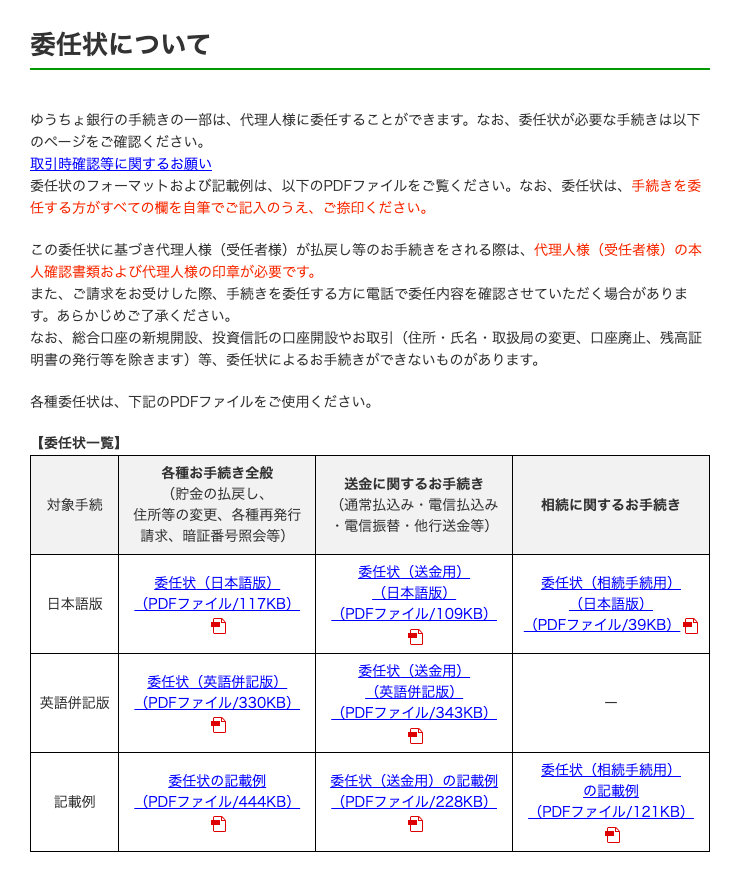
A power of attorney (ininjo) is a written document the account holder gives the bank, stating who is being asked to handle which matters.
- Japan Post Bank: an agent can be authorized in writing for some procedures.
- The power of attorney must be filled out entirely by hand and sealed by the person granting it.
- For a withdrawal by an agent, the agent’s own identity-verification documents and seal are also needed; the bank may also call to confirm the content of the authorization.
- This written-authorization method cannot be used to open a new integrated account, or to open or trade an investment trust account; but changing the registered address or name on an investment trust account, changing the post office used, closing the account, or issuing a balance certificate are not covered by this restriction.
- Tama Shinkin Bank: lists over-the-counter agent procedures for opening a non-check ordinary deposit account and for closing an account, among others.
- Opening a new account requires the account holder’s registered seal, the funds to deposit, a power of attorney, and identity-verification documents for both the account holder and the agent.
- A minor cannot open an integrated account, only an ordinary deposit account.
- The power of attorney must be filled out by the account holder; if transfers or similar transactions are needed beyond closing the account, these need to be added to the authorization’s content.
- Some procedures are still restricted to the account holder alone.
Having an Agent Procedure Does Not Mean You Can Hand Over the Account
No. An agent procedure only covers the specific procedures the bank lists; it does not mean the account can be handed over for a family member to use freely. Tama Shinkin Bank’s ordinary deposit rules likewise prohibit transferring the deposit, pledging it, setting up a third party’s rights in it, or letting a third party use the deposit, the deposit contract status, transaction rights or the passbook; only a pledge the bank itself approves as unavoidable, using the deposit as collateral, can be handled, and only in the bank’s specified format.
Example: if Mr. Lin’s account is with MUFG Bank and his sister qualifies as a relative sharing the same household finances, Mr. Lin himself could register her and apply for an agent card. But since he now lives outside Japan, whether this can actually be done needs to be confirmed with the bank first; and even if it is set up, the remitter for any transfer still has to be in Mr. Lin’s own name.
Which Fees Can Be Paid From a Family Member’s Account?
If you own property in Japan, there are taxes and various fees to pay every year. The answer is: it depends. National tax auto-debit is restricted to the taxpayer’s own-name account, while Himeji City’s local tax and Kawasaki City’s water bill can be set up for debit from a family member’s account.
| Fee | Can a family member’s account be used? | What to watch |
|---|---|---|
| National tax auto-debit | No, own name only | Advance application needed; cannot be used for late or amended filings |
| Himeji City local tax | Yes | The amount paid on your behalf may be treated as subject to gift tax |
| Kawasaki City water bill | Yes | Requires a new application |
Whether a family member’s account can be used depends on the type of fee and the rules of the local government involved.
National Tax Auto-Debit: Own-Name Account Only
The National Tax Agency (NTA, 国税庁) explains, as of the April 1, 2026 legal basis, that auto-debit tax payment, furikae nozei (振替納税), debits an account in the taxpayer’s own name, and requires a designation application submitted in advance to the Tax Office, a financial institution, or through e-Tax.
- Applies to: the final income tax return filed within the deadline, estimated tax payments, and a sole proprietor’s final or interim consumption tax return.
- Does not apply to: late filings and amended returns.
- If the debit fails: if an insufficient balance causes the debit to fail, a delinquent tax, an extra charge for paying late, is calculated starting the day after the statutory payment deadline, the deadline for payment set by law.
Some Local Taxes and the Water Bill: a Different-Name Account Is Allowed
Himeji City’s auto-debit tax payment system applies to the regular collection of the municipal and prefectural inhabitant tax and the forest environment tax, the fixed asset tax and city planning tax, and the light vehicle tax; it allows the account to be in the name of someone other than the taxpayer, the person legally liable for the tax, such as a family member. However, Himeji City also notes that the amount a family member pays on your behalf may be treated as subject to gift tax, and that the tax notice and any refund-related notice or request will still only be sent to the taxpayer themselves.
Kawasaki City’s Waterworks Bureau FAQ allows the user and the payer to be different people, for example a family member, someone living with you, or a case where the user is an employee and the payer is the company; setting up auto-debit of the water bill from an account in a different name requires a new application.
Note: the local tax and water bill examples above are limited to Himeji City and Kawasaki City; other local governments’ rules may differ, so confirm with the local government before applying. For the taxes due every year on owning property in Japan, see Zagdim’s guide on fixed asset tax, city planning tax and rental income reporting for a Japanese property.
Example: if Mr. Lin’s apartment is in Himeji City, he could apply to have the fixed asset tax debited from his sister’s account, but the amount she pays on his behalf may be treated as subject to gift tax, and the tax notice would still only be sent to Mr. Lin. If Mr. Lin wants to pay his income tax return through furikae nozei, he can only use an account in his own name.
Can National Pension Premiums Be Paid From a Spouse’s Account?
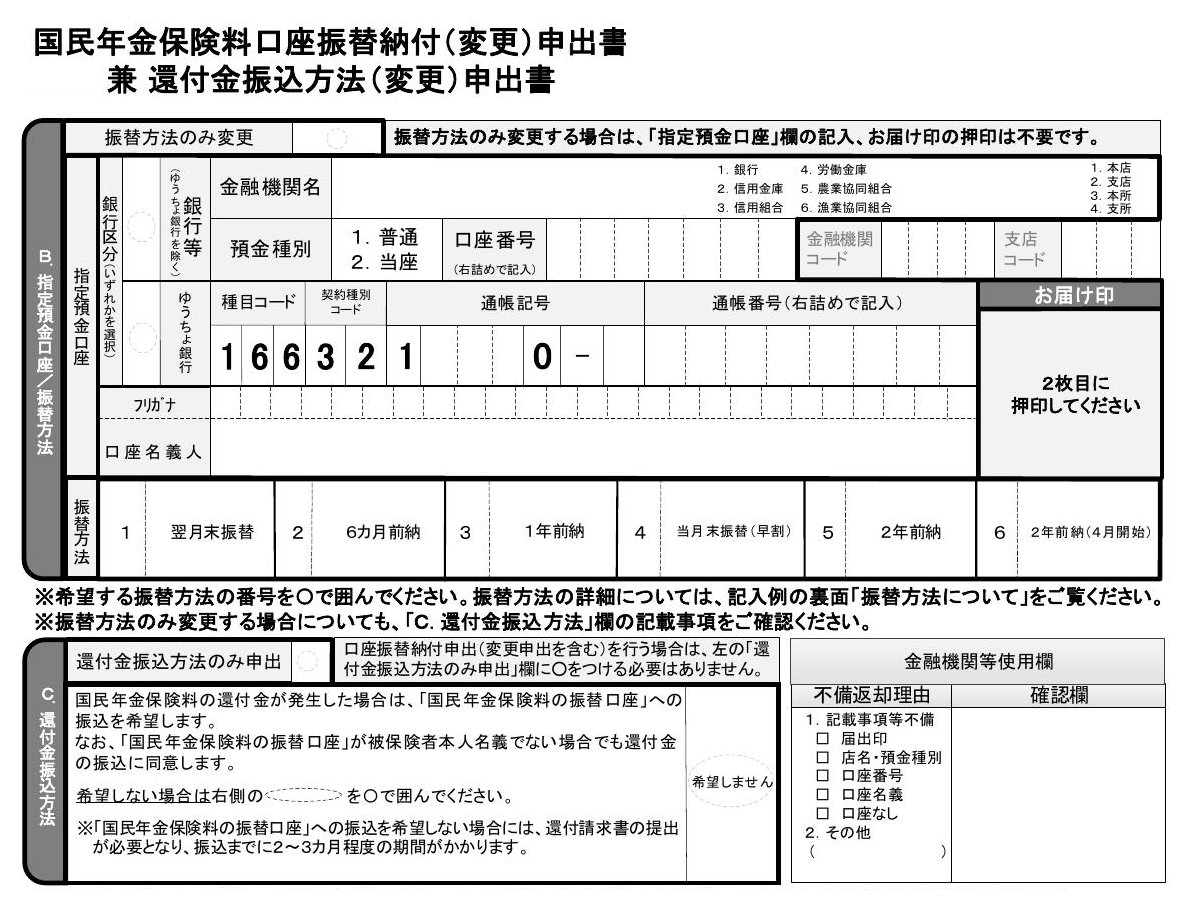
The Japan Pension Service’s application form for auto-debit of National Pension premiums has a separate “account holder” field, and the regular monthly premium can be auto-debited from an account that is not in the name of the insured person, the person enrolled in the National Pension who is liable for the premium. However, the form does not directly address whether a spouse’s account can be used for catch-up or back payments covering specific months after leaving Japan, paying premiums for an earlier period after the fact; confirm this with the Japan Pension Service before applying.
Can You Receive Overseas Remittances Into a Family Member’s Account?
The banks checked for this article all go by the name on the receiving account, so an overseas remittance should be paid into an account in the recipient’s own name.
Overseas Receipts Generally Require a Matching Name
- Japan Post Bank: in principle, the name on the receiving account must match the registered name in Roman letters, or the Roman-letter reading of a kanji or katakana name; it does not accept a remittance being collected by anyone other than the account holder.
- MUFG Bank: in principle, the remittance is paid into this bank’s account under the name specified in the payment instructions, and no advance procedure is usually required. But the bank may still ask for identity-verification documents, and, to rule out sanctions or money-laundering concerns, may look into the background and details of the transaction and ask for supporting documents.
- Yokohama Bank (横浜銀行): when handling an overseas remittance, it may also ask the customer to explain the transaction in detail and provide documents; anyone who does not cooperate cannot complete the transaction, confirmation can take time, and depending on the result, the bank may decline the remittance. The remittance details need to show the English name of the receiving account’s holder.
For readers, this means a bank’s checks may require you to explain the background of the transaction and provide documents; if you do not cooperate, or the bank’s checks raise concerns, the remittance may be declined.
Receiving an Overseas Remittance Without a My Number
When handling an overseas remittance, the bank reports the My Number (個人編號, マイナンバー) as required by law; there is an exception for someone who has no number because they are a non-resident, but only once they have formally declared their non-resident status to the bank, and the bank will still carry out its other checks. For more detail, see Zagdim’s guide on what KYC documents a Japanese bank wants, covering income proof, tax records and company documents. For the basic rights and restrictions on non-resident accounts, see Zagdim’s guide on what Japanese banks mean by “non-resident,” and how accounts differ depending on whether you have been in Japan less than six months or have already left Japan.
Frequently Asked Questions
Does paying a family member’s water bill break the law?
Not automatically just because a family member is handling it. Using Kawasaki City as an example, the water bill can be set up for auto-debit from a family member’s account. But note that the bank rules checked for this article prohibit letting a third party use the account itself.
After leaving Japan, can I just give an unused account to a family member?
No. MUFG Bank, SMBC and Tama Shinkin Bank all prohibit transferring an account under their rules; Japan Post Bank also warns that transferring an account, whether for payment or not, can be subject to punishment, and can affect your ability to open an account later.
Can national tax be auto-debited from a family member’s account?
No. The National Tax Agency’s furikae nozei auto-debit payment is debited from an account in the taxpayer’s own name.
Can my salary be paid directly into my spouse’s account?
Not when paid by bank transfer. Japan’s Labor Standards Act (労働基準法) and its related rules require that paying wages by bank transfer needs the worker’s consent, and the money must be paid into a deposit account in the worker’s own name, as designated by the worker.
Glossary
- Act on Prevention of Transfer of Criminal Proceeds (犯罪による収益の移転防止に関する法律): Japan’s law requiring identity verification for financial transactions, and punishing obtaining or providing a passbook, cash card or similar account tool for the purpose of obtaining financial services under someone else’s name.
- Furikae nozei (振替納税, auto-debit tax payment): the system under which national tax is automatically debited from an account in the taxpayer’s own name; it requires advance application.
- Koukin-kei (拘禁刑, custodial imprisonment): the type of penalty the Act on Prevention of Transfer of Criminal Proceeds sets for offenses related to lending or transferring a bank account.
- My Number (個人編號, マイナンバー): Japan’s individual number; banks report it as required by law when handling an overseas remittance.
Methodology and Sourcing Notes
This article’s description of criminal liability for lending or transferring an account is drawn from Article 26 of the Act on Prevention of Transfer of Criminal Proceeds: in the table above, “the party obtaining the account” corresponds to Paragraph 1, “the party providing the account” to Paragraph 2, “doing it as a business” to Paragraph 3, and “soliciting others to do it” to Paragraph 4. Before the amendment took effect on July 10, 2026, this was Article 28, with a lighter penalty, imprisonment of up to one year or a fine of up to 1 million yen; older material citing Article 28 refers to the same category of conduct. The rule requiring banks to verify the identity of the person actually handling a matter is in Article 4 of the same law. Whether a specific case amounts to a crime still depends on the facts, and the authorities have not set out every possible scenario of family members helping each other.
The agent-procedure and account-use rules summarized here are drawn only from the publicly available material of Japan Post Bank, MUFG Bank, SMBC, Yokohama Bank and Tama Shinkin Bank; other banks may differ. Tama Shinkin Bank’s prohibition on transferring an account is in Article 11 of its ordinary deposit rules. SMBC’s ordinary deposit rules are the October 18, 2021 version, and it has not been confirmed whether this is still the current version.
The national tax section is based on National Tax Agency No. 9201, as of the April 1, 2026 legal basis; the local tax and water bill section covers only Himeji City and Kawasaki City, and other local governments’ rules are not included.
The pension section summarizes only the wording of the Japan Pension Service’s general auto-debit application form; whether catch-up or back payments for specific months after leaving Japan can be debited from a spouse’s account is not directly addressed in the official material. The wage-remittance rule is in Article 24 of the Labor Standards Act and Article 7-2 of its Enforcement Regulations.
Have a question about this guide? Leave a comment below, or ask Zagdim directly.
Your first stop for international property and global living.
Research and insights. Know what’s changing. Understand what matters.
Sources
- e-Gov – Act on Prevention of Transfer of Criminal Proceeds, Article 4, Paragraphs 1, 4 and 6 (laws.e-gov.go.jp)
- e-Gov – Act on Prevention of Transfer of Criminal Proceeds, Article 26, Paragraphs 1 through 4 (laws.e-gov.go.jp)
- Japan Post Bank – August 1, 2024: Transferring, Taking Over or Buying and Selling an Account Is Prohibited by Law (jp-bank.japanpost.jp)
- Japan Post Bank – About Powers of Attorney (jp-bank.japanpost.jp)
- Japan Post Bank – Receiving International Remittances (Receiving Account Name
- Agent Receipt) (jp-bank.japanpost.jp)
- MUFG Bank – Ordinary Deposit Rules (Prohibition on Transfer, Pledging, etc.) (bk.mufg.jp)
- MUFG Bank – Receiving Overseas Remittances (Account Name
- Verification
- Number Registration) (bk.mufg.jp)
- SMBC – FAQ 8463: Can I Withdraw Money From a Family Member’s Bank Account? (Ordinary Deposits) (qa.smbc.co.jp)
- Tama Shinkin Bank – Agent Procedures (New Deposit Account Opening
- Power of Attorney) (shinkin.co.jp)
- Tama Shinkin Bank – Ordinary Deposit Rules, Article 11 (Prohibition on Transfer, Pledging) (shinkin.co.jp)
- Yokohama Bank – Overseas Remittances (Verification Documents
- Purpose of Remittance
- Recipient Name
- Number Registration) (boy.co.jp)
- Japan Pension Service – National Pension Premium Account Transfer Payment (Change) Application Form (pages 2–3) (nenkin.go.jp)
- e-Gov – Labor Standards Act, Article 24, Paragraph 1 (laws.e-gov.go.jp)
- National Tax Agency – No. 9201 Recommendation for Furikae Nozei (Name
- Scope
- Procedure) (nta.go.jp)
- Himeji City – Auto-Debit Payment (Eligible Tax Items
- Different-Name Account) (city.himeji.lg.jp)
- Kawasaki City Waterworks Bureau – Can the Water Bill Be Debited From an Account in a Name Different From the User’s? (city.kawasaki.jp)
Disclaimer
This article is a general summary of information and is not tax or legal advice for any individual case. Rules in Japan, and in the reader’s own country or region, may be updated; rely on the current announcements of the relevant authorities, and consult a qualified professional for your specific situation.