

*Researched and verified by Zagdim Research. Last verified: November 18, 2026.*
This article is part of Zagdim’s wiki series on Japanese bank accounts, written for readers living outside Japan who are considering buying property there. It explains how source-of-funds checks connect across banking, tax and the transaction process when you buy property in Japan. This matters now because, starting April 1, 2026, the acquisition-report rules for non-residents buying Japanese real estate changed: the only exemption left is for “related rights” acquired for specific purposes — buying the property itself still has to be reported. Japan’s Ministry of Land, Infrastructure, Transport and Tourism (MLIT) also revised its reference examples of suspicious real estate transactions on October 30, 2026. KYC (Know Your Customer) refers to the process financial institutions use to confirm who a customer is and what a transaction is for.
The key points:
- Banks, real estate agents and tax authorities each run their own confirmation or reporting system; passing the bank’s check does not mean the other steps are covered.
- The sale contract explains what the money is for, but it cannot substitute for proof of where the money originally came from.
- A non-resident who acquires Japanese real estate must file an acquisition report within 20 days of acquisition, regardless of the price or size of the property.
- When the seller is a non-resident, the buyer must generally withhold 10.21% of the price at payment, except when an individual is buying for their own or a relative’s residence and the price is 100 million yen or less.
Why Check Your Source of Funds Before You Buy?
The reason is that banks, real estate agents and tax authorities each run their own confirmation or reporting system — clearing the bank’s check does not mean everything else is covered:
- Banks confirm transactions under the Act on Prevention of Transfer of Criminal Proceeds and the Foreign Exchange and Foreign Trade Act (commonly abbreviated FEFTA).
- The National Tax Agency (NTA) runs systems such as the overseas remittance report and withholding tax on property purchases.
- Real estate agents are themselves classified as specified business operators (businesses the law requires to confirm customers during a transaction) and carry out their own transaction checks.
So before you buy, it helps to work out where your money is coming from and what it will be used for, so you can give the same, consistent explanation and documents at every step.
To understand why Japanese banks run KYC checks in the first place and what the legal basis is, see our companion article on why KYC matters for Japanese bank accounts.
**Example:** a buyer living outside Japan plans to buy an apartment in Tokyo, wiring the purchase funds from their own overseas bank account to an account designated by the agent or seller in Japan. The sections below use this buyer’s situation to illustrate what each step may involve.
Who Handles What When You Buy Property?
Different people are responsible for each confirmation or report. Here is a summary:
| Procedure | Who Is Responsible | When It Applies | Deadline |
|---|---|---|---|
| Bank wire transfer confirmation | The bank confirms; the customer provides explanation and documents | When arranging an international wire transfer | – |
| Real estate agent transaction confirmation | The licensed real estate transaction agent | At signing of the sale contract, or when acting as agent or broker | – |
| Overseas remittance report | The financial institution handling the transfer, submitted to the Tax Office | When an overseas inbound or outbound transfer exceeds 1 million yen | – |
| Withholding tax on a property purchase | The buyer (the payer, including individuals) | When buying land or a building in Japan from a non-resident or foreign corporation and paying in Japan | By the 10th of the month following the month of payment; the end of the following month if the payment is treated as made within Japan from overseas |
| Real estate acquisition report | The non-resident themselves, or a resident acting as their agent | When a non-resident acquires Japanese real estate or related rights | Within 20 days of acquisition, submitted to the Minister of Finance via the Bank of Japan |
What Will the Bank Ask When Purchase Funds Come From Overseas?
The bank may ask you to explain what this money will be used for (its purpose), and where the money originally came from (its source — for example salary, rental income or an inheritance). The documents required vary depending on the purpose and the source.
Based on examples disclosed publicly by three Japanese financial institutions checked for this article:
| What You Need to Explain | Documents the Banks Give as Examples |
|---|---|
| Purpose: buying property | MUFG Bank: the real estate sale contract and billing statement, among others; Kiyo Bank: the sale contract for the home purchase |
| Source: salary | MUFG Bank: pay slips, withholding tax statement, income certificate, employment contract, and salary transfer records |
| Source: rental income | MUFG Bank: lease documents |
| Source: inheritance | MUFG Bank: inheritance-related documents |
| Funds transferred in from another bank, or cash deposited shortly before the transfer | MUFG Bank: a copy of the relevant passbook, among other materials |
These are only examples from individual banks: the documents required vary by purpose and source, and a bank may still decline to proceed even after documents are submitted. Separately, Shizuoka Yaizu Shinkin Bank asks, for overseas inbound transfers, for the reason for the funds, the amount, and information on the sender’s relationship to the recipient, and may request further documents on how the funds are used afterward depending on what it finds.
Why can banks ask this? One legal basis is FEFTA: banks must first confirm that a customer’s payment or receipt is not a transaction requiring permission, approval or a report, or that the necessary procedures have already been completed, before they can process the exchange. Japan’s Ministry of Finance (MOF) explains that, aside from payments and receipts FEFTA designates as requiring a licence, overseas remittances are free in principle — but “free in principle” does not mean a bank’s confirmation can be skipped. If the information a financial institution obtains about the sender, the purpose of the remittance and so on does not match what the customer provided, or if it cannot obtain enough of the necessary information, the transfer may be delayed or may not go through at all.
**Example:** the buyer wires the purchase funds from their overseas bank account to the account the agent or seller designated in Japan. Beyond checking the sale contract to confirm the purpose, the Japanese bank may also ask whether the money was saved from salary, came from rental income, or was inherited, and ask for the matching supporting documents. The key point to remember: the sale contract explains the purpose of the funds, but it cannot substitute for proof of their original source.
Do Real Estate Agents Also Check the Source of Funds?
Real estate agents carry their own confirmation duty too: banks and real estate agents are each subject to their own statutory confirmation duty, and a check the bank has already done does not replace the check the agent has to carry out separately.
Licensed real estate transaction agents (Japan’s property brokers and transaction agents) are listed as specified business operators under the Act on Prevention of Transfer of Criminal Proceeds, and signing, acting as agent for, or brokering a sale contract is listed as a specified transaction (a transaction the law requires customer confirmation for). So a buyer may need to provide information on both the bank side and the agent side — though that does not mean the same documents have to be resubmitted at every step.
Japan’s MLIT revised its reference examples of suspicious transactions in real estate sales (for real estate transaction agents) on October 30, 2026. A suspicious-transaction report is filed when an agent judges a transaction to be suspicious and reports it to the relevant authority. The revised examples:
- Add two new categories: wanting to pay using crypto assets; and, in the context of a high-value cash purchase out of proportion to the buyer’s income or assets, wanting to transact without going through a financial institution.
- Also list: without reasonable grounds, payment being made by someone other than the contracting party, or a change in payment method — for example, an acquaintance temporarily covering a payment, a planned bank transfer being switched to cash at the last minute, or the payment being split into several small transfers.
Official guidance calls for a comprehensive judgment: matching an example on its face does not automatically mean a transaction is suspicious. When an agent is unsure, or when even one item matches, the general rule is to report it — but that rule does not apply if there is a clear, reasonable basis showing the transaction is not suspicious.
Buying Through a Company
If you plan to buy using a company’s name, the bank will need to confirm:
- The company name
- The location of its head office or main place of business
- The purpose of the transaction
- The nature of its business
- If there is a person able to substantially control how the company is run, that person’s identifying information as well
When enhanced due diligence applies (the stricter confirmation the law requires for higher-risk transactions), confirming the beneficial owner — the person who actually controls how a majority-vote corporation is run (a corporation whose voting rights are allocated according to shareholding; one that is majority-vote only because of its articles of incorporation does not count) — requires checking documents that show who holds the voting rights, such as the shareholder register, together with a self-declaration from the company’s representative or similar. For how to prepare these documents, see our companion guide, “What KYC Documents Do Japanese Banks Want? Income Proof, Tax Records, Company Documents and Asset Proof.”
How Does Source of Funds Affect Tax?
Where your money comes from also affects your taxes. The source of funds connects to Japan’s overseas remittance reporting, the withholding tax on property purchases, and whether money a family member provides counts as a loan or a gift. Sorting this out before you buy can reduce the chance of being asked for extra documents, or being taxed in ways you did not expect, after the fact.
Tax Information on Overseas Remittances
- When an overseas inbound or outbound transfer exceeds 1 million yen, the financial institution handling it submits an overseas remittance report to the Tax Office — a record of the sender’s and receiver’s names and addresses and the transaction amount. This is the financial institution’s own obligation; it does not mean this money is automatically taxable.
- Opening a new account at a Japanese financial institution also requires declaring your country of tax residence and related information, under the Common Reporting Standard (CRS). See our companion article on why KYC matters for Japanese bank accounts for details.
Withholding When the Seller Is a Non-Resident
If the seller does not live in Japan, the buyer may need to withhold tax before paying. When buying land, a building or similar property in Japan from a non-resident or a foreign corporation and paying the price within Japan, the buyer generally has to withhold tax at the time of payment.
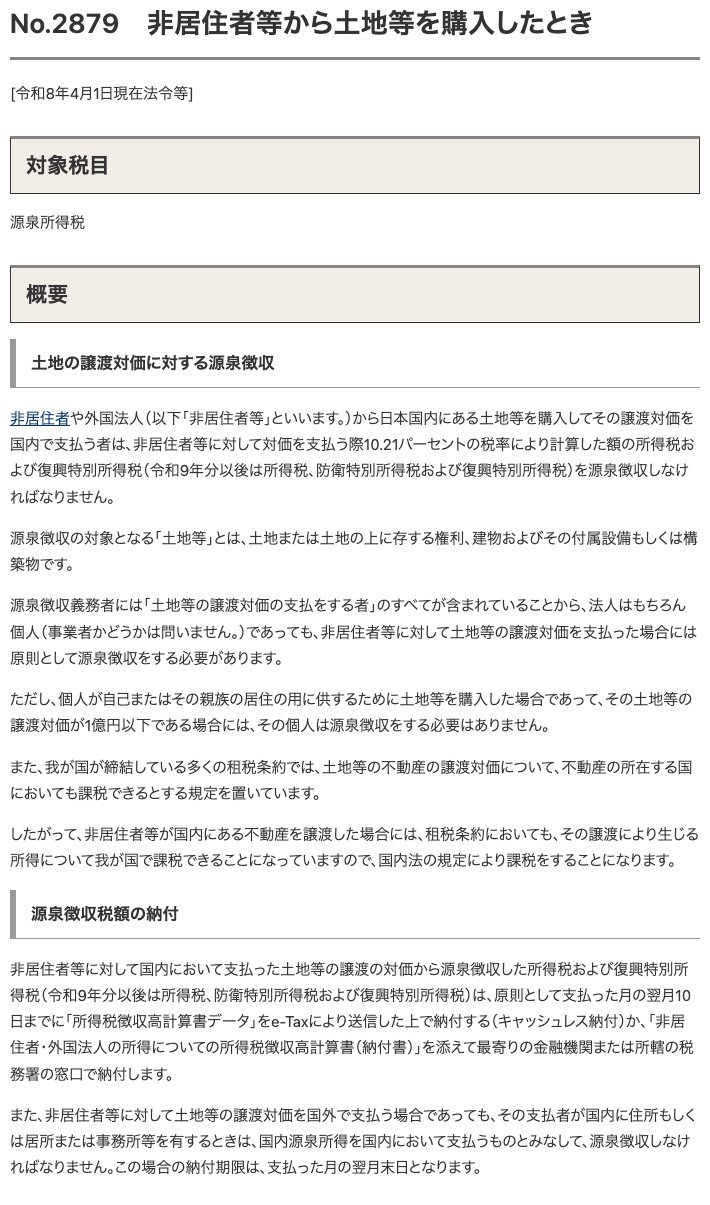
Withholding means the person paying deducts the tax from the price owed to the other party, then pays that tax to the tax authorities themselves. “Non-resident” here is a status under the Income Tax Act — an individual with no residence in Japan and no continuous place of abode in Japan for one year or more; this is determined by the seller’s tax status, not their nationality.
| Item | Details |
|---|---|
| Who withholds | The buyer (the payer), including individuals — not limited to businesses |
| How much | 10.21% of the price (income tax plus the special reconstruction income tax); from the 2027 tax year, the withheld taxes will also include the special defense income tax |
| When to pay | By the 10th of the month following the month of payment |
| Paying from overseas | If the payer has a residence, place of abode or office in Japan, the payment is treated as made within Japan and withholding is still required; the deadline then moves to the end of the month following the month of payment |
| Exception | Not required when an individual buys for their own or a relative’s residential use and the price does not exceed 100 million yen |
Detail on the exception:
- The 100 million yen threshold is based on the seller’s total price: the threshold is judged on the consideration the seller receives for the transfer, not on the amount each individual buyer pays. In an example the NTA gives, a property worth a total of 150 million yen is sold by one non-resident to two buyers who each buy half for their own residential use — both buyers still need to withhold.
- Mixed residential-and-commercial buildings: if the residential portion is the main use (more than half of the floor area is used for residence) and the price does not exceed 100 million yen, the non-residential portion also does not require withholding — but this still requires the buyer to be an individual purchasing for their own or a relative’s residence.
For buyers, this means whether withholding is required depends on whether the seller is a non-resident or a foreign corporation (based on the seller’s tax status, not nationality).
**Back to the example:** if the seller of that Tokyo apartment is a non-resident and the buyer is paying within Japan, the buyer first needs to check whether they qualify as “an individual, buying for their own or a relative’s residence, with a price that does not exceed 100 million yen.” If they do not qualify, they need to set aside the withholding amount when making payment.
The Tax Line When Family Provides the Purchase Funds
If the purchase funds are borrowed from parents or other relatives, the key question is whether it counts as a loan or a gift. The NTA explains:
- If it can be established as a genuine loan — based on factors such as the borrower’s ability to repay and their actual repayment record — the principal is not treated as a gift.
- In cases such as an interest-free loan, the value of the interest the lender forgoes may be treated as a gift.
- If it is substantively a gift dressed up as a loan, the principal is treated as a gift.
The KYC and tax questions around family-provided funds are covered in full in our companion article on why KYC matters for Japanese bank accounts.
What Other Reporting Duty Applies When a Non-Resident Buys Property?
Beyond banking and tax, there is a further report to file. A non-resident who acquires real estate or related rights located in Japan must, in principle, submit a “Report on the Acquisition of Real Estate or Related Rights Located in Japan” via the Bank of Japan to the Minister of Finance, within 20 days of acquisition.
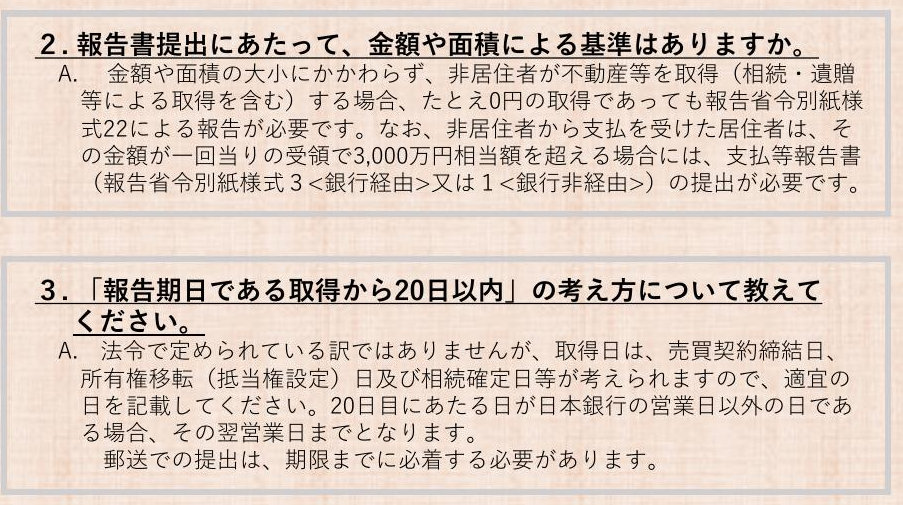
- It is not exempted based on the price or the size of the property.
- Acquisition by inheritance or bequest, or even an acquisition price of 0 yen, still has to be reported.
- “Non-resident” here is a status under FEFTA, which differs from the residency test under the Income Tax Act — the two terms cannot be used interchangeably.
When Can You Skip the Report?
The exemption applies only to “real estate-related rights” acquired on or after April 1, 2026, and only when the purpose is one of the following:
- For the buyer’s own, a relative’s, or an employee’s residence
- Needed for non-profit business activities carried out in Japan
- For the buyer’s own office
Outright ownership is not a “related right” covered by this exemption — buying the property itself still needs to be reported; a vacation home or second home also does not count as residential use. Whether something counts as residential use is, in principle, judged by the original intended purpose at the time of acquisition. The Ministry of Finance’s FAQ indicates that, where there is a reasonable reason for the gap in time between acquiring the property and actually moving in, the related-rights portion (for example a leasehold right — the right to lease land from the landowner) can be exempted from reporting; but when there is no particular reason and the move-in date is undetermined, it is advisable to report the related-rights portion as well.
Acquisition Date, Deadline and Who Files
- Acquisition date: the law does not fix a single date; the Ministry of Finance’s FAQ lists several dates to consider, such as the date the sale contract was signed, the date ownership transferred or a mortgage was registered, or the date an inheritance was finalized — the filer selects the appropriate date.
- Falling on a non-business day: if the 20th day is not a Bank of Japan business day, the deadline moves to the next business day; if filing by mail, it must arrive before the deadline.
- Joint ownership: each co-owner must file separately, filling in the area and purchase amount according to their own ownership share.
- Who files: the non-resident themselves, or a resident acting as their agent — for example a real estate agent — and it can be filed on paper or through the online system. If you delegate the filing to an agent, being authorized to act on your behalf does not mean the report has already been submitted.
**Example:** a couple living outside Japan jointly buy an apartment in Osaka; both of them are non-residents. In this situation, both of them have to file their own acquisition report, each filling in their own ownership share and the corresponding amount — one report covering both of them is not enough.
Frequently Asked Questions
A family member wires me the purchase funds. What will the bank ask? The bank may ask about your relationship to the sender and request supporting documents. For example, Shizuoka Yaizu Shinkin Bank asks, for overseas inbound transfers, for the reason for the funds, the amount, and information on the relationship between sender and recipient. Whether a loan from a relative counts as a gift for Japanese tax purposes depends on whether it can be established as a genuine loan.
If the purchase price is under 30 million yen, does that mean no reporting at all? No. The report that can be skipped under 30 million yen is FEFTA’s payment/receipt report: the general exemption threshold is any single transaction up to and including the equivalent of 30 million yen — and non-residents were never required to file this particular report in the first place. The non-resident real estate acquisition report is a separate system and is not exempted based on the price. The two are different systems.
If a non-resident is buying property to live in themselves, do they still need to file the real estate acquisition report? Yes. Acquiring ownership of real estate requires a report. Only “real estate-related rights” acquired on or after April 1, 2026 for the buyer’s own, a relative’s, or an employee’s residential use can be exempted when the conditions are met — and a vacation home or second home does not count as residential use.
Does buying through a company make KYC much more complicated than buying as an individual? When a bank handles a transaction for a corporation, it has to confirm the relevant corporate details. Beyond the company name, the location of its head office or main place of business, the purpose of the transaction and the nature of its business, the bank also has to confirm the person who can substantially control the company’s management. Where enhanced due diligence applies, a majority-vote corporation also needs to have its beneficial owner confirmed by checking documents such as the shareholder register that show who holds the voting rights.
Glossary
- Act on Prevention of Transfer of Criminal Proceeds: the Japanese law requiring banks, real estate transaction agents and other specified business operators to confirm customers at the time of a transaction, and to report a transaction as suspicious when they identify a concern.
- Foreign Exchange and Foreign Trade Act (FEFTA): the law banks rely on for confirmation before an exchange, and the basis for the payment/receipt report and the non-resident real estate acquisition report.
- Non-resident: under the Income Tax Act, an individual with no residence in Japan and no continuous place of abode in Japan for one year or more. FEFTA uses a separate standard for who counts as a “non-resident,” and the two cannot be used interchangeably.
- Source of funds: where the money originally came from — for example salary, rental income, or an inheritance.
- Withholding: the person paying deducts the tax owed from the price before paying the remainder, then pays the withheld amount to the tax authorities themselves.
- Overseas remittance report: the record a financial institution submits to the Tax Office when an overseas inbound or outbound transfer exceeds 1 million yen.
- Report on the Acquisition of Real Estate Located in Japan: the report that FEFTA requires a non-resident to file when they acquire Japanese real estate or related rights.
About This Research
The information in this article on the Act on Prevention of Transfer of Criminal Proceeds and FEFTA is based on the statutory text as found through Japan’s e-Gov law search; the sections on the payment/receipt report and the real estate acquisition report are based on explanations from the Bank of Japan and the Ministry of Finance; the sections on withholding on property purchases, loans from relatives, the overseas remittance report, and country-of-residence declarations are based on explanations from the National Tax Agency. The statutory references in the body of the article: the bank’s pre-exchange confirmation is Article 17 of FEFTA; real estate transaction agents being classified as specified business operators is under Article 2, Paragraph 2 of the Act on Prevention of Transfer of Criminal Proceeds. The statement that “banks and real estate agents each have their own confirmation duty, and a bank’s confirmation cannot substitute for an agent’s” is this article’s own summary drawn from how the law treats different specified business operators — it is not something stated directly by an official source.
The bank document examples cited come only from the three financial institutions checked for this article (MUFG Bank, Kiyo Bank, and Shizuoka Yaizu Shinkin Bank); they do not represent a uniform requirement across all financial institutions, and actual requirements still depend on each institution’s own judgment. Officially, there is no single fixed “acquisition date” for the real estate acquisition report; this article lists only the dates officially given as options, without making a determination for any individual case. The withholding tax rate that will apply from the 2027 tax year onward, once the special defense income tax is added, is not covered in this article. The buyer and the couple used as examples throughout this article are illustrative scenarios, not real cases.
Have a question about this guide? Leave a comment below, or ask Zagdim directly.
Your first stop for international property and global living.
Research and insights. Know what’s changing. Understand what matters.
Sources
- e-Gov Law Search — Act on Prevention of Transfer of Criminal Proceeds (犯罪による収益の移転防止に関する法律)
- e-Gov Law Search — Enforcement Regulations of the Act on Prevention of Transfer of Criminal Proceeds
- e-Gov Law Search — Foreign Exchange and Foreign Trade Act (外国為替及び外国貿易法)
- Ministry of Finance — To Those Transacting at Financial Institutions: Notes on Mismatched Information
- Ministry of Finance — FAQ: What Procedures Are Required for Remittances Between Japan and Overseas?
- Bank of Japan — FEFTA Reports FAQ
- MUFG Bank — Documents to Confirm Transaction Details
- Kiyo Bank — Request for Submission of Confirmation Documents for Overseas Remittances
- Shizuoka Yaizu Shinkin Bank — Request Regarding Confirmation of Overseas Remittance Content (Outbound/Inbound)
- MLIT — Reference Examples of Suspicious Transactions in Real Estate Sales (For Real Estate Transaction Agents)
- National Tax Agency — NTA Report 2026, Section IV: Appropriate and Fair Taxation, Collection and Response to International Transactions
- National Tax Agency — A Declaration Stating Your Country of Tax Residence Is Required When Opening an Account at a Financial Institution
- National Tax Agency — No. 2875: Distinction Between Residents and Non-Residents
- National Tax Agency — No. 2879: When Purchasing Land Etc. From a Non-Resident
- National Tax Agency — Treatment When Land Etc. Is Co-Owned
- National Tax Agency — Acquiring a Mixed-Use Residential Building for 100 Million Yen or Less From a Non-Resident
- National Tax Agency — No. 4420: Borrowing Money From a Parent
- Ministry of Finance — Overview of the Non-Resident Real Estate Acquisition Report System
- Ministry of Finance — FAQ on the Non-Resident Real Estate Acquisition Report
Disclaimer
This article is a general information summary and does not constitute tax or legal advice for any individual case. Rules in Japan, and in your home country or region, may change over time; follow the current guidance from the relevant authorities, and consult a qualified professional for your own situation.