

Verified by Zagdim Research | Last verified: November 18, 2026
This article is part of Zagdim’s wiki series on Japanese bank accounts. It is written for readers outside Japan who own property there, need to receive yen, or are planning to buy, and who want to understand what documents a Japanese bank’s know-your-customer (KYC) process can ask for and why. It matters now because, starting June 14, 2026, Japan began issuing a new type of specific residence card (one that combines the residence card and the Individual Number Card), which changes how a copy of it should be submitted when replying to a bank’s transaction-purpose confirmation. Separately, the National Tax Agency’s (国税庁, National Tax Agency, NTA) guidance for tax-residence self-certifications used from January 2026 states that even an account opened long ago may be asked by the financial institution to provide its tax-residence information. When sending money to buy property or receiving rent, a bank may also ask the customer to explain the purpose of the transaction and where the money came from.
KYC is the process a bank uses to confirm who you are and what a transaction is for. This article organizes the documents into four categories:
- Identity documents, for an individual or a company
- Proof of income and assets
- Proof of source of funds and purpose of the transaction
- Tax-related documents
Requirements vary by bank and by the type of transaction.
Key points first:
- A purpose-of-funds document is not proof of the source of funds. A sale and purchase contract explains that money is going toward buying property, but it does not prove where that money came from.
- The legal requirement to additionally verify income or assets only applies when a transaction is both classified as high-risk and involves a transfer of property worth more than 2 million yen. A bank may still ask for more documents under its own risk-management policy even outside that legal requirement.
- When a company is used to carry out the transaction, the bank must also identify the individual who actually controls that company.
- A non-resident without a My Number who has formally notified the bank of their non-resident status will not be refused an incoming overseas remittance for that reason alone.
**Example**: Elena lives outside Japan, owns a rental apartment there, and holds a Japanese bank account (assume it is an account she opened while living in Japan and that the bank has allowed her to keep). She plans to wire money from abroad to Japan and is also considering buying a second property through an overseas company she owns. The sections below use Elena’s situation to illustrate how the rules apply. (This is a fictional example, not a real case.)
For background on why KYC matters and its legal basis, see “Why Does Japan Bank KYC Matter? Account Opening, Remittances, Property Purchases and Source-of-Funds Checks for Foreigners.”
What Does a Bank Confirm for an Individual Account or Basic KYC?
This section covers the basic information a bank checks when an individual opens an account. In short, the bank needs to confirm your name, address, date of birth, the purpose of the transaction, and your occupation.
This requirement comes from Japan’s Act on Prevention of Transfer of Criminal Proceeds (犯罪による収益の移転防止に関する法律). The law requires banks to verify a customer’s identity for certain transactions, to prevent the proceeds of crime from being moved through the financial system. This confirmation process is called “verification at the time of transaction” — the bank checking who you are and what you intend to do when it carries out a transaction with you. The bank must confirm:
- Name
- Residential address
- Date of birth
- Purpose of the transaction
- Occupation
Exception: A foreign national who has no residence in Japan, and who meets the conditions set out in a cabinet order, has their address field handled according to matters set by the relevant ministerial ordinance. A cabinet order and a ministerial ordinance are additional rules and details the Japanese government issues to implement the law.
The purpose of the transaction and your occupation are, in principle, self-declared. Self-declaration means the customer, or their representative, states and fills this in themselves. The law’s general method for this confirmation is self-declaration, not checking supporting documents, but a bank may still require supporting evidence under its own risk-management policy.
When someone else handles the transaction on your behalf: if a company representative or another person actually carries out the transaction, the bank must also verify the identity of the person actually carrying it out, in addition to the customer (separate rules apply for government agencies and similar bodies).
No false statements: the customer or representative must not make a false statement about any of these confirmation items.
Replying to a Transaction-Purpose Confirmation With a Specific Residence Card
The residence card (在留カード) is the residence document held by a foreign national living in Japan. If you use the new specific residence card (the version that combines the residence card and the Individual Number Card) to reply to MUFG Bank’s transaction-purpose confirmation:
- By mail: you only need to submit a copy of the front; the back is not required
- Online: you need to submit images of both the front and the back, but when photographing the back you must cover the Individual Number and the QR code
**Example**: When the bank asks Elena to confirm the purpose of the transaction and her occupation, she declares this herself, in principle, and must not make a false statement. If the bank separately requires supporting evidence under its own risk-management policy, Elena would need to submit additional documents.
When Are Income Proof, a Bankbook or Asset Proof Required?
The law only requires a bank to carry out additional verification of assets and income when two conditions are met at the same time: the transaction is a “high-risk transaction requiring strict management,” and it involves a transfer of property worth more than 2 million yen.
Japan’s law lists the following as high-risk transactions:
- Suspected impersonation
- A suspected false statement in an earlier confirmation
- Transactions connected to specific countries or regions
- Other transactions set out by cabinet order
This additional confirmation is also limited to what is necessary to judge whether a suspicious-transaction report is required. So not every transaction over 2 million yen triggers this legal requirement, but a bank’s own risk-management policy may still lead it to ask for more documents in other situations.
If it does reach this stage, the law lists these personal asset and income documents:
- Withholding tax certificate (源泉徴収票)
- Final income tax return (確定申告書)
- Bankbook (預貯金通帳)
- Other similar asset or income documents
- The same documents for a spouse (spouse here includes a partner who is not legally registered but is, in substance, in a marriage-like relationship)
The confirmation method is to check one or more of these documents, or copies of them. The full list does not need to be submitted.
**Example**: Even if the money Elena is wiring is over 2 million yen, this legal confirmation is not triggered unless the transaction also counts as high-risk, though the bank may still ask her for more documents under its own risk-management policy. If the legal confirmation is triggered, Elena only needs to provide one or more of the documents above, not all of them.
Buying Property, Receiving Rent or Sending Money Abroad: What Purpose and Source-of-Funds Documents Have Banks Disclosed?
When buying property or sending money, a bank may ask about two things. One is what the money is for (its purpose); the other is where the money came from (its source of funds, called 原資 in Japanese).
Examples differ by bank and are also adjusted according to the stated purpose and source; even after documents are submitted, a bank may still decline to process the transaction based on its own assessment of the content. Below are examples disclosed by four financial institutions this article reviewed (MUFG Bank, Sumitomo Mitsui Banking Corporation [2019 notice], Kiyo Bank, and Shizuoka Yaizu Shinkin Bank); not every item on these lists needs to be submitted:
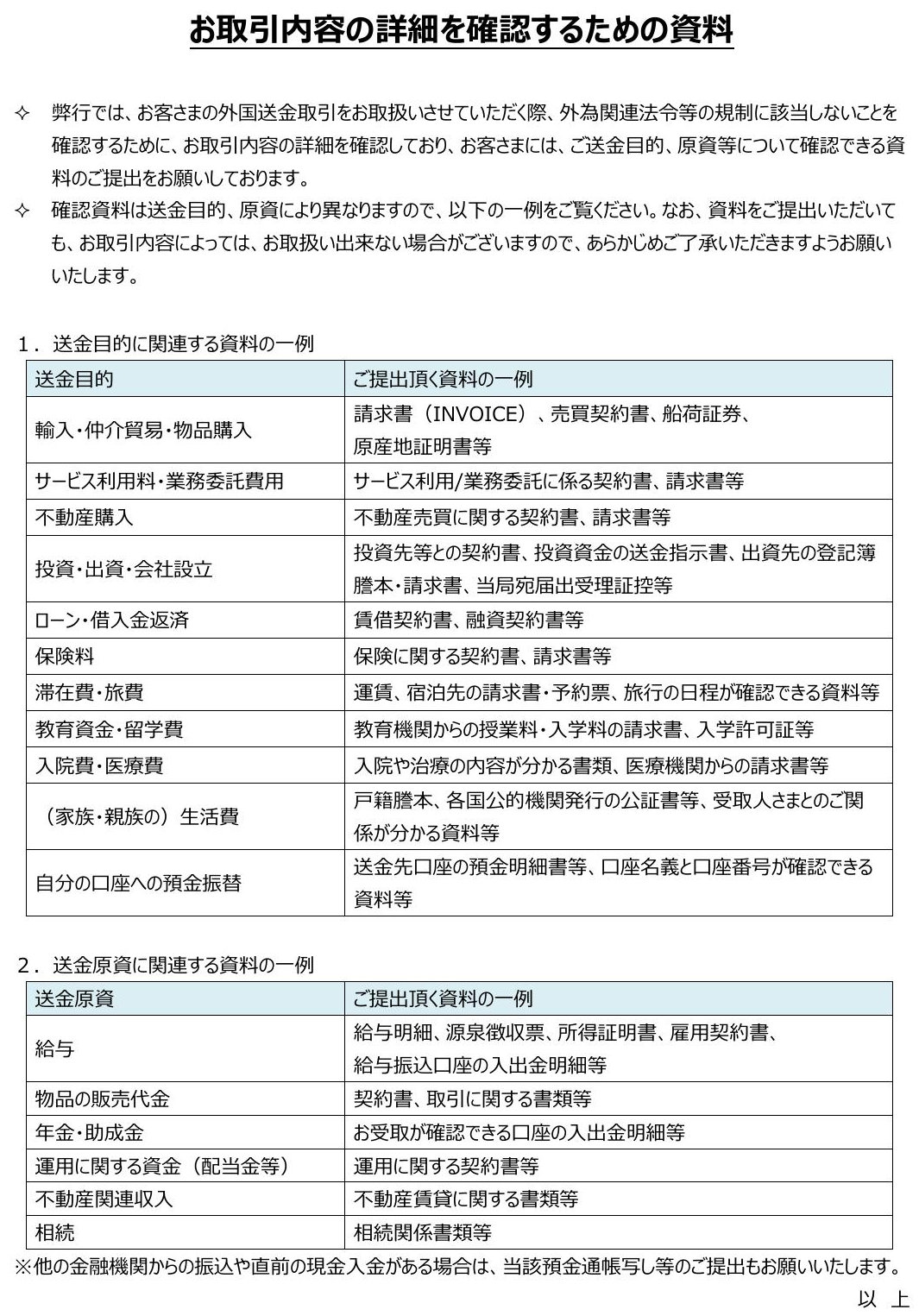
Examples of Purpose-of-Funds Documents
| Purpose | Example Documents |
|---|---|
| Buying property | Sale and purchase contract, invoice, etc. |
| Investment | Investment contract |
| Family living expenses | Family register, marriage or birth certificate, notarized documents from a government agency showing the relationship, or the other party’s income documents |
| Transfer between your own accounts | Statements or a bankbook that can confirm the account name and number |
Examples of Source-of-Funds Documents
| Source of Money | Example Documents |
|---|---|
| Salary | Pay slip, withholding tax certificate, income certificate, employment contract, salary transfer statement |
| Rental income | A lease document that can confirm the rent |
| Inheritance | Inheritance-related documents |
| Transfer from another bank, or a cash deposit shortly before the remittance | A copy of that bankbook, etc. |
A purpose-of-funds document is not proof of the source of funds. For example, a sale and purchase contract explains that the money is going toward buying property, but it does not prove where that money came from.
Cash as a source of funds also needs attention:
- Kiyo Bank: it will not process a foreign remittance from someone without a Kiyo Bank deposit account, or one that uses cash as its source of funds
- Shizuoka Yaizu Shinkin Bank: it will not accept cash for an outgoing foreign remittance
Money arriving does not guarantee it will be credited. At MUFG Bank, for example, when an incoming overseas remittance is received, the bank may request the recipient’s identity documents; to confirm there is no issue involving economic sanctions or money laundering, it may also ask about the background and details of the transaction and require supporting evidence. If the customer does not cooperate, cannot be reached, or the bank’s assessment of the information raises concerns, the remittance may not be credited.
When money comes from family, the distinction between a loan and a gift matters. A gift is property transferred to someone else without anything given in return. Japan’s National Tax Agency explains that between family members in a special relationship, such as parent and child:
- If it can genuinely be recognized as a loan, the principal is not treated as a gift
- But where, for example, no interest is charged, the value of that interest may be treated as a gift
- If something is a loan in form but a gift in substance, the principal is treated as a gift
For more on KYC and tax questions around money from family, see “Why Does Japan Bank KYC Matter? Account Opening, Remittances, Property Purchases and Source-of-Funds Checks for Foreigners.”
**Example**: If Elena’s remittance is for buying property, her purpose-of-funds document could be the sale and purchase contract and the invoice. If the money comes from rental income, her source-of-funds document could be a lease document that confirms the rent. If the money is a loan from family and can genuinely be recognized as a loan, the principal would not count as a gift.
What Company Documents Does a Bank Want for a Property Purchase or Account Opening Under a Company’s Name?
When a transaction is carried out in a company’s name, the bank needs to establish who the company is and who actually controls it behind the scenes. The bank must confirm the following; if someone can substantively control the company’s management, the bank must also verify that person’s identity:
- The company’s name
- The location of its head office or main place of business
- The purpose of the transaction
- Its business activities
Documents for a Company’s Business Activities
The confirmation method is to check one of the following documents, or a copy:
| Company Type | Acceptable Documents | Time Limit |
|---|---|---|
| A company whose head office is in Japan | Articles of incorporation; a legally required document stating the company’s business activities; a certificate of registered information; a similar certificate of business activities issued by a competent authority, etc. | Documents such as the certificate of registration and other documents issued by a competent authority with no expiry date must have been issued within 6 months of the confirmation date; other documents with an expiry date must still be valid on the confirmation date |
| A company that has not yet completed incorporation registration | A document from the head of the relevant administrative agency certifying its business activities | — |
| A company whose head office or main place of business is overseas (for example, a company in Taiwan or Hong Kong) | The documents above, plus: a document required under foreign law stating the company’s business activities; or a similar document or copy issued by a foreign government recognized by the Japanese government, or by an authorized international body | For the latter category, a document with an expiry date must still be valid on the confirmation date; one without an expiry date must have been issued within 6 months of the confirmation date |
How Is a Beneficial Owner Determined?
The bank needs to identify the company’s beneficial owner (実質的支配者), meaning the natural person (an actual individual, not a company) who can substantively control the company’s management. For a company whose voting rights are allocated according to shareholding (referred to here as a “majority-vote-by-capital” entity, but excluding a company that only falls into this category because of how its articles of incorporation are worded), Japanese law sets out, in principle, three tiers for identifying this person.
- First tier: a natural person who directly or indirectly holds more than one-quarter of the voting rights
- A person who clearly has no intention or ability to control management is excluded
- If another natural person holds more than one-half of the voting rights, other people who hold only just over one-quarter are also excluded
- Second tier: if no one qualifies at the first tier, look at who has a controlling influence through financing, transactions or similar relationships
- Third tier: if there is still no one, it is the natural person who represents the company and carries out its business
Indirect holding is calculated as the percentage the person holds directly, plus the percentage held by any company they control; a “controlling” company is determined by holding more than one-half of the voting rights.
The beneficial owner is generally self-declared by the customer’s representative or similar. When the law requires enhanced customer due diligence, the bank must also check the shareholder register (株主名簿), a securities report (有価証券報告書), or a similar document or copy that shows how voting rights are held, as declared by the customer’s representative.
A company’s own asset and income documents are only required by law at the high-risk confirmation stage, where the law lists the balance sheet (貸借対照表), profit and loss statement (損益計算書), and other similar company asset and income documents, checking one or more of these or copies of them.
**Example**: Elena’s overseas company falls into the category of a company whose head office is outside Japan; the acceptable business-activity documents for that category include a document required under foreign law stating the company’s business activities. If Elena’s company is a majority-vote-by-capital entity and she directly holds more than one-half of its voting rights, and does not clearly lack the intention or ability to control it, she would in principle be identified as the beneficial owner at the first tier; the company’s representative would only be treated as the beneficial owner if no one qualified at the first two tiers.
How Should You Prepare When a Bank Asks About a Tax Certificate, Tax Residence or My Number?
These are three separate matters, each with its own application or reporting process. In short: a tax certificate is requested from the local Japanese Tax Office (税務署, Tax Office); tax residence is entered on the bank’s self-certification form; and whether you need to report your My Number depends on the type of transaction.
What Types of Japanese Tax Certificates Are There?
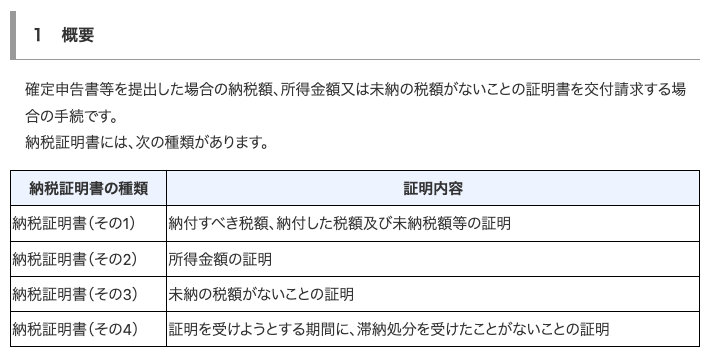
Japan’s National Tax Agency issues tax certificates (納税証明書) in four types, each for a different purpose:
| Type | What It Certifies |
|---|---|
| Type 1 | Tax payable, tax paid and unpaid tax, etc. |
| Type 2 | Amount of income |
| Type 3 | No unpaid tax |
| Type 4 | No default disposition during a specified period |
So “amount of income” and “no unpaid tax” correspond to Type 2 and Type 3 respectively; check which type the recipient actually wants before applying.
Where to apply: at the Tax Office that has jurisdiction over your current address or your place of tax payment.
If you cannot apply in person: if the individual or the company’s representative cannot attend in person, an authorized agent can handle it by attaching a power of attorney to the application. If an agent handles this as a business service, however, it falls under the tax-agent rules governed by the Certified Public Tax Accountant Act.
Whether an electronic version can be used: whether an electronic tax certificate’s PDF or XML file can be submitted directly needs to be confirmed with the receiving institution in advance.
CRS Tax-Residence Self-Certification
A bank asking you to fill in your country of tax residence, foreign taxpayer number and similar information relates to the Common Reporting Standard (CRS). In short, when opening an account or similar at a Japanese financial institution, you are required to self-certify your residence for tax purposes to that institution.
According to the National Tax Agency’s guidance, used from January 1, 2026:
- Anyone opening a new account or similar at a Japanese financial institution on or after January 1, 2017 is required to self-certify their tax residence information; from January 1, 2026, this scope expands to include certain fund transfer businesses
- Accounts opened on or before December 31, 2025 that were not originally required to file this self-certification may also be asked to file one voluntarily
- If the tax residence information changes after filing, an updated self-certification must be submitted within the set deadline, which includes the date three months after the change
| Situation | How to Fill It In |
|---|---|
| Tax residence is a foreign country | Enter that country’s taxpayer identification number |
| Tax residence is Japan | Still enter “Japan,” but no My Number is required |
| Both Japan and a foreign country are your tax residence | Both must be listed regardless of whether a tax treaty’s dual-residence tie-breaker rule applies |
| A specified legal entity | The tax residence of its beneficial owner must also be reported |
Tax residence for this purpose is not the same concept as “resident” under foreign exchange law, your residence status, or your nationality. Not entering a My Number on this self-certification form also does not mean a My Number is unnecessary for other procedures, such as a remittance or an investment.
**Example**: If Elena’s bank account was opened before 2017, no self-certification would have been required at the time, and the bank may still ask her to file one voluntarily now. If her tax residence is a particular country, she would enter that country’s taxpayer identification number.
Can You Open an Account or Receive an Overseas Remittance Without a My Number?
Someone living overseas may not have a Japanese My Number (マイナンバー). Whether this affects opening an account or receiving money depends on the bank and the type of transaction.
Under MUFG Bank’s current policy, for example:
- For a general deposit account opening, or a change of name or address: reporting a My Number is optional, and not reporting one currently does not affect the transaction
- For an outgoing or incoming overseas remittance: reporting is required
- If you have already reported your My Number to MUFG Bank once, you do not need to report it again
In a joint statement dated February 22, 2016, Japan’s Cabinet Office Social Security and Tax Number System Office and the Financial Services Agency stated clearly: where a remitter or recipient has no My Number because they are a non-resident, a financial institution will not refuse an incoming overseas remittance into a Japan-based account, or the withdrawal of those funds, for that reason alone, provided the non-resident status has already been formally reported to the institution.
Frequently Asked Questions
Do all banks want the same documents? No. Among the publicly available bank information gathered for this article, account-opening conditions and example documents differ, and are also adjusted according to the purpose of the transaction and the source of the funds.
Can I state a purpose that’s easier to get approved? No. Japanese law states that a customer or representative must not make a false statement about any item being confirmed at the time of a transaction.
Do I need to provide asset proof for any remittance over 2 million yen? No. The legal requirement for additional income and asset verification only applies to a high-risk transaction that also involves a transfer of property worth more than 2 million yen, though a bank may still ask for more documents under its own risk-management policy.
Can a non-resident without a My Number receive an overseas remittance? They will not be refused for that reason alone. According to the official joint statement of February 22, 2016, a non-resident without a My Number, because they are a non-resident, will not have an incoming overseas remittance into a Japan-based account, or the withdrawal of that money, refused by a financial institution for that reason alone, provided their non-resident status has already been formally reported to that institution.
Glossary
- Verification at the time of transaction: the process by which a bank, under the Act on Prevention of Transfer of Criminal Proceeds, confirms a customer’s identity and related information when carrying out certain transactions with them.
- Beneficial owner (実質的支配者): the natural person who can substantively control a company’s management, identified in order through tiers based on voting-rights holdings, controlling influence and similar factors.
- Source of funds (原資): where the money for a remittance or transaction comes from, for example salary, rental income or an inheritance.
- Tax certificate (納税証明書): a tax-related certificate issued by Japan’s National Tax Agency, available in four types, for example amount of income or no unpaid tax.
- CRS (Common Reporting Standard): an international standard requiring self-certification of tax residence information to a financial institution when opening an account or similar at that institution in Japan.
Methodology
- Content on verification at the time of transaction for individuals and companies, additional asset and income confirmation for high-risk transactions, and the determination of a beneficial owner is drawn from the text of Japan’s Act on Prevention of Transfer of Criminal Proceeds and its enforcement regulations. The relevant provisions are:
- Confirmation items for individuals and companies: Article 4, Paragraph 1 of the Act
- Method of self-declaring the purpose of the transaction and occupation, and documents for confirming business activities: Articles 9 and 10 of the Enforcement Regulations
- Verification of the person actually carrying out the transaction: Article 4, Paragraph 4 of the Act; special provisions for government agencies, etc.: Paragraph 5
- Prohibition on false statements: Article 4, Paragraph 6 of the Act
- Asset and income confirmation for high-risk transactions: Article 4, Paragraph 2 of the Act; asset and income documents for individuals and companies: Article 14, Paragraph 4 of the Enforcement Regulations
- Determination of the beneficial owner: Article 11 of the Enforcement Regulations; beneficial-owner verification for enhanced customer due diligence: Article 14, Paragraph 3 of the Enforcement Regulations
- The examples of remittance documents and the handling of the specific residence card are drawn from publicly disclosed materials from MUFG Bank, Sumitomo Mitsui Banking Corporation, Kiyo Bank, and Shizuoka Yaizu Shinkin Bank; there is no single, officially unified document list covering all banks, and individual bank practices may change.
- Sumitomo Mitsui Banking Corporation’s example remittance documents come from that bank’s July 2019 over-the-counter foreign remittance notice, which covers outgoing transactions to certain regions; Kiyo Bank’s examples come from that bank’s foreign remittance notice dated August 2026.
- The CRS tax-residence self-certification content is based on National Tax Agency guidance used from January 1, 2026; the My Number non-resident exception is based on the 2016 joint statement of the Cabinet Office Social Security and Tax Number System Office and the Financial Services Agency.
- The distinction between a loan and a gift between family members is based on the National Tax Agency’s Tax Answer guidance; whether an overseas family member or an overseas recipient of a gift is subject to Japanese tax depends on the individual case.
- Elena’s situation in this article is a fictional example used only to illustrate how the rules apply.
Have a question about this guide? Leave a comment below, or ask Zagdim directly.
Your first stop for international property and global living.
Research and insights. Know what’s changing. Understand what matters.
Sources
- e-Gov Law Search – Act on Prevention of Transfer of Criminal Proceeds, Article 4, Paragraph 1, Items 1–3
- e-Gov Law Search – Act on Prevention of Transfer of Criminal Proceeds, Article 4, Paragraph 1
- e-Gov Law Search – Act on Prevention of Transfer of Criminal Proceeds, Article 4, Paragraph 2
- e-Gov Law Search – Act on Prevention of Transfer of Criminal Proceeds, Article 4, Paragraphs 4 and 5
- e-Gov Law Search – Act on Prevention of Transfer of Criminal Proceeds, Article 4, Paragraph 6
- e-Gov Law Search – Enforcement Regulations of the Act on Prevention of Transfer of Criminal Proceeds, Articles 9 and 10
- e-Gov Law Search – Enforcement Regulations, Article 10, Item 2
- e-Gov Law Search – Enforcement Regulations, Article 10, Item 3
- e-Gov Law Search – Enforcement Regulations, Article 11, Paragraphs 1–4
- e-Gov Law Search – Enforcement Regulations, Article 14, Paragraph 3, Item 1
- e-Gov Law Search – Enforcement Regulations, Article 14, Paragraph 4, Item 1
- e-Gov Law Search – Enforcement Regulations, Article 14, Paragraph 4, Item 2
- MUFG Bank – Receiving an Overseas Remittance: Handling Under the Foreign Exchange and Other Laws
- MUFG Bank – Materials for Confirming the Details of Your Transaction: Examples of Remittance Purpose and Source of Funds
- Kiyo Bank – Request for Submission of Confirmation Documents for a Foreign Remittance: Document Examples and Terms
- Shizuoka Yaizu Shinkin Bank – Request Regarding Confirmation of Content for Outgoing and Incoming Foreign Remittances, Sections 1–3
- Sumitomo Mitsui Banking Corporation – Request Regarding Over-the-Counter Foreign Remittances: Remittances to Certain Regions, Document Examples
- National Tax Agency – G-1 Application Procedure for Tax Certificates: Types of Tax Certificate
- National Tax Agency – G-1 Application Procedure for Tax Certificates: Where to Apply, Electronic Tax Certificates, Who Can Apply
- National Tax Agency – No. 4420 Borrowing Money From a Parent: Overview and When It Is Treated as a Gift
- [National Tax Agency – A Self-Certification of Tax Residence Is Required When Opening an Account or Similar at a Financial Institution (For Use From January 1, Reiwa 8 [2026])](https://www.nta.go.jp/taxes/shiraberu/kokusai/crs/pdf/seidogaiyo_01.pdf)
- MUFG Bank – Request for Cooperation Regarding the Transaction Purpose Confirmation Form and How to Submit the Specific Residence Card
- MUFG Bank – About the My Number System
Important Notice
This article is general information and does not constitute tax or legal advice for any individual case. Rules in Japan, and in the reader’s own country, may be updated; please check current notices from the relevant authorities and consult a qualified professional for your own situation.