
*Written and verified by Zagdim Research. Last verified: 25 November 2026.*
The Reader’s Letter
Hello Zagdim,
>
I am asking on behalf of my boss. He is in his 50s, holds a passport from a European country and also has a Hong Kong ID card, and lives in Hong Kong. He is still the CEO of a company and still working. He has savings of more than THB 800,000 but does not yet have a Thai bank account. He would like to live in Thailand long term, and he has heard that he can apply for a retirement visa.
>
My questions: because he is still a CEO, would he be unable to get a retirement visa? If he still needs to manage the Hong Kong company remotely while in Thailand, would a DTV be more suitable? Also, must a retirement visa always begin with a 3-month Non-O visa, extended after entry, or can he apply directly in Hong Kong for a one-year visa?
>
To protect the reader, some details (such as age, city or dates) have been slightly changed; this does not affect the answer.
Zagdim’s Answer
Dear reader, thank you for writing in. Still being a CEO does not stop your boss from getting a Thailand retirement visa. What a retirement visa does not allow is working for a Thai company or Thai clients, or doing on-site work in Thailand. Handling a Hong Kong company’s affairs remotely from Thailand is not specifically regulated under the retirement visa, but the larger the share of company business he handles, the higher the risk that it is treated as working in Thailand. A retirement visa also does not have to start with a 3-month Non-O. If he is a Hong Kong permanent resident, he can apply directly in Hong Kong for a one-year O-A, with funds shown through Hong Kong bank deposits (his THB 800,000 or more in savings already meets the O-A deposit threshold), so he does not need to open a Thai account first. The DTV is another option; which one fits depends on how he plans to spend each year and how much of his time in Thailand goes to work.
Key Points
- A Thailand retirement visa is open from age 50 and does not require giving up an overseas job. What is not allowed is working for a Thai company or Thai clients, or doing on-site work in Thailand; the larger the share of time spent remotely running an overseas company, the higher the risk.
- Hong Kong permanent residents can apply directly in Hong Kong for a one-year O-A, with the deposit held in a Hong Kong bank.
- The 3-month Non-O route requires opening a Thai account after entry before the one-year extension can be applied for, so it has more steps.
- Who should pay attention: people aged 50 or over who are still running an overseas company and plan to live in Thailand long term.
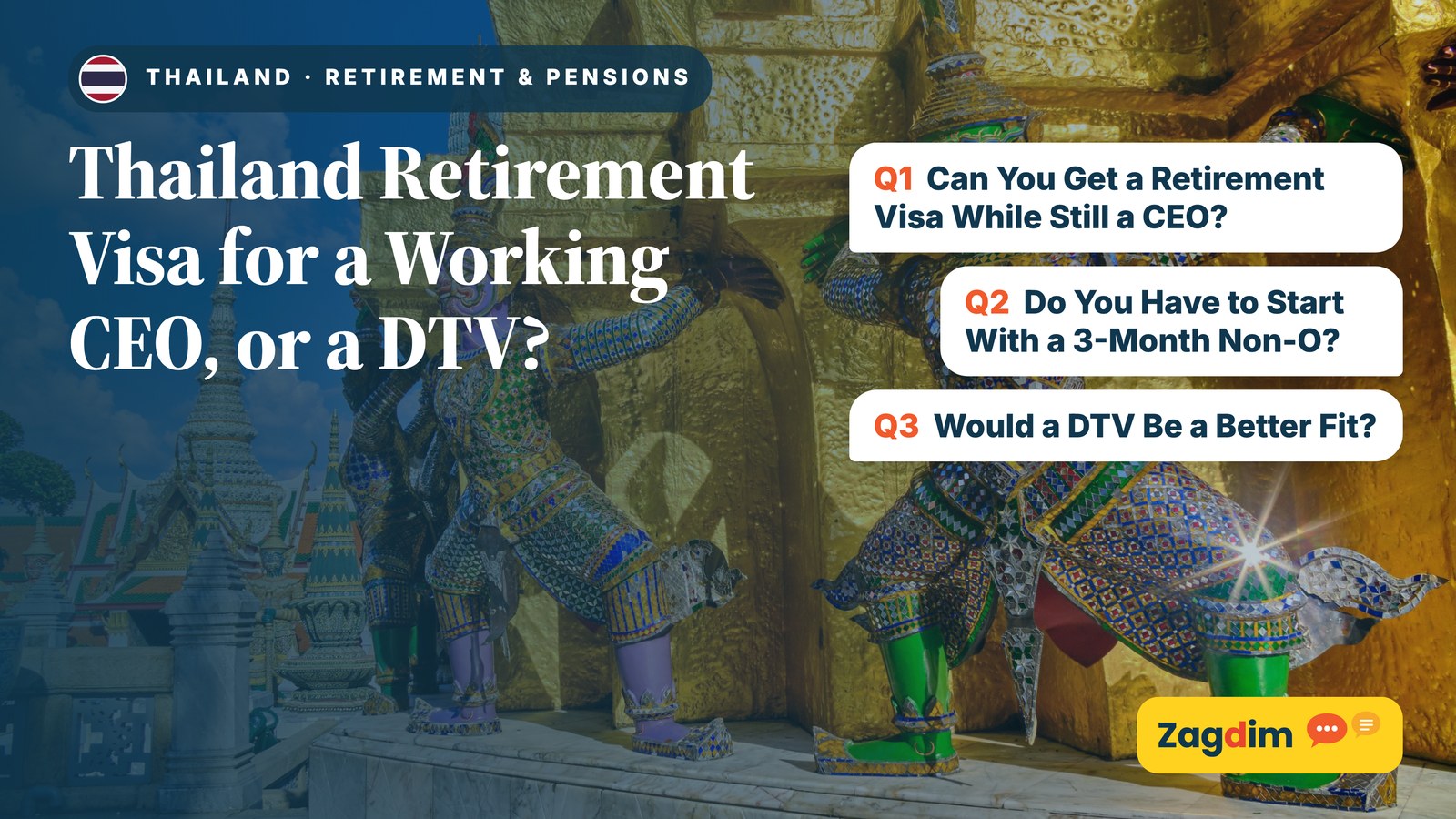
Can You Get a Retirement Visa While Still a CEO?
Yes. A retirement visa requires the applicant to be at least 50 years old. It does not require that they have already retired or stepped down from their company.
What matters is who you work for and where you work:
- Not allowed: being employed by a Thai company, providing services to a Thai company or Thai clients, or doing on-site work in Thailand (for example at a construction site or client location in Thailand). Neither the retirement visa nor the DTV allows these.
- Not specifically regulated: living in Thailand and handling a Hong Kong company’s affairs remotely, such as video meetings, approving documents and replying to email.
One caution: Thailand’s work law defines “work” very broadly. The larger the share of company business handled in Thailand, the higher the risk of being treated as working in Thailand.
Do You Have to Start With a 3-Month Non-O?
Not necessarily. Applying in Hong Kong, there are two routes:
| One-year O-A | 3-month Non-O, then extension after entry | |
|---|---|---|
| How long you can stay after one entry | 1 year, with multiple entries | 90 days, during which a one-year extension must be arranged |
| Funds | Hong Kong bank deposits are used at the time of application | Funds must also be shown at application; after entry, a Thai account must be opened before applying for the extension |
Since he does not yet have a Thai account, and wants to avoid moving money first and to have a full year from the day he enters, the O-A is more direct. To apply for an O-A in Hong Kong, he must first be a Hong Kong permanent resident. Other documents are also needed, such as a medical examination and a criminal record certificate.
Would a DTV Be a Better Fit?
It depends on how he lives and works. The DTV allows multiple entries over 5 years, with up to 180 days per entry, and can be extended once for another 180 days. To choose between the two, start with these questions:
- How long do you want to stay at a time? If you want a full year from the moment you enter, the retirement visa is simpler; with a DTV you need to extend or leave and re-enter to stay longer.
- How much of your time in Thailand goes to work? If you will be handling an overseas company’s affairs remotely every day, the DTV (remote work category) is a closer fit. If it is only occasional, the retirement visa has no specific rule, but the larger the share, the higher the risk.
- Do you need a Thai bank account? A DTV holder cannot open a Thai bank account. If he needs one in Thailand, that has to be part of the decision.
What Is Still Uncertain
If his Hong Kong ID card is not a permanent resident ID card, whether an O-A application can be accepted in Hong Kong must first be confirmed with the Royal Thai Consulate-General in Hong Kong. If it cannot, he can then ask which Thai mission will accept it, for example the Thai embassy or consulate in the country of his passport.
We wish you and your boss a smooth start to your plans for a long stay in Thailand.
Need help with this? Talk to the Zagdim reader desk
If you are deciding which route fits you, or which authority to deal with, the Zagdim Reader Desk can understand what you need and shortlist suitable professionals for your situation. The Reader Desk does not charge readers.
Message the Zagdim reader desk on WhatsApp Message the Zagdim reader desk on LINE
Have a question about this guide? Leave a comment below, or ask Zagdim directly.
Your first stop for international property and global living.
Research and insights. Know what’s changing. Understand what matters.
Sources
- Thai Ministry of Foreign Affairs, Non-Immigrant Visa O-A
- Royal Thai Consulate-General, Hong Kong, Visa Information
- Thai Ministry of Foreign Affairs, DTV Infographic
- Department of Employment, Emergency Decree on the Management of Foreign Workers (No. 2)
All sources accessed 25 November 2026.
This article is based on a question received by the Zagdim Reader Desk; identifying details were changed. The answer draws on what Zagdim knows about these applications and was checked against official sources.
Important Notice
This article is general information and is not legal, tax or immigration advice. Rules and fees may change; check the latest notices from the relevant authority before you apply. Information last checked: 25 November 2026.