



























Who Can Apply for Singapore PR? Six Groups Apply Online, and Citizenship Takes At Least 2 Years as a PR First
Under the rules of Singapore’s Immigration & Checkpoints Authority (ICA), Singapore PR (permanent residence) is open to six groups of foreigners who apply online, the application fee is S$100 per application, and applications are processed within 6 months once all documents are complete. An adult who wants to become a Singapore citizen must first hold PR for at least 2 years.
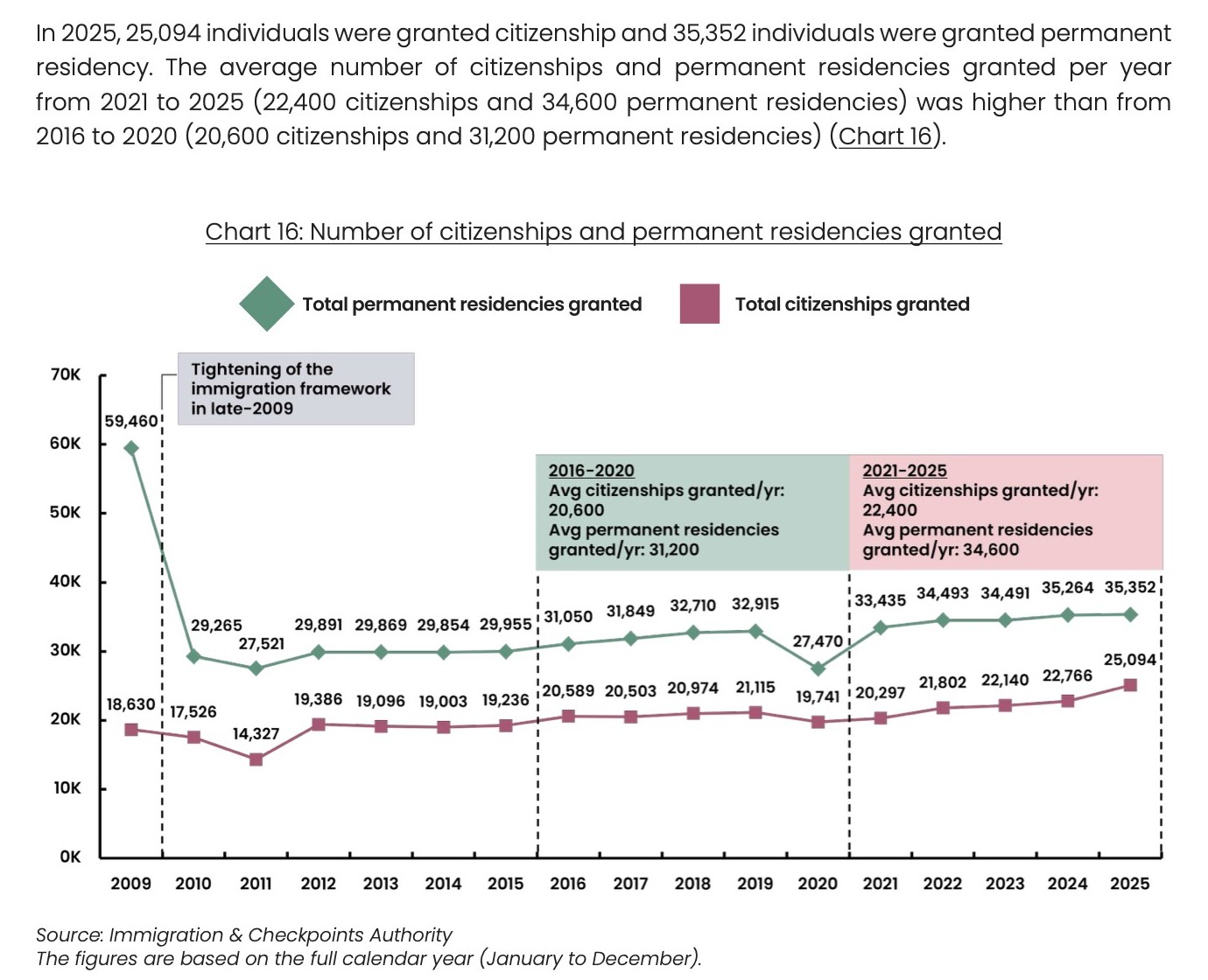
On 25 September 2026, the National Population and Talent Division (NPTD) in Singapore’s Prime Minister’s Office published its annual population report, Population in Brief 2026, jointly with the Department of Statistics, the Ministry of Home Affairs, ICA and the Ministry of Manpower. The report shows that 35,352 people were granted Singapore PR in 2025 and 25,094 were granted citizenship. Between 2021 and 2025, an average of around 34,600 PRs and 22,400 citizenships were granted each year, both higher than the 2016–2020 averages of 31,200 and 20,600. The report also states that all adult new citizens came from the PR population — in Singapore, you must hold permanent residence before you can apply for citizenship. Malaysia’s national news agency Bernama reported on the figures the following day.
This guide brings together ICA’s current Singapore PR eligibility rules, how to apply online, the fees, processing times, the obligations that come with PR, and the conditions for citizenship, in one place you can check against.
Key Points
- Who needs to take note: people working in Singapore on an Employment Pass (EP) or S Pass who are thinking of settling long term; foreign spouses of Singapore citizens or PRs; foreign families whose children study in Singapore; and anyone planning to take up Singapore citizenship later.
- Singapore PR has no published “minimum years of residence” or “minimum salary”. What ICA sets out is six groups who may apply, plus the factors it weighs: family ties, economic contributions, qualifications, age, family profile and length of residence.
- Once you hold Singapore PR, the two things most likely to cause trouble are travelling without a valid Re-Entry Permit (REP) and National Service obligations for sons.
- Citizenship requires at least 2 years as a PR, and because Singapore does not allow adults to keep dual citizenship, you will need to renounce your existing nationality along the way.
Singapore PR Eligibility: The Six Groups ICA Accepts
Permanent Resident (PR) status allows a foreigner to live in Singapore long term, and is approved by ICA. All six groups below are taken from ICA’s “Becoming a Permanent Resident” page (updated 13 March 2026):
| Applicant group | Who logs in to submit |
|---|---|
| Spouse of a Singapore citizen or PR | The spouse sponsors, logging in with Singpass |
| Unmarried child under 21 born to, or legally adopted by, a Singapore citizen or PR within a legal marriage | The parent sponsors, logging in with Singpass |
| Aged parent of a Singapore citizen aged 21 or over | The citizen child sponsors, logging in with Singpass |
| Employment Pass or S Pass holder | The applicant submits with their own Singpass |
| Student studying in Singapore who has passed at least one national exam (PSLE, GCE N/O/A Level) or is in the Integrated Programme (IP) | Singpass for those aged 15 and over; the non-Singpass option for those under 15 |
| Foreign investor in Singapore | Applies through the Economic Development Board’s (EDB) Global Investor Programme (GIP) |
Two points are often missed:
- For the aged-parent group, ICA specifies parents of a Singapore citizen — parents of a child who is only a PR are not covered.
- In assessing applications, ICA considers the applicant’s family ties to Singaporeans, economic contributions, qualifications, age, family profile and length of residence, to judge whether the applicant can contribute to Singapore, integrate into society and is committed to putting down roots. ICA does not publish approval rates or a scoring system.
Separately, the National Arts Council (NAC) runs the Foreign Artistic Talent Scheme (ForArts) for outstanding international arts professionals. NAC handles the first stage, but applicants must still submit a PR application to ICA, which makes the final decision.
How to Apply for Singapore PR: ICA e-Service and Your Documents
All Singapore PR applications are made online through ICA e-Service. In practice there are three things to watch:
- Every applicant has to log in and confirm. Each person included in the application must log in with Singpass (or the dedicated login ICA provides for those not eligible for Singpass) to review the form and make a declaration before it can be submitted. A Singpass account can take 2 to 5 working days to approve, and ICA recommends that everyone registers before the application is started.
- Documents must be uploaded as certified true copies. Documents not in English need an official translation: ICA accepts translations by the embassy of the issuing country, by a notary public in Singapore or in the place of issue, or a private translation certified by the embassy or notarised by a notary public. Incomplete documents may mean the application is not accepted.
- Male applicants should read up on National Service before applying. ICA asks all male applicants to check the National Service rules on the Central Manpower Base (CMPB) website before submitting.
ICA also states plainly on the page that it has no connection with any external organisation claiming to be a Singapore immigration specialist, consultant or partner, and does not support or endorse such PR application services.
Singapore PR Fees and Processing Time
The fees and processing time below all come from ICA’s “Becoming a Permanent Resident” page. None of the fees are refundable:
| Stage | Item | Fee |
|---|---|---|
| On submission | PR application fee | S$100 per application |
| Completing formalities after approval | Entry Permit | S$20 |
| Completing formalities after approval | 5-year Re-Entry Permit (REP) | S$50 |
| Completing formalities after approval | Singapore identity card | S$50 |
Payment can be made by Visa, MasterCard, American Express, direct debit from Singapore internet banking (DBS/POSB, OCBC, UOB, Standard Chartered), or PayNow.
Processing time: ICA’s wording is that, provided all required documents are complete and in order, applications are processed within 6 months — and it notes that some applications may take longer. The outcome is sent by email, and progress can be checked on MyICA or e-Service.
Successful applicants first receive In-Principle Approval, and only become Singapore PRs once the required formalities are completed. PRs aged 15 and over receive a blue identity card.
After You Get Singapore PR: Re-Entry Permits, Good Conduct and National Service
The 180-Day Rule for Re-Entry Permits (REP)
A Singapore PR who leaves Singapore and wants to return as a PR must hold a valid REP. According to ICA’s “Entry Permit and Re-Entry Permit Conditions for Singapore Permanent Residents” page:
| Situation | Rule |
|---|---|
| You leave without a valid REP | You must apply for an REP within 180 days of leaving; if you do not, you lose PR |
| You leave with an REP, but it expires while you are abroad | You must apply within 180 days of the REP’s expiry; if you do not, you lose PR |
| You apply within 180 days, but the application is refused | You also lose PR |
| Renewing an REP | You can apply online with Singpass from 3 months before expiry |
| Getting a new passport | You must transfer the remaining REP validity to the new passport online |
New Permit Conditions From 1 December 2025
From 1 December 2025, ICA added new conditions to all Entry Permits and Re-Entry Permits: a permit may be cancelled if the holder breaches its conditions, is found by a court or authority to have broken the law, or is judged by the Controller of Immigration to have behaved undesirably (including acting against national or public interest, threatening security, or harming public order). ICA also lists good-conduct conditions, such as not interfering in Singapore’s domestic politics, not importing foreign politics into Singapore, not engaging in activities that undermine social harmony, and not committing crimes. A PR who breaches them will have their status reviewed, which may lead to PR being revoked.
National Service for Male Singapore PRs
Under the Enlistment Act 1970, all male Singapore citizens and PRs must serve National Service (NS) unless exempted. The rules below come from the National Service section of ICA’s PR application page:
| Item | Rule |
|---|---|
| Who it covers | Males who obtained citizenship or PR as foreign students or under their parents’ sponsorship |
| Registration | At 16½ years old |
| Enlistment | As soon as possible after turning 18; may first complete A Levels, a polytechnic diploma or an equivalent pre-university qualification |
| University studies | The Ministry of Defence (MINDEF) does not grant deferment for university; those who obtain status while at university must interrupt their studies to enlist |
| Obligations after full-time service | Become Operationally Ready National Servicemen (NSmen), up to age 50 for officers and age 40 for other ranks |
| Penalty for breaking the law | A fine of up to S$10,000, imprisonment of up to 3 years, or both |
ICA also warns that giving up or losing PR without completing full-time NS will seriously affect any future application to work, study or hold a long-term pass in Singapore, and will also affect family members’ long-term passes, sponsorship eligibility, REP renewals and citizenship applications.
Singapore Citizenship Requirements: PR First, Then Four Stages
Who Can Apply for Citizenship
The eligibility rules below all come from ICA’s “Becoming a Singapore Citizen” page (updated 30 June 2026):
| Applicant | Conditions |
|---|---|
| Adult PR | At least 2 years as a PR and aged 21 or over; may apply together with a PR spouse and unmarried children under 21 |
| Spouse of a citizen | At least 2 years as a PR and married to a Singapore citizen for at least 2 years |
| Child of a citizen | Unmarried child under 21 born to, or legally adopted by, a Singapore citizen within a legal marriage |
| PR student | Resident in Singapore for more than 3 years (at least 1 of them as a PR), and has passed at least one national exam or is in the IP |
| Aged parent of a citizen | Is a PR, and the parent of a Singapore citizen aged 21 or over |
Citizenship fees: S$100 per application on submission, then S$70 for the certificate of citizenship and S$10 for the identity card (for new citizens aged 15 and over) after approval. ICA states that citizenship applications are processed within 12 months.
The Four Stages of Citizenship
According to ICA’s “Your Singapore Citizenship Roadmap”:
- Online application: normal processing time is 12 months.
- In-principle approval: applicants aged 16 to 60 must complete the Singapore Citizenship Journey (SCJ), made up of online learning modules and a quiz, an experiential tour and a dialogue session with community leaders; this takes about 2 months.
- Approval letter and registration: download the letter needed to renounce your foreign citizenship, apply to your home country’s authorities to renounce it (for those aged 21 and over), settle anything that must be dealt with before renunciation (ICA’s example is property held in your name), and then attend your appointment at the ICA Building to register as a citizen.
- Citizenship ceremony: usually held 3 to 6 months after registration, where the certificate of citizenship is presented.
Singapore Does Not Allow Adults to Keep Dual Citizenship
ICA has stated that the government currently has no plans to allow dual citizenship, and that anyone who wishes to become a Singapore citizen should be prepared to give up their existing nationality. The “renounce foreign citizenship” step in stage 3 is how that policy is carried out in practice. How to renounce your original nationality, and how long it takes, depends on the rules of the authorities in your home country.
The Investor Route: Global Investor Programme (GIP)
For foreign investors in Singapore, ICA directs applicants to EDB’s Global Investor Programme (GIP), which is administered by Contact Singapore under EDB. GIP thresholds are set by business scale — it is not a route for ordinary salaried professionals. The thresholds below are taken from EDB’s GIP Factsheet (version dated 5 May 2025); the actual criteria are whatever EDB’s latest announcement says:
| Applicant type | Main thresholds | Investment options available |
|---|---|---|
| Established business owner | At least 3 years’ entrepreneurial track record; company annual turnover of at least S$200 million (and the same on average over the past three years); at least 30% shareholding if a private company | A, B or C |
| Next-generation business owner | Family holds at least 30% of the company or is the largest shareholder; company annual turnover of at least S$500 million; applicant is part of the management | A, B or C |
| Founder of a fast-growth company | Unlisted company valued at at least S$500 million and backed by reputable venture capital or private equity investors | A, B or C |
| Family office principal | At least 5 years’ entrepreneurial, investment or management track record; net investible assets of at least S$200 million (excluding real estate) | C only |
The three investment options: A is investing at least S$10 million in a new or expanded business in Singapore; B is investing S$25 million in a GIP-select fund; C is setting up a single family office in Singapore with assets under management of at least S$200 million. A spouse and unmarried children under 21 can be included as dependants, and sons who obtain PR as dependants must also serve National Service; parents cannot be included.
Common Misunderstandings About Singapore PR: Five Things to Get Clear First
One: “Work in Singapore for a set number of years and you’ll get PR”
Why that is incomplete: ICA publishes no minimum length of residence or salary threshold; EP and S Pass holders are simply one of the groups eligible to apply. Length of residence is just one factor, weighed alongside family ties, economic contributions, qualifications and age.
Practical note: being eligible to apply does not mean you will be approved, and ICA does not publish approval rates.
Two: “I’m a PR, so I can apply for PR for my parents”
Why that is incomplete: ICA’s “aged parent” group covers the parents of a Singapore citizen aged 21 or over, not the parents of a PR.
Practical note: check first whether the sponsor is a citizen or a PR — the two can sponsor different people.
Three: “Once I have PR, I can live overseas indefinitely”
Why that is incomplete: travelling as a PR depends on a valid REP. If you leave without a valid REP, or it expires while you are abroad, you must apply within 180 days or lose PR — and a refused application has the same result.
Practical note: keep track of your REP’s expiry date; you can renew online from 3 months before it expires.
Four: “My son can finish university first and do National Service afterwards”
Why that is incomplete: ICA states that MINDEF does not grant deferment for university studies; males who obtained citizenship or PR as students or under a parent’s sponsorship register at 16½ and enlist after completing pre-university studies or turning 18, whichever is later.
Practical note: families with sons should weigh the NS timeline against their children’s education plans before applying.
Five: “Using a consultant makes approval more likely”
Why that is incomplete: ICA states plainly that it has no connection with any external organisation claiming to be an immigration consultant or partner, and does not support or endorse such PR application services.
Practical note: applications are made only through ICA e-Service; prepare your documents and translations to ICA’s requirements.
Singapore PR Application Scenarios
One: A Professional Who Has Worked in Singapore on an EP for Three Years
Background: a foreign professional has worked in Singapore on an EP for three years and plans to settle long term.
How to handle it: EP holders are one of the groups ICA accepts, so the applicant submits through ICA e-Service with their own Singpass. If a spouse and children apply at the same time, every applicant must log in to confirm, and anyone without Singpass needs to set it up first.
What not to overlook: if a son obtains PR as part of the application, he will have National Service obligations; and the S$100 application fee is not refunded whatever the outcome.
Two: A Foreign Spouse Married to a Singapore Citizen
Background: a foreign spouse married to a Singapore citizen wants Singapore PR and may later consider citizenship.
How to handle it: the citizen spouse sponsors the PR application, logging in with Singpass. After at least 2 years as a PR and at least 2 years of marriage, the citizen spouse can sponsor a citizenship application.
What not to overlook: during the citizenship process you will have to apply to your home country’s authorities to renounce your existing nationality, so allow time for that step.
Three: A Foreign Family Whose Child Is at Secondary School in Singapore
Background: the family lives in Singapore on long-term passes, and their child has passed the PSLE.
How to handle it: students studying in Singapore who have passed a national exam can apply for PR themselves — with Singpass if aged 15 or over, or through the non-Singpass option if under 15.
What not to overlook: a boy who obtains PR as a student must register for National Service at 16½; if he later gives up PR without completing NS, it will affect future applications to work or study in Singapore and his family’s pass applications.
FAQ: Singapore PR Applications and Citizenship
How much does a Singapore PR application cost?
Under ICA’s rules, each application costs S$100 on submission. After approval, completing the formalities costs S$20 for the Entry Permit, S$50 for a 5-year Re-Entry Permit and S$50 for the Singapore identity card. None of the fees are refundable; payment can be made by credit card, direct debit from Singapore internet banking or PayNow.
How long does a Singapore PR application take?
ICA’s wording is that, provided all required documents are complete and in order, applications are processed within 6 months, and some applications may take longer. The outcome is sent by email, and progress can be checked on MyICA or ICA e-Service. Successful applicants first receive In-Principle Approval and become PRs once the formalities are completed.
Can I apply for Singapore PR on an S Pass?
Yes. Of the six groups ICA lists, Employment Pass and S Pass holders form one group, and apply through ICA e-Service with their own Singpass. ICA publishes no minimum salary or minimum length of residence; applications are assessed on economic contributions, qualifications, age, family profile, length of residence and other factors taken together.
Does my son have to do National Service if he is a Singapore PR?
Under the Enlistment Act 1970, male Singapore citizens and PRs must serve National Service unless exempted. Boys who obtained PR as foreign students or under their parents’ sponsorship must register at 16½ and enlist after completing pre-university studies or turning 18; MINDEF does not grant deferment for university. Giving up PR without completing NS will affect future applications to work or study in Singapore, as well as family members’ passes.
Will I lose Singapore PR if I live overseas for a long time?
It comes down to the Re-Entry Permit (REP). Under ICA’s rules, if a PR leaves without a valid REP, or the REP expires while they are abroad, they must apply for an REP within 180 days; failing to apply in time, or having the application refused, means losing PR. An REP can be renewed online with Singpass from 3 months before it expires.
How long do I need to be a PR before applying for Singapore citizenship?
Adults generally need at least 2 years as a PR and to be aged 21 or over; spouses of Singapore citizens need at least 2 years as a PR and at least 2 years of marriage. Citizenship applications are processed within 12 months, and after in-principle approval, applicants aged 16 to 60 must also complete the Singapore Citizenship Journey (SCJ).
Can I keep my original nationality if I become a Singapore citizen?
No. ICA has stated that the government currently has no plans to allow dual citizenship, and that anyone wishing to become a Singapore citizen should be prepared to give up their existing nationality. During the process, applicants aged 21 and over must apply to their home country’s authorities to renounce their nationality before registering as a citizen at ICA.
Planning a Long-Term Move to Singapore? Ask Zagdim
For Singapore PR, citizenship or any other practical question about living in Singapore, Ask Zagdim.
Life abroad? Ask Zagdim.
Your first stop for international property and global living.
Research and insights. Know what’s changing. Understand what matters.
Get overseas change alerts → When a change affects you, we’ll write.
Important Disclaimer
This article is general information and does not constitute legal or immigration advice, nor does it indicate the outcome of any application. It is based on the current public pages of Singapore’s Immigration & Checkpoints Authority (ICA), material published by the Economic Development Board (EDB), and Population in Brief 2026, published in September 2026. Singapore PR and citizenship applications are assessed case by case by ICA, and the rules may change. Before applying, check ICA’s and EDB’s latest announcements, and consult a suitably qualified professional where necessary.
Rules current as of September 2026; refer to ICA and EDB for the latest official position.
References
Immigration & Checkpoints Authority – Becoming a Permanent Resident / Immigration & Checkpoints Authority – Becoming a Singapore Citizen / Immigration & Checkpoints Authority – Entry Permit and Re-Entry Permit Conditions for Singapore Permanent Residents / Immigration & Checkpoints Authority – Your Singapore Citizenship Roadmap / Immigration & Checkpoints Authority – Response on Dual Citizenship (16 February 2013) / Singapore Economic Development Board – Global Investor Programme / National Arts Council – Foreign Artistic Talent Scheme (ForArts) / National Population and Talent Division – Population in Brief 2026 / The Star – Singapore population grows 1.6 pct to 6.21 mln in June 2026