
































Why Couldn’t a 34-Year-Old Stroke Patient Use Japan Long-Term Care Insurance? A 27 September 2026 Report Highlights the Age-40 Divide
According to the Ministry of Health, Labour and Welfare (MHLW, Kosei Rodo-sho), Japan long-term care insurance (kaigo hoken) only begins at age 40: people aged 65 and over are Category 1 insured persons, and people aged 40 to 64 are Category 2 insured persons. Anyone under 40 who needs care has to use disability welfare services (shogai fukushi sabisu) instead. These services are based on the Act on Comprehensive Support for Persons with Disabilities (Shogaisha Sogo Shien Ho), and applications are made to the municipality (shikuchoson) where you live.
On 27 September 2026, Tokai Television (Tokai TV) reported, in a story carried by Yahoo! News Japan, on a man who is now 37. At 34, while working for a trading company in Tokyo, he suffered a brainstem infarction. He was unconscious for about a month and survived, but was left with severe after-effects including paralysis on both sides of his body. At the time of the report he was in rehabilitation, aiming to return to work in autumn 2027. The report noted that rehabilitation under medical insurance runs for up to 180 days after onset, and that long-term care insurance would normally take over after that — but he was under 40 when he fell ill, so he was not covered by long-term care insurance.
The same stroke leads to different systems depending on whether it happens at 34 or 44, at 64 or 66. So what does the long-term care insurance that foreigners living and working in Japan pay each month, through their salary or insurance premiums, actually cover? This guide first explains how the system works, then sets out which system applies when care is needed in three age bands — under 40, 40 to 64, and 65 and over — and finally looks at what readers in different situations need to watch.
Key Points
- Who needs to take note: foreigners working, freelancing or studying in Japan; anyone in Japan who has turned 40 and started having long-term care insurance premiums deducted; and families planning to bring parents aged 65 and over to live with them in Japan.
- Long-term care insurance in Japan does not depend on nationality: foreigners who are registered as residents and live in Japan, or expect to live there, for more than 3 months become insured persons from age 40, and Category 2 premiums are paid together with health insurance premiums.
- People aged 40 to 64 can only use long-term care insurance when their care needs are caused by one of 16 specified diseases (tokutei shippei). Cerebrovascular disease is on the list; injuries such as those from traffic accidents are not. From 65, the cause does not matter.
- People under 40 who need care apply for disability welfare services at the disability welfare counter of their municipality (shikuchoson). Medical insurance benefits such as the high-cost medical expense benefit and the sickness and injury allowance can also help bridge the gap.
How Japan Long-Term Care Insurance Works: Who Joins, How Premiums Are Paid and What You Pay When You Use It
Automatic Enrolment at 40: Category 1 and Category 2 Insured Persons
The scheme began in April 2000, and the insurer is the municipality where you live. MHLW’s explanation is direct: when a person turns 40, they join long-term care insurance as an insured person (hihokensha), and from then on pay a monthly long-term care insurance premium (kaigo hokenryo). The two categories of insured person differ as follows; everything in the table comes from MHLW’s “What Is Long-Term Care Insurance?” (Kaigo Hoken to wa) and “Overview of the Long-Term Care Insurance System” (Kaigo Hoken Seido no Gaiyo, July 2025):
| Category | Who | How premiums are paid | When you can use it |
|---|---|---|---|
| Category 1 insured person (dai-1-go hihokensha) | Aged 65 and over | Collected by the municipality, in principle deducted from pension | When you need long-term care (yokaigo) or support in daily life (yoshien), whatever the cause |
| Category 2 insured person (dai-2-go hihokensha) | Aged 40 to 64 and enrolled in medical insurance | Collected by the health insurance or National Health Insurance scheme together with medical insurance premiums | Only when the need for long-term care or support is caused by one of the 16 specified diseases |
In either category, you must first pass the care-needs certification (yokaigo nintei) before using care services. Paying premiums does not by itself entitle you to call on services.
Foreigners Are Included: Resident Registration and a Stay of More Than 3 Months
Foreigners are insured persons under the scheme in the same way. A Q&A on foreign residents that MHLW issued to local governments on 1 June 2012 states that foreign residents as defined in Article 30-45 of the Basic Resident Registration Act are insured persons under long-term care insurance, including people living in Japan on statuses such as “Entertainer” (kogyo) and “Dependent” (kazoku taizai). People whose period of stay is 3 months or less but who are expected to stay for more than 3 months may also be included at the municipality’s discretion. For those who join after arriving in Japan, eligibility starts from the date they register their move-in. MHLW’s latest administrative notice, dated 30 April 2026, still refers to these handling principles.
The following foreigners are not insured persons under long-term care insurance, based on the MHLW Q&A above and Kobe City’s public guidance (updated 13 November 2024):
| Status of residence | Insured under long-term care insurance? |
|---|---|
| “Designated Activities” for coming to Japan to receive medical treatment, or to care for someone receiving treatment | No |
| “Designated Activities” for long-term sightseeing or recreation | No |
| “Diplomat”, and members of the US forces and their families | No |
| “Official” with a period of stay of 3 months or less | No |
| Other foreign residents with a resident record who stay for more than 3 months | Yes (from age 40) |
The same MHLW Q&A also notes that newly arrived foreigners must still declare their income, and that municipalities cannot calculate premiums on the assumption of no income simply because a person’s status of residence does not permit work.
What You Pay When You Use It: 10% to 30%
Once certified, you pay in principle 10% of the cost of care services, with insurance covering the rest. People aged 65 and over with income above a certain level pay 20% or 30%. According to Bunkyo City’s public guidance, Category 2 insured persons aged 40 to 64 pay 10% regardless of income. Everyone who is certified receives, each year, a certificate stating their co-payment ratio (kaigo hoken futan wariai sho), which must be shown together with the insurance card when using services.
Which System Applies When You Need Care: Japan Long-Term Care Insurance by Age Band
The three age bands below are based on MHLW’s “What Is Long-Term Care Insurance?” and the National Rehabilitation Center for Persons with Disabilities’ (Kokuritsu Shogaisha Rihabiriteshon Senta) page “About Welfare Services” (Fukushi Sabisu ni tsuite Shiritai):
| Age at onset | Cerebrovascular disease (stroke) | Non-specified causes such as brain injury from a traffic accident | Where to apply |
|---|---|---|---|
| Under 40 | Disability welfare services under the Act on Comprehensive Support for Persons with Disabilities | Disability welfare services | Municipal disability welfare counter |
| 40 to 64 | Long-term care insurance takes priority in principle; services not offered by long-term care insurance can be obtained through disability welfare services | Disability welfare services | Long-term care insurance counter; disability welfare counter |
| 65 and over | Long-term care insurance | Long-term care insurance | Municipal long-term care insurance counter |
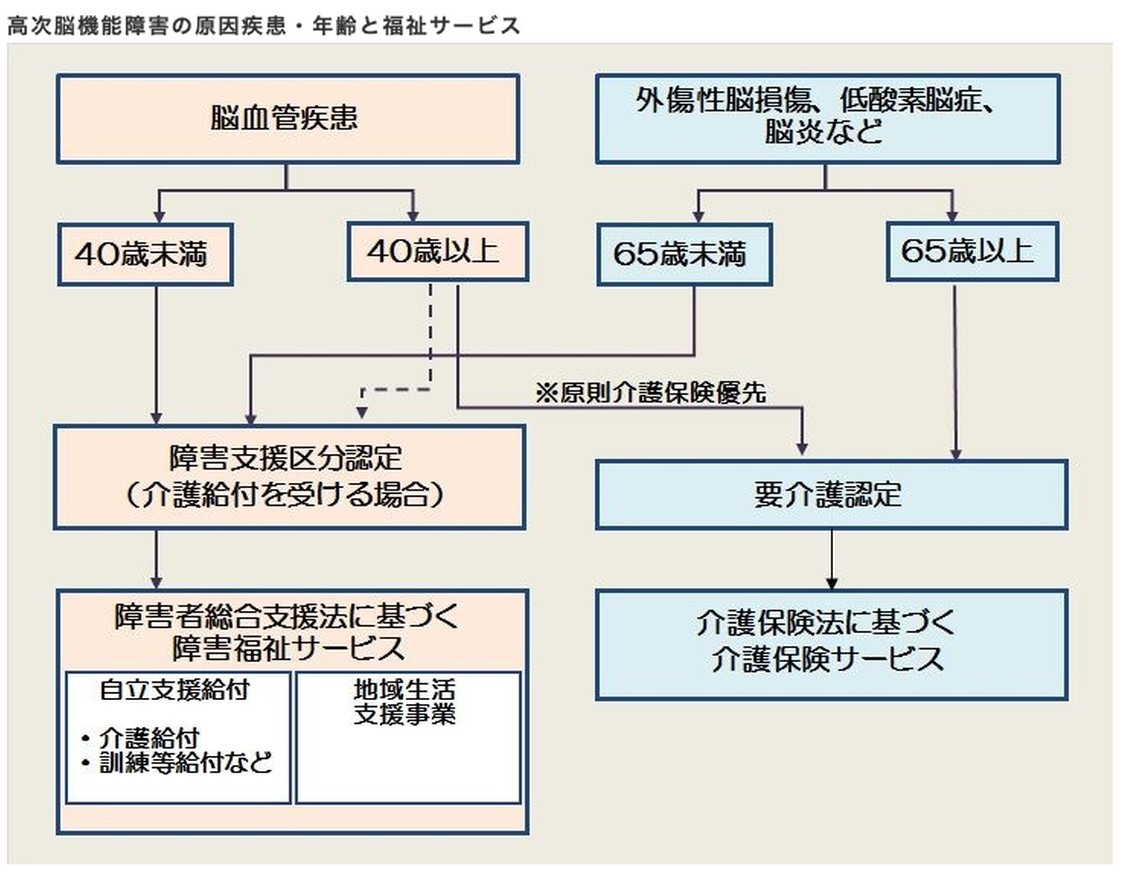
This flowchart comes from the National Rehabilitation Center for Persons with Disabilities’ explanatory page on higher brain dysfunction (koji noki shogai — cognitive impairments such as memory and attention problems after brain injury), but its logic for splitting by age and system matches the table above.
Under 40: Disability Welfare Services
People under 40 are not insured under long-term care insurance, so the main system when they need care is disability welfare services under the Act on Comprehensive Support for Persons with Disabilities. These fall into two broad types: “care benefits” (kaigo kyufu), which help with bathing, toileting, meals and similar needs, and “training benefits” (kunren-to kyufu), aimed at independent living and employment. To use care benefits, you first need a disability support category certification (shogai shien kubun nintei). Enquiries and applications both go to the disability welfare counter of your municipality.
What you pay for disability welfare services is capped each month according to household income. The four categories below come from MHLW’s “User Charges for Persons with Disabilities” (Shogaisha no Riyosha Futan); for people aged 18 and over, the “household” counts only the person and their spouse:
| Category | Household income | Monthly cap |
|---|---|---|
| Public assistance | Household receiving public assistance (seikatsu hogo) | 0 yen |
| Low income | Household exempt from municipal resident tax | 0 yen |
| General 1 | Household paying municipal resident tax, with an income-based portion under 160,000 yen (excluding residents of care facilities aged 20 and over and group home users) | 9,300 yen |
| General 2 | All others | 37,200 yen |
People whose paralysis of the limbs or speech impairment meets MHLW’s grading table can apply to their municipality for a physical disability certificate (shintai shogaisha techo). Holding the certificate brings various reductions and support with taxes, public charges and employment, and also gives access to disability welfare services.
40 to 64: Japan Long-Term Care Insurance Only for 16 Specified Diseases
People aged 40 to 64 are already paying long-term care insurance premiums, but can only use it when their care needs are caused by one of the 16 specified diseases below. The list is taken from MHLW’s “Criteria for Selecting Specified Diseases” (Tokutei Shippei no Sentei Kijun no Kangaekata), under Article 2 of the Enforcement Order of the Long-Term Care Insurance Act:
| Group | Specified diseases |
|---|---|
| Brain and nerves | Cerebrovascular disease (nokekkan shikkan); presenile dementia; amyotrophic lateral sclerosis (ALS); progressive supranuclear palsy, corticobasal degeneration and Parkinson’s disease; spinocerebellar degeneration; multiple system atrophy |
| Bones and joints | Rheumatoid arthritis; ossification of the posterior longitudinal ligament; osteoporosis with fractures; spinal canal stenosis; osteoarthritis with marked deformity of both knee joints or both hip joints |
| Other | Terminal cancer (only where a doctor judges recovery is not possible); progeria; diabetic neuropathy, diabetic nephropathy and diabetic retinopathy; arteriosclerosis obliterans; chronic obstructive pulmonary disease (COPD) |
Cerebrovascular disease is on the list, so a stroke at 40 or over is in principle handled first by long-term care insurance. The National Rehabilitation Center for Persons with Disabilities also explains that care services take priority over disability welfare services, but services that long-term care insurance does not offer — such as independence training (jiritsu kunren) and employment transition support (shuro iko shien) — can still be applied for through disability welfare services. Conversely, a brain injury caused by a traffic accident or other trauma between 40 and 64 is not a specified disease, so it goes through disability welfare services.
65 and Over: Any Cause, Apply for Care-Needs Certification
For Category 1 insured persons aged 65 and over, whether the need arises from illness, injury or age-related decline, anyone certified as requiring long-term care or support can use long-term care insurance services, such as home care, day care, home adaptations and admission to a care facility.
How to Apply for Japan Long-Term Care Insurance: Five Steps to Care-Needs Certification
The process below comes from MHLW’s “Overview of the Long-Term Care Insurance System” and public guidance from the Fukuoka Prefecture Long-Term Care Insurance Wide-Area Union:
| Step | What happens |
|---|---|
| 1. Application | Apply for care-needs certification at the long-term care insurance counter of your municipality; community comprehensive support centres (chiiki hokatsu shien senta) also take enquiries |
| 2. Assessment visit | A municipal assessor visits your home and carries out a 74-item basic assessment of your physical and mental condition |
| 3. Attending physician’s opinion | Your attending doctor provides a written opinion |
| 4. First and second determinations | A computer makes the first determination from the assessment results, then a care-needs certification board of health, medical and welfare experts makes the second |
| 5. Notification | In principle, you are notified within 30 days of applying; results are not applicable (independent), requiring support 1 or 2, or requiring long-term care 1 to 5 |
The result is recorded on your insurance card, including the care (or support) level, the period of validity and the benefit limit, which together determine which services you can use.
What Other Support Is There for People Under 40? High-Cost Medical Expense Benefit, Sickness and Injury Allowance, Disability Certificates
Although people under 40 cannot use long-term care insurance, medical insurance itself offers several benefits that can help bridge the gap. The basis differs for each row:
| Support | What it provides | Who can use it | Source |
|---|---|---|---|
| High-cost medical expense benefit (kogaku ryoyohi) | If your out-of-pocket medical costs in one month exceed a limit, the excess is refunded; the limit depends on age and income, and from August 2026 the monthly caps were adjusted and a new annual cap introduced | Members of employee health insurance and National Health Insurance | Japan Health Insurance Association (Kyokai Kenpo), “High-Cost Medical Expense Benefit” |
| Sickness and injury allowance (shobyo teatekin) | If you cannot work because of an illness or injury not related to work, it is paid from the 4th day after 3 consecutive days off; the daily amount is about two-thirds of your standard daily remuneration, for up to 1 year and 6 months in total | Members of company health insurance | Japan Health Insurance Association, “Sickness and Injury Allowance” |
| Sickness and injury allowance under National Health Insurance | Article 58 of the National Health Insurance Act says municipalities “may” provide it by local ordinance; it is not mandatory | Members of National Health Insurance | National Health Insurance Act |
| Physical disability certificate | Available to people whose paralysis of the limbs or speech impairment meets the grading table | People who meet the grade | National Rehabilitation Center for Persons with Disabilities |
| Mental disability health and welfare certificate (seishin shogaisha hoken fukushi techo) | Available for higher brain dysfunction; the medical certificate must be issued at least 6 months after the first consultation, and the application made within 3 months of its issue | People with a qualifying diagnosis | National Rehabilitation Center for Persons with Disabilities |
Foreigners in Japan and Japan Long-Term Care Insurance: By Situation
The table below sets out common situations; each row is based on MHLW’s Q&A on foreign residents, its explanation of Category 2 premiums, and public guidance from Meguro City and Kobe City:
| Situation | Relationship to long-term care insurance | What to watch |
|---|---|---|
| Foreigner working for a Japanese company, enrolled in health insurance | Category 2 from age 40; premiums deducted from salary together with health insurance premiums | Before 40, care needs go through disability welfare services; the sickness and injury allowance is also available |
| Self-employed, freelancers, students (National Health Insurance) | Category 2 from age 40; premiums included in National Health Insurance premiums | National Health Insurance may not offer a sickness and injury allowance; most students are under 40 and not covered by long-term care insurance |
| Foreign resident aged 65 or over with a resident record | Category 1; can use it whatever the cause | Premiums collected by the municipality |
| Parents visiting family on a short-term stay | No resident registration, so generally not covered by long-term care insurance or National Health Insurance | Medical treatment and care in Japan are in principle paid in full out of pocket; follow your municipality’s guidance |
| “Designated Activities” for medical stays or long-term sightseeing and recreation | Not insured persons | As above |
Working in Japan: Health Insurance and Long-Term Care Insurance Deducted Together
If you work for a company in Japan and are enrolled in its health insurance, a long-term care insurance premium line appears on your payslip once you turn 40. According to MHLW, Category 2 premiums are collected by each medical insurer together with health insurance premiums, so there is nothing extra to arrange. The point to note is that if you have a sudden stroke or serious injury before 40, long-term care insurance cannot help; you will rely on the high-cost medical expense benefit and sickness and injury allowance under medical insurance, and on your municipality’s disability welfare services.
Self-Employed People and Students: National Health Insurance Members
According to Meguro City’s public guidance, foreigners in Japan who are self-employed, freelancing or studying and who stay for more than 3 months must join National Health Insurance, within 14 days of registering their move-in. After turning 40, the long-term care insurance premium is included in the National Health Insurance premium. Unlike company employees, whether a sickness and injury allowance exists under National Health Insurance is decided by each municipality’s ordinance, so there may be no income replacement if you are too ill to work — something to know in advance.
Families Bringing Parents to Japan: Can Parents Aged 65 and Over Use It?
Whether parents aged 65 and over can use long-term care insurance depends on whether they have become “foreign residents”. If they have a resident record, stay for more than 3 months and their status of residence is not one of the excluded types in the table above, they are Category 1 insured persons and can apply for care-needs certification when they need care. Conversely, parents visiting on a short-term stay without resident registration are generally not covered; and MHLW and local government guidance both state that people in Japan on “Designated Activities” for medical stays or long-term sightseeing and recreation are not insured persons. Which status of residence would allow parents to live in Japan long term is a separate question that this guide does not cover.
Common Misunderstandings About Japan Long-Term Care Insurance: Five Things Foreigners Most Often Get Wrong
One: “I pay long-term care insurance premiums, so I can use it if I have a stroke”
Why that is incomplete: people aged 40 to 64 can only use it when their care needs are caused by one of the 16 specified diseases; people under 40 are not even insured persons yet.
Practical note: for care needs before 40, go to your municipality’s disability welfare counter.
Two: “Foreigners don’t have to join Japan long-term care insurance”
Why that is incomplete: according to MHLW, foreign residents with resident registration are insured persons, join automatically at 40, and pay premiums through health insurance or National Health Insurance.
Practical note: the long-term care insurance premium on your payslip or National Health Insurance bill is a statutory premium, not an optional add-on you can opt out of.
Three: “Anyone aged 40 to 64 who needs care after an injury can use long-term care insurance”
Why that is incomplete: brain injury from a traffic accident or other trauma is not a specified disease, so people aged 40 to 64 go through disability welfare services, and only switch to long-term care insurance from 65.
Practical note: before applying, check whether the cause is on the list of 16 specified diseases.
Four: “Once you use long-term care insurance, you can’t use disability welfare services”
Why that is incomplete: long-term care insurance takes priority, but services it does not offer, such as independence training and employment transition support, can still be applied for through disability welfare services.
Practical note: if you want to return to work, consult both the long-term care insurance counter and the disability welfare counter.
Five: “Parents visiting Japan can also use Japan long-term care insurance”
Why that is incomplete: long-term care insurance covers foreign residents with resident registration; parents on a short-term stay without a resident record are generally not covered, and “Designated Activities” for medical stays and long-term sightseeing and recreation are expressly excluded.
Practical note: before bringing parents to Japan, check their status of residence and resident registration, and plan ahead for medical and care costs.
Japan Long-Term Care Insurance Scenarios
One: A 35-Year-Old Taiwanese Engineer Working in Tokyo Has a Sudden Stroke
Background: works for a Japanese company, is enrolled in company health insurance and is not yet 40.
How to handle it: the high-cost medical expense benefit can reduce out-of-pocket hospital costs. For periods when they cannot work and the company is not paying salary, they can claim the sickness and injury allowance after 3 consecutive days off, for up to 1 year and 6 months in total. If home care or training to return to work is needed after discharge, they apply for disability welfare services at their municipality’s disability welfare counter; anyone with paralysis of the limbs can apply for a physical disability certificate at the same time.
What not to overlook: long-term care insurance does not apply; the details of disability welfare services, and how they apply to foreigners, follow the guidance of the municipality where they live.
Two: A 52-Year-Old Hong Kong Designer Freelancing in Osaka Has a Cerebral Infarction
Background: self-employed, enrolled in National Health Insurance and already paying long-term care insurance premiums (Category 2).
How to handle it: cerebrovascular disease is one of the 16 specified diseases, so they apply to the municipality for care-needs certification and, once certified, can use long-term care insurance services with a 10% co-payment. If they want employment training, employment transition support — which long-term care insurance does not offer — can be applied for separately at the disability welfare counter.
What not to overlook: whether National Health Insurance offers a sickness and injury allowance is decided by municipal ordinance, so check in advance what income replacement is available while they cannot work.
Three: A Family Bringing a 68-Year-Old Mother to Live With Them in Tokyo
Background: the adult children work in Japan and want their mother to live with them long term and use care services if needed.
How to handle it: if the mother obtains a status that allows resident registration and a stay of more than 3 months, and it is not an excluded type such as a medical stay or long-term sightseeing and recreation, she is a Category 1 insured person and can apply for care-needs certification when she needs care, whatever the cause.
What not to overlook: if she comes to Japan on a short-term stay without a resident record, she is generally not covered by long-term care insurance or National Health Insurance; whether a status of residence can be obtained is a separate question.
FAQ: Japan Long-Term Care Insurance for Foreigners
Do foreigners in Japan have to join Japan long-term care insurance?
Yes. According to the Q&A on foreign residents that MHLW issued to local governments, foreign residents as defined in the Basic Resident Registration Act are insured persons under long-term care insurance and join automatically at 40; people whose period of stay is 3 months or less but who are expected to stay for more than 3 months may also be included at the municipality’s discretion. People staying on “Designated Activities” for medical stays or long-term sightseeing and recreation, and those with “Diplomat” status and similar, are not included.
If I have a stroke before 40 and cannot use Japan long-term care insurance, where do I apply for care?
Enquire and apply at the disability welfare counter of your municipality for disability welfare services under the Act on Comprehensive Support for Persons with Disabilities. These include care benefits for bathing, toileting, meals and similar, and training benefits aimed at independent living and employment; to use care benefits you first need a disability support category certification. What you pay is capped each month according to household income, at a maximum of 37,200 yen, and 0 yen for low-income households.
When can people aged 40 to 64 use Japan long-term care insurance?
Only when the need for long-term care or support is caused by one of the 16 specified diseases, which include cerebrovascular disease, terminal cancer, rheumatoid arthritis, presenile dementia and Parkinson’s disease; the list is set by Article 2 of the Enforcement Order of the Long-Term Care Insurance Act. Injuries such as those from traffic accidents are not on the list, so people aged 40 to 64 go through disability welfare services. Before using services, you must apply to your municipality for care-needs certification.
How are Japan long-term care insurance premiums paid? Will foreigners get a separate bill?
For Category 2 insured persons aged 40 to 64, premiums are collected by the health insurance or National Health Insurance scheme together with medical insurance premiums: company employees have them deducted from salary, and National Health Insurance members pay them as part of their premium. For Category 1 insured persons aged 65 and over, premiums are collected by the municipality and in principle deducted from pension. Newly arrived foreigners with no income record in Japan must still declare their income to the municipality.
How much do I pay when using Japan long-term care insurance?
In principle 10%. People aged 65 and over with income above a certain level pay 20% or 30%; Category 2 insured persons aged 40 to 64 pay 10% regardless of income. Everyone certified receives a certificate stating their co-payment ratio, which must be shown together with the insurance card when using services. Costs such as accommodation and meals are charged separately.
Can parents aged 65 and over coming from overseas use Japan long-term care insurance?
It depends on whether they become foreign residents with resident registration and a stay of more than 3 months. If so, they are Category 1 insured persons and can apply for care-needs certification when they need care, whatever the cause. Parents visiting on a short-term stay without a resident record are generally not covered, and “Designated Activities” for medical stays and long-term sightseeing and recreation are expressly excluded. Individual cases follow the guidance of the municipality where they live.
How long does care-needs certification take?
In principle, you are notified within 30 days of applying. You apply to your municipality, an assessor visits for a 74-item basic assessment, your attending doctor provides an opinion, and after a first determination by computer and a second by the care-needs certification board, the result is not applicable (independent), requiring support 1 or 2, or requiring long-term care 1 to 5. For people aged 40 to 64, the care needs must also be caused by one of the 16 specified diseases.
Planning to Work or Live Long Term in Japan? Ask Zagdim
To work out which insurance you or your family belong to in Japan, which counter to go to when care is needed, or any other practical question about living in Japan, Ask Zagdim.
Life abroad? Ask Zagdim.
Your first stop for international property and global living.
Research and insights. Know what’s changing. Understand what matters.
Get overseas change alerts → When a change affects you, we’ll write.
Important Disclaimer
This article is general information and does not constitute medical, legal or social insurance advice, nor does it indicate the outcome of any application. It is based on public pages, explanatory materials and administrative notices published by the Ministry of Health, Labour and Welfare between 2012 and 2026; the National Rehabilitation Center for Persons with Disabilities; the Japan Health Insurance Association; the National Health Insurance Act; and public guidance from Yokohama City, Kobe City, Meguro City, Bunkyo City and the Fukuoka Prefecture Long-Term Care Insurance Wide-Area Union. Long-term care insurance, disability welfare and medical insurance benefits may change, and practice may differ by locality. For your own situation, follow the guidance of your municipality, your health insurer and your attending doctor, and where necessary consult a suitably qualified professional such as a labour and social security attorney (shakai hoken romushi) or a medical social worker.
Rules current as of September 2026; refer to the Ministry of Health, Labour and Welfare and your municipality for the latest official position.
References
Tokai Television – From “a wheelchair for life” to recovery: a trading-company employee who had a stroke at 34 faces a “system barrier” in rehabilitation for his return to work (via Yahoo! News Japan) / Ministry of Health, Labour and Welfare – What Is Long-Term Care Insurance? (Long-Term Care Service Information Disclosure System) / Ministry of Health, Labour and Welfare – Criteria for Selecting Specified Diseases / Ministry of Health, Labour and Welfare – Overview of the Long-Term Care Insurance System (July 2025) / Ministry of Health, Labour and Welfare – Materials on Premiums for Category 2 Insured Persons / Ministry of Health, Labour and Welfare – Long-Term Care Insurance Update Vol. 289: Q&A on the Handling of Foreign Residents as Insured Persons under the Long-Term Care Insurance System / Ministry of Health, Labour and Welfare – Long-Term Care Insurance Update Vol. 1500 (30 April 2026) / Ministry of Health, Labour and Welfare – User Charges for Persons with Disabilities / National Rehabilitation Center for Persons with Disabilities – About Welfare Services / Japan Health Insurance Association – Sickness and Injury Allowance / Japan Health Insurance Association – High-Cost Medical Expense Benefit / e-Gov – National Health Insurance Act / Yokohama City – Do Foreign Nationals Join Long-Term Care Insurance? / Kobe City – Are Foreign Nationals Also Insured under Long-Term Care Insurance? (Aged 65 and Over) / Meguro City – National Health Insurance Enrolment for Foreign Nationals / Bunkyo City – Co-Payment Ratio for Long-Term Care Insurance Users / Fukuoka Prefecture Long-Term Care Insurance Wide-Area Union – Notification of Results