
































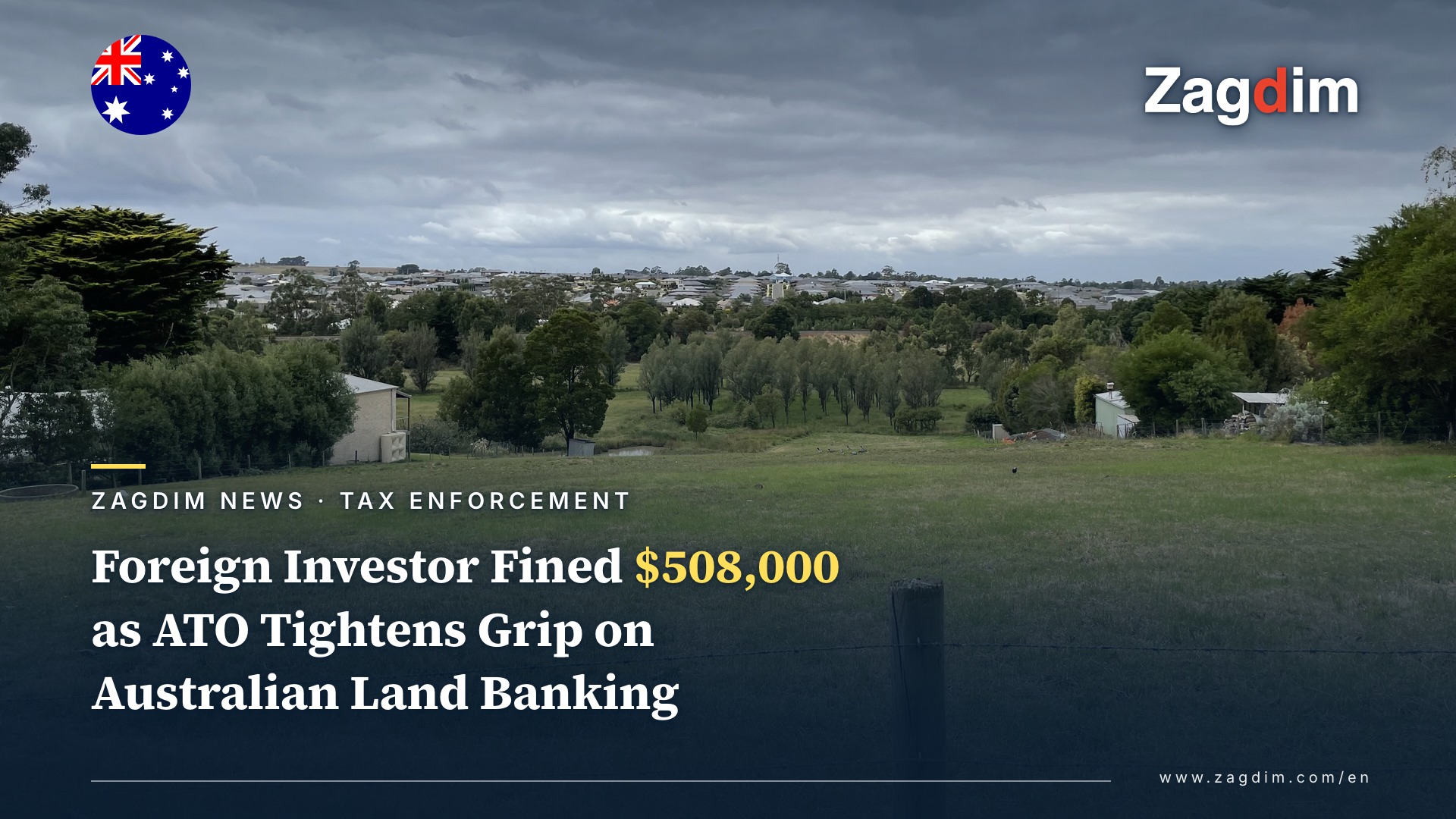
The Federal Court has ordered a foreign investor to pay a $508,000 penalty after the Australian Taxation Office (ATO) proved she breached the conditions attached to her foreign investment approval by leaving a residential block of land vacant for more than a decade. The investor, a resident of the People’s Republic of China, bought the vacant block at 8 Rogers Close in Berwick, Victoria, in 2011 under a foreign investment approval that required a dwelling to be built within four years. No dwelling was built. Alongside the penalty, the court also imposed asset-freezing orders and a registered legal charge over the land to stop it being sold before the case was resolved.
The ruling affects any foreign national who holds Australian residential land under a conditional foreign investment approval, not just the individual investor in this case. The ATO said this is the second foreign investor it has fined for land banking, and that the case grew out of an audit program targeting vacant foreign-owned land held for future gain rather than developed as required. In the 2024–25 financial year alone, the ATO’s compliance program addressed 217 breaches of Australia’s foreign investment rules and forced the disposal of 111 residential properties that had been held in breach of those conditions.
Australia’s foreign investment framework generally requires non-resident buyers of vacant residential land to complete construction within a set timeframe, and separately imposes an annual vacancy fee on foreign-owned residential property left unoccupied. The ATO has said it will keep using its enforcement powers — including forced sale — to bring illegally land-banked property held by foreign investors back into the domestic housing market. “Where foreign investors do not abide by the law, the ATO can and will use its powers to bring illegally ‘land-banked’ property held by foreign investors back into the Australian housing market. This may include the forced sale of land,” an ATO representative said, as reported by Smart Property Investment.
Separately, the ATO has been advising property investors more broadly — a group that includes foreign nationals still holding approved Australian residential property — not to rush into commissioning valuations ahead of a capital gains tax (CGT) overhaul that takes effect on 1 July 2027. Under legislation already passed by federal Parliament, gains accrued up to that date will continue to qualify for the existing 50 per cent CGT discount, while gains accrued afterwards will be taxed under a new inflation-indexed cost-base method with a minimum 30 per cent tax rate. Because the change hinges on a property’s value as at 30 June 2027, a valuation obtained now cannot serve that purpose; industry guidance reported by Australian Property Review says a valuation dated to that day can be commissioned retrospectively, after the fact, and does not need to be arranged years in advance. For foreign investors who retain FIRB-approved Australian property, this valuation planning question sits alongside — and does not replace — their existing obligation to comply with development and vacancy conditions under the foreign investment rules.
References
Smart Property Investment – Foreign investor hit with $508k penalty over land banking / Australian Property Review – Capital gains tax valuation deadline could cost investors thousands