





























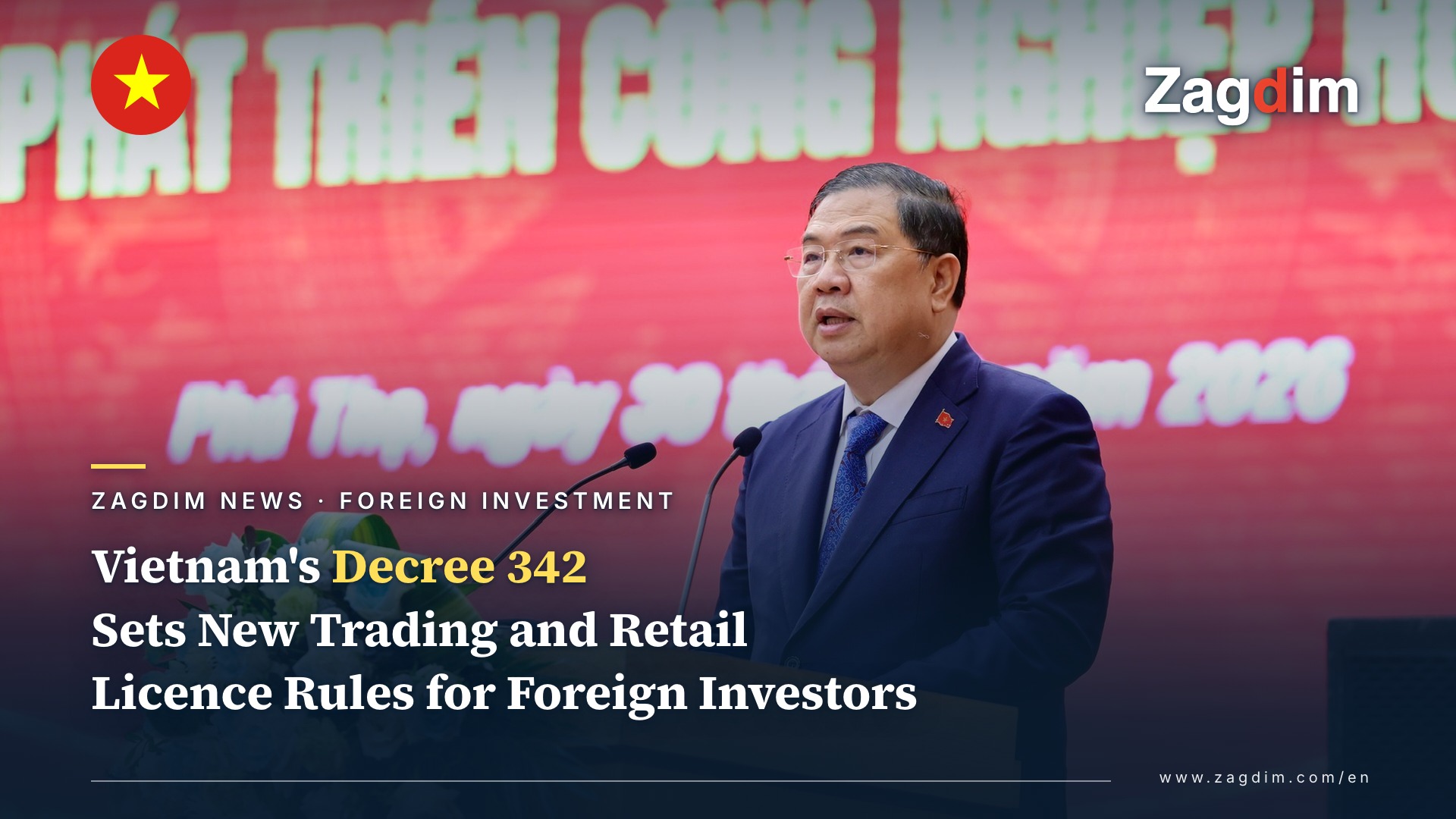
Vietnam has issued Decree 342/2026/ND-CP, published 3 September 2026 and taking effect 18 October 2026, overhauling how foreign investors and foreign-invested enterprises (FIEs) obtain licences for goods trading, retail and related activities, according to Vietnam Briefing, the Dezan Shira & Associates publication that advises foreign investors in Vietnam. The decree replaces Decree 09/2018/ND-CP. Vietnam’s official Government Portal — the Official Gazette (Cong Bao) and the e-Portal document system (Van Ban) — confirms the same decree number, 3 September issue date and 18 October effective date; the Government’s own news outlet reports it was signed by Permanent Deputy Prime Minister Pham Gia Tuc on the Prime Minister’s behalf.
The decree affects any foreign investor or FIE engaged in goods trading and directly related activities — not only shops and supermarkets, but export, import and distribution rights, plus certain logistics, goods leasing, trade promotion, commercial intermediary, e-commerce platform and tendering activities. Two licences remain distinct: a business licence, now decided by the provincial People’s Committee where the FIE is headquartered (routine consultation with the Ministry of Industry and Trade is removed from the procedure), and a retail establishment licence for each outlet, decided by the province where that outlet sits. A new security-consultation step requires input from the Ministry of Public Security and the Ministry of National Defence — generally within 14 working days — for applications involving non-treaty investors or activities outside Vietnam’s market-opening commitments, foreign-controlled operators of certain large digital platforms, and large retail networks above set outlet-count thresholds (for example, 100 or more outlets each under 500 square metres).
A longstanding economic needs test (ENT) for opening additional retail outlets is narrowed for some investors and clarified for others. Investors from countries or territories with which Vietnam has treaty commitments to abolish the ENT are exempt, subject to each treaty’s terms and timetable. Where no treaty exemption applies, an extra outlet still escapes the ENT if its selling area is under 500 square metres, it sits in a trade centre, and it is not a convenience store, mini mart or supermarket — all three conditions must be met. Where the ENT does apply, assessment sits with the commune for outlets under 5,000 square metres and with the province for larger ones, and a provincial ENT council has 20 working days to issue its assessment once an application is complete.
Decree 342 lands as Vietnam pursues a broader push to widen foreign-investor access. Separately, at a National Assembly Standing Committee meeting in Hanoi on 30 September 2026, Minister of Finance Ngo Van Tuan presented a draft amendment to the 2025 Investment Law intended to further relax market-access conditions for foreign investors and accelerate the roadmap for upgrading Vietnam’s stock-market status, according to The Investor. The government plans to submit that draft law to the National Assembly for approval at its October 2026 session, with the law expected to take effect 31 March 2027. Tuan said Vietnam’s results so far in attracting, managing and using foreign investment “have not matched the country’s potential, advantages and new development requirements.”
References
Vietnam Briefing – Vietnam’s Decree 342: What Foreign Investors Need to Know About Trading and Retail Licences / The Investor – Vietnam Seeks to Expand Foreign Investors’ Market Access With Investment Law Revision