

























This article is part of the Zagdim Japan property series on rules for foreign buyers. It answers one question: when a foreigner buys property in Japan, is there a quota or an ownership-share limit? The overall rules are covered in the series’ main article, “What to Understand Before a Foreigner Buys Property in Japan.”
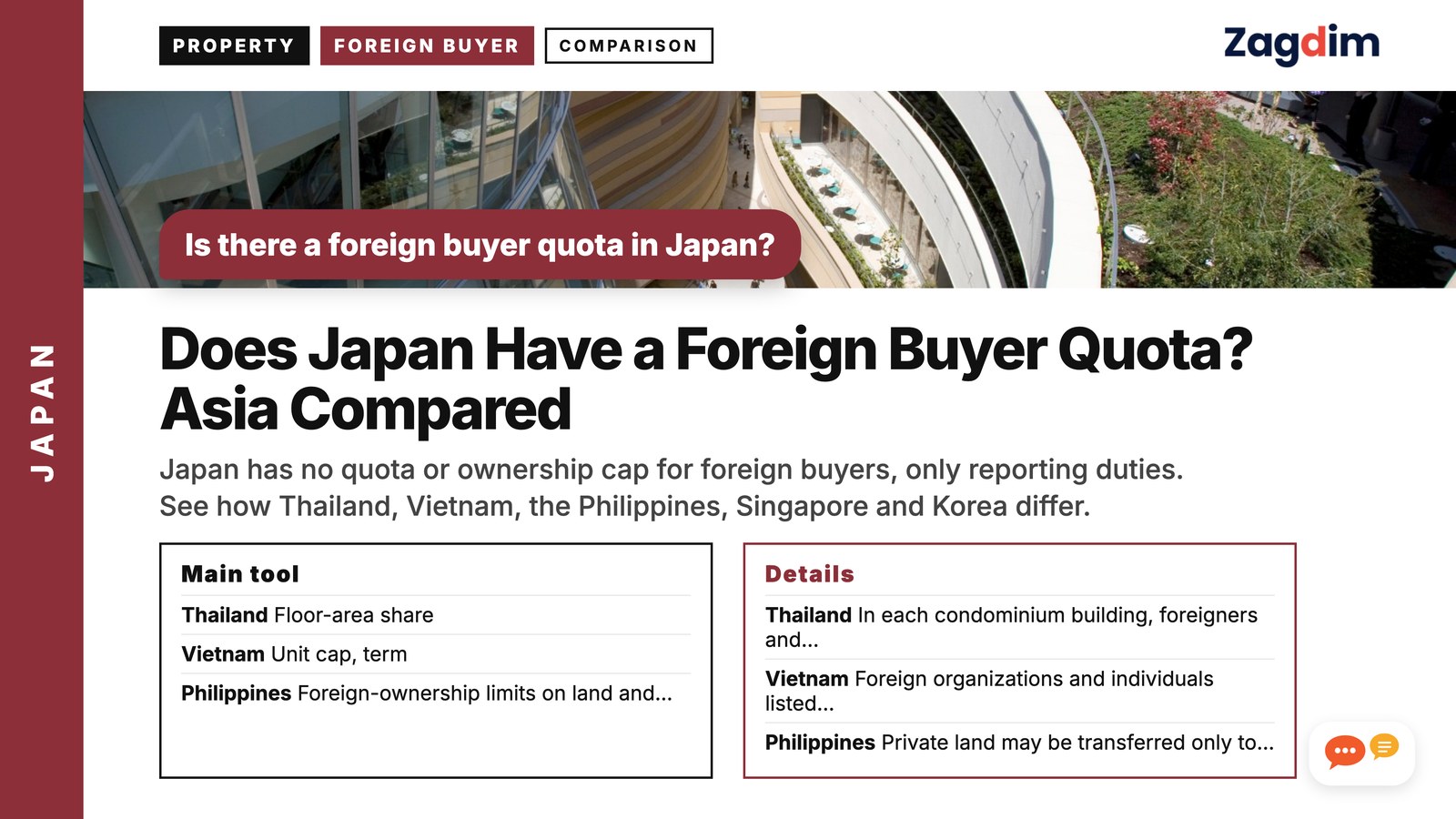
There is not. As of September 2026, Japan has no foreign ownership share or quota system, so a situation in which “the foreigner allotment for this building has run out” does not exist under the law. Japan instead takes a different approach: it requires buyers to file reports, so that the government knows who is buying. The sections below cover Japan first, then compare the approaches of Thailand, Vietnam, the Philippines, Singapore and South Korea.
Do You Need to Check a Foreigner Quota When Buying in Japan?
No. Japan currently has no foreigner quota and no cap on foreign ownership share.
Real estate transactions do not distinguish between foreigners and Japanese nationals, and are in principle equally free. The clear exception is farmland: buying or selling farmland requires permission from the Agricultural Committee (農業委員会) or a similar body.
This refers to national-level rules. The management rules of an individual condominium (マンション) and a developer’s sales conditions are a separate matter and should be checked with the property itself before signing.
With No Quota, What Does Japan Regulate for Foreign Buyers?
Japan regulates reporting, not quotas. Its four measures in 2026 all aim at knowing who is buying:
- Nationality declared at registration: From October 5, 2026, an individual who will become the registered owner must declare nationality when applying for registration. Japanese nationals must declare too. This does not apply to corporations.
- Buying forest land: From April 2026, a person who newly becomes the owner of forest land must state nationality when filing the notification.
- Filings by corporations: From April 2026, a corporation filing under the Forest Act, the National Land Use Planning Act or the Act on the Survey and Regulation of the Use of Important Land (重要土地等調査法) must state the nationality and other details of its representative.
- Buyers living abroad: The real estate acquisition report under the Foreign Exchange and Foreign Trade Act (外国為替及び外国貿易法, “FEFTA”) was widened from April 2026 to cover acquisitions made for purposes other than investment.
For a buyer, these are procedures to complete, not thresholds that decide whether a purchase is allowed. Before signing, ask who is responsible for filing each report.
How Do Other Asian Markets Regulate Foreign Buyers?
The five markets below each take a different approach: some control ownership share, some limit the term, some use tax to adjust demand, and some use a permit system.
| Market | Main tool | Details |
|---|---|---|
| Thailand | Floor-area share | In each condominium building, foreigners and the legal entities listed in the law may together hold no more than 49% of the total floor area of all units, judged when the condominium is registered. Land generally may not be owned by foreigners, with exceptions. |
| Vietnam | Unit cap, term | Foreign organizations and individuals listed in the law may own housing within housing investment and development projects, except projects in national defense and security areas. The cap is 30% of the total units in one apartment building; for detached houses it is 250 units in an area equivalent to one ward-level population. A foreign individual’s ownership term runs no more than 50 years from the date the certificate is issued, and can be extended once for another 50 years. A person married to a Vietnamese citizen and living in Vietnam has the same housing ownership rights as a Vietnamese citizen. |
| Philippines | Foreign-ownership limits on land and condominiums | Private land may be transferred only to persons qualified to acquire or hold public land, except by hereditary succession; a natural-born Filipino who has lost citizenship may acquire it within the limits set by law. Where the common areas of a condominium are held by a corporation, a unit transfer may not push that corporation’s foreign interest above the limit set by current law. |
| Singapore | Approval, tax | Foreigners must apply for approval to buy landed residential property, but not to buy a condominium unit. Foreigners buying any residential property pay a 60% Additional Buyer’s Stamp Duty (ABSD), calculated on the purchase price or market value, whichever is higher, applicable from April 27, 2023. There are exceptions for those who receive citizen treatment under a free trade agreement. |
| South Korea | Zone-based permit | The Seoul metropolitan area has designated zones for foreigners’ land transactions (외국인 토지거래허가구역), effective August 26, 2026 to August 25, 2027. They apply to residential transactions in residential zones above 6 square meters and commercial zones above 15 square meters; according to Japanese government material, permanent residents are excluded. |
The Thailand, Vietnam and Philippines rows rely on English translations or on summaries by Japanese government bodies, and have not been checked against the official local texts as of the check date. In every case, the current official local rules prevail.
On the Singapore exception, the tax authority gives the example of a Singapore permanent resident who is also a U.S. citizen: such a person buying a first residential property does not pay this tax. Treatment for other statuses needs to be checked separately.
So “is there any quota left?” is a question only for markets that use a ratio system. Local provisions are amended from time to time, so check again before signing.
Will Japan Introduce Limits Later?
This is still under study and has not been decided. According to government documents published up to July 24, 2026, the Japanese government is reviewing measures such as regulation of condominium acquisition, and will refer to the approaches of other countries.
Later developments could not be confirmed here. Before signing, check the latest announcements again.
How Much Are Foreigners Buying in Japan?
In 2025, among condominiums traded in the six central wards of Tokyo, buyers presumed to be foreign (外国人類推者) made up 11.9%, covering both new and resale units.
Nationwide, owners whose registered address is overseas (国外居住者) hold 127,000 land parcels (0.06%) and 108,000 buildings (0.2%).
The two sets of figures must not be added together. The first is presumed from filings or registered names; the second is based on the registered address, so Japanese nationals living abroad are also included.
What to Confirm Next
- If you like a particular condominium in Japan: confirm its management rules and sales conditions with the property itself.
- If you are comparing several markets: first work out whether each one regulates ownership share, term, tax or permits, then check the current rules with the local authority.
- If you want to understand registration, filings and reports before and after a purchase in Japan: go back to the main article, “What Rules to Understand Before a Foreigner Buys Property in Japan.”
FAQ: Foreign Buyer Quotas in Japan
Can foreign buyers in Japan run into a situation where the foreigner allotment is sold out?
Not under the system. As of September 2026, Japan has no foreigner quota or ownership-share cap. The management rules of an individual condominium and the developer’s sales conditions need to be checked with the property itself.
Are Thailand’s 49% and Vietnam’s 30% calculated the same way?
No. Thailand’s figure is based on floor area: the total floor area of all units in the condominium building, judged when the condominium is registered. Vietnam’s is based on the number of units: the total units in one apartment building. In both cases, the current official local rules prevail.
Is Singapore’s 60% a cap on foreign ownership share?
No. The 60% is a tax rate. Foreigners buying residential property in Singapore pay Additional Buyer’s Stamp Duty, which has nothing to do with ownership share. There are exceptions for those who receive citizen treatment under a free trade agreement.
Source Notes
Facts were checked on September 29, 2026. “Japan has no foreigner quota” is a conclusion drawn from official documents. The three documents reviewed (a report of the House of Representatives Research Bureau and two Cabinet Secretariat documents) list procedures such as real estate registration, FEFTA reports, Forest Act notifications, Agricultural Land Act permits, National Land Use Planning Act filings and Important Land Survey Act filings, and none of them contains an ownership-share or quota system. The officials do not state outright, however, that there is no quota. Individual condominium management rules, developers’ sales conditions, self-regulatory measures by real estate associations and local government ordinances were outside the scope of the check.
The Thai Condominium Act and the Vietnamese Housing Law were read in unofficial English translations; the Philippine Condominium Act was taken from a legal database; the Thai land point follows a summary by Japan’s Ministry of Land, Infrastructure, Transport and Tourism. None of these could be checked against the official local texts. The 11.9% figure comes from a Cabinet Secretariat compilation, and “new and resale units both included” comes from a press release the same day from the Ministry of Land, Infrastructure, Transport and Tourism.
Measures such as condominium acquisition regulation are still under review. The basis is government documents published up to July 24, 2026, and the position may change afterward.
Have a question about this guide? Leave a comment below, or ask Zagdim directly.
Your first stop for international property and global living.
Research and insights. Know what’s changing. Understand what matters.
Sources
- 衆議院調査局国土交通調査室 – 調査報告「外国人による不動産取得に関する整理」: https://www.shugiin.go.jp/internet/itdb_rchome.nsf/html/rchome/shiryo/202602_real_estate_acquisition_by_foreign_nationals.pdf/$File/202602_real_estate_acquisition_by_foreign_nationals.pdf
- 内閣官房 – 外国人による土地取得等のルールの在り方検討会(第1回)資料3「我が国の土地等に関連する制度及び運用状況等について」: https://www.cas.go.jp/jp/seisaku/symbiotic_society/gaikokujin_tochishutoku/kaisai-jokyo/dai1/shiryo3.pdf
- 内閣官房 – 総合的対応策 国民の安全・安心のための取組における進捗状況(令和8年6月時点・詳細版): https://www.cas.go.jp/jp/seisaku/symbiotic_society/pdf/sougoutekitaiousaku_shinchoku_shosai_r80724.pdf
- 内閣官房 – 総合的対応策 進捗等を踏まえた、今後の取組の方向性: https://www.cas.go.jp/jp/seisaku/symbiotic_society/pdf/sougoutekitaiousaku_torikumi_houkousei_r80724.pdf
- 内閣官房/内閣府審議会参考資料 – 外国人による不動産取得等の実態把握について(施策パッケージ): https://www.cao.go.jp/tochi-chosa/shingikai/doc/shiryou15-5.pdf
- 法務省 – 検索用情報の申出について(職権による住所等変更登記関係): https://www.moj.go.jp/MINJI/minji05_00678.html
- 内閣官房 – 外国人等による我が国の土地・建物の所有・取得状況の全体像: https://www.cas.go.jp/jp/seisaku/symbiotic_society/pdf/gaikokujin-tochitatemono-shoyujokyo.pdf
- 国土交通省 – 報道発表:不動産登記情報を活用した新築マンションの取引の調査結果を公表: https://www.mlit.go.jp/report/press/tochi_fudousan_kensetsugyo05_hh_000001_00276.html
- Siam Legal Thailand Law Library – Thailand Condominium Act B.E. 2522 (1979), Sections 19-19/3, English translation: https://library.siam-legal.com/thai-law/condominium-act-ownership-sections-19-1-19-11/
- 国土交通省 – 海外建設・不動産市場データベース:タイの不動産関連情報: https://www.mlit.go.jp/totikensangyo/kokusai/kensetsu_database/thailand/page5.html
- LuatVietnam – Vietnam Housing Law No. 27/2023/QH15 (English translation), Articles 16-20: https://english.luatvietnam.vn/dat-dai/housing-law-no-27-2023-qh15-284800-d1.html
- LuatVietnam – Vietnam Law No. 43/2024/QH15 (English translation): https://english.luatvietnam.vn/tai-chinh/law-43-2024-qh15-amend-land-law-housing-law-law-on-real-estate-business-and-law-on-credit-institutions-360200-d1.html
- Supreme Court of the Philippines E-Library – 1987 Constitution, Article XII National Economy and Patrimony: https://elibrary.judiciary.gov.ph/thebookshelf/showdocs/45/25555
- The LawPhil Project – Republic Act No. 4726 (The Condominium Act): https://lawphil.net/statutes/repacts/ra1966/ra_4726_1966.html
- Singapore Land Authority – Foreign ownership of property: https://www.sla.gov.sg/regulatory/foreign-ownership-of-property/
- Inland Revenue Authority of Singapore – Additional Buyer’s Stamp Duty (ABSD): https://www.iras.gov.sg/taxes/stamp-duty/for-property/buying-or-acquiring-property/additional-buyer’s-stamp-duty-(absd
- 대한민국 국토교통부 보도참고자료 – 외국인 투기 방지를 위해 토지거래허가구역이 1년간 연장된다: https://www.molit.go.kr/USR/NEWS/m_72/dtl.jsp?lcmspage=1&id=95092323
Important Notice
This article is a general information summary and does not constitute individual legal, tax or investment advice. Facts were checked on September 29, 2026; for other markets, rely on the current official local rules.