






























This article is part of the Zagdim Japan property series on rules for foreign buyers. It answers one question: can a foreigner own land in Japan? The overall rules are covered in the series’ main article, “What to Understand Before a Foreigner Buys Property in Japan.”
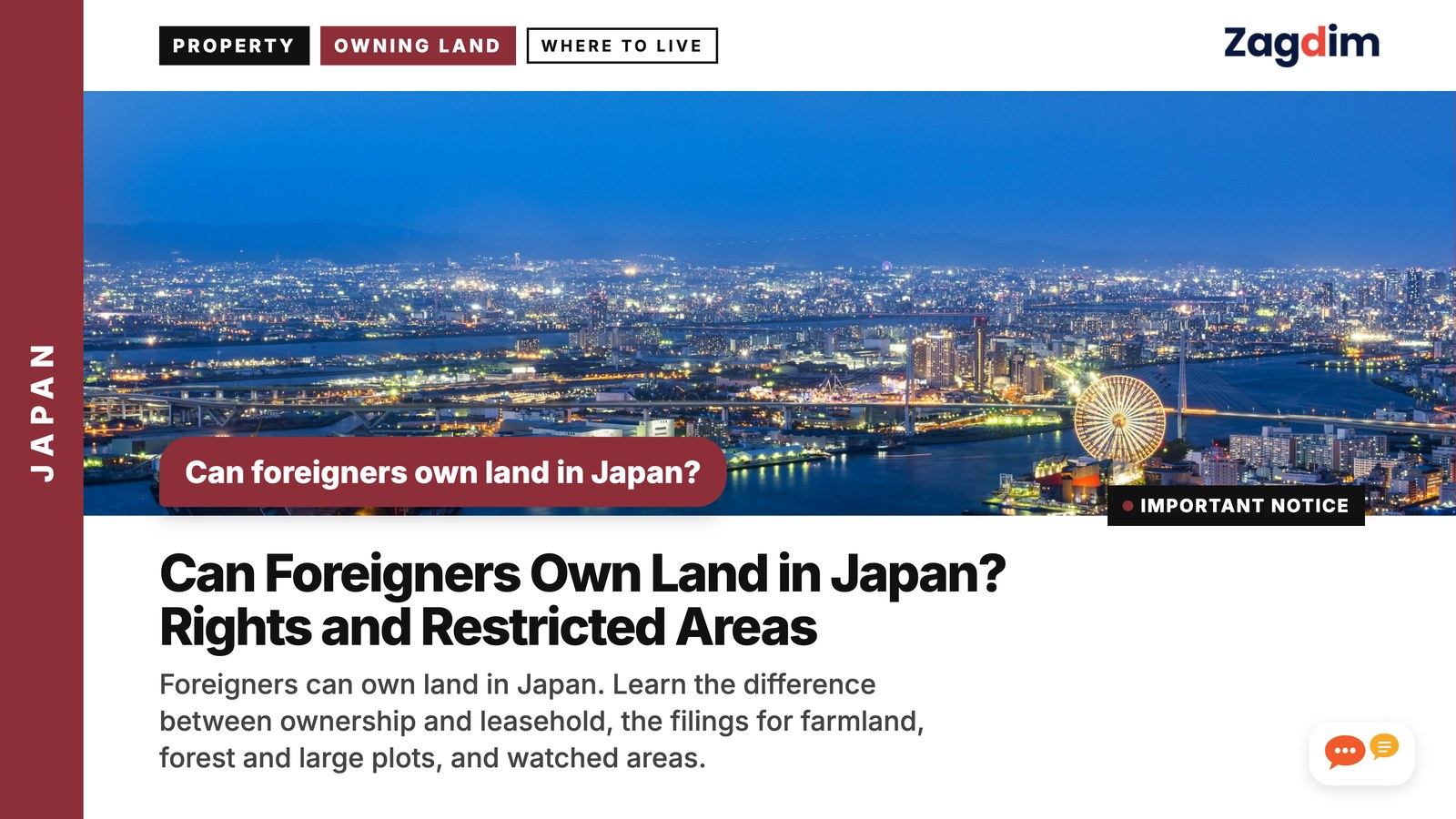
Yes. Before buying, three things need to be clarified separately: whether what you acquire is ownership, what type of land it is, and whether it lies in a restricted area.
Can Foreigners Own Land in Japan, and Is Ownership Limited in Time?
Foreigners can own land, and the law currently sets no time limit on ownership. A foreigner acquiring real estate in Japan is, in principle, as free to do so as a Japanese national.
Ownership (所有権) means that, within the limits set by law, you may freely use, take the benefits of and dispose of the land.
As of June 2026, Japan has not set up a prior control on “acquiring land” itself from a security standpoint. Two advance procedures still exist: buying farmland for cultivation requires prior permission, and buying or selling land or buildings of 200 square meters or more inside a special watch area requires, where the conditions are met, a filing before the contract is signed.
Am I Buying Ownership or a Leasehold?
It depends on the type of right attached to the property. Some houses come with a leasehold (借地権), which is the right to use someone else’s land in order to own a building.
A leasehold has a term: the law sets 30 years, and where the contract provides a longer term, the contract governs.
There is also a fixed-term leasehold (定期借地権), whose term is set at 50 years or more and which can provide that the lease will not be renewed at expiry and that the owner cannot be asked to buy the building. These provisions must be made in writing, such as in a notarized document. Fixed-term leaseholds also come in other types, which this article does not cover.
Can I Use the Land as I Intend?
It depends on the type and size of the land. Three kinds of land each carry their own procedure:
| Type of land | What to do | Who, and when | What to state |
|---|---|---|---|
| Farmland (acquired for cultivation) | Obtain permission from the Agricultural Committee (農業委員会) | The person acquiring the farmland; a transaction without permission is void | Nationality and other details; resident foreigners also state their period of stay and expiry date |
| Forest | Notify after acquisition | The new owner, within 90 days of becoming the owner, to the head of the municipality (市町村長) | Nationality and other details; a person living abroad also attaches a contact in Japan |
| Large land | Notify after signing | The buyer, within 2 weeks of the contract date, through the head of the municipality where the land is located | Intended use, transaction price, nationality and other details |
Farmland permission does not depend on nationality: only a person who can use the farmland efficiently can acquire it, so a foreigner living overseas will find it very hard to qualify. There are also cases exempt from permission.
Forest means forest within the forest plan area of each prefecture, and a notification is required regardless of size. Land that is not registered as forest but is forest in actual condition is also likely to require notification. A person who has already filed a large-land notification does not need to file again.
Thresholds for large land: 2,000 square meters or more in urbanization promotion areas (市街化区域), 5,000 square meters or more in city planning areas outside those, and 10,000 square meters or more outside city planning areas.
What Is a Restricted Area, and What Happens If I Buy Inside One?
You can buy, but a transaction that meets the conditions must be notified before the contract is signed. The restricted area meant here is the special watch area (特別注視区域), designated under the Act on the Survey and Regulation of the Use of Important Land (重要土地等調査法). The Act aims to prevent land around important facilities such as defense facilities, and on remote border islands, from being used in ways that impair their function.
When a filing is required:
- Size: 200 square meters or more of land or buildings inside the area.
- Contract: sale, gift, exchange and similar contracts, including preliminary contracts.
- Who, and when: both seller and buyer must file, before the contract is signed. When filing by post, the filing must reach the Cabinet Office by the day before the planned contract date.
- What to state: intended use, the transferee’s nationality and other details. Japanese nationals must also state “Japan.” If the transferee is a corporation, its representative, officers (役員) and those with voting rights also need to be confirmed.
Inheritance, division of an estate, and transfers of rights such as mortgages and leaseholds do not require a filing. There are also other exempt cases.
Signing without filing, or filing false information, may be punished by detention (拘禁刑) of up to 6 months or a fine of up to 1 million yen.
A filing is not a permit, and the signing procedure can continue after it is made. According to the government’s explanation, the Act does not affect ordinary life and business activity, and living in a house from which the inside of a facility can be seen is generally not an act that impairs its function. This is only an example, and other conduct may still be found to qualify. As of June 30, 2026, the government has not issued any recommendation or order under the Act.
Do I Still Have to Report to the Government After Buying?
If you are a non-resident under the Foreign Exchange and Foreign Trade Act (外国為替及び外国貿易法, “FEFTA”), yes. Whether you are a non-resident depends on where you live, not on nationality.
After a non-resident acquires real estate in Japan, a report must be submitted to the Minister of Finance through the Bank of Japan within 20 days. It is required regardless of amount or size, and acquisition by inheritance is included. For land or buildings acquired on or after April 1, 2026, a report is required whatever the purpose; the only exempt cases are certain acquisitions of related rights such as leaseholds.
The report must be written in Japanese and may be submitted by an agent who is a resident, for example a real estate agent. Ask before signing who will be responsible for it.
Failing to report, or reporting falsely, can be punished by detention of up to 6 months or a fine of up to 500,000 yen. Even after the deadline has passed, the report still has to be submitted.
What to Confirm Before Signing
Confirm five things with the agent or seller:
- Whether the right is ownership or a leasehold, and if a leasehold, its term and special terms.
- Whether the registered land category and the actual condition show farmland or forest.
- Whether the area reaches the thresholds above.
- Whether the location is inside a special watch area, according to the Cabinet Office’s announcements.
- Whether you are a non-resident under FEFTA.
In addition, rules on land acquisition from a security perspective are still under review, according to government documents published up to July 24, 2026. For the full picture of the system, see the main article, “What to Understand Before a Foreigner Buys Property in Japan.”
FAQ
What procedures are needed to inherit land or property in Japan?
Inheritance registration (相続登記) must be applied for within 3 years of the date you learn that you have begun to inherit and learn that you have acquired ownership. A non-resident must also submit the FEFTA report; if the inherited land is forest within a forest plan area, the forest notification must be made.
If I buy a condominium, do I need to watch for special watch areas too?
Yes. For a condominium (マンション) in a special watch area, a pre-contract filing is likewise required when the floor area of the exclusive portion is 200 square meters or more.
Are a “watch area” and a “special watch area” the same?
No. For land and buildings within a watch area (注視区域), no filing is required before signing.
Source Notes
Facts were checked on September 29, 2026, drawing on the Japanese originals of laws and government bodies’ documents; the English here is a summary. “Ownership has no time limit” is an inference: the Civil Code provisions on the content of ownership set no duration, and no official document states outright that ownership is unlimited in time. “Real estate acquisition by foreigners is in principle as free as for Japanese nationals” comes from the House of Representatives Research Bureau’s February 2026 report on the Civil Code; “no prior control on acquisition” is recorded under security in the Cabinet Secretariat’s June 2026 material. Items not checked include: building and use restrictions for individual plots, conversion of farmland, other types of fixed-term leasehold, leaseholds under older law, and how to look up whether a particular address lies in a designated area. Developments in land acquisition rules after July 24, 2026 could not be confirmed and may change.
Have a question about this guide? Leave a comment below, or ask Zagdim directly.
Your first stop for international property and global living.
Research and insights. Know what’s changing. Understand what matters.
Sources
- e-Gov法令検索 – 民法(明治29年法律第89号): https://laws.e-gov.go.jp/law/129AC0000000089
- 衆議院調査局国土交通調査室 – 調査報告「外国人による不動産取得に関する整理」: https://www.shugiin.go.jp/internet/itdb_rchome.nsf/html/rchome/shiryo/202602_real_estate_acquisition_by_foreign_nationals.pdf/$File/202602_real_estate_acquisition_by_foreign_nationals.pdf
- e-Gov法令検索 – 借地借家法(平成3年法律第90号): https://laws.e-gov.go.jp/law/403AC0000000090
- 内閣官房 – 外国人による土地取得等のルールの在り方検討会(第1回)資料3「我が国の土地等に関連する制度及び運用状況等について」: https://www.cas.go.jp/jp/seisaku/symbiotic_society/gaikokujin_tochishutoku/kaisai-jokyo/dai1/shiryo3.pdf
- 内閣官房 – 総合的対応策 国民の安全・安心のための取組における進捗状況(令和8年6月時点・詳細版): https://www.cas.go.jp/jp/seisaku/symbiotic_society/pdf/sougoutekitaiousaku_shinchoku_shosai_r80724.pdf
- 内閣官房 – 総合的対応策 進捗等を踏まえた、今後の取組の方向性: https://www.cas.go.jp/jp/seisaku/symbiotic_society/pdf/sougoutekitaiousaku_torikumi_houkousei_r80724.pdf
- 内閣府 – 区域の指定について: https://www.cao.go.jp/tochi-chosa/kuiki.html
- 内閣府 – 届出について(重要土地等調査法): https://www.cao.go.jp/tochi-chosa/todokede.html
- 内閣府 – 重要土地等調査法リーフレット: https://www.cao.go.jp/tochi-chosa/doc/leaflet.pdf
- e-Gov法令検索 – 重要土地等調査法(令和3年法律第84号): https://laws.e-gov.go.jp/law/503AC0000000084
- 内閣府 – 重要施設の施設機能及び国境離島等の離島機能を阻害する土地等の利用の防止に関する基本方針(閣議決定): https://www.cao.go.jp/tochi-chosa/doc/kihonhoshin.pdf
- 内閣府 – 勧告・命令の実施状況について: https://www.cao.go.jp/tochi-chosa/kankoku.html
- 財務省 – リーフレット 外為法に基づく「本邦にある不動産又はこれに関する権利の取得に関する報告書」の提出: https://www.mof.go.jp/policy/international_policy/gaitame_kawase/real_property/real_property_leafletJ.pdf
- 財務省 – 外為法に基づく不動産取得報告 よくあるご質問(FAQ): https://www.mof.go.jp/policy/international_policy/gaitame_kawase/real_property/FAQ_J.pdf
- 林野庁 – 森林の土地の所有者届出制度: https://www.rinya.maff.go.jp/j/keikaku/todokede/
- 国土交通省 – 土地取引規制制度(国土利用計画法): https://www.mlit.go.jp/totikensangyo/totikensangyo_tk2_000019.html
- 法務省 – 相続登記の申請義務化について: https://www.moj.go.jp/MINJI/minji05_00599.html
Important Notice
This article is a general information summary and does not constitute individual legal or tax advice. Facts were checked on September 29, 2026; rely on the current announcements of the competent Japanese authorities.