






























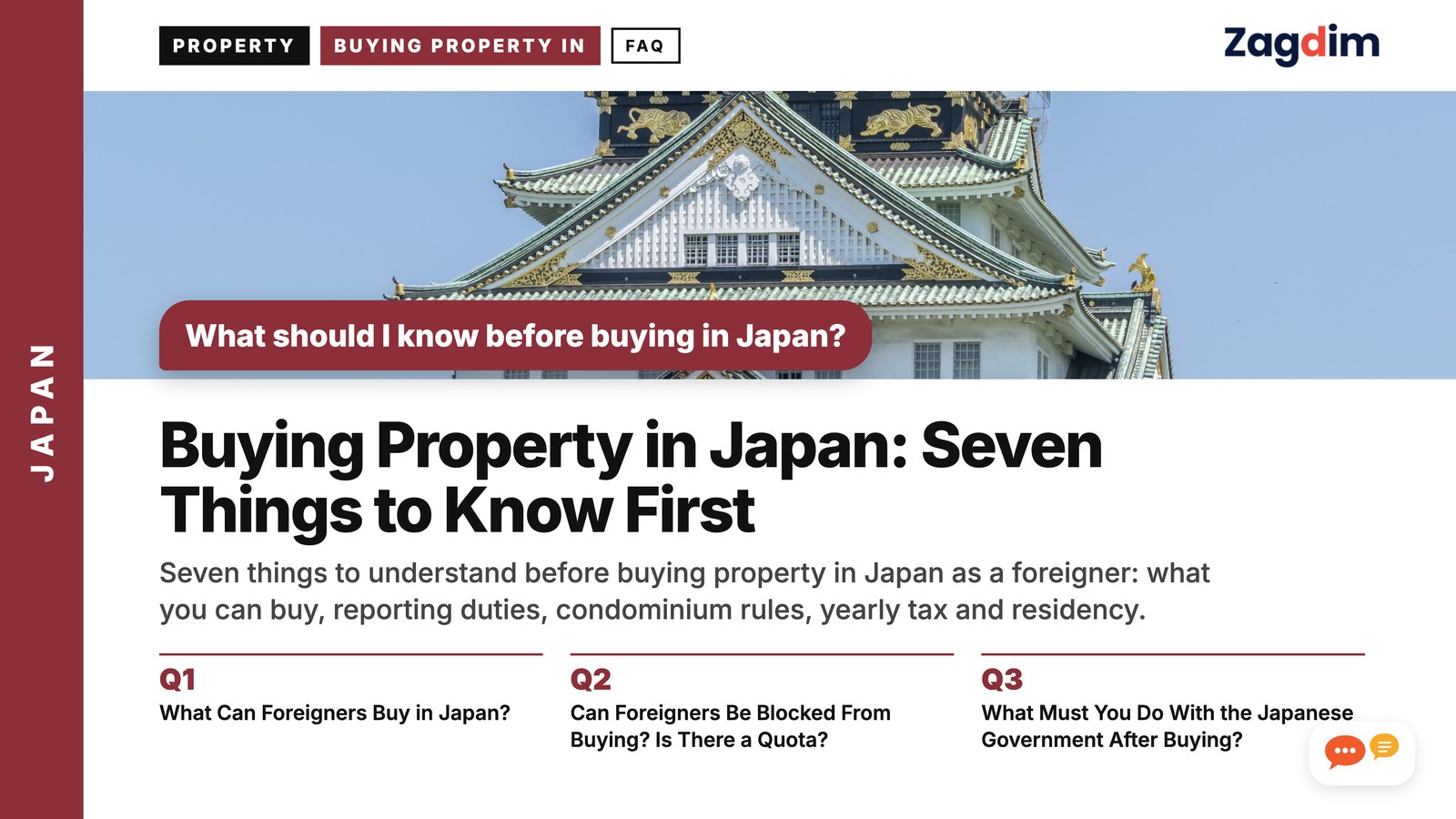
This is the introductory guide in Zagdim’s Japan property series. It is written for people who are starting to consider buying property in Japan and have not yet decided, and it gives the overall outline before you read the detailed articles in the series.
Foreigners can buy property in Japan and receive the same ownership as Japanese citizens. After the purchase, though, there are reports and registrations to complete; a condominium means jointly managing the building with the other owners; tax is due every year you hold the property; and owning a home does not give you a status to live in Japan.
The seven points below are worth understanding before taking the next step. Each one is paired with a detailed article in the series.
The Seven Things at a Glance
- Foreigners can buy, but when viewing a property, first find out whether the land is owned outright or held under a leasehold.
- Japan currently has no quota on foreign buyers, but the rules are under review, so check again before you sign.
- A buyer who lives outside Japan must report the acquisition to the Japanese government within 20 days of buying, and registration requires a few extra items.
- The location and type of land can add another filing.
- Buying a condominium means joining the management of the whole building, so read the bylaws, the repair reserve fund and the building’s age before signing.
- Tax is due every year while you hold the property, and an owner abroad needs to arrange someone in Japan to handle it.
- Owning a home is not immigration. Residency in Japan is a separate application.
1. What Can Foreigners Buy in Japan?
Remember first: You can buy land, detached houses (一戸建て, ikkodate) and condominiums. When viewing a property, the first thing to confirm is whether the land is held through ownership or a leasehold.
Why: As of September 2026, Japanese real estate transactions make no distinction between foreigners and Japanese citizens. The buyer receives the same ownership (所有権, shoyūken) as a Japanese buyer, and the law currently sets no term on ownership. A leasehold (借地権, shakuchi-ken) is different: the house is yours, but you rent the land from the landowner. The statutory base term is 30 years, a longer term applies if the contract provides one, and some types follow different term rules. The one clear exception is farmland: buying farmland for cultivation requires prior permission from the agricultural committee (農業委員会, nōgyō iinkai), which is basically very hard for a foreigner living overseas to obtain.
What to confirm or ask:
- Is the land owned outright or held under a leasehold?
- If it is a leasehold, how many years remain, and is there any agreement that it ends without renewal? One type, the fixed-term leasehold (定期借地権, teiki shakuchi-ken), runs for 50 years or more and can be agreed to end without renewal.
- Is the land category (地目, chimoku) on the registry, and the actual condition of the land, farmland or forest?
Details: In the Zagdim series, see “What property can foreigners buy in Japan?” and “Land ownership, land use and restricted zones in Japan”.
2. Can Foreigners Be Blocked From Buying? Is There a Quota?
Remember first: Japan currently has no quota on foreign buyers, so you do not need to worry about running out of places. Before signing, though, check again whether the government has announced new rules.
Why: As of September 2026, Japan has no ceiling on foreign ownership share and no quota system. The current approach is to require reporting and to know who is buying, for example by declaring nationality at registration (see point 3). According to government documents published up to July 24, 2026, the government is reviewing rules on land acquisition from a security perspective and is also reviewing measures on condominium acquisition. Neither has been decided. For reference, of the condominiums traded in the six central wards of Tokyo in 2025, buyers presumed to be foreigners from filings or registered names accounted for 11.9%, counting new and resale units together.
What to confirm or ask:
- There is no national quota, but the management bylaws of an individual condominium and a developer’s sales terms must be checked with that property.
- Before signing, check once more for any new announcement on land or condominium acquisition rules.
- When comparing other markets, first sort out whether the other country is controlling share, term, tax or permission. In Singapore, for example, a foreigner buying landed residential property must apply for approval first.
Details: In the Zagdim series, see “Is there a quota on foreign buyers in Japan? How it differs from other Asian markets”.
3. What Must You Do With the Japanese Government After Buying?
Remember first: If you live outside Japan, you must file a Foreign Exchange and Foreign Trade Act report within 20 days of buying Japanese property, even for your own use. Agree before signing who will file it.
Why: The Foreign Exchange and Foreign Trade Act (外国為替及び外国貿易法, gaikoku kawase oyobi gaikoku bōeki-hō) requires a non-resident (非居住者, hikyojūsha) who acquires Japanese real estate to submit a report to the Minister of Finance through the Bank of Japan within 20 days, regardless of the amount or area. For acquisitions on or after April 1, 2026, a report is required whatever the purpose. Failing to report, or reporting falsely, is punishable by imprisonment of up to 6 months (拘禁刑, kōkinkei) or a fine of up to 500,000 yen, and the report must still be filed even after the deadline has passed. When ownership is registered, foreigners and people living overseas also need to prepare a few more items than Japanese buyers.
What to confirm or ask:
- Whether you are a non-resident. The test is where you live, not your nationality. A foreigner is in principle presumed to be a non-resident; a person who works at an office in Japan, or who entered Japan and has been there 6 months or more, is presumed to be a resident.
- Whether you file the report yourself or an agent living in Japan, such as a real estate broker, files it. The report must be written in Japanese.
- Who prepares the registration materials: a name in Roman letters (ローマ字氏名, rōmaji shimei) and supporting documents (for example, a passport copy, which must be valid on the date the registration application is accepted), a contact person in Japan (国内連絡先となる者, kokunai renrakusaki to naru mono; if there is none, you can state that there is none), and, from October 5, 2026, a declaration of nationality. Nationality is internal information for the registry and is not made public with the registration.
**Example: Ms. Lin, who lives in Taiwan**
>
Ms. Lin works in Taiwan and plans to buy a Tokyo condominium in November 2026 and stay a few times a year. She does not work at an office in Japan and has not been in Japan for 6 months, so under the Foreign Exchange and Foreign Trade Act she is in principle presumed to be a non-resident.
>
Within 20 days of acquiring it she must file the report. The report is required even if the home is for her own use, and a broker living in Japan can file it for her. At registration she provides her Roman-letter name and supporting documents such as a passport copy, a contact person in Japan (or a statement that there is none), and her nationality. The area names listed in the Ministry of Justice circular include “Taiwan”. What she should do: before signing, ask who prepares the report and who prepares the registration materials.
Details: In the Zagdim series, see “What foreigners need to understand before buying in Japan” and “Buying a home in Japan is not immigration”.
4. Does the Property’s Location Add a Filing?
Remember first: Before signing, ask the broker to confirm whether the property is inside a “special watch area” (特別注視区域, tokubetsu chūshi kuiki) and whether its area reaches 200 square meters.
Why: Special watch areas are designated under the Important Land Survey Act around defense facilities and other important facilities, and on remote border islands. For land or buildings of 200 square meters or more inside such an area, both seller and buyer must file before signing the contract; for a condominium, the area counted is that of your own unit (the exclusively owned part). This is a filing, not a permit, and the sale can go ahead after filing. But signing without filing can be punished by imprisonment of up to 6 months or a fine of up to 1 million yen. As of March 2026, 150 special watch areas have been designated across Japan.
What to confirm or ask:
- Whether the property is inside a special watch area, based on the Cabinet Office’s public notice. A similarly named watch area (注視区域, chūshi kuiki) does not require this filing.
- How the area is counted: land by each parcel, condominiums by your own unit’s exclusively owned part. There are also situations exempt from filing.
- Whether the land is forest. For forest listed in a regional forest plan, the new owner must report to the mayor of the municipality (市町村長) within 90 days, regardless of area. Land that is not registered as forest but is forest in actual condition also probably needs a report.
- Whether the land is very large. For example, 2,000 square meters or more in an urbanization promotion area (市街化区域), the buyer must file within 2 weeks of the contract date.
Details: In the Zagdim series, see “Land ownership, land use and restricted zones in Japan”.
5. What to Check When Buying a Japanese Condominium
Remember first: Before buying a condominium, obtain the building’s bylaws and long-term repair plan, and confirm the date on which the building received its building confirmation.
Why: All the owners in a condominium legally form one management body, called the management association (管理組合, kanri kumiai). The building’s rules are in its bylaws (規約, kiyaku), and the cost of common areas is in principle shared in proportion to the exclusive floor area of your unit. The money set aside for future major repairs is the repair reserve fund (修繕積立金, shūzen tsumitate-kin); there is no statutory standard for it. An official survey for Reiwa 5 (fiscal 2023) found that 36.6% of condominiums had saved less than their plan required. On earthquake resistance, the current new seismic standard has applied since June 1981, and the date of the building confirmation (建築確認, kenchiku kakunin) is what you look at. The Ministry of Land, Infrastructure, Transport and Tourism explains that many buildings built before 1981 under the old standard have insufficient earthquake resistance.
What to confirm or ask:
- How much the repair reserve fund is each month and which accumulation method is used. The Ministry’s guidance regards the level (equal-amount) method as preferable; under the stepped-increase method, the amount is raised in stages.
- Compare against the guidance’s reference values. For example, for a condominium of fewer than 20 floors and under 5,000 square meters of total floor area, the average is 335 yen per square meter per month, excluding mechanical parking.
- In what year the long-term repair plan was last reviewed, and how far the actual savings fall short of the plan.
- Whether the unit has any unpaid amounts arising from the bylaws or from owners’ meeting resolutions. By law, such claims can also be enforced against the person who takes over the unit.
- Whether the bylaws require the appointment of a domestic manager (国内管理人, kokunai kanrinin). From April 1, 2026, an owner with no domicile or residence in Japan can choose a person living in Japan to receive meeting notices and vote on their behalf. The law says an owner “may” choose one, and the bylaws can make it mandatory.
Details: In the Zagdim series, see “What foreigners should check when buying a Japanese condominium”.
6. What Do You Pay Each Year While Holding the Property, and Who Handles It?
Remember first: Include the yearly holding taxes in your cost of ownership, and decide before buying who in Japan will handle taxes, registration and condominium management while you are overseas.
Why: Once you are the owner, you pay fixed asset tax (固定資産税, kotei shisan-zei) every year, with January 1 as the reference date. The standard rate is 1.4%, and a municipality can set a different rate by ordinance. The amount is calculated on the taxable standard value, not on the purchase price. If the property is in an urbanization promotion area, you also pay city planning tax (都市計画税, toshi keikaku-zei), at a rate that cannot exceed 0.3%. There are three kinds of agent in Japan, belonging to three separate systems, and completing one does not mean the other two are done.
| Name | Where it is used | Required? |
|---|---|---|
| Contact person in Japan | Ownership registration | If there is none, you can state that there is none |
| Domestic manager | Condominium management | The law says one may be appointed; the bylaws can require it |
| Tax agent (納税管理人, nōzei kanrinin) | Tax | Must be designated by a non-resident for filing, paying and receiving refunds of national taxes; fixed asset tax is reported separately to the mayor of the municipality, and designation can be skipped if it is recognized as not affecting collection |
What to confirm or ask:
- Who serves as tax agent for national taxes and for fixed asset tax.
- After moving or changing your name, you must file a change of registration within 2 years, and an owner living overseas must apply personally. Without a justifiable reason, failing to do so can be punished by an administrative fine (過料, karyō, a monetary penalty) of up to 50,000 yen.
- If you plan to rent it out: when you are a non-resident, a tenant who pays rent in Japan must withhold 20.42% at the time of payment; there is no withholding when an individual rents it for themselves or relatives to live in.
- If you later sell: a buyer who pays the price in Japan must withhold 10.21%; there is no withholding when an individual buys it for themselves or relatives to live in and the price is 100 million yen or less. Both rates reflect the law in force on April 1, 2026; from 2027 the name of the tax item changes, and the combined rate does not change.
Details: In the Zagdim series, see “What foreigners need to understand before buying in Japan” and “Buying a home in Japan is not immigration”.
7. Can You Live in Japan After Buying?
Remember first: Plan “buying a home” and “residing in Japan” as two separate things. Buying a home does not bring a visa or permanent residence.
Why: As of September 2026, Japan has no status of residence (在留資格, zairyū shikaku, the category of status under which a foreigner lives in Japan) that is obtained by owning real estate, and owning property is not a requirement for permanent residence. An owner who has no other status of residence and enters on a temporary visitor status (短期滞在, tanki taizai) receives a period of stay of 90 days, 30 days or 15 days each time, or a period of up to 90 days individually designated by the Minister of Justice. Also, status of residence, resident under the Foreign Exchange and Foreign Trade Act, and resident under the Income Tax Act are three separate determinations, and meeting one does not mean meeting the other two.
What to confirm or ask:
- To apply as a Business Manager (経営・管理, keiei kanri): the criteria from October 16, 2025 include capital of 30 million yen or more and employing at least 1 full-time staff member; buying a home is not itself among the criteria. Whether a rental business qualifies is judged against the current requirements of the Immigration Services Agency (入管庁), case by case.
- To apply for permanent residence: in principle you need to have lived in Japan continuously for 10 years or more, with some special cases.
- Whether you count as a resident for tax: the Income Tax Act looks at whether you have a domicile in Japan, or have had a residence continuously for one year or more.
**Example: Mr. Chan, who lives in Hong Kong**
>
Mr. Chan wants to buy two condominiums in Osaka to rent out, and also hopes to live in Japan long term afterward. Buying property does not itself bring a status of residence. When he enters on temporary visitor status, his period of stay each time is 90, 30 or 15 days (with individual designation also possible). To apply as a Business Manager, he must meet the criteria from October 16, 2025, such as capital of 30 million yen or more and at least 1 full-time employee; whether the rental business qualifies is reviewed case by case by the Immigration Services Agency.
>
During the rental period, a tenant who pays rent in Japan must withhold 20.42%, except where an individual rents it for themselves or relatives to live in. What he should do: treat rental investment and residence in Japan as two separate tracks and confirm the conditions for each.
Details: In the Zagdim series, see “Buying a home in Japan is not immigration: property, visas and tax status”.
Three Things That Depend on Your Own Situation
The seven points above are general rules. For the following three, the answer varies from person to person:
- Your residence and work situation in Japan. The Foreign Exchange and Foreign Trade Act and the Income Tax Act each have their own test for residents, and the result affects whether you must file a report and how tax is applied.
- The specific property you have in mind. Whether the land is owned or leasehold, whether it is in a special watch area, its area, and what the condominium bylaws say can only be judged once you have the property’s documents.
- How you plan to use it. Living in it, using it as a vacation home, renting it out, or also wanting to reside in Japan affects whether tax is withheld from rent and whether you need to apply separately for a status of residence.
Topics to Work Out Next
This article covers only the rules to understand before buying. When you are ready to go further, several other topics need to be worked out separately:
- Whether someone living overseas can get a mortgage in Japan: Japanese housing loans
- What costs you pay when buying a home: transaction costs when buying in Japan
- How the process runs from offer to handover, and who does what at each step: the buying process in Japan
- After buying, how to arrange the management association, rental management and repairs: owning and managing Japanese property
- If you plan to rent it out, how to think about tenants, rental yield and tax: renting out in Japan and rental yield
- If you sell later, how the process, tax and moving funds out work: selling and exiting Japanese property
- When a family member dies or makes a gift, inheritance tax, gift tax and inheritance procedures for Japanese property: Japanese inheritance tax and gift tax
Japan Property FAQ
Can foreigners buy property in Japan?
Yes. As of September 2026, Japanese real estate transactions make no distinction between foreigners and Japanese citizens, and land, detached houses and condominiums can all be bought. The one clear exception is farmland for cultivation, which requires prior permission. A buyer living outside Japan must file a Foreign Exchange and Foreign Trade Act report within 20 days of buying, and registration requires a few extra documents.
Does buying a home in Japan give you a visa or permanent residence?
No. There is currently no status of residence obtained through owning real estate, and owning property is not a requirement for permanent residence. To live in Japan long term, you need to apply separately under the conditions of each status of residence.
Do you need an agent in Japan when buying from overseas?
It depends which kind. A non-resident must designate a tax agent when filing, paying or receiving refunds of Japanese national taxes. For the contact person in Japan used in registration, you can state that there is none. For the domestic manager of a condominium, the law says one may be appointed, but the bylaws can make it mandatory.
About the Data
The information in this article was checked as of September 29, 2026. No separate verification was done for this article: every fact comes from the fact-check tables of Zagdim’s series on rules for foreigners buying property in Japan, and this article is updated when the series is updated. The following conclusions are drawn from official documents, and no official source states them in a single sentence: “there is no quota on foreigners”, “ownership has no term”, “there is no status of residence obtained by buying a home”, “owning property is not a requirement for permanent residence”, “buying a home is itself not among the Business Manager criteria”, and “an owner with no other status of residence entering on temporary visitor status is subject to the same set of periods”. “There is no control on transactions apart from farmland” comes from a February 2026 summary report of the House of Representatives Research Bureau, not from statutory text; the 11.9% figure is a ratio presumed from filings or registered names. The review of land acquisition rules and condominium acquisition regulation is based on government documents published up to July 24, 2026; later developments could not be verified and may change.
Detailed grounds and sources are given in each article in the series.
Important Notice
This article is a general summary of information and does not constitute individual legal, tax, financial or immigration advice. The information was checked as of September 29, 2026. Rules may change, so rely on the current announcements of Japan’s competent authorities and consult a qualified professional where needed.
Have a question about this guide? Leave a comment below, or ask Zagdim directly.
Your first stop for international property and global living.
Research and insights. Know what’s changing. Understand what matters.