






























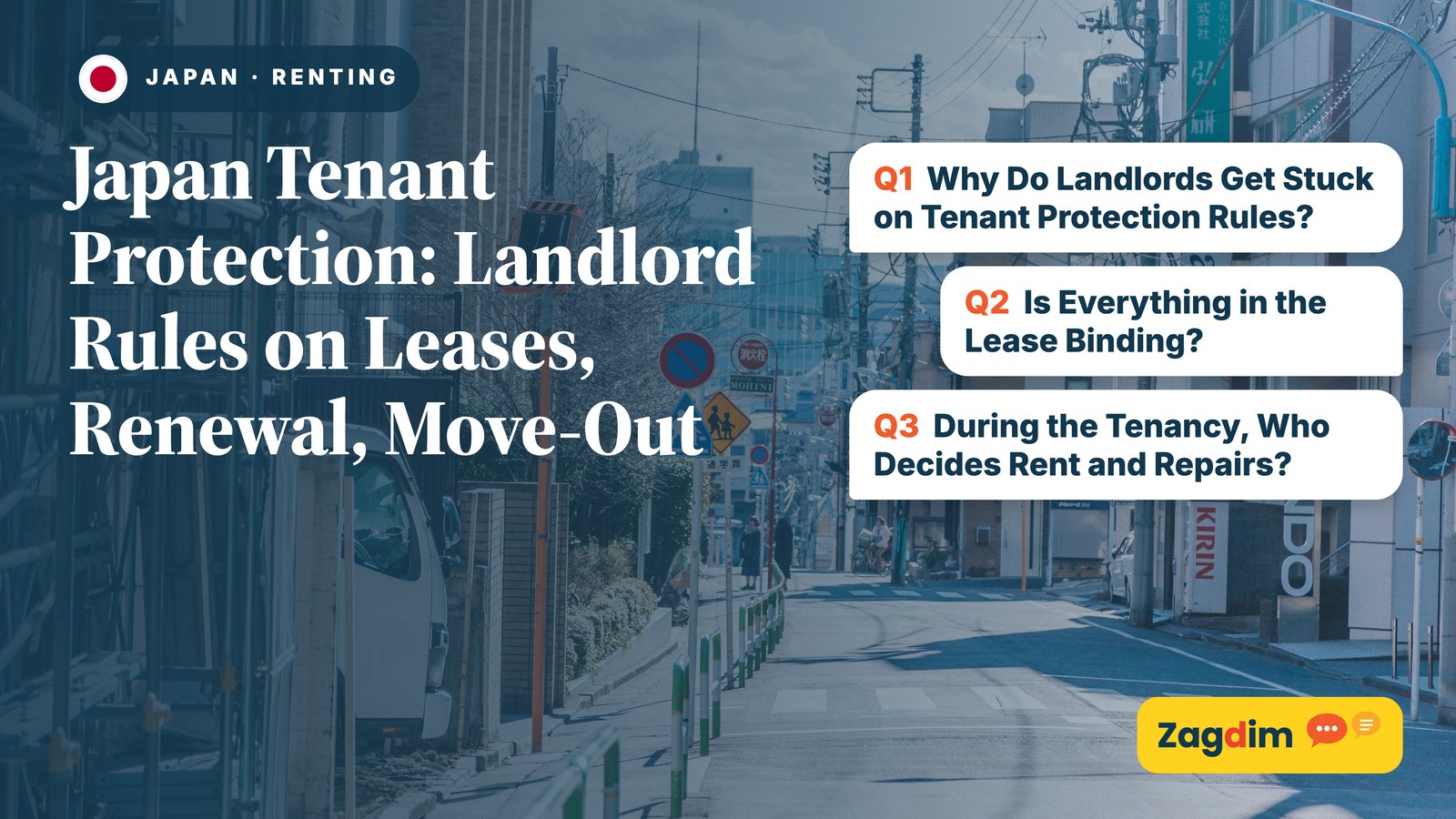
This article is part of the Zagdim wiki series on Japanese property. It explains how Japan’s tenant protection rules affect an owner at each stage: signing the lease, the rental period, renewal, move-out and resale. It is written for owners who already rent out a home in Japan, or plan to, and who live abroad.
Tenants in Japan are protected by the Land and Building Lease Act (借地借家法, Shakuchi Shakuya Ho) and the Civil Code (民法). For a landlord, this has four main effects. First, once a home is let under an ordinary lease, not renewing or terminating it requires a justifiable reason. A landlord who wants to take the home back on a fixed date can instead use a fixed-term lease before letting; an ordinary lease can also end where there is a justifiable reason or both sides agree. Second, a clause that breaks the renewal rules and works against the tenant is void, even if it is written into the lease.
Third, during the tenancy the landlord is in principle responsible for repairs, and either side may request a rent adjustment. At move-out, ordinary wear and tear and aging are generally not the tenant’s cost, and the deposit is returned after unpaid amounts are deducted once the landlord has the property back. Fourth, if a home with a sitting tenant is sold, the landlord’s position and the duty to return the deposit pass to the buyer together.
Why Do Landlords Get Stuck on Tenant Protection Rules?
Japan’s rental law contains mandatory provisions. However clearly a clause is written, it does not count if it breaks those provisions and works against the tenant. Your lease may have been prepared by a brokerage or management company and may contain renewal fees, move-out cleaning charges or a no-rent-reduction clause. From the contract alone, you cannot tell which of these are valid.
Owners who live overseas should watch two points in particular. When you want the home back for your own use, an ordinary lease cannot be ended on that need alone. And when you buy a home that already has a tenant, the deposit the previous owner collected becomes yours to return later.
What Else Should You Know About Ordinary and Fixed-Term Leases Before Letting?
The basic difference between the two types is this. Under an ordinary lease (普通借家), a landlord who does not renew or who terminates needs a justifiable reason (正当の事由). A fixed-term lease (定期建物賃貸借) is made in writing, with written notice given in advance that it will not be renewed, and it ends when the term ends. For terms of one year or more, the landlord must notify the tenant between one year and six months before the term ends. When signing, also keep the following points in mind:
- Terms under one year: If an ordinary lease sets a term of less than one year, it is treated as having no fixed term. This rule does not apply to fixed-term leases, so on the wording of the statute a term of under one year can be agreed.
- Electronic contracts: A fixed-term lease concluded as an electromagnetic record is treated as written. The advance written explanation can be provided by electronic means with the tenant’s consent. Without the advance explanation, the no-renewal clause is invalid.
- Rent can be fixed in the lease: If a fixed-term lease contains a special clause on rent adjustment, neither side can request a rent increase or decrease under the Land and Building Lease Act (see below).
For how the two lease types work in practice, with examples and notice procedures, see the related guide on how foreign owners arrange the management association, rental management and repair costs after buying in Japan.
Is Everything in the Lease Binding?
No. Article 30 of the Land and Building Lease Act provides that a special clause that breaks the lease renewal provisions (Articles 26 to 30) and works against the tenant is void. Article 37 also lists Article 31 (the effect of the lease on a new owner after a sale) and several other articles as mandatory in the same way. The table below reflects the statutes, court decisions and Ministry of Land, Infrastructure, Transport and Tourism (MLIT) guidelines as of September 2026.
| Clause a landlord wants in the lease | Does it hold? |
|---|---|
| Ordinary lease says “ends at expiry, no renewal” | Void: it breaks the renewal rules and works against the tenant. To take the home back at expiry, the requirements for a fixed-term lease must be met |
| “No rent increase during the agreed term” | Valid as agreed |
| “No rent reduction” | The statute states only that a clause against increases holds as agreed. It does not state the effect of a clause against reductions. Where a fixed-term lease has a rent adjustment clause, the increase and decrease requests do not apply |
| Fixed-term lease (residential, under 200 square meters) says “the tenant may not terminate early” | Void: it breaks the early-termination rule and works against the tenant |
| Tenant may not demand that the landlord buy, at market value, fixtures such as tatami mats or doors and windows installed with consent (造作, *zosaku*) at move-out | This purchase claim is not among the mandatory provisions in Article 37, so it can be excluded by a special clause |
| Tenant bears ordinary wear and tear (for example move-out cleaning, wallpaper replacement) | Must meet the three requirements in the guidelines, with the scope stated specifically in the contract and the tenant’s clear consent. Effect is judged case by case |
| Renewal fee (更新料) charged on renewal | The Supreme Court held that a clearly and specifically worded renewal fee clause, at a not excessive amount, is not void under Article 10 of the Consumer Contract Act. Judged case by case |
What Must Be Met to Make a Tenant Bear Ordinary Wear and Tear?
MLIT’s guidelines on restoration to original condition (原状回復) say that special clauses which do not breach mandatory law can be set under freedom of contract. But making the tenant pay for repairs of aging or ordinary wear and tear imposes a new obligation. The guidelines compile case law and list three requirements. If they are not met, the clause’s effect may be disputed:
- The special clause is necessary and not exploitative, with an objective and reasonable basis.
- The tenant knows that, under the clause, they bear repair and similar obligations beyond the ordinary restoration duty.
- The tenant has expressed willingness to bear those obligations under the clause.
The Supreme Court precedent cited in the guidelines requires, at a minimum, that the lease text specifically state which ordinary wear and aging repair costs the tenant bears, or that the landlord explain this orally and the tenant clearly understands it and agrees. The guidelines also warn that a clause that unilaterally harms the consumer’s interests may be void under Article 10 of the Consumer Contract Act (消費者契約法), and that stating in advance details such as unit prices for future restoration costs is indispensable to preventing disputes.
Can a Landlord Charge a Renewal Fee?
The law does not provide that a landlord may collect a renewal fee. To charge one, it must be written into the lease. In its judgment of July 15, 2011, the Supreme Court held that a clearly and specifically worded renewal fee clause in a lease is not void under Article 10 of the Consumer Contract Act, nor is it a clause against the tenant under Article 30 of the Land and Building Lease Act, unless special circumstances exist, such as an excessive amount compared with the rent and renewal period.
In that case, the renewal fee was two months’ rent with a one-year renewal period, and the court found no special circumstances. This judgment rests on that case’s facts. It does not mean any amount is valid.
During the Tenancy, Who Decides Rent and Repairs?
Either side can request a rent adjustment, and if they cannot agree a court decides. Repairs are in principle the landlord’s responsibility, and if a landlord delays, the tenant can make the repair and claim the cost from the landlord.
When a Tenant Asks for a Reduction or You Want to Raise Rent
Either side may request a rent increase or decrease when economic conditions such as taxes or land prices change, or when the rent is out of line with comparable nearby homes. The statute gives no calculation formula, and if the parties cannot agree, a court decides. Until the judgment becomes final, each side handles payment as follows:
- You request an increase and no agreement is reached: Until the judgment is final, the tenant may pay the amount they consider reasonable. If the amount already paid turns out to be short, the tenant must pay the shortfall with interest at 10% per year.
- The tenant requests a reduction and no agreement is reached: Until the judgment is final, you may ask the tenant to pay the amount you consider reasonable. If what you have received exceeds the proper rent, you must refund the excess with interest at 10% per year.
For a landlord, this means that a rent increase cannot be imposed unilaterally. When a tenant requests a reduction, you can keep collecting what you consider reasonable, but if the court later sets a lower figure, the excess comes back with interest.
Who Fixes a Broken Home, and Does the Rent Drop?
The landlord is responsible for repairs needed for the home to be usable, except damage caused by the tenant. A tenant may not refuse when the landlord needs to carry out necessary acts to preserve the home. Under the revised Civil Code in force from April 1, 2020, a tenant may make the repair if the landlord does not repair within a reasonable period after notice, or if the situation is urgent. The statute does not say how many days a “reasonable period” is.
- Costs advanced by the tenant: For necessary expenses that fall on the landlord, the tenant can claim reimbursement immediately. For useful expenses that improve the home, reimbursement is due when the lease ends, and a court may grant the landlord a suitable grace period on request.
- Partial loss of use: If this is not the tenant’s fault, rent is reduced in proportion to the part that cannot be used. The statute has no conversion table and does not say after how many days of malfunction a reduction starts. If the remaining part cannot serve the purpose of the lease, the tenant may cancel the lease.
- Total loss of use: If the whole home is lost or otherwise unusable, the lease ends.
For an owner abroad, who takes repair reports and what the person may fix without asking must be arranged in advance. For how remote management works in practice, see the related guide on managing Japanese rental property from overseas: tenants, repairs, tax and communication with agents.
At Move-Out, How Are the Deposit and Restoration Calculated?
The deposit is returned after the tenant’s unpaid amounts are deducted, once you have the home back. The tenant bears only damage they caused. Ordinary wear and tear and aging fall on the landlord, and the tenant’s share declines with the number of years elapsed.
The Deposit
Under the Civil Code, a deposit (敷金, *shikikin*) is any money a tenant gives a landlord to secure rent and other debts, whatever it is called. A deposit labeled a “security deposit” is the same. When the lease ends and you have the home back (or when the tenant lawfully transfers the leasehold), you must return the deposit minus the tenant’s monetary debts arising under the lease.
If the tenant is behind on rent, you may apply the deposit against it, but the tenant cannot demand that you treat the deposit as the rent. The Civil Code sets no deadline in days for returning the deposit. Key money (礼金, *reikin*) and *shikibiki* (敷引) are also not covered by the Civil Code, so they depend on what the lease says.
Restoration to Original Condition: What Does the Tenant Bear?
Under Article 621 of the Civil Code, a tenant has a duty to restore to original condition (原状回復) damage that arose after move-in, but not wear from ordinary use or aging. MLIT’s restoration guidelines (re-revised edition, August 2011) are, like the model clauses on remaining belongings discussed below, reference guidance or a template and not law. What governs is the contract you signed.
The guidelines state that they are not legally binding and assume privately let housing at roughly market rent. A signed contract is in principle handled as written, and the guidelines are consulted in negotiations when the contract is unclear or there were problems at signing. Under the guidelines, the tenant bears the cost of restoring wear and damage caused by intent, negligence, breach of the duty of care of a prudent manager (善管注意義務), or use beyond the ordinary manner.
How elapsed years are counted (the guidelines’ method):
- Tatami base (畳床), carpet, cushion flooring (クッションフロア) and wallpaper: the tenant’s share is calculated by treating the value as declining to 1 yen over 6 years, so the more years, the lower the share.
- Equipment has its own useful lives, for example 5 years for a kitchen sink; 6 years for air conditioners, refrigerators, gas stoves and intercoms; and 15 years for toilets, wash basins and other plumbing and sanitary fixtures.
- A lost key is not subject to elapsed years.
- Even beyond the elapsed years, a tenant may still bear the cost of damage caused intentionally or negligently, for example removing deliberate graffiti on wallpaper.
Examples listed in the guidelines (not a statutory list; valid special clauses and individual cases may differ):
- Landlord bears: floor dents from furniture, black marks on walls behind a TV or refrigerator, marks from posters or paintings, thumbtack holes that do not require replacing the base board, screw holes from an air conditioner the tenant installed, and wallpaper discoloration from sunlight.
- Tenant bears: scratches from moving in or out, smoke residue and odor from smoking, nail or screw holes that require replacing the base board, and intentional damage such as graffiti. On smoking, the guidelines say it is appropriate for the tenant to bear cleaning or replacement of a whole room’s wallpaper only when the wallpaper throughout the room is discolored or carries the odor.
The Ministry of Justice’s explanation of the revision also gives glass cracked by an earthquake as an example of ordinary wear and aging, and scratches and odor caused by pets as an example of what is not.
**Example: Ms. Huang, living in Singapore, rents out a Tokyo apartment**
>
Ms. Huang rents out a Tokyo apartment under an ordinary lease with no special clause making the tenant bear ordinary wear and tear. The tenant moves out after 7 years. The room has sun-faded wallpaper, black marks behind the refrigerator and one wallpaper scratch from moving out.
>
Under the guidelines, the discoloration and black marks fall on the landlord. The scratch falls on the tenant, but with wallpaper valued down to 1 yen over 6 years, the tenant’s share has already fallen with the years. Once she has the home back, the deposit less the tenant’s unpaid amounts is returned to the tenant. What she needs to do: at the inspection, sort each item of damage into aging, ordinary wear and tenant-caused damage, keep records, and then compare with what the lease says.
What Else Must a Broker Explain for a Tokyo Rental?
Under the Tokyo Metropolitan Ordinance on Preventing Disputes in Residential Leases (東京における住宅の賃貸借に係る紛争の防止に関する条例, commonly called the Tokyo Rules), when a licensed real estate broker (宅建業者, *takken gyosha*) brokers or acts as agent for a new lease of a residential home in Tokyo, the broker must hand over a written explanation in addition to the important matters explanation. It covers the basic approach to restoration to original condition and repairs during occupancy, what the tenant bears under this lease (whether there are special clauses and what they say), and the contact point for equipment repair and maintenance.
- Scope: New leases from October 1, 2004, excluding renewals; business properties such as shops and offices are excluded; a broker from outside Tokyo handling a Tokyo property must also explain.
- The obligation is on the broker, not the owner: If you let directly with no broker brokering or acting as agent, you are outside it. If the tenant is itself a licensed broker, the broker only needs to hand over the document.
- No fine: If a broker fails to deliver or explain, the governor may give guidance or a recommendation, and may publish the name of a broker who does not comply.
For a landlord, this means that within the scope, any special clause you add to the lease must be explained to the tenant in writing by the broker.
What Can Help When Choosing a Rent Guarantor or Renting to Elderly Single Tenants?
- Rent guarantee companies: These are businesses that guarantee a tenant’s rent debts, called *yachin saimu hosho gyosha* (家賃債務保証業者) in Japanese. MLIT’s registration system for rent debt guarantors took effect on October 25, 2017, and a registration is valid for 5 years. The system is voluntary, and unregistered companies may operate. When choosing a guarantor, the register can serve as a reference.
- Belongings left after a tenant’s death: In June 2021, MLIT and the Ministry of Justice issued model contract clauses on handling remaining belongings (残置物の処理等に関するモデル契約条項), intended for leases to single tenants aged 60 or over. The tenant and an agent sign a separate mandate contract authorizing the agent to cancel the lease after the tenant’s death and handle the belongings in the home.
Using the model clauses is not a legal obligation. The preface to the clauses warns that using them where the risk of remaining belongings is low (for example where there is already an individual guarantor) may make them void under Article 90 of the Civil Code or Article 10 of the Consumer Contract Act, with courts deciding case by case. They presuppose that the tenant and the agent fully understand and agree voluntarily.
If You Buy or Sell a Tenanted Home, Does the Lease Go With It?
Yes. Where the tenant has moved in, the lease is effective against a later buyer even if it is not registered, as long as the home has been delivered to the tenant. When the home is sold, the landlord’s position passes to the buyer, and the previous owner’s obligations to reimburse expenses and to return the deposit are taken over by the buyer too.
- Registration: The buyer must complete the ownership transfer registration before asserting the landlord’s position against the tenant.
- Exception: If seller and buyer agree to keep the landlord’s position with the seller, and the buyer leases the home back to the seller, the landlord’s position does not pass. It passes to the buyer when the lease between those two ends.
- Taking the home back for personal use: After a change of owner, an ordinary lease still requires a justifiable reason to take the home back for yourself.
- Leases signed before April 1, 2020: In principle the pre-revision Civil Code applies. According to the Ministry of Justice, a lease renewed by agreement after the effective date is treated like a new lease, and the revised Civil Code applies, with exceptions.
- Fixed-term leases: Before taking over, confirm that the previous owner made the lease as required and gave the advance written explanation. Without that explanation, the no-renewal clause is invalid.
The same rules apply when you later sell a home that is let: the landlord’s position and the duty to return the deposit move to the buyer with the home. What documents to prepare and how to handle the deposit depend on the type of lease, how it was signed and renewed, and the deposit terms.
**Example: Mr. Chang, based overseas, considers a rented Osaka apartment**
>
The apartment Mr. Chang is looking at is already let. The tenant moved in under an ordinary lease in 2019 and signed a renewal by agreement with the owner in 2023. Because the tenant is already living there, when Mr. Chang buys, the landlord’s position passes to him. He must complete the ownership transfer registration to assert it against the tenant, and the duty to return the deposit the previous owner collected passes to him as well.
>
The lease was renewed by agreement after April 1, 2020, so under the Ministry of Justice’s explanation the revised Civil Code applies. If he later wants to take the apartment back for his own use, he still needs a justifiable reason. What he needs to do: before signing, ask the seller for the lease and the renewal agreement, confirm the deposit amount, and check how the sale contract handles the deposit.
Which Common Claims Should You Treat With Caution?
- “Pay move-out compensation (立退料) and you can take the home back”: Move-out compensation is only one factor in judging a justifiable reason. There is no statutory amount or formula, and it is decided by negotiation or by a court case by case.
- “An ordinary lease automatically renews for the same number of years”: If the term ends without notice and the lease is renewed, the renewed lease has no fixed term.
- “A fixed-term lease must be notarized”: The statute says a “notarized deed or other document in writing” (公正証書等書面), so a written document is enough.
- “Renewal fees are always lawful” and “wallpaper over 6 years is a legal rule”: The first rests on a case-specific judgment, and the second is the calculation method in MLIT’s guidelines.
- “All rent guarantee companies are registered with MLIT”: Registration is voluntary.
- “A master lease marked as rent guaranteed means the rent will not fall”: MLIT’s guidelines on master leasing warn that for a master lease signed as an ordinary lease, even if the contract says no rent reduction, the master lessee may still request a reduction under the Land and Building Lease Act, and your refusal to renew also needs a justifiable reason. See the main article for details.
How Should a Landlord Decide What to Do Next?
- Not yet let: First decide between an ordinary lease and a fixed-term lease, then check each special clause against the table above. State the scope and unit prices in any restoration clause.
- Already let: Take out the lease and confirm the lease type, the dates it was signed and renewed (before or after April 1, 2020), whether it has a renewal fee or restoration clause, the deposit amount, and who handles repair reports.
- The tenant asks for a reduction or move-out, or a dispute arises: If no agreement is reached, a court decides. Where a justifiable reason, the effect of a special clause or move-out compensation is involved, consult a lawyer if necessary.
- Considering a home with a tenant: First obtain the lease and deposit records, then decide on the offer and the handover conditions.
For the overall arrangements during ownership, including the management association, management company and tax, return to the related guide on how foreign owners arrange the management association, rental management and repair costs after buying in Japan.
FAQ: Japanese Leases and Tenant Protection
When a Japanese tenant moves out, can the landlord make the tenant pay for brand-new wallpaper?
In principle, no. The Civil Code provides that ordinary wear and aging are outside the tenant’s duty to restore, and MLIT’s guidelines reduce the tenant’s share as years pass, treating wallpaper as worth 1 yen after 6 years. To make a tenant bear ordinary wear and tear, there must be a clear special clause that meets the requirements.
Can a lease in Japan include a renewal fee?
To charge one it must be written into the lease, because the law does not provide for it. The Supreme Court judgment of July 15, 2011 held that a clearly and specifically worded renewal fee clause at a not excessive amount is not void under Article 10 of the Consumer Contract Act. That case involved two months’ rent with a one-year renewal period, and it is judged case by case.
What happens to the existing lease and deposit if I buy a tenanted property in Japan?
If the tenant has moved in, the landlord’s position passes to the buyer on sale, and the duty to return the deposit passes too. The buyer can assert the landlord’s position against the tenant only after completing the ownership transfer registration. Taking the home back for personal use under an ordinary lease still requires a justifiable reason.
Glossary
- Land and Building Lease Act (借地借家法): the Japanese law governing renewal, termination, rent changes and fixed-term leases for building leases.
- Ordinary lease (普通借家): a building lease without an agreement that it ends at expiry without renewal; the landlord needs a justifiable reason not to renew or to terminate.
- Fixed-term lease (定期建物賃貸借): a building lease that, by written agreement, ends at expiry without renewal.
- Justifiable reason (正当の事由): the reason a landlord needs under an ordinary lease to refuse renewal or terminate, judged by weighing factors such as each side’s need to use the home.
- Move-out compensation (立退料): a payment a landlord offers to get a tenant to leave; one factor in judging a justifiable reason.
- Renewal fee (更新料): a payment the lease requires the tenant to make on renewal; the law does not provide for it, so it exists only if the contract says so.
- Deposit (敷金): money a tenant gives a landlord to secure rent and other debts, whatever it is called.
- Restoration to original condition (原状回復): the tenant’s duty at move-out to restore damage arising after move-in; ordinary wear and aging are not included.
- Duty of care of a prudent manager (善管注意義務): the ordinary duty of care a tenant owes in using the home; wear caused by breaching it falls on the tenant.
- Installed fixtures (造作): items such as tatami mats and doors and windows added to the home with the landlord’s consent.
- Licensed real estate broker (宅建業者): a business that brokers or acts as agent for the sale and rental of buildings as a business.
About the Data
The information was checked as of September 30, 2026, and rests on Japan’s Land and Building Lease Act, Civil Code, Consumer Contract Act, Tokyo Metropolitan ordinance, and official materials from MLIT, the Ministry of Justice and the Supreme Court. No other web research was done.
The following conclusions are drawn from the statutes, and no official source states them in a single sentence. “After a change of owner, taking the home back for personal use still requires a justifiable reason” is inferred from Articles 26 to 30 and 38 of the Land and Building Lease Act and Article 605-2 of the Civil Code. “There is no fixed condition or amount for justifiable reason and move-out compensation” is inferred from Article 28 of the Act, which lists only factors to consider; court decision statistics were not checked. “The purchase claim for installed fixtures can be excluded by a special clause” is inferred from Article 33 not being among the mandatory provisions listed in Article 37. The effect of a clause against rent reductions is not stated in the statute, and this article makes no judgment on it. “A fixed-term lease can set a term under one year” follows the wording of Article 38. The deadline for returning the deposit, key money and *shikibiki*, the number of days in a “reasonable period” and the rate of rent reduction are all not provided in the statutes checked.
The restoration guidelines, the model clauses on remaining belongings and the master lease guidelines are guidelines or templates from MLIT (jointly with the Ministry of Justice for the belongings clauses), not law. The renewal fee conclusion comes from one Supreme Court judgment and rests on that case’s facts; whether an individual landlord counts as a business operator under the Consumer Contract Act was not checked. The Tokyo Rules were checked only against the Tokyo ordinance. It was not stated in the materials checked whether a lease renewed by operation of law at expiry without notice (statutory renewal) is governed by the revised Civil Code after the contract law revision, so the examples cover only renewal by agreement.
Have a question about this guide? Leave a comment below, or ask Zagdim directly.
Your first stop for international property and global living.
Research and insights. Know what’s changing. Understand what matters.
Sources
- e-Gov Law Search – Land and Building Lease Act
- e-Gov Law Search – Civil Code
- Ministry of Justice – Pamphlet “賃貸借契約に関するルールの見直し”
- Ministry of Justice – 民法(債権関係)改正法の施行期日について
- e-Gov Law Search – Consumer Contract Act
- Courts in Japan – Supreme Court Second Petty Bench judgment of July 15, 2011 (平成22(オ)863)
- MLIT Housing Bureau – 原状回復をめぐるトラブルとガイドライン(再改訂版)
- MLIT – 「原状回復をめぐるトラブルとガイドライン」について
- Tokyo Metropolitan Government – 東京における住宅の賃貸借に係る紛争の防止に関する条例
- Tokyo Metropolitan Housing Policy Headquarters – 賃貸住宅紛争防止条例
- MLIT – Press release 家賃債務保証業者の登録に必要な事項を定めました
- MLIT – 家賃債務保証業者登録制度 Q&A
- MLIT – 残置物の処理等に関するモデル契約条項
- Ministry of Justice – Press release (残置物の処理等に関するモデル契約条項)
- MLIT and Ministry of Justice – 残置物の処理等に関するモデル契約条項(前注)
- MLIT – サブリース事業に係る適正な業務のためのガイドライン
Important Notice
This article is a general information summary and is not individual legal, tax or real estate advice. The information was checked as of September 30, 2026. How rules, guidelines and court decisions apply may differ by case and with future changes in the law. Rely on the current notices of Japan’s competent authorities and on the contract you signed, and consult a qualified lawyer or other professional where needed.