






























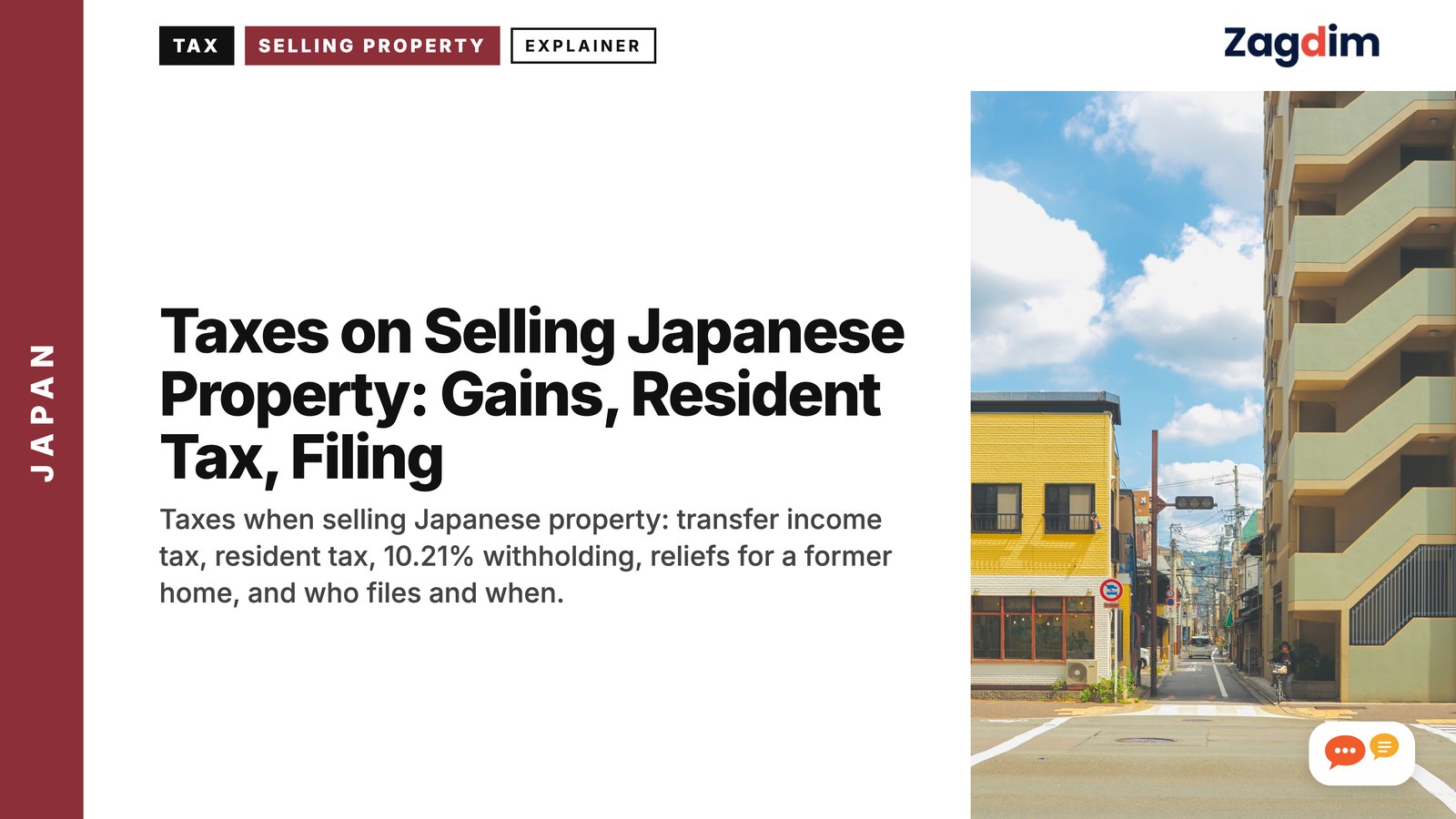
This article is part of the Zagdim wiki series on buying property in Japan. It explains which taxes an owner who lives overseas pays when selling Japanese property, how each is calculated, and who files and when. It is written for readers who are preparing to sell and want to understand the tax before signing a contract. For the full picture of the sale process, withholding and remitting the proceeds, see the main guide on thinking about the exit before buying Japanese property.
The profit from selling property is called transfer income (譲渡所得, joto shotoku). Owners living overseas still pay Japanese income tax and a surtax on it. The tax is calculated on the gain, not on the sale price. The filing period is February 16 to March 15 of the year after the sale. A person living overseas must first appoint a tax agent in Japan (納税管理人, nozei kanrinin) and file through that agent. Resident tax (住民税, juminzei) depends on whether you have an address in Japan on January 1 of the year after the sale. As of September 2026, a seller who has lived outside Japan throughout is generally not charged resident tax on this transfer income. When a buyer pays in Japan, the buyer generally withholds 10.21% of the price first; this is only a prepayment and is settled when you file. If the property was rented out, the sale of the building portion is a separate matter for consumption tax, and whether any tax is actually due depends on exemption conditions.
How Does Tax on a Japanese Property Sale Differ From What You Expect?
Four points on the tax when selling Japanese property run against intuition:
- The 10.21% withheld is not the final tax. It is withheld on the full price, while the actual tax is calculated on the gain. After filing, you may get a refund or you may owe more.
- Holding years are counted on January 1 of the year of sale. The long-term and short-term split, and the 10-year threshold for a former home, are not counted from the purchase date to the handover date.
- Resident tax looks at January 1 of the year after the sale. For someone who still lived in Japan in the year of sale, the result depends on when they moved out.
- Depreciation increases the gain. The acquisition cost of the building is reduced by depreciation over the holding period, and the longer the property was rented, the more is deducted.
Which Taxes Apply When You Sell Property in Japan?
| Tax | What it is charged on | Seller living overseas |
|---|---|---|
| Income tax plus surtax | Transfer income (the gain) | Payable; final return (確定申告, kakutei shinkoku) filed through a tax agent from February 16 to March 15 of the year after the sale |
| Resident tax | The same transfer income | Depends on whether you have an address in Japan on January 1 of the year after the sale; as of September 2026, generally not charged on someone who lived overseas throughout |
| 10.21% withholding | The full price | Not a separate tax but a prepayment withheld when the buyer pays, settled when you file |
| Consumption tax | The building portion of a property used for rental | A taxable item as of September 2026; whether it is actually payable depends on conditions such as taxable sales two years earlier |
| Stamp duty (印紙税, inshizei) | A paper sales contract | The original you hold must also carry a stamp; your share can be counted as a transfer expense |
The income tax rate depends on the holding period. If the property was held for more than 5 years on January 1 of the year of sale, it is long-term and the income tax is 15%. If it was held for 5 years or less, it is short-term and the income tax is 30%. Both carry a further surtax of 2.1% of the income tax amount, with exceptions. Property acquired by inheritance or gift generally has its holding period counted from the date the deceased or the donor originally acquired it. On these rates, income tax plus surtax is about 15.315% for long-term and about 30.63% for short-term. For income arising on or after January 1, 2027, the surtax is replaced by a 1% special defense income tax (防衛特別所得税) plus a 1.1% special reconstruction income tax (復興特別所得税), which still totals 2.1%. The rate table and examples of long-term and short-term dates are in the main guide on exiting Japanese property; for stamp duty amounts, see the article on how Japanese property is sold.
How Is the Gain Calculated, and Why Does Depreciation Count?
Taxable transfer income = sale price – (acquisition cost + transfer expenses) – special deduction. It is calculated separately from salary and other income. The fixed asset tax and city planning tax that the buyer reimburses you for, covering the period from the sale date to year-end, are also counted in the sale price.
Acquisition cost (取得費, shutokuhi) includes:
- The purchase price, construction price, purchase commission (for example, the brokerage fee paid when you bought), equipment costs and improvement costs.
- Registration and license tax (including registration costs), real estate acquisition tax and stamp duty paid at purchase. For property used for rental, these taxes are not counted in acquisition cost.
- Survey fees paid when acquiring the land.
- The part of interest on a loan taken to buy the property that corresponds to the period up to the day use actually began.
Amounts already counted as necessary expenses in business income and similar cannot be counted twice. If the acquisition cost is unknown, or the actual cost is below 5% of the sale price, 5% of the sale price may be used as the acquisition cost (the estimated acquisition cost, 概算取得費). For that reason, the purchase contract and receipts should be kept until the sale filing is complete.
The acquisition cost of the building is reduced by the equivalent of depreciation over the holding period (減価償却費相当額). There are two methods:
- Building used for business: add up the yearly depreciation from acquisition to sale; a year in which it was not claimed as a necessary expense is still added in. A rented home is generally calculated this way.
- Building not used for business: building acquisition price x 0.9 x depreciation rate (償却率) x years elapsed. The rate is 0.031 for wood, 0.034 for wood-frame mortar (木骨モルタル) and 0.015 for reinforced concrete (including steel-framed reinforced concrete). A remainder of 6 months or more in the years elapsed counts as one year, and less than 6 months is dropped; the depreciation equivalent is capped at 95% of the building acquisition price.
The more depreciation is deducted, the lower the acquisition cost and the higher the transfer income. Where two uses followed one another, for example living in the home and then renting it out, have a tax accountant (税理士, zeirishi) confirm how to split the calculation before filing.
Transfer expenses (譲渡費用, joto hiyo) are costs paid directly for the sale, such as the brokerage fee, the stamp duty you bear, survey fees, and relocation payments (立退料, tachinryo) paid to a tenant to move out for the sale. Costs and losses from demolishing a building to sell the land, and a penalty paid on a signed sale so the property could be sold elsewhere on better terms, are also transfer expenses. Repair costs, fixed asset tax and other upkeep costs, and costs of collecting the price, are not transfer expenses.
If you sell at a loss, the loss can only be set against transfer income from other land and buildings in the same year, not against salary or other income; a loss on selling a home you lived in has separate exceptions.
Example: Ms. He, who lives in Hong Kong
Ms. He owns a reinforced concrete apartment that she has never rented out and uses only for vacations. She sells it after holding it for 10 years and 4 months. The figures below are purely illustrative: the building acquisition price is assumed to be JPY 10 million, with no other costs, and the actual amount follows the filing calculation.
- A remainder of less than 6 months is dropped, so the years elapsed are 10.
- Under the method for a building not used for business: JPY 10 million x 0.9 x 0.015 x 10 = JPY 1.35 million, so the acquisition cost of the building becomes JPY 8.65 million (calculated by the formula above).
- If a home used only for vacations is treated as a villa or similar property used mainly for leisure, the JPY 30 million special deduction does not apply; the determination is made case by case and needs a tax accountant’s judgment.
What she needs to do: find the purchase contract, confirm how much of the price was for the building and how much for the land, and ask a tax accountant to calculate the acquisition cost.
Do Sellers Living Overseas Pay Resident Tax?
The income-based portion of resident tax (所得割, shotokuwari) is calculated on the previous year’s income and charged to people who have an address in Japan on January 1 of the year. A transfer income from a sale in 2026 therefore falls under resident tax for fiscal 2027, and what counts is whether you have an address in Japan on January 1, 2027.
As of September 2026, a seller who is no longer living in Japan on January 1 of the year after the sale is generally not charged resident tax on this transfer income; a seller who has lived overseas throughout is in this position. Watch for the following cases:
- Still living in Japan in the year of sale and moving out only after January 1 of the following year. Resident tax is still charged. Chuo Ward in Tokyo explains that moving abroad during the year does not change the amount, and a taxpayer without an address in the ward must submit a tax agent notification.
- Leaving the country is judged to be only a trip. Edogawa Ward in Tokyo explains that, depending on the length and purpose of the stay abroad and how the person lives while away, a person judged to be only traveling is treated as still living in the municipality they left and is taxed there.
For those who are charged, resident tax on transfer income is 5% for long-term and 9% for short-term. Where the reduced rate for a home held over 10 years applies, it is 4% on the portion up to JPY 60 million, with exceptions. These rates consist of prefectural tax and municipal tax: 2% plus 3% for long-term, 3.6% plus 5.4% for short-term, and 1.6% plus 2.4% for the reduced rate. For a person whose address is in a designated city (指定都市), the split differs but the total is the same. On these rates, income tax, surtax and resident tax together come to about 20.315% for long-term and about 39.63% for short-term.
In addition, local tax law provides that an individual who has a house (家屋敷, yashiki) in a locality but no address there is charged only the per-capita portion (均等割, kintowari). Whether the period in which you still held the property in Japan before the sale is treated this way depends on each municipality’s determination, and you can confirm it with the municipality where the property is located.
Example: Mr. Zhang, who works in Osaka
Mr. Zhang is Taiwanese and works in Osaka. He bought an apartment there in March 2016 and lives in it. In September 2026 he sells it while still living there, and in December he moves back to Taichung and completes the move-out procedure.
- On January 1, 2026 he had held the property for more than 5 years, so it is long-term; it is not more than 10 years, so the reduced rate for a home held over 10 years does not apply (derived from the rules).
- He was still living there himself at the time of sale, which meets the residence requirement for the JPY 30 million special deduction; other conditions must also be met.
- He no longer lives in Japan on January 1, 2027, so he is generally not charged resident tax on this transfer income; if he had postponed moving until February 2027, he would be charged.
- By the time the filing period arrives he lives in Taiwan, so he must submit a tax agent appointment notification to the tax office when appointing, or before leaving the country.
What he needs to do: settle the order of the sale date and the moving date, appoint a tax agent before leaving, and ask a tax accountant to confirm the timing and method of filing.
What Conditions Apply to the Two Reliefs for a Former Home?
The JPY 30 million special deduction: when you sell a home you lived in, up to JPY 30 million can be deducted from transfer income however long you held it. The conditions include:
- You lived in the home as its owner.
- You still live in it, or you sell it by December 31 of the year that contains the day three years after you stopped living in it. What the home is used for after you leave (for example, renting it out) does not affect this requirement.
- The buyer is not a person with a special relationship to you, such as a parent, child or spouse.
- You did not use this deduction in the previous year or the year before that.
- It does not apply if you moved in only to qualify for the deduction, lived there only temporarily, or the home is a villa or similar property used mainly for leisure; if you own two or more homes, it covers only the main residence. Other conditions also apply.
The reduced rate for a home held over 10 years: all five conditions below must be met.
- The home and land are in Japan and you live in them now, or you sell them within the deadline above after moving out.
- On January 1 of the year of sale, you have held both the home and the land for more than 10 years.
- You did not use this reduced rate in the previous year or the year before that.
- You are not using another special rule such as replacement of a residence or exchange; the JPY 30 million special deduction can be used at the same time.
- The buyer is not a person with a special relationship, which includes, besides parents, children and spouses, relatives who share your livelihood, relatives who will live in the home with you after the sale, a de facto partner, and a corporation with a special relationship.
When it applies, the portion of taxable long-term transfer income up to JPY 60 million is charged income tax of 10%, which with the surtax comes to 10.21%. Above JPY 60 million, income tax is (taxable long-term transfer income – JPY 60 million) x 15% + JPY 6 million. For those charged resident tax, a further 4% applies to the portion up to JPY 60 million, which on these rates brings the total to about 14.21%; resident tax on the amount above that is calculated differently.
What to prepare when filing: both reliefs require the prescribed documents with the final return. To claim the JPY 30 million special deduction for a home sold after moving out, attach the breakdown statement for transfer income (譲渡所得の内訳書). If the address on your resident record on the day before signing the sale contract differs from this home, also attach documents such as a copy of the family register addendum (戸籍の附票) that prove you lived there. The official explanation consulted does not say which document a seller of foreign nationality may submit, so confirm this with a tax accountant before filing.
Relation to the mortgage tax credit: if you used the JPY 30 million special deduction in the year you moved in, the year before or the year before that, you cannot use the housing loan special deduction (住宅借入金等特別控除, the mortgage tax credit). If you plan to buy another home in Japan to live in after the sale and claim that credit, take this into account first.
As of September 2026, property that was only rented out and never lived in by the owner generally cannot use either relief, and the rate returns to the ordinary 15% for long-term or 30% for short-term. Where a former home is sold after the owner has moved overseas, the official explanation does not distinguish residents from non-residents and does not exclude non-residents; whether it applies should be confirmed with a tax accountant before filing.
Who Files, and When?
Filing is your responsibility. Income from selling Japanese property is Japan-source income, so even if you live overseas you must in principle file a final return, calculated in the same way as for people living in Japan. The filing period is February 16 to March 15 of the year after the sale. The definition of a non-resident (非居住者) is in the main guide on exiting Japanese property.
Withholding is the buyer’s responsibility. When a buyer in Japan pays a non-resident, the buyer must in principle withhold 10.21% of the price (the statutory income tax rate of 10% plus the surtax) and pay it in by the 10th of the month after payment. If the buyer pays outside Japan but has an address in Japan or similar, the payment is also treated as made in Japan, and the payment deadline is the end of the following month. An individual buying for their own or a relative’s residence at a price of JPY 100 million or less does not withhold. Withholding is only a prepayment. If the tax calculated on your actual transfer income is lower than the amount withheld, the difference can be refunded after filing; if it is higher, you must pay the balance. If nothing was withheld, the duty to file does not go away.
Appoint the tax agent first. A person with neither an address nor a residence in Japan who needs to file must appoint a tax agent from among people who have an address or residence in Japan, either an individual or a corporation, and submit an appointment notification to the tax office. The notification should be filed when the agent is appointed or before you leave Japan, and at the latest before the final return is filed. The tax agent for national tax and the tax agent for local taxes such as fixed asset tax and resident tax are separate procedures.
If you do not appoint one yourself, the tax office can ask you in writing to notify it of a tax agent by a designated date within 60 days, or ask in writing a person in Japan who is convenient to act as your tax agent. If you still do not notify, the tax office can designate a specified tax agent (特定納税管理人): an adult spouse or other relative who shares your livelihood, or a person closely connected to the transaction by contract, such as a property management company. A specified tax agent only receives and forwards tax documents; they do not file or pay tax for you.
Does Japan Still Tax You Under Tax Treaties With Hong Kong and Taiwan?
Yes. Article 13, paragraph 1 of the Japan-Hong Kong tax agreement (in force August 14, 2011) provides that gains a Hong Kong resident makes from transferring real property located in Japan may be taxed by Japan; what counts as real property is defined by the law of the place where the property is located. Paragraph 6 of the same article provides that gains from transferring other property are taxed only by the party where the transferor resides.
The tax arrangement between Japan and Taiwan is a private-sector arrangement between the Interchange Association (now the Japan-Taiwan Exchange Association) and the Taiwan-Japan Relations Association (formerly the Association of East Asian Relations), in force June 13, 2016. It is not a formal treaty; the Ministry of Finance explains that the arrangement, together with the domestic laws that implement it, is equivalent to a tax treaty as a whole. Article 13, paragraph 1 of the arrangement likewise provides that gains a Taiwan resident makes from transferring real property located in Japan may be taxed by Japan, and paragraph 5 provides that gains from other property are taxed only where the person resides.
That Japan may tax the gain does not mean only Japan taxes it. How the Taiwan or Hong Kong side treats it is outside the scope of this article.
Is Consumption Tax Due on Selling a Property You Rented Out?
As of September 2026, when an individual sells a building used as a rental home or rental shop, the sale is subject to consumption tax. Whether it is actually payable depends on whether you are exempt from the duty to pay:
- If taxable sales in the base period (基準期間, for an individual, two years earlier) are JPY 10 million or less, you are in principle exempt.
- However, there is no exemption if you are registered as a qualified invoice issuer (適格請求書発行事業者), if taxable sales in the specified period (特定期間, for an individual, January 1 to June 30 of the previous year) exceed JPY 10 million, or if you have filed a notification electing to become a taxable business.
These are only the general rules, and exceptions exist; have a tax accountant confirm whether tax is due in your individual circumstances.
What Situations Need Extra Care?
- Still living in Japan in the year of sale and leaving around year-end: resident tax looks at January 1 of the next year, so the move-out date and the move-out procedure change the result.
- Holding years close to 5 or 10: they are judged on January 1 of the year of sale, and selling a year later may mean a different rate.
- Cannot find the purchase contract and receipts: when the acquisition cost is unknown, 5% of the sale price can be used as the estimated acquisition cost; if the real cost is higher than 5%, there are no documents to prove it.
- Rented out for many years: depreciation accumulated during the rental period shrinks the acquisition cost and enlarges the transfer income.
- Selling to family or a corporation with a special relationship: if the buyer is a person with a special relationship, neither home relief applies.
- Selling at a loss: the loss cannot be set against salary or other income; when tax was withheld, you must file to get the difference refunded.
- No tax agent appointed: the tax office can designate a specified tax agent, but that person will not file for you.
How Should You Prepare Before Selling?
Before signing, it helps to gather the following:
- Whether you have an address in Japan, and whether you have had a residence there continuously for a year or more; this decides whether you are a resident or a non-resident under income tax law.
- The purchase contract, receipts and registration cost details, and how much of the price was for the building and how much for the land.
- How long you held the home and the land on January 1 of the year of sale.
- For a home you lived in: the date you moved out and the records on your resident record, and whether the sale falls within the December 31 deadline of the third year.
- For a home you rented out: the depreciation reported each year, taxable sales two years earlier, and whether you are registered as a qualified invoice issuer.
- A candidate for tax agent for national tax; for those who will be charged resident tax, a separate procedure is handled with the municipality.
Which reliefs are available and whether resident tax is charged depend on when you leave Japan, how the property was used and the sale date.
For the sale process and brokerage fees, see the article on how Japanese property is sold. For selling a property with a tenant in it, see the article on selling a tenanted property in Japan. For what banks check when sale proceeds are sent abroad, see the article on sending sale proceeds out of Japan. For the overall process, see the main guide on exiting Japanese property.
Japanese Property Sale Tax FAQ
If I sell Japanese property at a loss, do I still need to file in Japan?
When 10.21% was withheld, you must file to get the excess tax refunded. The loss can only be set against transfer income from other land and buildings in the same year, not against salary or other income; a loss on selling a home you lived in has separate exceptions.
I still lived in Japan in the year of sale and moved back home before year-end. Do I pay resident tax?
Resident tax looks at whether you have an address in Japan on January 1 of the year after the sale. Someone who has moved out and completed the move-out procedure before then is generally not charged resident tax on this transfer income; someone who moves out only after that January 1 is still charged.
Can I use the JPY 30 million deduction on a Japanese apartment I use only for vacations?
In principle, no. A villa or similar home used mainly for leisure does not qualify for the JPY 30 million special deduction. The rate returns to 15% for long-term or 30% for short-term, based on the holding period on January 1 of the year of sale, plus the surtax.
Glossary
- Transfer income (譲渡所得): the gain from selling real estate.
- Acquisition cost (取得費) and transfer expenses (譲渡費用): the purchase costs and sale costs deducted from the sale price when calculating transfer income.
- Depreciation equivalent (減価償却費相当額): the amount deducted over the holding period when calculating the building’s acquisition cost.
- Income-based portion (所得割): the part of resident tax calculated on income; resident tax on transfer income belongs to this part.
- Per-capita portion (均等割): the other part of resident tax; a person with a house in the locality but no address there is charged only this part.
- House (家屋敷): a term in local tax law; whether a home you keep in Japan counts depends on each municipality’s determination.
- Designated city (指定都市): a city for which local tax law sets a different split of resident tax.
- Tax agent (納税管理人): the person who files, pays tax and receives tax documents for a taxpayer living overseas.
- Specified tax agent (特定納税管理人): a person designated by the tax office when the taxpayer has not appointed one, who only receives and forwards tax documents.
- Qualified invoice issuer (適格請求書発行事業者): a consumption tax registration; a registered person is not exempt from the duty to pay even if taxable sales two years earlier were JPY 10 million or less.
Notes on the Sources
- The information was checked on September 30, 2026, against explanations from the National Tax Agency, the Ministry of Internal Affairs and Communications and the Ministry of Finance; Japan’s Income Tax Act, Special Taxation Measures Act, Local Tax Act and Act on General Rules for National Taxes; explanations from Chuo Ward and Edogawa Ward in Tokyo; and the Japan-Hong Kong tax agreement and the Japan-Taiwan private tax arrangement.
- The following conclusions are drawn from official documents; the officials do not state them in a single sentence:
- That a seller no longer living in Japan on January 1 of the year after the sale is generally not charged resident tax on this transfer income is inferred from the Local Tax Act and the Chuo Ward and Edogawa Ward explanations of resident tax in general; the officials do not use a property sale as an example.
- That property only rented out and never lived in cannot use the JPY 30 million special deduction or the reduced rate is inferred from the requirement that the owner live in the home.
- That the two reliefs do not distinguish residents from non-residents is drawn from the National Tax Agency explanation and the provisions containing no such distinction; the full set of related circulars was not checked.
- That the sale of a building used for rental is subject to consumption tax is stated here only as the general rule on what is taxable and the exemption conditions; whether tax is actually payable depends on individual conditions.
- That a rented home is depreciated under the “building used for business” method is inferred from the National Tax Agency’s distinction between the two methods; whether a vacation home is a villa, and whether it is “not used for business”, is decided case by case.
- That withholding is settled by refund or balance payment, and that filing is required even when nothing was withheld, is inferred from the National Tax Agency explanation that income from selling real estate must in principle be filed and that a return can be filed to get withheld tax refunded.
- 15.315%, 30.63%, 20.315%, 39.63% and 14.21%, and the JPY 1.35 million and JPY 8.65 million in Ms. He’s example, are figures calculated from the official rates and formulas, not amounts published by the authorities; the JPY 10 million in the example is an assumption.
- Matters the sources consulted do not address: which document a seller of foreign nationality may use in place of the family register addendum, whether a refund can be paid to an overseas account, whether early repayment fees on a mortgage and mortgage cancellation costs count as transfer expenses, and taxation on the Taiwan or Hong Kong side.
- Things that may change: from January 1, 2027 the surtax becomes the special defense income tax plus the special reconstruction income tax, with the total unchanged; the National Tax Agency’s filing explanation pages do not yet reflect this reform. The resident tax rates on transfer income are set in the supplementary provisions of the Local Tax Act, which state that they apply for the time being.
Have a question about this guide? Leave a comment below, or ask Zagdim directly.
Your first stop for international property and global living.
Research and insights. Know what’s changing. Understand what matters.
Sources
国税庁-タックスアンサー No.2875 居住者と非居住者の区分 / 国税庁-タックスアンサー No.2878 国内源泉所得の範囲 / 国税庁-タックスアンサー No.1932 海外勤務中に不動産を売却した場合 / 国税庁-タックスアンサー No.1440 譲渡所得(土地や建物を譲渡したとき) / 国税庁-タックスアンサー No.3202 譲渡所得の計算のしかた(分離課税) / 国税庁-タックスアンサー No.3208 長期譲渡所得の税額の計算 / 国税庁-タックスアンサー No.3211 短期譲渡所得の税額の計算 / 国税庁-防衛特別所得税及び復興特別所得税の源泉徴収のあらまし(令和9年1月以後の源泉徴収) / 国税庁-タックスアンサー No.3252 取得費となるもの / 国税庁-タックスアンサー No.3258 取得費が分からないとき / 国税庁-タックスアンサー No.3261 建物の取得費の計算 / 国税庁-タックスアンサー No.3255 譲渡費用となるもの / 国税庁-タックスアンサー No.3203 不動産を譲渡して譲渡損失が生じた場合 / 国税庁-タックスアンサー No.2250 損益通算 / 国税庁-タックスアンサー No.7140 印紙税額の一覧表(その1) / 国税庁-タックスアンサー No.3302 マイホームを売ったときの特例 / 国税庁-タックスアンサー No.3305 マイホームを売ったときの軽減税率の特例 / 国税庁-タックスアンサー No.3314 過去に居住していたマイホームを売ったとき / e-Gov法令検索-租税特別措置法 / e-Gov法令検索-地方税法 / 総務省-地方税制度:個人住民税 / 江戸川区-1月1日現在、海外へ出国中の場合の住民税の取り扱い / 中央区-国外転出するときの個人住民税の手続き / 国税庁-タックスアンサー No.2879 非居住者等から土地等を購入したとき / e-Gov法令検索-所得税法 / e-Gov法令検索-所得税法施行令 / e-Gov法令検索-国税通則法 / 国税庁-タックスアンサー No.1926 海外勤務中に不動産所得などがある場合 / 国税庁-所得税・消費税の納税管理人の選任届出又は解任届出手続 / 国税庁-特定納税管理人制度の概要(令和4年1月) / 財務省-日本国政府と中華人民共和国香港特別行政区政府との間の租税協定(和文) / 日本台湾交流協会-公益財団法人交流協会と亜東関係協会との間の租税取決め(和文) / 財務省-租税条約に関する資料 / 国税庁-タックスアンサー No.3240 個人が事業用建物等を譲渡した場合の消費税 / 国税庁-タックスアンサー No.6501 納税義務の免除
Important Notice
This article is general information and does not constitute individual tax, legal or financial advice. The information was checked on September 30, 2026. Rates, deadlines and rules may change; rely on the current announcements of the competent Japanese authorities and, where needed, consult a qualified tax accountant (税理士).