































Arrange On-the-Ground Support Before Deciding What to Outsource
Living overseas, you can still handle rent reconciliation, paperwork, and some tenant communication yourself. But viewings, handovers, inspections, and emergency repairs usually need someone physically present. Settling these arrangements before the property is let is more practical than scrambling to find someone after something has already gone wrong.
You can appoint a suitable agent or property management company for part of the work, or manage everything yourself and separately line up reliable on-the-ground support. The key is that every task has a clearly assigned person, a way to reach them, and defined authority to act.
What a Full-Service Management Contract Should Spell Out
“Full-service management” does not necessarily mean every task and cost is included. Before signing, confirm the following:
| Task | What to Clarify |
|---|---|
| Letting and handover | Whether viewings, tenant screening, an inventory list, and move-in photos are included |
| Rent collection and arrears follow-up | Who collects payment, when it is remitted, and how late payment is reported to the owner |
| Repairs | Who obtains quotes, what amount needs prior approval, and how emergencies are handled |
| Inspections and reporting | How often income-and-expense reports are provided, and when unit inspections are scheduled under the lease |
| Move-out and re-letting | Whether deposit settlement, cleaning, repairs, and re-letting are charged separately |
| Ending the arrangement | How keys, the lease, funds, and unfinished matters are handed over |
Before engaging a company, also check its registration and the scope of its business qualification. The person handling letting is not necessarily also qualified to take on other regulated management services.
Itemized Rent Statements Show What the Property Actually Nets
Rent can go directly into the owner’s account as agreed, or be collected by an authorized management agent. Whichever method is used, keep a payment record, and record rent, deposits, management fees, and amounts paid on the owner’s behalf separately.
If what is received is a net amount after deductions, the owner still needs to check the rent due for the month, the amount actually received, the items deducted, and any arrears. A deposit should not be treated as rental income that is free to spend.
Rent, loan payments, management fees, and necessary expenses can be reconciled on a fixed monthly basis, with a separate reserve set aside for vacancy and unexpected repairs. If a tenant does not pay on time, the owner’s own loan payments and other bills generally still fall due as usual.
Set Repair Authority in Advance So Tenants Know Who to Contact
Owners can agree in advance on the quoting and approval process for routine repairs, as well as the contact sequence and scope of response for emergencies such as water leaks or electrical safety issues. The approval threshold should be set according to the owner’s own property and finances; there is no single figure that fits every unit.
After the management agent handles a repair, it should provide photos, a description of the work, and receipts; approval should be obtained again before any further work proceeds. Where common areas or interfloor leaks are involved, the building management must also be notified rather than treating the matter purely as an in-unit repair.
Tell tenants how to report issues at move-in, and keep one point of contact who can handle time differences or emergencies. Any later entry for inspection or works must still follow the lease and applicable law.
Living Abroad Does Not Exempt Rent From Malaysian Reporting
Rent generated by a Malaysian property is generally Malaysia-sourced income. An owner living overseas, or rent paid into an offshore account, does not by itself change the source of the income or the related reporting obligation.
Tax residency status must be determined under the statutory conditions for the relevant assessment year, including days present in Malaysia and applicable cross-year linking rules. It cannot be decided simply by nationality, visa status, or by calling oneself an “overseas owner.”
The relevant chargeable income of a non-resident individual currently generally attracts a 30% rate; a resident individual is taxed at the applicable progressive rates. This does not mean every non-resident simply multiplies total rent received by 30%: deductible expenses and chargeable income must first be calculated under the rules. Personal tax reliefs that non-residents cannot claim also do not mean that none of the letting-related expenses can be deducted.
Keep Interest, Principal, and Different Expense Types Separate When Reporting
When organizing records, keep the lease, rent collection records, loan interest statements, taxes, insurance, and other letting-related receipts, and have them categorized by whoever files the return.
Qualifying loan interest, quit rent, assessment rates, fire insurance, and general repairs may be deductible; loan principal cannot be claimed as a rental expense. Initial expenses for first letting, capital improvements, and routine repairs are also treated differently — not everything with a receipt can simply be deducted.
An income-and-expense statement from a management company can help with organizing records, but it does not mean the owner’s tax filing has been completed. If a tax agent is engaged, separately confirm the scope of the filing, the documents required, deadlines, and submission records.
Common Misunderstandings
“If rent goes into an overseas account, I don’t need to report it in Malaysia.”
Where the receiving account is located does not by itself change the source of rent from a Malaysian property; it must still be handled under the applicable rules.
“Since I live abroad, I’m automatically taxed at 30%.”
Confirm tax residency status for the year first, then calculate chargeable income. It cannot be decided from a residential address alone.
“Once it’s with a management company, it’s enough to just receive the monthly payment.”
Arrears, deductions, repairs, and the lease expiry date should still be checked, and the owner should know who holds the deposit and the documents.
What to Check Next
Owners who have just become overseas landlords should first assign a responsible person for rent collection, on-site handover, repairs, and tax reporting, then set up shared records for documents and income and expenses.
Those comparing management companies can request quotes using the same task checklist, and confirm payment collection, authorization, and exit arrangements. Owners who are already letting can start by checking whether the past few months’ rent and expenses reconcile.
Individual tax matters should be confirmed by a qualified tax professional based on the actual facts.
FAQ
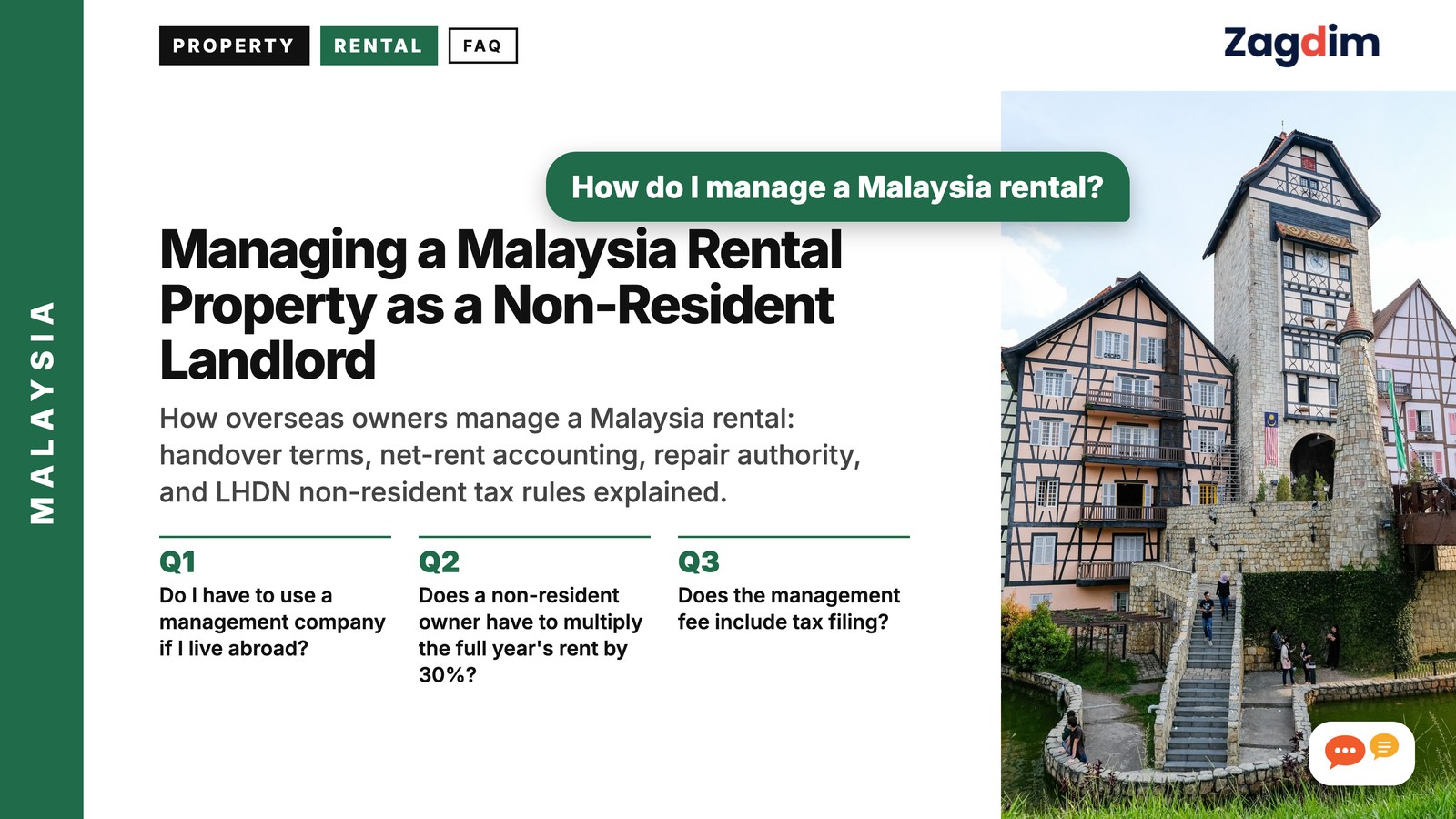
Do I have to use a management company if I live abroad?
Not necessarily. This can be decided based on time, resources, and available on-site support, but rent collection, repair reporting, handover, and emergency contact should all have a clear arrangement.
Does a non-resident owner have to multiply the full year’s rent by 30%?
No, it cannot be calculated that way directly. The 30% rate generally applies to the relevant chargeable income; deductible expenses must be worked out under the tax rules, and residency status must be confirmed first.
Does the management fee include tax filing?
Not necessarily. The scope of service should be confirmed separately — an income-and-expense report and completing the income tax filing are different pieces of work.
Disclaimer
This article covers the general arrangements for an individual owner who personally holds and lets a property; it is not legal, tax, or investment advice. Company ownership, short-term letting operations, and other special circumstances need separate assessment. Actual liability is governed by applicable law, the lease, and the management agreement. Information verified as of October 6, 2026.
Have a question about this guide? Leave a comment below, or ask Zagdim directly.
Your first stop for international property and global living.
Research and insights. Know what’s changing. Understand what matters.
References
- LHDN — Non-resident individuals: applicable tax rate and reporting for rental income
- LHDN — Public Ruling No. 11/2017: Residence Status of Individuals
- LHDN — Public Ruling No. 12/2018: Income from Letting of Real Property
- LHDN — Individual income tax rates
- LPEPH — Public search for registered companies and professionals
- Strata Management (Maintenance and Management) Regulations 2015: handling of common-area and interfloor leaks (official version, Putrajaya Corporation)