





























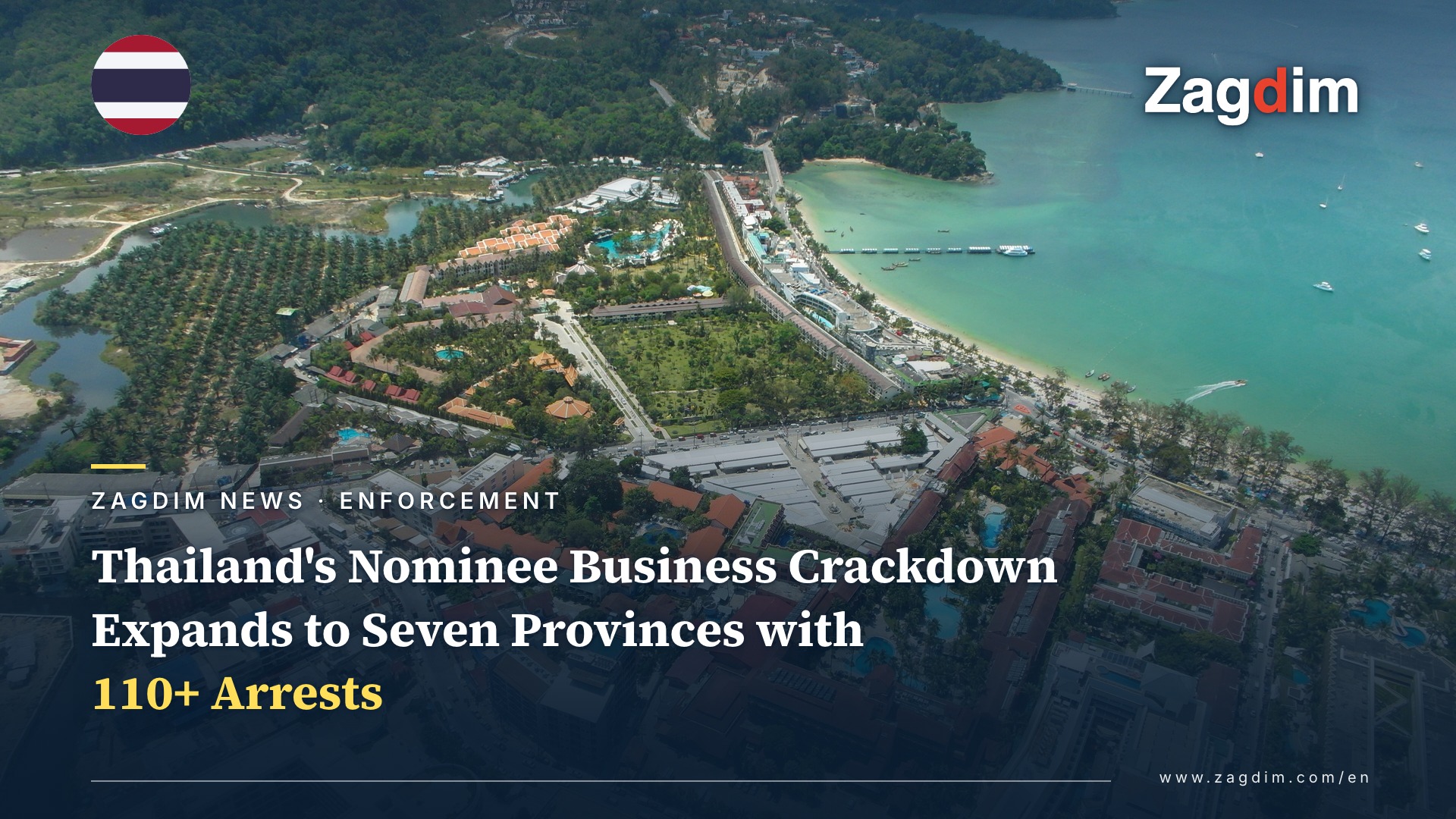
Thailand’s government has expanded a crackdown on foreign-Thai nominee business structures, known domestically as the “Phangan model,” into seven provinces, leading to more than 110 arrests and dozens of warrants, according to Bloomberg News. The operation targets companies where a Thai national is listed as majority shareholder on paper without having made a genuine investment — a workaround foreigners have used to get around Foreign Business Act restrictions that bar majority foreign ownership of land and of tourism-related businesses such as hotels and restaurants, unless operators hold explicit permission or qualify for an exemption.
The scrutiny is concentrated where the practice is most widespread. On Koh Phangan and neighboring Koh Samui — where the “Phangan model” originated — nearly 70% of some 16,800 registered companies have foreign co-ownership, led respectively by Israeli and French nationals, compared with about 12% of registered companies nationwide, according to Commerce Ministry data cited by Bloomberg. Authorities say they have identified more than 240 businesses across the two islands that exploited nominee structures, involving foreign nationals from Russia, Germany, Israel, Switzerland and France among others, with thousands more companies still under investigation. On the resort island of Phuket, foreigners hold shares in about 35% of some 32,000 registered companies, led by nationals from Russia, China and the UK.
The Commerce Ministry has also widened scrutiny to the Thai professionals who help set up the arrangements. Officials are examining about 140 accountants at 29 firms who appear as shareholders of record in more than 2,000 companies with foreign involvement and combined investment of 2.5 billion baht; one accountant alone is listed as a shareholder in 212 companies. “Not every case involves a nominee structure,” said Poonpong Naiyanapakorn, director general of the Department of Business Development, “but this is the high-risk group.” Deputy Interior Minister Polapee Suwunchiwee has personally led hotel inspections across the southern tourist islands in recent months, ordering managers to produce business licences for properties suspected of operating under illegal foreign-ownership structures; Bloomberg journalists accompanied three such inspections in Phuket in July. “This is our land, we shouldn’t let foreign entities simply come in and run things. Thailand must remain Thai,” Polapee said.
Authorities have also linked nominee structures to money-laundering risk: in one 2024 case in Chonburi province, Thai police broke up a Chinese-led scam network that had converted stolen funds into cryptocurrency and used Thai-nominee companies to acquire property, before seizing more than 152 million baht (about US$4.5 million) in assets. Nationally, the number of new companies with foreign shareholdings of up to 49.99% almost doubled in 2022 from the year before and kept climbing through 2023 and 2024, before contracting 18% in 2025, according to government data cited by Bloomberg.
The crackdown is unfolding alongside — but on a legally separate track from — an immigration-policy tightening already in effect: the government cut visa-free entry for most nationalities from 60 to 30 days last month, which Bloomberg reported is intended to make it harder for foreigners to use repeated tourist-visa stays to remain long-term or run a business informally. Prime Minister Anutin Charnvirakul, whose party was elected in February on a Thailand-first platform, has framed the nominee-business issue as a threat to national and economic security. “Ultimately, foreigners are the ones who control the companies. We need to fix this,” he said in May, after joining a police raid on villas with illegal ownership structures linked to Israeli investors on Koh Phangan.
Officials have signaled the enforcement drive is still widening rather than winding down: thousands of companies beyond the 240 already identified on Phangan and Samui remain under review, and the extension of scrutiny to nominee accountants points to enforcement moving further up the chain, from individual foreign operators to the Thai professionals who structure the arrangements for them.