






























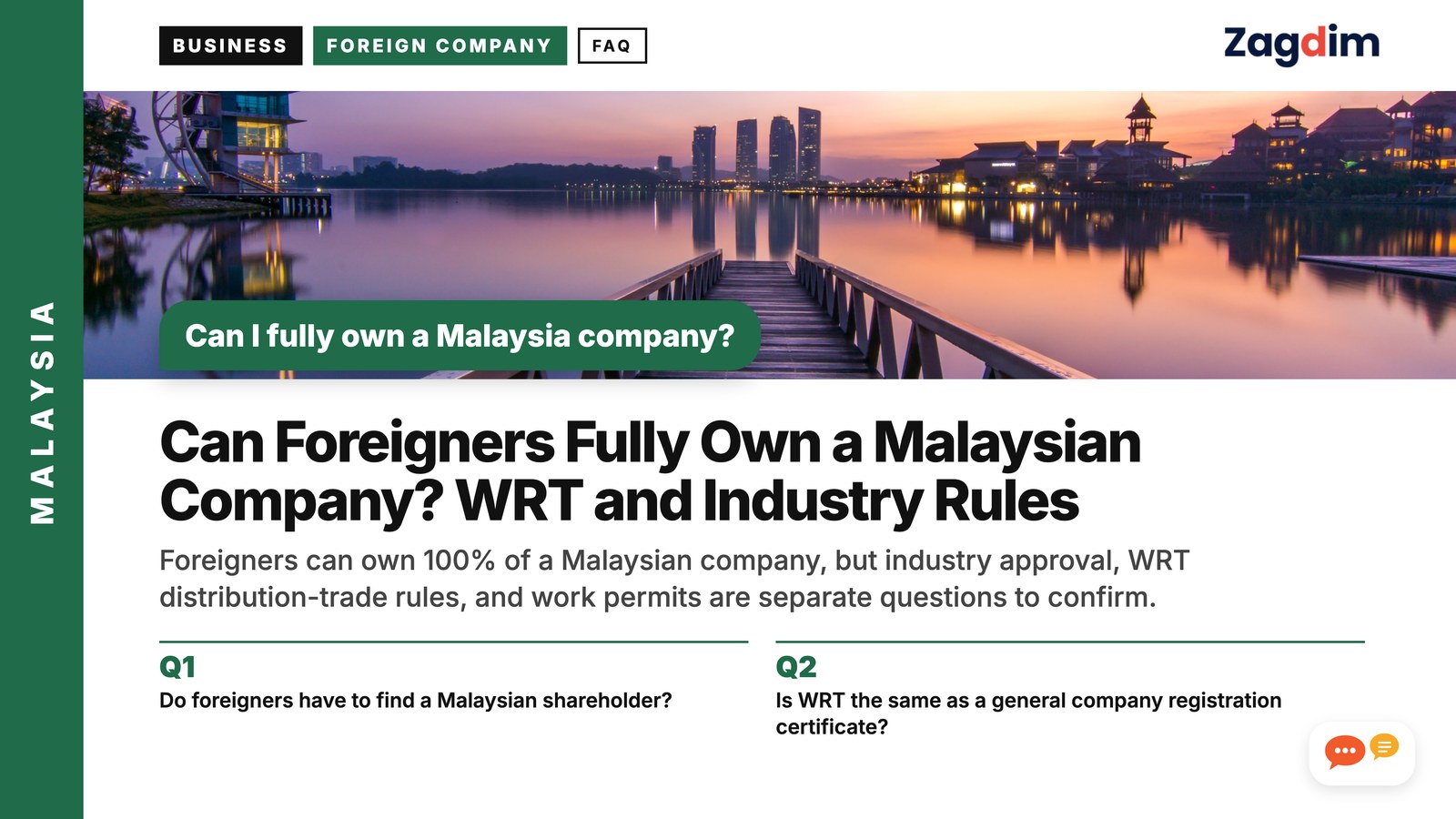
A foreign national can be the sole shareholder of a Malaysian private company. That much is straightforward under company law. What trips people up is assuming that owning 100% of the shares also settles whether the company can actually operate in its chosen line of business. Company registration resolves the legal entity and shareholding structure; the right to operate still depends on the specific industry.
Full Ownership Does Not Automatically Clear You to Operate
A company described as a “trading company” can mean very different things. Wholesaling goods, running a physical retail store, selling regulated products, and providing services can each carry different approval requirements, even under the same general label. The company’s name or the business description filed at registration is not enough on its own to tell you whether full foreign ownership is permitted for that activity.
Separate Shareholding, Management, and Licensing First
Before assuming a structure is workable, four questions need to be checked separately:
| What to Confirm | The Question Behind It |
|---|---|
| Who holds the shares | Does company law, and the specific industry, allow this level of foreign shareholding? |
| Who manages the company | Is there a director who meets the usual residency requirement? |
| What the business is allowed to do | Does it require approval from a regulator, a local business license, or a product permit? |
| Whether foreign staff can legally work there | Is a separate Employment Pass (EP) or other applicable work permit needed? |
Having a local director does not turn the company into a locally owned one. Conversely, having a foreign shareholder does not automatically bar every type of business activity.
WRT Depends on the Actual Distribution Business, Not Just the 51% Figure
The approval commonly referred to in the market as “WRT” generally covers foreign participation in wholesale, retail, and related distributive trade activities. The current distributive trade guidelines set out conditions by business type, and some business types are not open to foreign participation at all.
The guidelines, in their general wording, state that foreign operators are “encouraged and advised to obtain approval before commencing operations” – this should not be rewritten into a blanket statement that every foreign-owned company is legally required to hold the same WRT license. At the same time, that wording does not mean approval can be ignored: depending on the specific business type, other licenses and work permit applications may be conditional on obtaining the relevant approval.
The more reliable approach is to bring the actual details – products, customers, sales channels, store format, and shareholding – to the relevant authority for confirmation. In particular, the capital threshold that the Expatriate Services Division (ESD) applies to certain companies with 51% or more foreign ownership should not be treated as the single trigger point for every WRT approval.
Confirm the Business Category Before Signing a Lease or Starting Renovations
If you plan to open a physical store, check the scope for foreign participation, the capital required, and any local licensing requirement before committing to a lease or fit-out. Successfully incorporating the company and getting a bank to open an account are not substitutes for operating approval.
If you are considering a local co-shareholder, the arrangement should involve real capital contribution, real voting rights, and a real exit arrangement. Using someone else’s name as a nominee does not remove the obligation to report true beneficial ownership and control.
Situations That Are Often Misread
“Company law allows 100% foreign ownership, so there is no need to check industry restrictions.”
Eligibility to hold shares and approval to operate are two separate questions, and each needs to be confirmed on its own.
“Foreign ownership is below 51%, so none of the distribution approvals apply.”
51% is not a universal threshold shared across every regulation. Each case needs to be checked against the actual business type and the specific application involved.
What to Check Next
Start with a one-page summary of what the company sells, who it sells to, and where it operates, together with who holds the shares. Once the industry requirements are clear, you can decide whether full ownership is workable, how much capital is needed, and when foreign staff can be hired. Industry eligibility and approvals are ultimately confirmed by the relevant authority, not by the company registration itself.
FAQ
Do foreigners have to find a Malaysian shareholder?
Not necessarily. Company law allows a foreign national to be the sole shareholder, but industry-specific conditions may impose separate restrictions.
Is WRT the same as a general company registration certificate?
No. WRT concerns approval for foreign participation in distributive trade, and is separate from SSM registration and from local business licenses.
Can a foreign shareholder start working immediately after the company is registered?
Not on the basis of shareholding alone. A separate work permit, and confirmation of its scope, is required.
Disclaimer
This article is based on information publicly available as of October 8, 2026, and is provided for general reference only. It does not constitute legal, tax, financial, or immigration advice. Actual arrangements should be confirmed against the company’s specific circumstances, applicable law, and the current requirements of the relevant authorities.
Sources
SSM – Starting a Company; KPDN – Guidelines on Foreign Participation in Distributive Trade Services Malaysia 2022; ESD – Online Guidebook V6 2025 (company registration and capital requirements); SSM – Guidelines for the Reporting Framework for Beneficial Ownership of Companies, 2025 revision
Have a question about this guide? Leave a comment below, or ask Zagdim directly.
Your first stop for international property and global living.
Research and insights. Know what’s changing. Understand what matters.