































Start By Asking What the Capital Is For
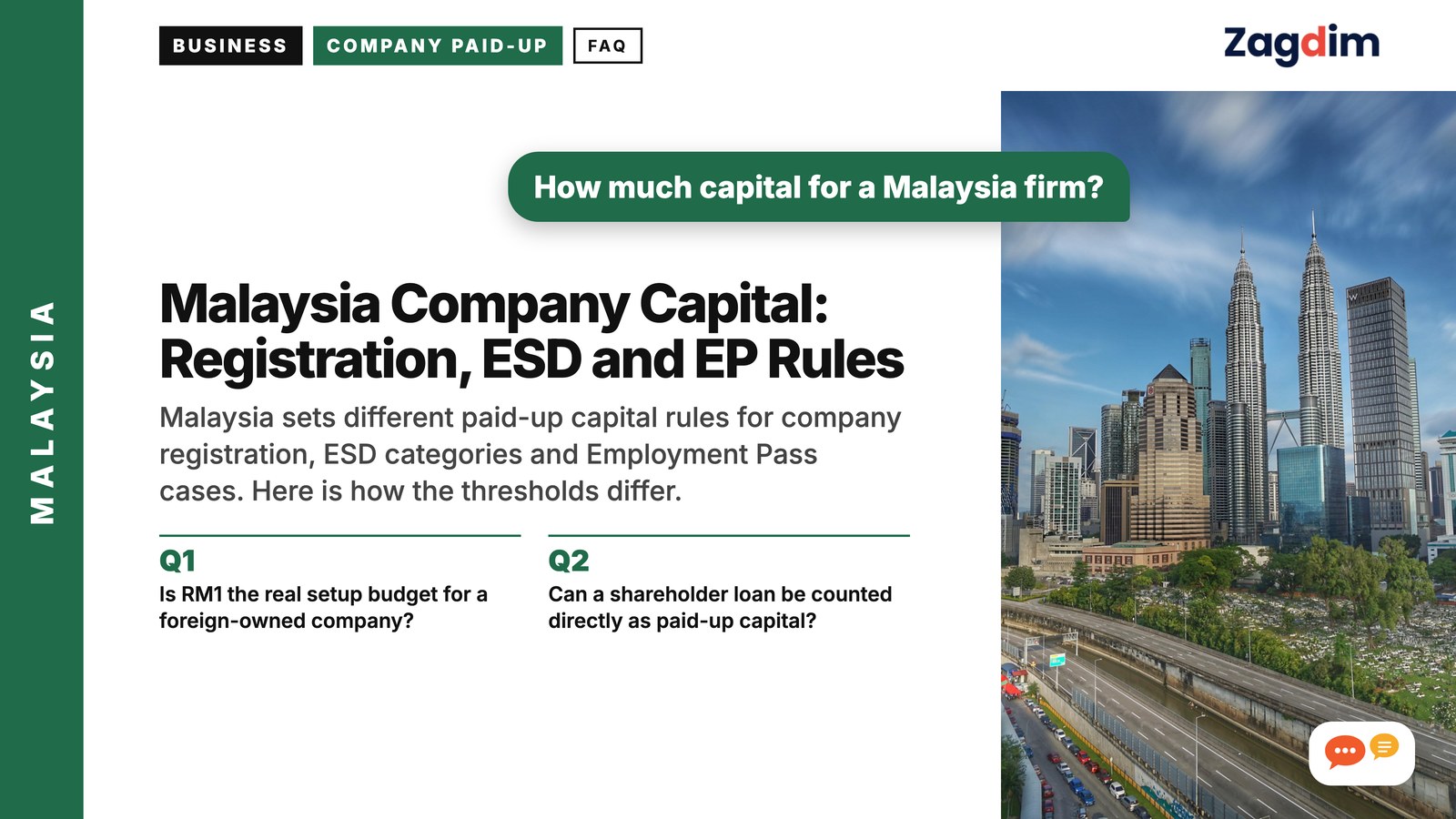
“You can set up a company in Malaysia for RM1” and “a foreign-owned company needs RM500,000” both circulate in service descriptions, but they are often answers to different questions.
Company incorporation, industry licensing, Expatriate Services Division (ESD) company registration, and the actual funds needed to run a business each carry their own requirements. Incorporating with a very low paid-up share capital does not, by itself, mean a company qualifies to hire foreign staff or to operate in a particular regulated business.
A Low Paid-Up Capital Registration Does Not Mean Low-Cost Operations
A private limited company must have shares and shareholders, but the commonly advertised RM1 incorporation arrangement should not be treated as the capital standard that applies across every industry, licence and work permit.
Paid-up capital is money that shareholders put into the company, not a fee paid to the government. Once the company holds the funds, they still need to be properly recorded, and how they are used and returned is governed by company law. Registration fees, company secretary fees, rent, salaries and an operating reserve are separate items that still need to be budgeted for.
ESD Company Registration Has Its Own Paid-Up Capital Requirements
According to the paid-up capital categories published in the ESD guidebook:
| Company Ownership or Business Situation | Paid-Up Capital Threshold in the Guidebook |
|---|---|
| 100% local ownership | RM250,000 |
| Local-foreign joint venture, with foreign shareholding of at least 30% | RM350,000 |
| 100% foreign ownership | RM500,000 |
| Foreign shareholding of 51% or more, involving designated wholesale and retail trade activities | RM1,000,000, and Wholesale and Retail Trade (WRT) approval must also be confirmed |
| Specific unregulated services sectors listed in the guidebook | RM1,000,000, confirmed according to the listed category |
A joint venture is not limited to a 50:50 split, and a shareholding structure that does not fit neatly into one of these rows should not simply be matched to the cheapest category by default. The relevant industry regulator may also have its own requirements.
These are thresholds for company registration and for preparing an application, not a guarantee that meeting the paid-up capital figure will secure an Employment Pass (EP). The foreign position itself, the applicant’s qualifications, the salary, and the company’s actual operations are still reviewed separately.
Capital, Loans and Bank Balances Are Not Interchangeable
If a shareholder remits RM500,000 but it is recorded on the books as a shareholder loan, a bank balance of RM500,000 alone does not automatically count as RM500,000 in paid-up share capital. Converting it into capital requires the relevant approvals, a share allotment, and filings, and the paperwork needs to match the actual movement of funds.
Capital also should not be deposited only briefly to support an application and then returned to a private account without proper basis afterward. A company still needs genuinely available working capital to pay salaries, rent and suppliers going forward.
Common Misunderstandings
“Putting RM500,000 in the Bank Means Every Requirement Is Met”
The nature of the funds, the capital registration, the company category and any other approval requirements still need to be confirmed.
“Meeting the Capital Threshold Means an EP of Any Duration Can Be Approved”
Capital is only one factor. The company and the individual applicant are still reviewed under current policy.
How to Work Out the Next Step
Start by confirming the business activity, the foreign shareholding percentage, and whether foreign staff need to be hired, then check the corresponding capital requirement against that. When budgeting, keep paid-up capital, incorporation costs and monthly operating expenses as separate line items, and confirm there is still enough working capital left after the capital contribution is made. Specific thresholds should be confirmed against the current requirements of the relevant authority.
FAQ
Is RM1 the real setup budget for a foreign-owned company?
No. A low-capital incorporation arrangement does not cover licensing, foreign-position applications or operating costs.
Can a shareholder loan be counted directly as paid-up capital?
No. The two are different in law and in the accounts, and converting a loan into capital requires completing the relevant procedure.
Does meeting the ESD capital requirement guarantee an EP will be approved?
Not necessarily. The company’s eligibility, the position, the salary, the applicant’s background and other conditions are still reviewed.
Disclaimer
This article is based on information available as of October 8, 2026, and is provided for general reference only. It does not constitute legal, tax, financial or immigration advice. Actual arrangements should be confirmed against the company’s specific circumstances, applicable laws, and the current requirements of the relevant authorities.
Sources
SSM — Companies Act 2016 (to be read together with its amendments); ESD — Online Guidebook V6 2025 (company registration and capital requirements); ESD — Revised Employment Pass Salary Policy, effective June 1, 2026
Have a question about this guide? Leave a comment below, or ask Zagdim directly.
Your first stop for international property and global living.
Research and insights. Know what’s changing. Understand what matters.