





























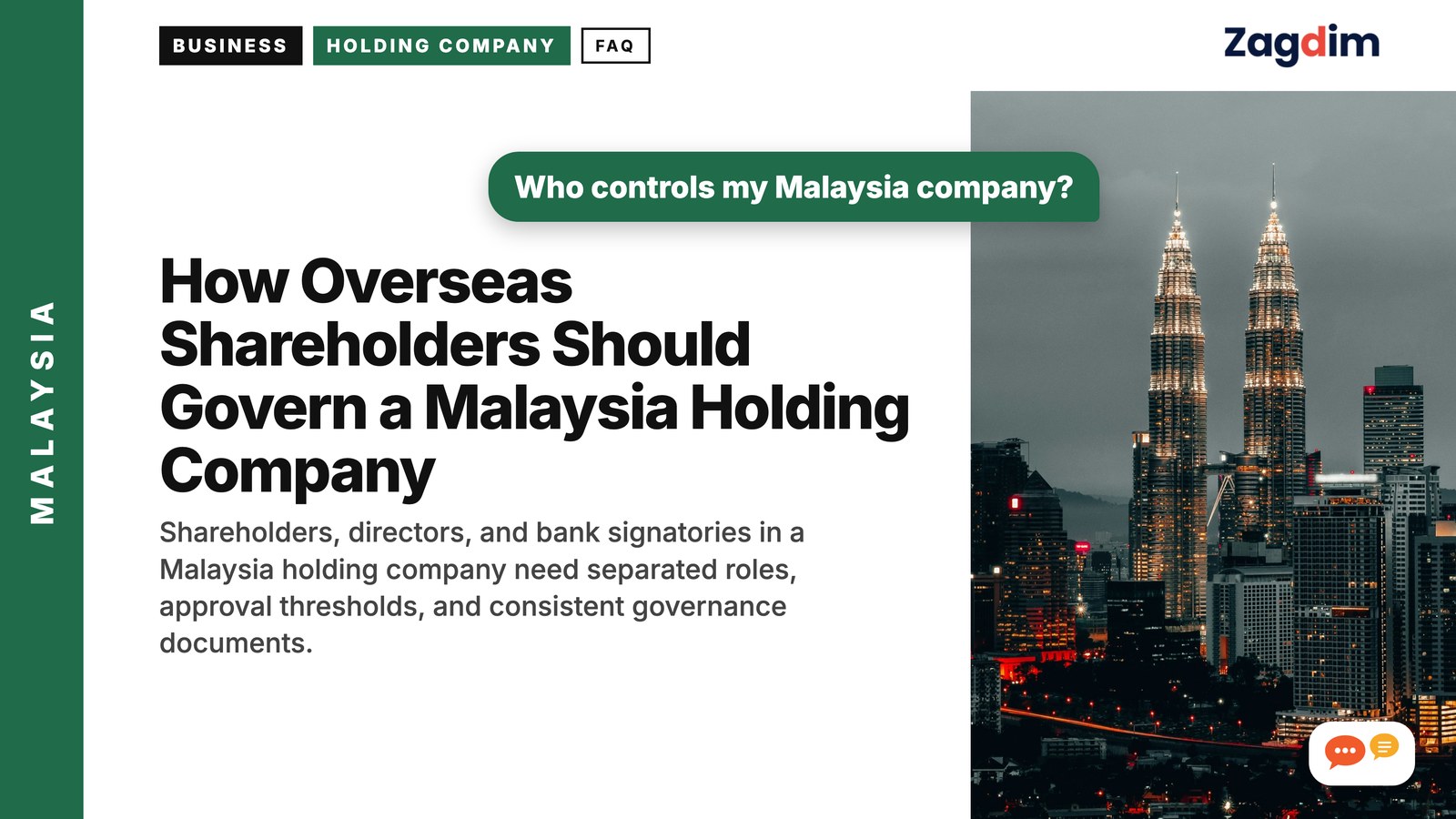
A Malaysia holding company is often owned by shareholders based overseas, with local directors appointed to handle day-to-day company matters. This arrangement can serve a real purpose, but the roles of shareholder, director, and bank signatory still need to be kept separate. Owning shares does not let a shareholder bypass the board and deal directly with every company transaction; having a management duty as a director does not mean any one director can move all of the company’s funds alone. The oversight arrangements that will actually work should be designed together before the company is incorporated.
Equity Share Alone Doesn’t Decide Who Votes or Appoints
Ordinary shares and other classes of shares can carry different distribution and voting rights. When several shareholders invest together, they should confirm which matters are decided by the board and which require shareholder approval, and check that the statutory thresholds and the company’s own constitutional documents are consistent with each other.
Matters such as taking on new borrowing, selling major assets, making payments to related companies, issuing new shares, or providing guarantees can each have their own approval arrangement set according to actual need. Internal documents cannot lower the approval standard that the law itself requires.
Director Authority and Bank Mandates Need to Line Up
Board resolutions, the company’s constitution, or other applicable internal rules can define signing and management authority, but bank operations still have to be set up according to the authorization format the bank itself accepts.
Payment processes can be split into preparation, review, and approval stages, each with its own amount limit. Overseas shareholders should be able to receive regular banking, financial, and investment reports, and local directors need enough information of their own to exercise independent judgment.
If a company has not adopted its own constitution, it is still governed by the Companies Act and other documents that remain in effect. The absence of a constitution does not mean the absence of rules, and a shareholders’ agreement cannot be used to override a director’s statutory duties to the company.
A Shareholders’ Agreement Should Cover What Happens When Things Go Wrong
| Matter | Can Be Agreed in Advance |
|---|---|
| Funding shortfalls | Whether further capital contributions are required, and the consequences of not contributing |
| Profit distribution | Policy on retaining working capital versus paying dividends |
| Disagreements | Reserved matters, voting, and deadlock procedures |
| Shareholder exit | Transfer restrictions, valuation, pre-emption rights, and payment arrangements |
| Death or incapacity | Representation, share succession, and the procedure that follows |
The shareholders’ agreement, the company’s constitution, and board resolutions should all be consistent with each other. Signing a single template agreement is unlikely, on its own, to resolve the real questions around holding and exiting shares.
Business Substance Can’t Be Replaced by Renting an Address
Why the company is based in Malaysia, who makes the decisions, how the investment is managed, and who provides the services should all be something the company can demonstrate with facts. Board minutes should reflect discussions and decisions that actually took place, and should not be drafted after the fact to document a meeting that never happened.
The substance requirements for bank due diligence, corporate tax residency, transfer pricing, and foreign-sourced income exemptions are not all identical. Being able to explain the commercial rationale for a structure does not automatically mean it qualifies for every tax benefit.
Common Misunderstandings
“A resident director just has to sign whatever the overseas shareholder instructs.”
A director still has to carry out their duties. Where there is a conflict of interest, a director cannot simply give priority to the nominating shareholder’s wishes as a matter of course.
“Having an office address and a shareholders’ agreement automatically means there’s enough substance.”
Substance also depends on actual activity, resources, management, and the applicable rules. The name given to a document cannot substitute for how the company actually operates.
What to Check Next
Start by listing out the routine and the major decisions the company will face, then assign who approves, signs, and reports on each. Where there is more than one shareholder, the terms for further funding and for exit should be agreed before money is committed, with a lawyer turning those terms into a set of mutually consistent documents.
Frequently Asked Questions
Can a resident director hand all responsibility back to the overseas shareholders?
No. Dividing up authority does not automatically remove a director’s statutory duties.
Does a private company always need a constitution?
Not every company limited by shares is required to adopt a constitution, but it remains governed by the Companies Act and whatever governance documents are in effect.
Is there a single checklist for business substance that covers every situation?
No. Banks, tax residency rules, and specific tax incentives each apply their own test.
Note
This article is based on information accessible as of October 8, 2026, and is for general information only; it does not constitute legal, tax, financial, or investment advice. Structuring, international payments, and tax treatment should be confirmed against the actual transaction, the recipient’s identity, and the applicable law.
Sources
SSM — Companies Act 2016, Sections 66, 196, 213-218, 245-259, and others; SSM — Guidelines for the Reporting Framework for Beneficial Ownership of Companies (2025 revision); LHDN — Tax Treatment in Relation to Income Received from Abroad, 2024 amendment (check subsequent amendments for current deadlines); HSBC Malaysia — Onboarding Requirements for Local and Foreign Companies
Have a question about this guide? Leave a comment below, or ask Zagdim directly.
Your first stop for international property and global living.
Research and insights. Know what’s changing. Understand what matters.