































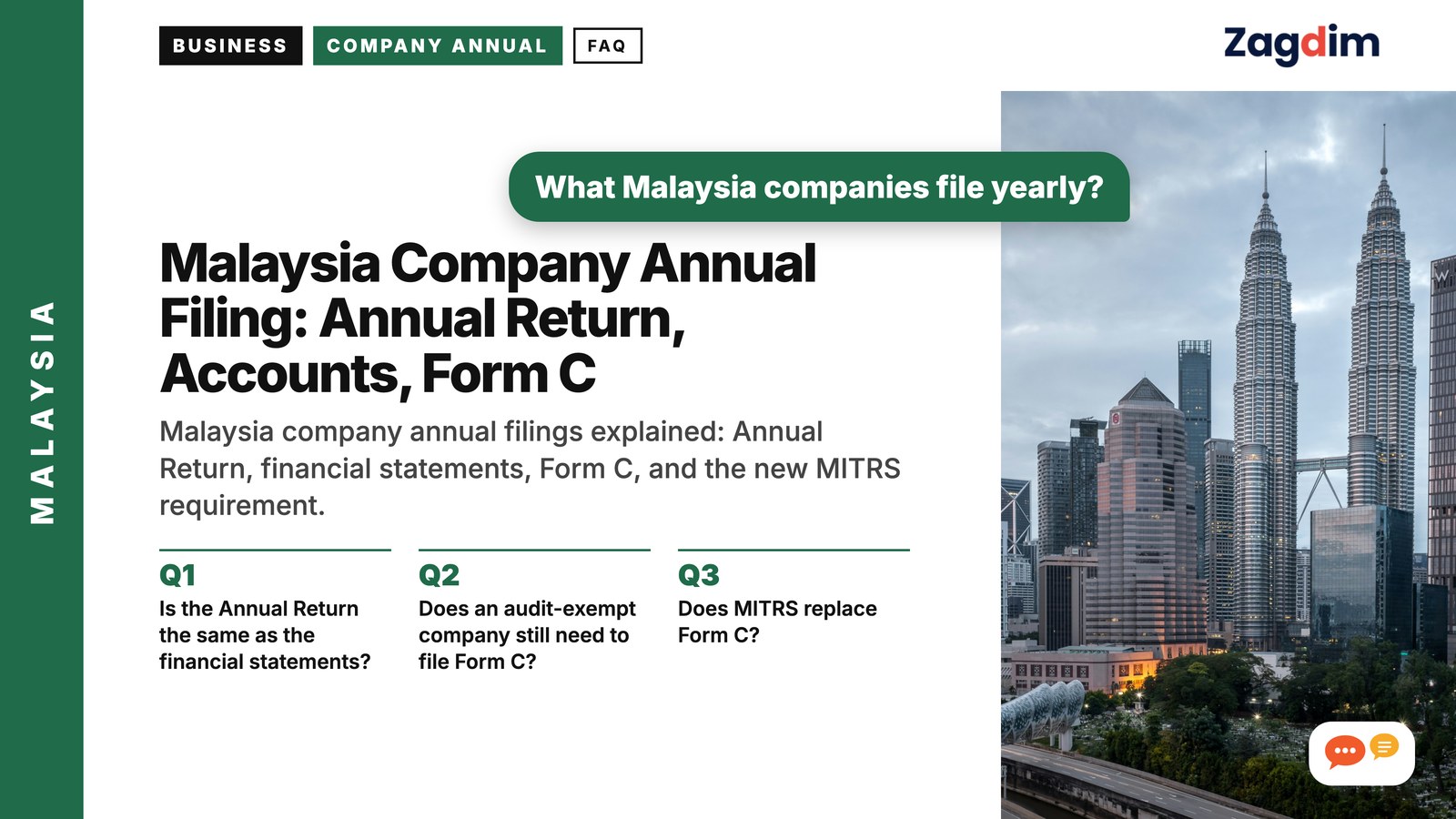
A company registered in Malaysia has three separate annual filing obligations, and keeping them straight matters: the Annual Return, the financial statements, and Form C. Each one serves a different purpose, runs on its own clock, and filing one does not complete the others.
Three Different Documents, Each With Its Own Job
The Annual Return updates the company’s registered information. The financial statements report on the company’s financial position. Form C handles the company’s income tax filing.
These are not three copies of the same “annual report,” and submitting one does not automatically finish the other two. A useful starting point is to list the company’s incorporation anniversary and its financial year end, and schedule each task from there.
Annual Return Follows the Incorporation Anniversary
The Annual Return is generally due within 30 days of the incorporation anniversary, with a corresponding exemption in the year of incorporation itself. Even if nothing about the company’s particulars has changed, the annual filing still cannot be skipped.
Changes to directors, the company secretary, the registered office, shareholding, or beneficial ownership may also trigger separate notification requirements. These cannot simply be left to be picked up at the next Annual Return.
Financial Statements Follow a Sequence: Prepare, Circulate, Submit
Directors generally must prepare the company’s first set of financial statements within 18 months of incorporation, and follow the statutory deadlines tied to the financial year end after that. For a private company, financial statements generally must be circulated to members within 6 months of the financial year end, then filed with SSM within 30 days of the circulation date.
The actual first-year dates, and any approved extension, need to be checked separately. The “30 days after circulation” rule should not be read as allowing a company to add another 30 days on top, however long it took to finish preparing the statements in the first place.
Audit exemption carries its own eligibility criteria and documentation requirements. Even where audit is not required, the company must still prepare financial statements that meet the applicable standards and complete the required filings.
After Form C Comes the MITRS Filing
A company’s Form C is generally due within 7 months of the end of its accounting period, and any balance of tax owed must also be paid by the deadline. Any e-filing grace period or extension should be confirmed against the arrangement announced for that year.
Starting from year of assessment 2025, companies and limited liability partnerships have been brought into the phased MITRS requirement. Within 30 days after the relevant filing deadline, a company must submit its financial statements, tax computation, and any applicable capital allowance or incentive computations through the designated system. Filing Form C does not mean this step has already been completed.
Track Everything with One Table
| Item | What Sets the Schedule | What Directors Should Check |
|---|---|---|
| Annual Return | Incorporation anniversary | Filed content and acknowledgment |
| Financial statements | Financial year end; special first-year deadline | Signed copy, circulation date, and proof of filing |
| Form C and tax | End of accounting period | Tax computation, filing acknowledgment, and payment |
| MITRS | Applicable filing deadline | Document checklist and upload acknowledgment |
CP204 estimates, employer filings, industry licenses, and e-invoicing also need to be scheduled separately, according to the company’s specific circumstances.
Common Misunderstandings
“My company secretary said the Annual Return was filed, so this year’s tax filing is done.”
Confirm which specific document is being referred to, then check the acknowledgment for that filing.
“All the deadlines run from the financial year end.”
The Annual Return is generally tied to the incorporation anniversary instead, and the two should not be used interchangeably.
What To Do Next
Ask the company secretary and tax agent for the company’s actual date schedule, and keep preparation, director confirmation, and formal submission as separate steps. Keep the acknowledgment for each completed filing rather than relying on a verbal update alone.
Frequently Asked Questions
Is the Annual Return the same as the financial statements?
No. They differ in purpose, content, and deadline.
Does an audit-exempt company still need to file Form C?
Yes. Audit exemption does not remove the company’s tax filing obligation.
Does MITRS replace Form C?
No. MITRS is a separate arrangement for submitting specified data and documents, and must be completed according to its own applicable procedure.
Note: This article is based on information available as of October 8, 2026, and is for general informational purposes only. It does not constitute legal, tax, or employment advice. The general deadlines listed here should be checked against any individual exemptions, approved extensions, and that year’s specific filing arrangements.
Sources
SSM — Companies Act 2016, Sections 66, 196, 213–218, 245–259, and others; SSM — Practice Directive 10/2024: Audit Exemption; LHDN — Section 82B MITRS Filing Programme, YA 2026; LHDN — Return Form Filing Programme for 2026
Have a question about this guide? Leave a comment below, or ask Zagdim directly.
Your first stop for international property and global living.
Research and insights. Know what’s changing. Understand what matters.