






























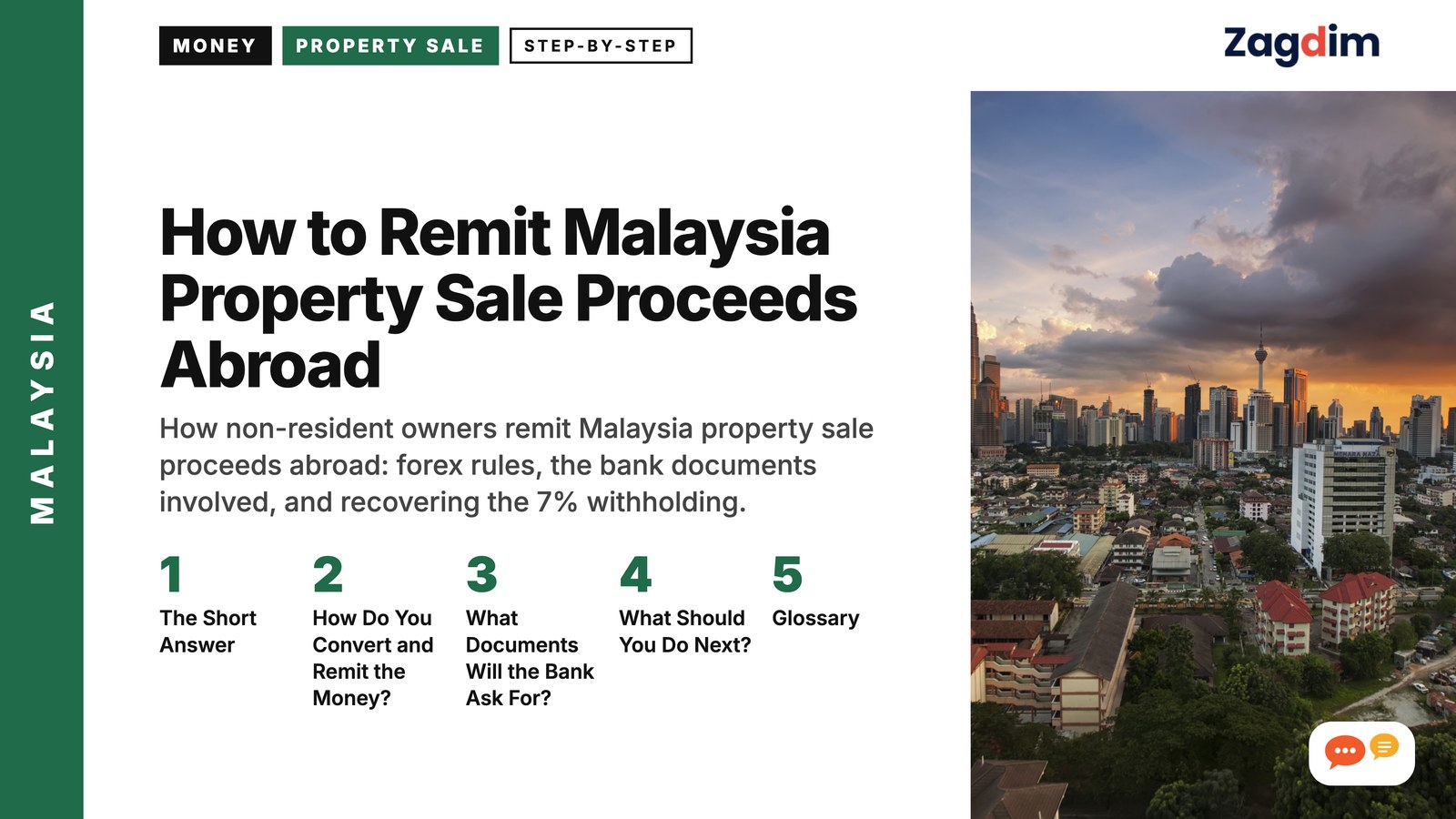
This article is part of Zagdim’s Malaysia property series. It covers how a foreign owner who sells property in Malaysia can remit the sale proceeds abroad under Malaysia’s foreign exchange rules, what documents the bank will typically ask for, and when the 7% the buyer withholds at completion is actually released back to the seller. It is written for owners who are neither Malaysian citizens nor permanent residents. The full sale process is covered in Zagdim’s main article, Selling Property in Malaysia as a Foreigner: Buyers, Process, Taxes and Remitting the Funds.
Why Does Remitting Sale Proceeds Get Stuck?
An older rule from the 1998 capital-control period still circulates online: at that time, non-residents remitting capital gains needed prior approval from an exchange control officer. Current foreign exchange policy has superseded that rule, but banks still need to confirm the source and purpose of the funds. In practice, the sticking point is usually not the regulation itself, but incomplete documentation, or treating the buyer’s 7% withholding as if it were already available to remit.
The Short Answer: Can You Remit It?
Yes. Under Bank Negara Malaysia’s foreign exchange policy, non-resident investors may freely repatriate the proceeds of divestment, profits and income from their investments in Malaysia, and the remittance must be made in foreign currency. As of October 9, 2026, the foreign exchange rules reviewed for this article set no cap on the amount and do not require prior approval from the central bank; the specific documents required are at the discretion of the bank handling the transaction.
Who Do These Rules Apply To? How Does Forex Policy Define “Non-Resident”?
Residency under foreign exchange policy is defined differently from residency for income tax purposes, which is based on days spent in the country. Owners who live abroad and do not hold Malaysian permanent residency are generally non-residents for this purpose. Non-citizens who hold Malaysian permanent residency and are habitually resident in Malaysia are classified as residents under Bank Negara Malaysia’s definition, and the non-resident divestment rules do not apply to them directly.
Whether holders of a Malaysia My Second Home (MM2H) pass who do not have permanent residency are automatically treated as non-residents under foreign exchange policy is not clearly stated in the sources reviewed. This remains unconfirmed; the classification recorded by the handling bank governs in practice.
How Do You Convert and Remit the Money?
- Remit in foreign currency. Divestment proceeds must be remitted in foreign currency. Non-residents may convert ringgit into foreign currency on a spot basis, for any purpose, through a licensed onshore bank or its approved overseas offices.
- Accounts. Non-residents may open ringgit or foreign-currency accounts with a licensed onshore bank; deposits and withdrawals follow the bank’s normal review procedures.
- Supporting documents for External Accounts. Movements of funds into or out of a non-resident’s ringgit External Account require supporting documents consistent with foreign exchange rules, subject to the bank’s internal review.
Paperwork is easiest to reconcile when the receiving account, including any overseas receiving account, is opened in the owner’s own name.
What Documents Will the Bank Ask For?
In practice, owners can prepare the following documents, though whether all of them are required is up to the bank handling the transaction:
| Document | Purpose |
|---|---|
| Sale and purchase agreement and transfer documents for the sale | Identifies which transaction the funds relate to |
| Lawyer’s completion statement, mortgage redemption and fee breakdown | Shows how the sale price became the net proceeds |
| Lawyer’s payment notice and bank deposit records | Matches the source and amount of the funds |
| e-CKHT filing confirmation, tax computation and payment receipt | Shows how the Real Property Gains Tax (RPGT) was handled |
| Sale and purchase agreement, remittance records and loan records from the original purchase | Supports the bank’s source-of-funds check |
| Overseas receiving account details | Verifies the remittance instructions |
If there is an outstanding mortgage, the seller needs to provide the bank’s redemption statement. The sale price first settles the mortgage and discharges the charge on the property; only the balance is paid out to the seller.
It is best to give the bank the amount you plan to remit and the documents above for pre-approval before completion. What is required depends on your account type and the original source of funds; owners who are unsure which category applies to them should check with their bank or a qualified adviser.
When Do You Get Back the Buyer’s 7% Withholding?
When the seller is a foreign individual, the buyer withholds 7% of the sale price and pays it to the Inland Revenue Board of Malaysia (Lembaga Hasil Dalam Negeri, LHDN) within 60 days of the disposal date, to be credited against the seller’s RPGT. This amount sits with the tax authority, not in the seller’s account, so it cannot be counted as part of the funds available to remit immediately after completion.
- Amount withheld in excess of tax due: refunded to the seller through the refund procedure.
- Advance notification of the tax amount: from January 1, 2026, sellers can formally notify the buyer of their self-computed tax amount before the buyer pays it over, so the buyer pays the lower, notified amount instead and the seller does not need to wait for a refund.
- No chargeable gain: filing Form CKHT 3, once received by the buyer through e-CKHT, can exempt the transaction from withholding.
In the worked example from the main article, a Kuala Lumpur condominium sold for RM1.45 million would have RM101,500 withheld by default, against a computed tax liability of RM39,285. Notifying the tax amount in advance would let RM62,215 bypass the refund process entirely. The full calculation is in Zagdim’s article, How Much Tax Do You Pay Selling Property in Malaysia? RPGT at 30%/10%, the Buyer’s 7% Withholding, and a Worked Example.
Separately, any tax or shortfall must be settled within 90 days of the disposal date; late payment carries a 10% surcharge and can also lead to a travel restriction. Until the tax position is settled, sellers should avoid remitting the full proceeds without keeping back funds to cover the tax due.
What Should You Do Next?
- Confirm whether your bank has you registered as a resident or non-resident.
- Locate the sale and purchase agreement and remittance records from your original purchase.
- Discuss with your lawyer whether to notify the tax amount before the buyer pays it over.
- Ask the bank handling the transaction for a written document checklist before completion.
Owners who are not in Malaysia and need to appoint someone to receive funds and handle the process on their behalf should see Zagdim’s article, Selling Property in Malaysia From Abroad: Power of Attorney, Notarization and Consular Authentication.
FAQ: Remitting Malaysia Property Sale Proceeds
Does remitting sale proceeds require prior approval from Bank Negara Malaysia?
As of October 9, 2026, the foreign exchange rules reviewed for this article do not require prior approval and set no cap on the amount. Non-residents’ divestment proceeds must be remitted in foreign currency, and the documents required are at the bank’s discretion.
Can sale proceeds be remitted directly in ringgit to an overseas account?
No. Non-residents’ divestment proceeds must be remitted in foreign currency. Non-residents can convert ringgit into foreign currency through an onshore bank and then remit it to an overseas account.
Do I have to wait for the 7% withholding refund before remitting other funds?
The official sources reviewed do not impose this requirement. Whether other funds are already available to remit, and what documents the bank needs, should be confirmed separately with a lawyer and with the bank handling the transaction.
Glossary
- Bank Negara Malaysia: Malaysia’s central bank, which sets foreign exchange policy.
- Foreign Exchange Policy: The rules governing foreign exchange transactions by residents and non-residents.
- Non-resident: A classification under foreign exchange policy, distinct from the day-count residency test used for income tax.
- External Account: A ringgit account that a non-resident holds with an onshore bank.
- Redemption statement: A statement issued by a bank showing the outstanding amount owed on a mortgage.
- Section 21B withholding: The portion of the sale price that the buyer withholds and remits to the tax authority on the seller’s behalf, to be credited against RPGT.
Sources and Verification
This article was compiled from Zagdim research. The legal and regulatory portions have been checked against the cited texts (Verified by Zagdim); market-practice portions are noted separately. Data was checked as of October 9, 2026. The foreign exchange rules are based on Bank Negara Malaysia’s foreign exchange policy pages; the statement that there is “no cap and no requirement for prior approval” reflects the absence of such requirements in the pages reviewed. The 1998 prior-approval rule is a historical rule that has been superseded by current foreign exchange policy. The list of bank documents is a practical compilation and is not based on any single bank’s published checklist. The statement that permanent residents are forex residents follows Zagdim’s own research from September 2026; Bank Negara Malaysia’s original definition text was not re-read in this round. The foreign exchange status of MM2H holders remains unconfirmed.
Have a question about this guide? Leave a comment below, or ask Zagdim directly.
Your first stop for international property and global living.
Research and insights. Know what’s changing. Understand what matters.
References
- Bank Negara Malaysia – Non-resident: Investing in Malaysia
- Bank Negara Malaysia – Non-resident: Buying and Selling of FX
- Bank Negara Malaysia – Non-resident: Payment in Ringgit
- Bank Negara Malaysia – Information on Repatriation of Dividends, Interest, Rental, Fees, Commissions or Profits (1998)
- Inland Revenue Board of Malaysia (LHDN) – Responsibility of Disposer and Acquirer
- Inland Revenue Board of Malaysia (LHDN) – RPGT Payment Procedure and Refund
- Inland Revenue Board of Malaysia (LHDN) – CKHT Operational Guideline No. 2 of 2026
- Malaysia law – Finance Act 2025 (Act 874)
- National House Buyers Association (HBA) – FAQ on Sale and Purchase
- Zagdim – Non-Resident Property Sale Proceeds Remittance Documents Compilation (2026-09-25)
Important Notice
This article is general information and does not constitute individual legal, tax or financial advice. Data was checked as of October 9, 2026. Foreign exchange rules and bank requirements may change; the current requirements of Bank Negara Malaysia and the bank handling the transaction govern.