






























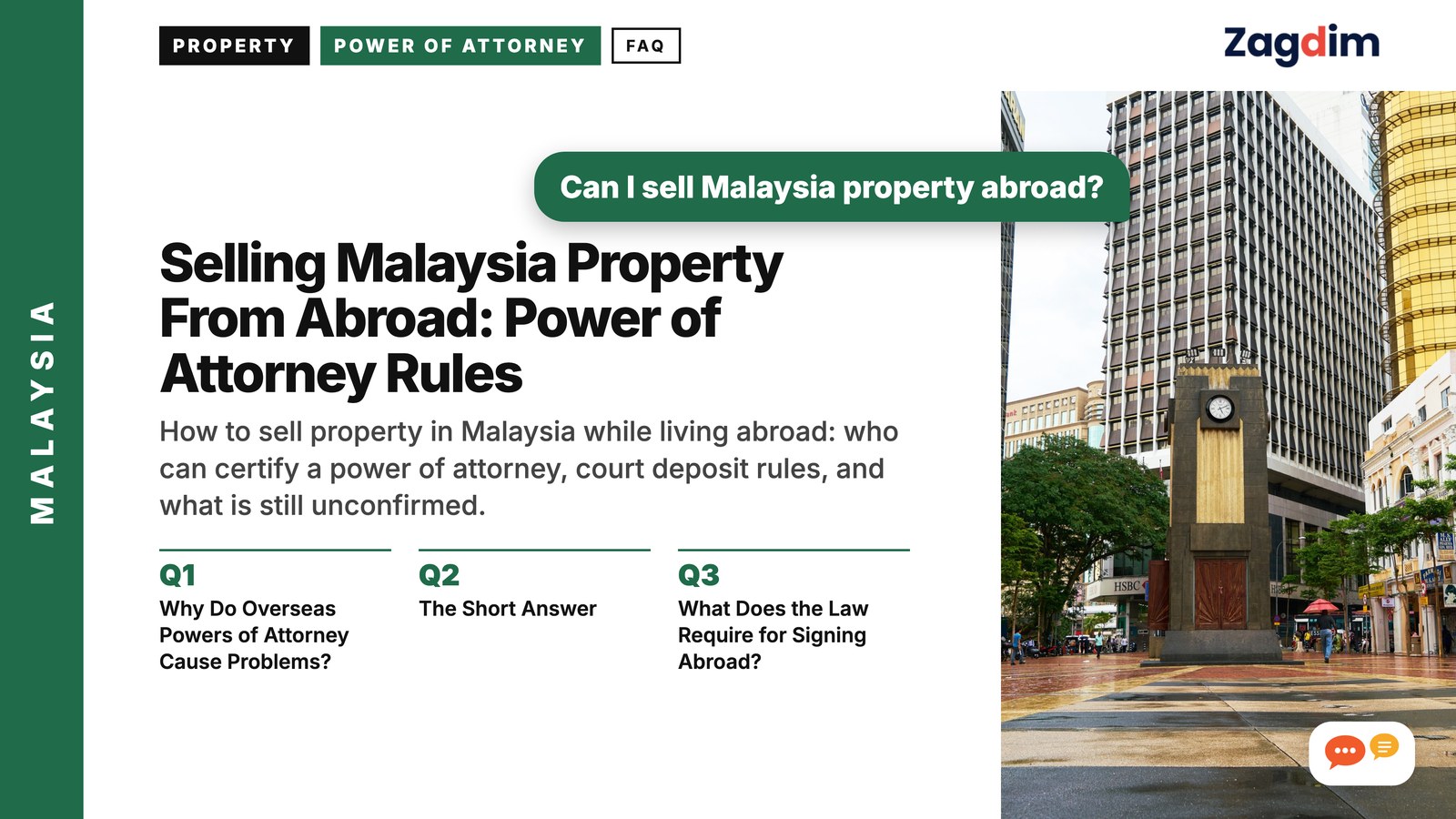
This article is part of Zagdim’s Malaysia property series. It is written for an owner living outside Malaysia, for example in Hong Kong or Taiwan, who cannot travel to Malaysia in person to sign the sale and transfer documents. It sets out how a power of attorney should be signed, who may certify it, whether it must be deposited with the court, and what still needs confirming. For the full sale process, see Zagdim’s companion article on selling property in Malaysia as a foreigner, covering buyers, process, taxes, and remitting funds.
Why Do Overseas Powers of Attorney Cause Problems?
Powers of attorney signed in Peninsular Malaysia are governed by the Powers of Attorney Act 1949 (Act 424). When a power of attorney is signed outside Malaysia, the signature must be certified by one of the categories of certifying officer that the law names, and the power of attorney generally also needs an authenticated true copy deposited with the High Court before it takes effect. Choosing the wrong certifying officer, skipping the deposit step, or using a language or translation that does not meet requirements can all mean having to redo the process.
The Short Answer: Can You Authorize Someone Else to Sell?
Yes. A power of attorney signed outside Peninsular Malaysia must be certified by one of: a notary public, a commissioner for oaths, a judge or magistrate, or a consular officer of Malaysia, and the certification must be in a form that the Registrar of the High Court will accept. An authenticated true copy of the power of attorney generally has to be deposited with the High Court. A power of attorney used only for a transaction at the Land Office, once witnessed in accordance with the relevant law, may be exempt from the deposit requirement.
Whether a power of attorney signed before a notary public also needs separate certification from a Malaysian diplomatic or trade mission afterward is not clearly stated in the sources checked for this article. This remains unconfirmed; confirm with the handling lawyer before submitting documents.
What Does the Law Require for Signing Abroad?
Section 3(1)(b) of the Powers of Attorney Act 1949 lists who may certify a power of attorney signed outside Malaysia:
- A notary public
- A commissioner for oaths
- A judge or magistrate
- A consular officer of Malaysia
The certification must be in a form the Registrar of the High Court will accept. This Act applies only to Peninsular Malaysia; Sabah and Sarawak have their own separate rules.
Does the Power of Attorney Need to Be Deposited With the Court? Does It Need a Translation?
Generally, yes. Under Section 4, an authenticated true copy of the power of attorney must be compared and marked “true copy” by a Senior Assistant Registrar of the High Court and then deposited, for the authorization to take effect in Peninsular Malaysia. If the power of attorney is not in Malay or English, a certified Malay or English translation must be deposited alongside it.
One exception applies: a power of attorney used specifically for a transaction handled by a land registrar or land administrator may be exempt from the deposit requirement if it has been witnessed in accordance with the relevant provisions (related sections of the National Land Code). This article’s research did not locate the original text covering the Land Office’s own registration and witnessing requirements for this exemption; that point remains unconfirmed.
A power of attorney is also subject to stamp duty, charged as a fixed amount unrelated to the transaction value. The current amount follows the Inland Revenue Board of Malaysia’s rules in effect at the time.
What Steps Apply When Signing Outside Malaysia?
Under the law, signing before a notary public (and having that notary certify the document) is one of the accepted methods under Section 3; certification by a consular officer at a Malaysian mission abroad is another.
What still needs confirming at the practical level:
- Whether, after notarization in the signer’s own jurisdiction, the Malaysian lawyer or Land Office will additionally require certification by the relevant Malaysian diplomatic or trade mission in that jurisdiction
- Whether a Malaysian mission that functions as a trade or friendship office rather than a full consulate (such as the kind of office Malaysia maintains in some jurisdictions without formal diplomatic relations) can accept this certification, and whether its staff qualify as a “consular officer” under the Act
- The fees involved in each case
The sources checked for this article did not state these three points clearly; they remain unconfirmed. Before submitting documents, ask the handling lawyer which form of certification they will accept, then confirm the specific requirements with the relevant mission.
Can You Sign Directly Abroad Without Setting Up a Power of Attorney?
This is currently unconfirmed. The documents a seller needs to sign include the sale and purchase agreement, the Real Property Gains Tax (RPGT) forms, the stamp duty forms, and either Transfer Form 14A (Borang 14A), where a title has been issued, or a deed of assignment, where it has not. Whether a seller can skip the power of attorney altogether and sign Form 14A directly before a notary abroad was not confirmed in the sources checked for this article.
Tax filing itself does not require being physically present: RPGT is filed online through e-CKHT on the MyTax portal, a seller without a tax reference number can apply for one through e-Daftar, and the filing can also be handled by a lawyer or a licensed tax agent.
This depends on where the signing takes place and which certification the handling lawyer will accept.
What To Decide Next
- Decide first: appoint an agent to handle the whole process under a power of attorney, or sign the sale agreement and transfer documents yourself while abroad.
- Ask the handling lawyer to set out in writing the scope of the power of attorney, which certification it requires, and whether it needs to be deposited with the High Court.
- Drafting the power of attorney in English or Malay can avoid the need for a translation.
- If a lawyer or tax agent is handling the tax filing, note the deadlines: 60 days from the sale date to file, and 90 days to pay.
For how sale proceeds are received and remitted, see Zagdim’s companion article on remitting Malaysia property sale proceeds, covering foreign exchange rules, bank documents, and the 7 percent withholding refund.
FAQ: Selling Malaysia Property by Power of Attorney From Abroad
Can a power of attorney notarized outside Malaysia be used directly in Malaysia?
Certification by a notary public is one of the methods named in the Powers of Attorney Act. Whether an additional layer of certification from the relevant Malaysian mission is also required is not clearly stated in the sources checked for this article; this remains unconfirmed, so confirm with the handling lawyer first.
Can a power of attorney written in a language other than Malay or English, such as Chinese, be used in Malaysia?
When deposited with the High Court, a power of attorney not in Malay or English must be accompanied by a certified Malay or English translation. Drafting it directly in English can avoid the need for a translation.
If the owner lives abroad, does Real Property Gains Tax still have to be filed in person in Malaysia?
No. RPGT is filed online through e-CKHT on the MyTax portal, and the filing can be handled by a lawyer or a licensed tax agent on the owner’s behalf.
Key Terms
- Powers of Attorney Act 1949: The law governing certification and deposit of powers of attorney in Peninsular Malaysia.
- Notary Public: One of the officers who may certify a power of attorney signed abroad.
- Consular Officer of Malaysia: An officer at a Malaysian mission abroad who may certify a signature.
- Senior Assistant Registrar: The High Court officer responsible for depositing powers of attorney.
- Transfer Form 14A (Borang 14A): The form used to register a transfer for a property that already has an issued title.
- e-CKHT: The online filing system for Real Property Gains Tax.
Source Notes
This article was compiled by Zagdim research. The statutory provisions have been cross-checked against the original text (Verified by Zagdim); market practice is noted separately. Data was checked as of October 9, 2026. The text of the Powers of Attorney Act 1949 used here is a consolidated version republished on a law firm’s website. The following points remain unconfirmed: whether notarization outside Malaysia requires an additional layer of certification from the relevant Malaysian diplomatic or trade mission; whether a mission that is not a full consulate qualifies as a “consular officer” under the Act; the fees involved; the Land Office’s own registration and witnessing requirements for the lawyer-executed exemption from deposit; whether Form 14A can be signed directly abroad without a power of attorney; and the stamp duty amount for a power of attorney. This round of research did not locate the relevant web pages for Malaysia’s missions covering Hong Kong and Taipei.
Have a question about this guide? Leave a comment below, or ask Zagdim directly.
Your first stop for international property and global living.
Research and insights. Know what’s changing. Understand what matters.
References
- Low & Partners, “Powers of Attorney Act 1949” (https://www.lowpartners.com/powers-attorney-act-1949/)
- Inland Revenue Board of Malaysia, “Introduction to Stamp Duty” (https://www.hasil.gov.my/en/duti-setem/pengenalan-duti-setem/)
- Inland Revenue Board of Malaysia, “Responsibility Of Disposer And Acquirer” (https://www.hasil.gov.my/en/?p=19951)
- Inland Revenue Board of Malaysia, “CKHT Operational Guidelines No. 2 of 2026” (https://www.hasil.gov.my/wp-content/uploads/20260317-garis-panduan-operasi-ckht-bil-2-tahun-2026.pdf)
- National House Buyers Association, “FAQ on Sale and Purchase” (https://www.hba.org.my/faq/sale_and_purchase.htm)
Important Notice
This article is general information and does not constitute individual legal advice. Data was checked as of October 9, 2026. Certification and deposit requirements may change; follow the current requirements of Malaysia’s relevant authorities, the handling lawyer, and the relevant diplomatic mission.