






























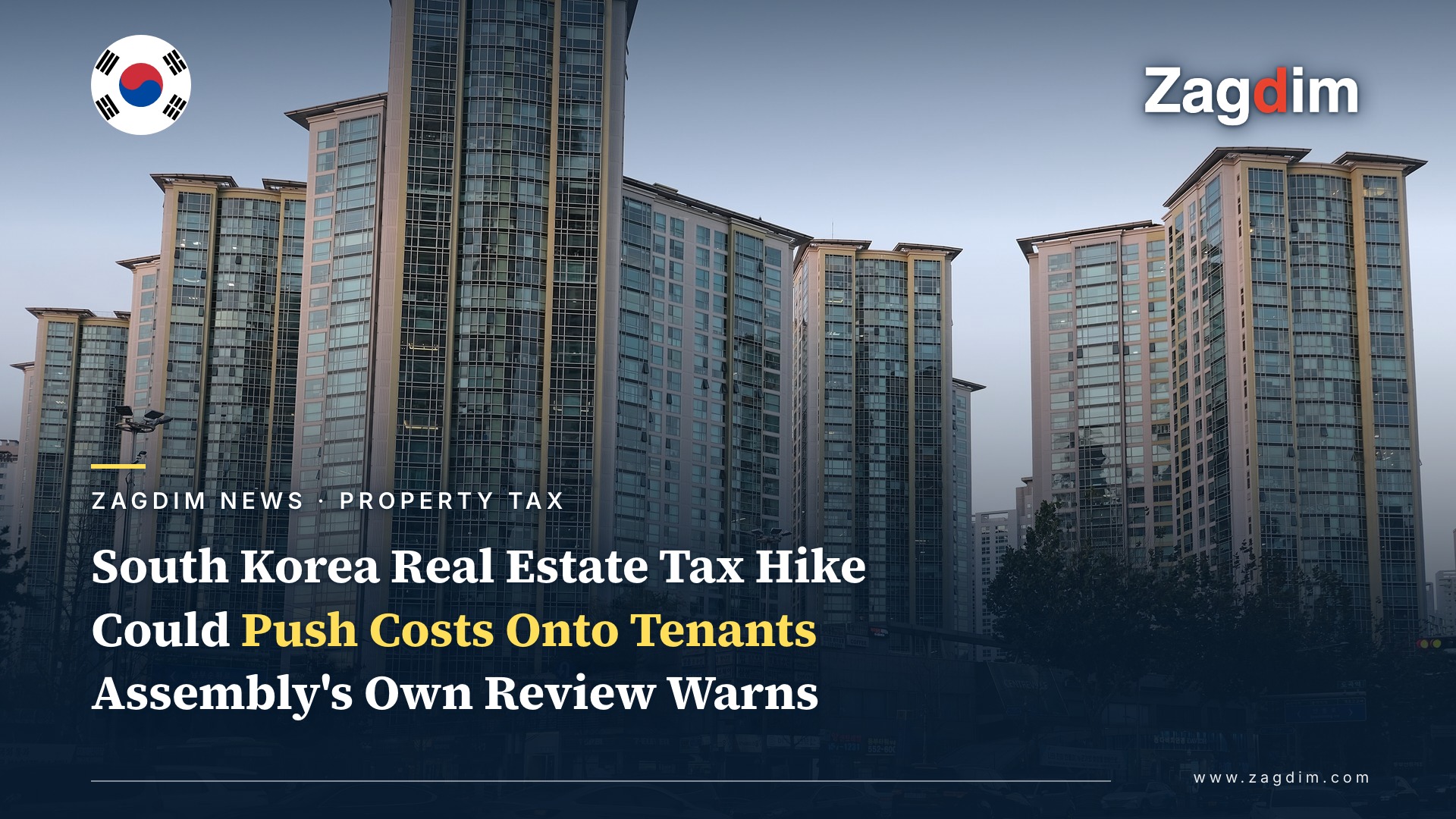
South Korea’s National Assembly Strategy and Finance Committee has published a legislative review report, under Chief Expert Member Lee Jung-eun, warning that the government’s planned Comprehensive Real Estate Tax hike could backfire by pushing costs onto tenants rather than only multi-home owners. Local outlets including SBS and Chosun Ilbo reported the findings on 25 October 2026.
The core of the amendment unifies the tax-rate system by housing value and raises rates above a tax base of 600 million won (about US$450,000). The bracket from 600 million won up to 1.2 billion won (about US$910,000), currently taxed at 1.0%, rises to 1.3% after 2028. In the four brackets above 1.2 billion won, rates for owners of two or fewer homes rise by 0.7 to 2.3 percentage points. The plan also raises the Fair Market Value Ratio used to calculate the tax base from 60% to 70%.
The committee’s warning: “High holding-tax burdens on multi-home owners lead to increased costs for landlords, which may be passed on to tenants in the form of rent increases,” potentially increasing — rather than easing — tenants’ housing-cost burden and distorting both the jeonse (lump-sum deposit) and monthly rental markets. The committee separately flagged that differentiating the basic deduction by residence status could accelerate population concentration in the Seoul metropolitan area and reduce rental supply elsewhere, and that converting the Long-Term Holding Special Deduction into a new Long-Term Residence Income Deduction — capped at 1 billion won (about US$750,000) starting in 2029 — risks shrinking transaction volume and listings.
For anyone renting in Korea rather than owning, the committee’s own analysis is the thing to watch: a tax aimed at multi-home owners is, by the government’s own legislative reviewer’s reading, a tax that can show up on a tenant’s renewal notice instead.