
































This Zagdim guide compares rent increase rules in Sydney, Melbourne, Hong Kong, Taiwan, Singapore, Malaysia and mainland China (Taiwan usually describes this as adjusting rent upward). It is written for people who live in these places and are considering renting abroad or holding international property.
How Many Times a Year Can a Landlord Raise Rent? Generally Once in 12 Months in Sydney and Melbourne
According to official sources as of 31 October 2026, rent increase rules in Sydney and Melbourne generally allow at most one increase in 12 months, but the notice period and the conditions during a fixed term differ. Elsewhere, the applicable rules and the lease terms need to be checked separately.
When a landlord proposes an increase, the first thing to confirm is not necessarily how much, but when to check what. In Sydney and Melbourne, check the interval and the notice procedure when a notice arrives. For general housing in Hong Kong, private housing in Singapore and Malaysia, it matters most to confirm the rent adjustment clause before signing or renewing.
Key Points
- Who should take note: readers who rent in Sydney or Melbourne or plan to go there, tenants and landlords in Hong Kong, Taiwan, Singapore, Malaysia and mainland China, and people who hold rental property overseas.
- When you receive a rent increase notice: Sydney and Melbourne generally allow at most one increase every 12 months. Sydney requires at least 60 days’ written notice, and Melbourne at least 90 days’ notice on the prescribed form. Hong Kong’s regulated tenancies of subdivided units also have specific rent adjustment rules.
- Before signing and renewing: official sources for general housing in Hong Kong, private housing in Singapore and Malaysia show no uniform rule on frequency, notice period or size of increases, so it is even more important to confirm what the lease says in advance.
- During the term and when the term ends: Taiwan and mainland China have limits during the lease term, but these cannot be assumed to cover what happens after the term ends. Check the applicable rules and what both parties agreed.
Sydney and Melbourne: At Most Once a Year, and What Else to Check When a Notice Arrives
Rental rules in Australia are set by each state. This guide covers only New South Wales, where Sydney is, and Victoria, where Melbourne is. Check other states separately.
The frequency is the same in both places. The differences are in three areas. The table below is based on official sources from the New South Wales Government, Victorian legislation and Consumer Affairs Victoria:
| What to look at | Sydney | Melbourne |
|---|---|---|
| Notice | At least 60 days, in writing, which can be by email | At least 90 days, on the prescribed form |
| During a fixed term | Allowed, subject to the same 12-month limit; no increase in the first 12 months after the lease begins | Not allowed, unless the lease states the amount or calculation method |
| If you think it is too much | Apply to the NSW Civil and Administrative Tribunal (NCAT) within 30 days of the notice | Apply for a rent assessment within 30 days of the notice; judged against the market range |
The difference directly affects lease planning. Say you sign a 2-year fixed-term lease in Sydney that begins in 2025. Once 12 months have passed, if the landlord proposes an increase, at least 60 days’ written notice is still required, but there is no need to wait for the 2 years to end. In the same situation in Melbourne, if the lease does not state an amount or calculation method, rent cannot go up before the term ends.
When a notice arrives, count the days first. A notice with less than 60 days in Sydney, or less than 90 days or not on the prescribed form in Melbourne, should be queried first. Victoria’s 90 days applies from 25 November 2025, so older material saying 60 days no longer applies. Under section 44 of Victoria’s Residential Tenancies Act 1997, an increase that breaches that section is invalid.
On the amount, official sources in both places list no cap. If you think an increase is too high, you can apply under the local procedure, but applying does not mean the increase will necessarily be adjusted, and it is not the same as a statutory cap. Melbourne also has a standard to note: being unable to afford the rise is not a valid reason. From 31 March 2026, the authority can consider more factors when deciding whether an increase is excessive.
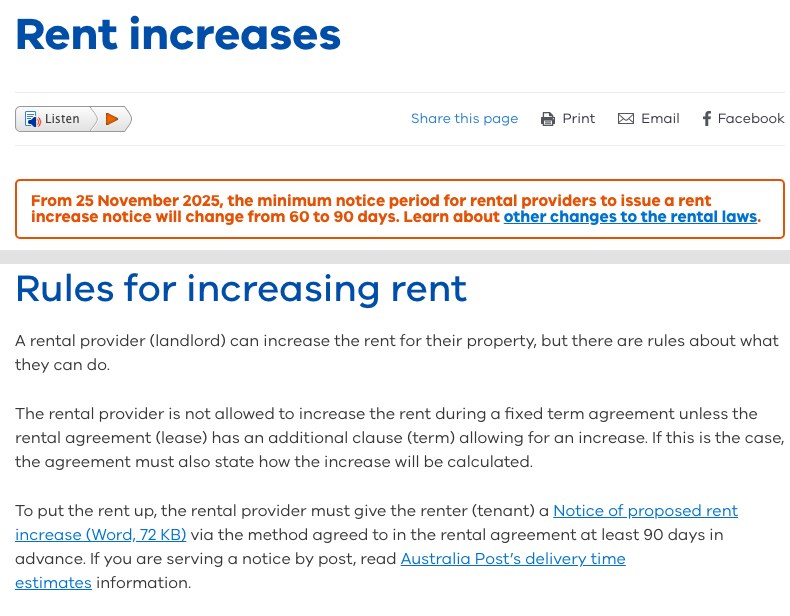
For older leases with separate rules, check the lease start date first:
- Sydney: for fixed-term leases of under 2 years that began before 13 December 2024, rent cannot go up unless the lease states the amount or calculation method. If it does, the lease applies, which may mean more than one increase a year, and no separate notice is needed if the lease also states the effective date. After the term ends, the 12-month rule returns.
- Melbourne: for fixed-term or periodic leases that began before 19 June 2019, the official page gives a 6-month interval. For those that became periodic on or after 19 June 2019, it is 12 months.
Rent Increase Rules in Seven Places: What to Check, and When
Putting the seven places side by side, the most useful question is whether this increase matches the local rules and the lease. The point at which you need to confirm this differs from place to place. The grouping below is a reading order, not a legal classification, and does not suggest that any place offers better protection.
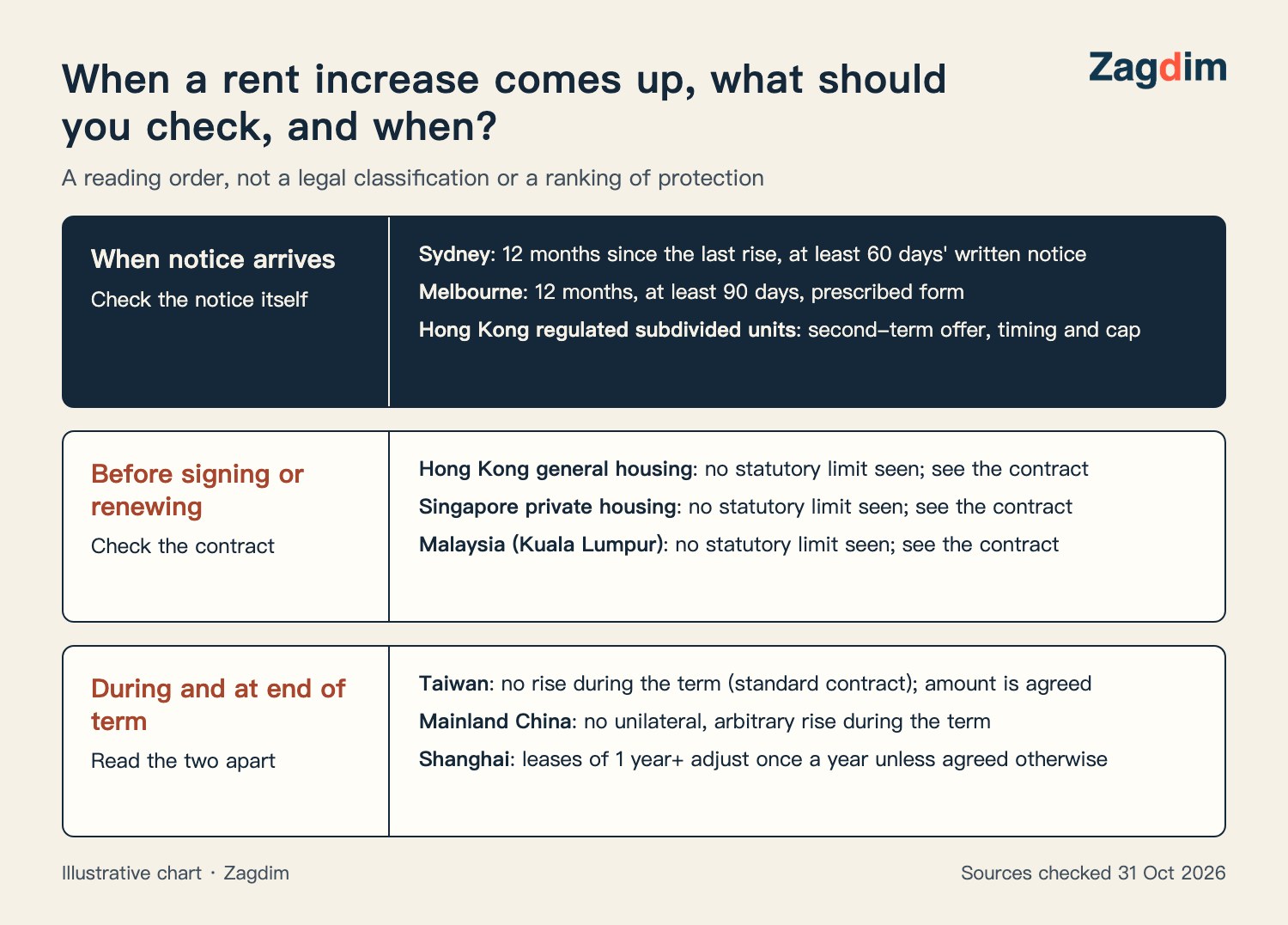
- When you receive a rent increase notice: Sydney, Melbourne and Hong Kong’s regulated tenancies of subdivided units have stated frequency, procedures or caps, so the notice itself needs to be checked against them.
- Before signing and renewing: no statutory limits were found for general housing in Hong Kong, private housing in Singapore or Malaysia, so what the contract says matters especially.
- During the term and when the term ends: in Taiwan and mainland China the key point is the limit during the lease term, and rules for the term cannot be applied directly to what happens after it ends.
Rent Increase Rules Compared: Frequency, Notice and Limits During the Term
The amount needs to be looked at separately. Among the official sources checked for this guide, the only cap on the size of an increase is for Hong Kong’s regulated tenancies of subdivided units, at a maximum of 10%. Sydney and Melbourne regulate frequency and notice, and their official sources list no limit on how much each increase can be.
The table below sets out official sources in each place. “Not found” means no such rule was seen in official sources, which does not mean the law certainly has none. See the note at the end.
| Place | Increases per year | Notice | Rent adjustment during a fixed term | Cap on amount |
|---|---|---|---|---|
| Sydney (New South Wales) | At most once in 12 months; none in the first 12 months of a lease | At least 60 days, in writing | Yes, subject to the same 12-month limit (separate rules for leases of under 2 years that began before 13 December 2024) | No cap listed on official pages; tenants who think it excessive can apply to the tribunal within 30 days |
| Melbourne (Victoria) | At most once in 12 months | At least 90 days, on the prescribed form | No, unless the lease states the amount or calculation method | The law sets no amount; tenants who think it excessive can request an assessment, judged against the market range |
| Hong Kong (general housing) | No statutory limit found | No statutory notice period found | No uniform rule found; check the contract | No cap found |
| Hong Kong (regulated tenancies of subdivided units) | Within a 4-year cycle, only the second term can be raised, once | Offered in the second calendar month before the second term starts | No increase during either term; at the start of the second term, adjustment under the rules | No more than the change in the official rent index, maximum 10%; rent must fall if the index falls |
| Taiwan | No statutory limit found | No statutory notice period found | No (mandatory provisions for standard residential lease contracts) | Agreed between the parties; the Land Act’s 10% cap does not apply to rental housing |
| Singapore (private housing) | No statutory limit found | No statutory notice period found | No uniform rule found; check the contract | No cap found |
| Malaysia (Kuala Lumpur) | No statutory limit found | No statutory notice period found | No uniform rule found; check the contract | No cap found |
| Mainland China (national) | No national limit found | No national rule found | Cannot be raised unilaterally and arbitrarily | No national cap found |
| Mainland China (Shanghai) | Leases of 1 year or more: only once a year, unless the contract says otherwise | No rule found | Cannot be raised unilaterally | No standing cap found; the government can set rents or limit rises when rents rise markedly |
Hong Kong, Singapore and Malaysia: Read the Contract Before a Notice Arrives
In the official sources checked for this guide, no uniform rule on frequency, size or notice period for rent increases was found for general housing in these three places. This does not mean no other limits apply, and it does not mean a landlord can raise rent at any time. Whether rent can go up during the lease depends on what the contract says. Before signing, confirm whether rent can be adjusted during the term, when, how notice is given and how the amount is calculated.
Hong Kong general housing: private housing rents are left to the market (Legislative Council research paper, December 2020). The often-quoted “six months for a yearly tenancy, one month for a monthly tenancy” is the notice period for ending a tenancy when the contract is silent, and has nothing to do with rent increases.
Singapore private housing: the Council for Estate Agencies (CEA) explains that the parties are free to negotiate lease terms, and that the official template is a guide, not mandatory. HDB flats are outside the scope of this guide. Read the contract in your hands clause by clause.
Malaysia: Bank Negara Malaysia’s fourth-quarter 2017 bulletin says there is no law dedicated to the residential rental market, and no specific rule was found for Kuala Lumpur either. A government media report on 10 August 2026 showed the Residential Tenancy Act still at the “planning to draft” stage, with no timetable. Once enacted, the rules may change, so people signing long leases or holding rental property should keep watching.
Taiwan and Mainland China: Look at the Lease Term and the End of the Term Separately
Taiwan: point 4 of the mandatory provisions for standard residential lease contracts says a landlord cannot, for any reason, ask to raise rent during the lease term. Individual landlords who use the standard residential lease contract should check this set too. The scope needs a careful look: Article 4 of the Rental Housing Market Development and Regulation Act excludes leases for leisure or tourism, those run by the government or its dedicated legal persons or agencies, those run by cooperatives, and leases of under 30 days, and subletting has its own standard contract provisions.
When terms are renewed, the amount is agreed between landlord and tenant (Article 6 of the Act), and no statutory frequency or notice period for increases has been found. The often-quoted “10% a year of the declared total value” is Article 97 of the Land Act, which does not apply to rental housing. If a contract says “adjusted every 6 months”, a Department of Land Administration presentation lists this wording as the form used in the old contract, and contrasts it with the current version, under which rent cannot be adjusted.
Mainland China: the Administrative Measures for Commodity Housing Leasing say landlords cannot unilaterally and arbitrarily raise rent during the contract, covering commercial housing on state-owned land within urban planning areas. No national rule on frequency, size or notice period for increases was found, and the State Council’s Housing Rental Regulations, in force from 15 September 2025, do not address them either.
Hong Kong’s Subdivided Units and Shanghai: Do Not Apply General Rules to Every Lease
Hong Kong’s regulated tenancies of subdivided units: a subdivided unit is a flat divided into several small units for rent. The legal basis is Part IVA of the Landlord and Tenant (Consolidation) Ordinance. General housing practice cannot be applied here:
- Cycle: a 4-year cycle, split into 2 years plus 2 years, with no increase during either term.
- Second term: the increase cannot exceed the change in the Territory-wide private domestic rental index, to a maximum of 10%. If the index falls, rent must drop by at least the same percentage. The percentage allowed follows the Rating and Valuation Department’s published figure.
- Landlord: must make the offer on Form AR1 in the second calendar month before the second term starts. If the offer is late or non-compliant, the landlord is treated as having made the offer and the tenant as having accepted it, with rent based on the last rent payable in the first term; if the controlled percentage is negative, rent must still be reduced.
- Tenant: to accept the offer, must sign Form AR1 and return it to the landlord before the first term expires. Otherwise it counts as a refusal, no second term is granted, and the tenant must move out when the first term ends.
The Basic Housing Units Ordinance (Cap. 658) governs living standards, registration and recognition, and the official pages do not say it covers rent.
Shanghai: the rules are more specific than the national ones. For leases of 1 year or less, rent should be agreed once. For leases of more than 1 year, rent can be adjusted only once a year, unless the contract says otherwise, and the landlord cannot raise it unilaterally during the contract. When rents rise or may rise markedly, the government can lawfully take measures such as price-rise declarations and limits on rents or rises, and landlords must comply. This is a tool available to the government, not a standing cap.
If You Are an Overseas Landlord: Confirm Whether Rent Can Be Adjusted Before Signing
Rent adjustment arrangements need to be thought through at signing. In Melbourne, to keep room to raise rent during a fixed term, the lease must state the amount or calculation method. For an increase taking effect on the same day, a Melbourne notice must go out 30 days earlier than a Sydney one, and the form differs: Sydney allows written notice by email, while Melbourne requires the prescribed form. If a local agent manages the property, ask before signing who is responsible for rent increase notices and when they go out. Where the contract decides, the timing, size and notice method of increases should be written into the lease.
Before Signing, During the Term and After a Notice: A Rent Increase Checklist
This checklist is a first-pass check and cannot decide an individual case. Compare your actual situation with the applicable rules and your contract.
Before signing
- Does the place have a statutory frequency, notice period or cap for rent increases?
- Does the lease say whether rent can be adjusted during the term, when, and how it is calculated?
- On renewal, how is rent set, and who has to raise it first?
During the term
- Are you in a fixed term now? When did the lease begin, and when was rent last adjusted?
- In Sydney, watch for short leases that began before 13 December 2024. In Melbourne, watch for older leases that began before 19 June 2019.
After a notice arrives
- Does this increase match the local rules and the lease?
- Are the number of days, the form and the interval right?
- In Sydney and Melbourne, if you think it is too much, you must apply within 30 days.
Rent Increase Rules: Frequently Asked Questions
How Many Times a Year Can a Landlord in Sydney Raise Rent?
Generally at most once in 12 months, with no increase in the first 12 months of a lease, and at least 60 days’ written notice. Fixed-term leases of under 2 years that began before 13 December 2024 have separate rules.
How Many Times a Year Can a Landlord in Melbourne Raise Rent?
Generally at most once in 12 months, with at least 90 days’ notice on the prescribed form. For fixed-term or periodic leases that began before 19 June 2019, the official page gives a 6-month interval; for those that became periodic on or after 19 June 2019, it is 12 months.
Do Sydney and Melbourne Rent Increase Rules Allow a Rise During a Fixed Term?
In Sydney it can, subject to the 12-month limit, and fixed-term leases of under 2 years that began before 13 December 2024 have separate rules. In Melbourne it cannot, unless the lease states the amount or calculation method.
Do Hong Kong Rent Increase Rules Include a Cap?
No statutory cap was found for general housing, so it depends on the lease. For regulated tenancies of subdivided units, rent cannot go up during a term, and the second-term increase is limited by the official rent index, to a maximum of 10%, with rent falling if the index falls.
Can a Landlord in Taiwan Raise Rent During the Lease Term?
The mandatory provisions for standard residential lease contracts say a landlord cannot, for any reason, ask to raise rent during the lease term. The amount is agreed between the parties, and the Land Act’s Article 97 10% a year of declared total value does not apply to rental housing.
How Much Notice Is Needed for a Rent Increase in Singapore and Malaysia?
Official sources for both places show no statutory notice period for rent increases, so the contract mainly decides. Malaysia’s Residential Tenancy Act was still at the “planning to draft” stage in a report on 10 August 2026.
Comparing Rental Rules Abroad? Ask Zagdim
Rent increase rules and contract wording in each place affect how you rent and let property. If you are comparing rental conditions in different places, or considering holding rental property overseas, bring your situation to Ask Zagdim.
Life abroad? Ask Zagdim.
Your first stop for international property and global living.
Research and insights. Know what’s changing. Understand what matters.
Newsletter for overseas updatesSubscribe →
Data Notes and Important Disclaimer
This article is general information and is not legal, tax or investment advice. Sources were checked on 31 October 2026 and the content is current as of that date. Rules and official figures in each place change, so rely on the latest official notices and on the contract in your hands.
“Not found” means no such rule was seen in official sources and does not mean all regulations were exhausted, especially for rent increase notice periods in Hong Kong general housing, Taiwan, Singapore, Malaysia and mainland China. Taiwan’s local government regulations were not reviewed one by one. The standard contract content follows the current version on the Executive Yuan website (last amended 18 April 2025), so compare it with the latest version when signing. Whether Malaysia’s bill was tabled during the parliamentary sitting of 5 October to 8 December 2026 could not be confirmed. No record was found of mainland China’s two sets of measures being repealed, but recent changes cannot be fully ruled out, and whether Shanghai’s price intervention measures are currently in use was not confirmed. The percentage for the second term in Hong Kong’s subdivided units follows the Rating and Valuation Department’s published figure.
References
New South Wales Government – When and How Rent Can Be Increased / New South Wales Government – What Landlords Should Know About Rent Increases / New South Wales Government – Tenants and Rent Increases / Victorian Legislation – Residential Tenancies Act 1997 (Authorised Version No. 111) / Consumer Affairs Victoria – Rent Increases / Consumer Affairs Victoria – New Changes to Rental Laws / Rental Dispute Resolution Victoria – Excessive Rent Disputes / Hong Kong Rating and Valuation Department – Regulated Tenancies of Subdivided Units: Second Term Tenancy / Hong Kong Rating and Valuation Department – Regulated Tenancies of Subdivided Units: Second Term Tenancy (Chinese version) / Hong Kong Rating and Valuation Department – Tenancy Matters FAQ / Hong Kong Housing Bureau (on the Rating and Valuation Department website) – Template for Tenancy Agreement (for a Regulated Tenancy to Which Part IVA of the Landlord and Tenant (Consolidation) Ordinance (Cap. 7) Applies) / Hong Kong Housing Bureau – Tackling the Issue of Subdivided Units / Hong Kong Basic Housing Units Website – Basic Housing Units Ordinance / Hong Kong Legislative Council Secretariat – Private Domestic Rental Market in Hong Kong (December 2020) / Taiwan Laws and Regulations Database – Rental Housing Market Development and Regulation Act, Article 4 / Taiwan Laws and Regulations Database – Rental Housing Market Development and Regulation Act, Article 6 / Taiwan Laws and Regulations Database – Rental Housing Market Development and Regulation Act, Article 5 / Taiwan Laws and Regulations Database – Land Act, Article 97 / Hualien County Government (hosting) – Ministry of the Interior Department of Land Administration Presentation on the Rental Housing Act and Standard Lease Provisions (2025) / Executive Yuan – Mandatory and Prohibited Provisions for Standard Residential Lease Contracts / Ministry of the Interior – Amendment to Point 18 of the Mandatory Provisions for Standard Residential Lease Contracts / Council for Estate Agencies, Singapore – Renting or Renting Out a Private Residential Property / Digitalised Property Transactions Workgroup – Tenancy Agreement Template for Lease of Private Residential Properties / Bank Negara Malaysia – Quarterly Bulletin Q4 2017 Box Article: Affordable Housing: Challenges and the Way Forward / Parliament of Malaysia – Dewan Rakyat 2026 Sitting Calendar / Radio Televisyen Malaysia – KPKT Plans to Draft Three New Housing Acts / Government of China – Housing Rental Regulations (State Council Decree No. 812) / Guangdong Provincial Government (reprint) – Administrative Measures for Commodity Housing Leasing / Shanghai Municipal Government – Shanghai Measures on Residential Housing Leasing / Shanghai Municipal Government – Shanghai Housing Rental Regulations