































UK Earned Settlement Moves the Standard Wait for ILR From 5 to 10 Years, With Shorter Paths for Contribution
Under UK earned settlement, set out in the Home Office’s November 2026 consultation response, the standard qualifying period for indefinite leave to remain (ILR) will rise from 5 to 10 years, with 3 or 5-year paths for high earners, public service workers and British connections, and 20 years after immigration breaches or public funds use.
Home Secretary Shabana Mahmood made an oral statement on earned settlement to the House of Commons on 2 November 2026, and the Home Office published its full response and the consultation findings the same day. The immigration law site Free Movement summarised the response on 2 and 3 November. The response follows a public consultation that ran from 20 November 2025 to 12 February 2026 and, according to the government, received 204,667 responses. The new framework still has to be written into the Immigration Rules, and the official documents give no start date.
This guide is for anyone working or living in the UK, or thinking about moving there: how the current rules count, how the new tiers work, what BN(O) and Skilled Worker visa holders need to check, and what to prepare now.
Key Points
- Who should pay attention: holders of Skilled Worker, BN(O), family and Health and Care visas and their dependants, and international students who plan to stay and work in the UK.
- UK earned settlement has four tiers: 3, 5, 10 and 20 years. Everyone must first meet mandatory requirements on criminality, government debt, B2 English, the Life in the UK Test and a minimum income contribution.
- The BN(O) route keeps its 5-year path, but the government says applicants must meet the new criminality requirement and the B2 English standard. The documents do not yet say item by item whether the income, National Insurance and public funds rules also apply.
- No start date has been announced. The government will first publish technical guidance and a full impact assessment, and settlement is decided under the rules in force at the time of the decision, not on arrival.
The Current Rules: Five Years on Most Routes, Plus a 10-Year Long Residence Route
Under the current system, most routes that lead to settlement allow an ILR application after 5 years, including the Skilled Worker, BN(O) and partner-of-a-British-citizen routes. There is also a 10-year Long Residence route for 10 continuous years of lawful residence, which can include time on Student and Graduate visas.
Most applicants aged 18 to 64 currently need to pass the Life in the UK Test and show English at B1. The ILR fee listed on GOV.UK on 3 November 2026 is £3,226 per person. Fees under the new system have not been announced.
UK Earned Settlement Tiers: 3, 5, 10 and 20 Years Compared
All four tiers below come from Table 1 and Chapter 2 of the Home Office response. Earnings are assessed on a “best years” basis, so the threshold does not have to be met every year:
| Years | Who it is for | Must meet one of | Must not have |
|---|---|---|---|
| 3 years | The highest economic contributors | Earned at least £125,141 in 3 of the 4 years before applying; or qualifies through the Highest Talent Group (subject to review pending a Migration Advisory Committee report) | Accessed specified public funds in the last 5 years; committed a qualifying immigration breach as an adult |
| 5 years | Higher earners, public service workers, people with a British connection | Earned at least £50,271 in 3 of the last 5 years; or works in an eligible health or education public service occupation; or is the partner, parent or child of a British citizen, or on the UK Ancestry route | As above |
| 10 years | The new default | Earned at least £12,571 in 5 of the previous 7 years | As above |
| 20 years | People whose immigration breach or public funds use rules out an earlier path | Earned at least £12,571 in 5 of the previous 7 years and meets all mandatory requirements | — |
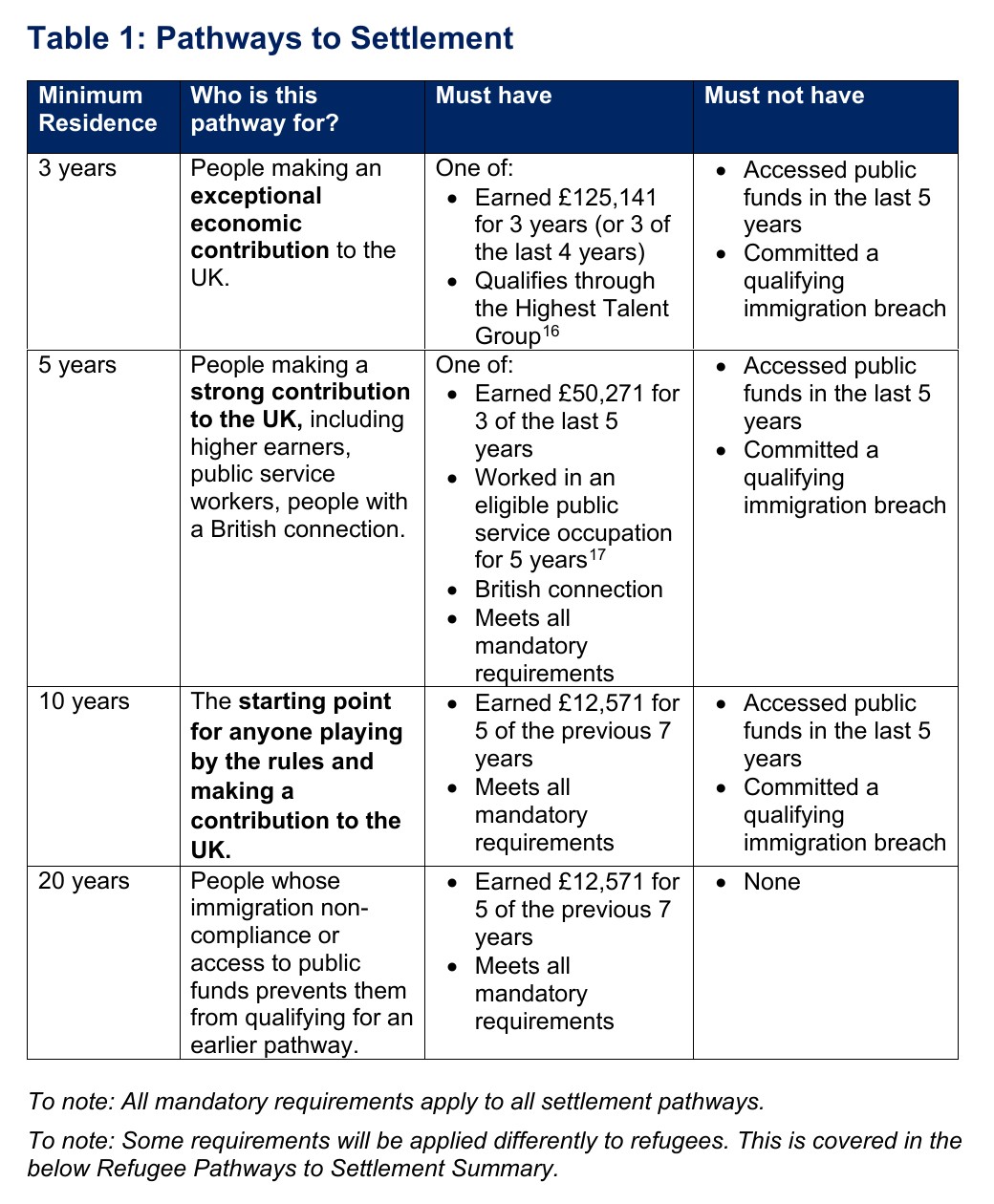
The three earnings thresholds line up with the additional rate, higher rate and basic rate of income tax, and the government says they will move with those thresholds. Eligible public service occupations are listed in Annex C of the response, including doctors, nurses, pharmacists, physiotherapists, school and nursery teachers and social workers.
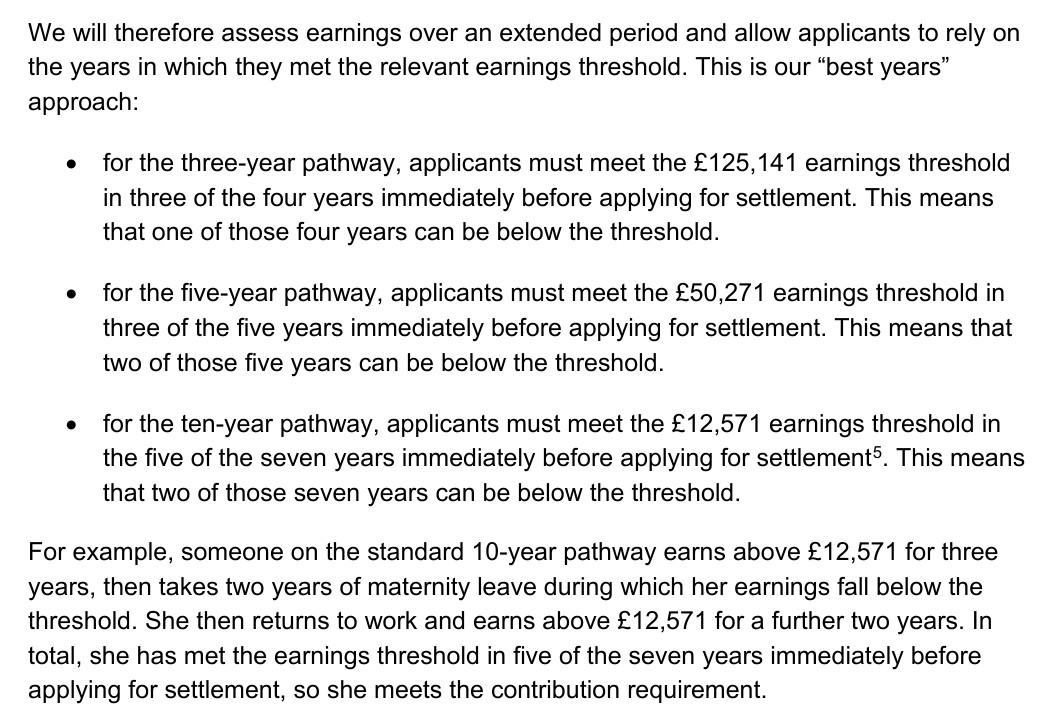
The “best years” approach is meant to cover dips for maternity leave, caring or illness. The government’s own example: someone on the 10-year path works for 3 years, takes 2 years of maternity leave and then works for another 2 years. They have met the threshold in 5 of the 7 years before applying, so they meet the contribution requirement.
Compared with the November 2025 proposals, the government confirmed three changes: volunteering will no longer shorten the wait; C1 English will no longer take a year off; and workers in roles below RQF level 6 will no longer face the proposed 15-year path and will use the 10-year path instead.
Mandatory Requirements for Everyone: Criminality, Debt, English, the Test and Income
The government says these cannot be offset by higher earnings, public service or other contributions:
- No criminal record: any adult applicant with a criminal record in the UK will be refused, including suspended sentences, conditional cautions, court fines and community sentences. Today, refusal is mandatory only for sentences of 12 months or more. Overseas convictions lead to refusal where the conduct would be an offence in the UK, with discretion kept for differences between legal systems.
- No government debt: no unpaid NHS charges, tax, National Insurance contributions or litigation debt owed to the Home Office.
- B2 English: up from B1. Existing exemptions for under-18s, people aged 65 and over and those with a physical or mental condition continue.
- Life in the UK Test: retained with the same exemptions; the government is reviewing its content.
- Minimum income contribution: £12,571 a year for at least 3 years. Couples can combine earnings to meet a household threshold of £25,142, so one partner earning enough can cover both. Children, people aged 65 and over and those unable to work because of a physical or mental condition are exempt.
Overstaying, breaching visa conditions, using deception in an application or frustrating immigration control as an adult places someone on the 20-year path, regardless of earnings. On public funds, the government will start from the existing definition in the Immigration Rules and will set out which benefits count, and the safeguards for vulnerable groups, before implementation.
BN(O) Visa: Still Five Years, With B2 English and the New Criminality Rule
BN(O) is one of the routes the government named as keeping its current path. Page 21 of the response lists it under existing government commitments:
“Hong Kong BN(O): Settlement after five years, subject to route requirements.”
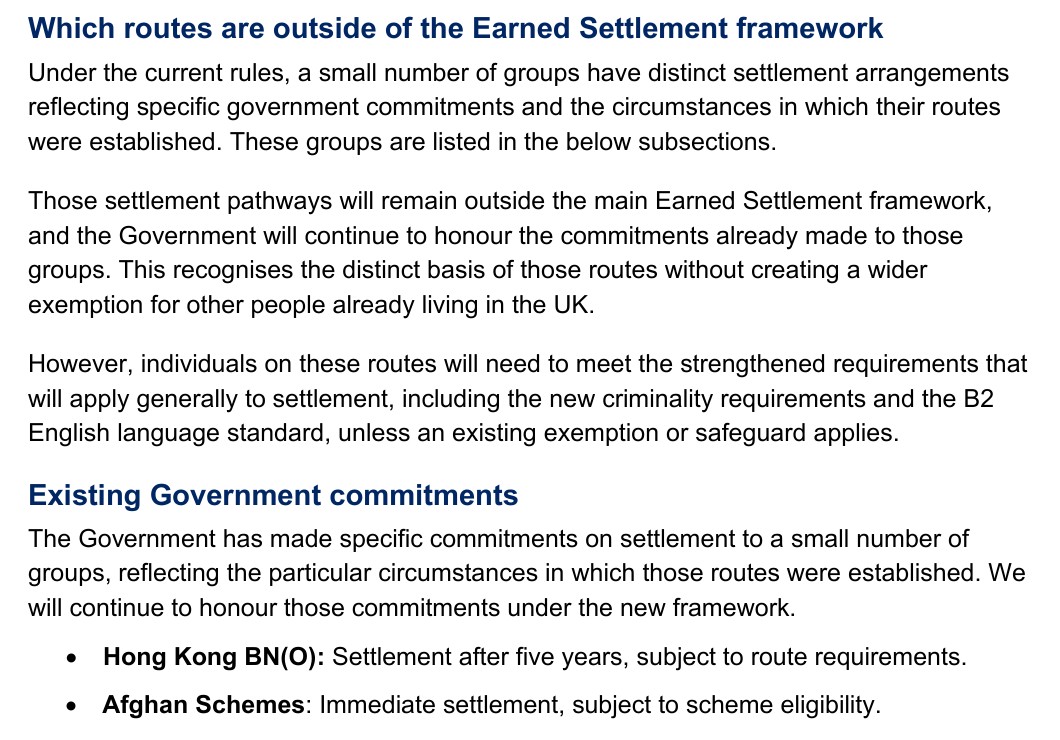
The same page says people on routes outside the main framework still need to meet the strengthened requirements that apply generally to settlement, “including the new criminality requirements and the B2 English language standard”, unless an existing exemption or safeguard applies. The Home Secretary’s statement and the Home Office press release also list BN(O) among the groups keeping their current pathways.
What the documents say, and what they do not yet say:
| Item | What the official documents say | Source |
|---|---|---|
| Qualifying period | 5 years, not 10 | Response p.21, oral statement, press release |
| Criminality | Must meet the new no-criminal-record requirement | Response p.21 |
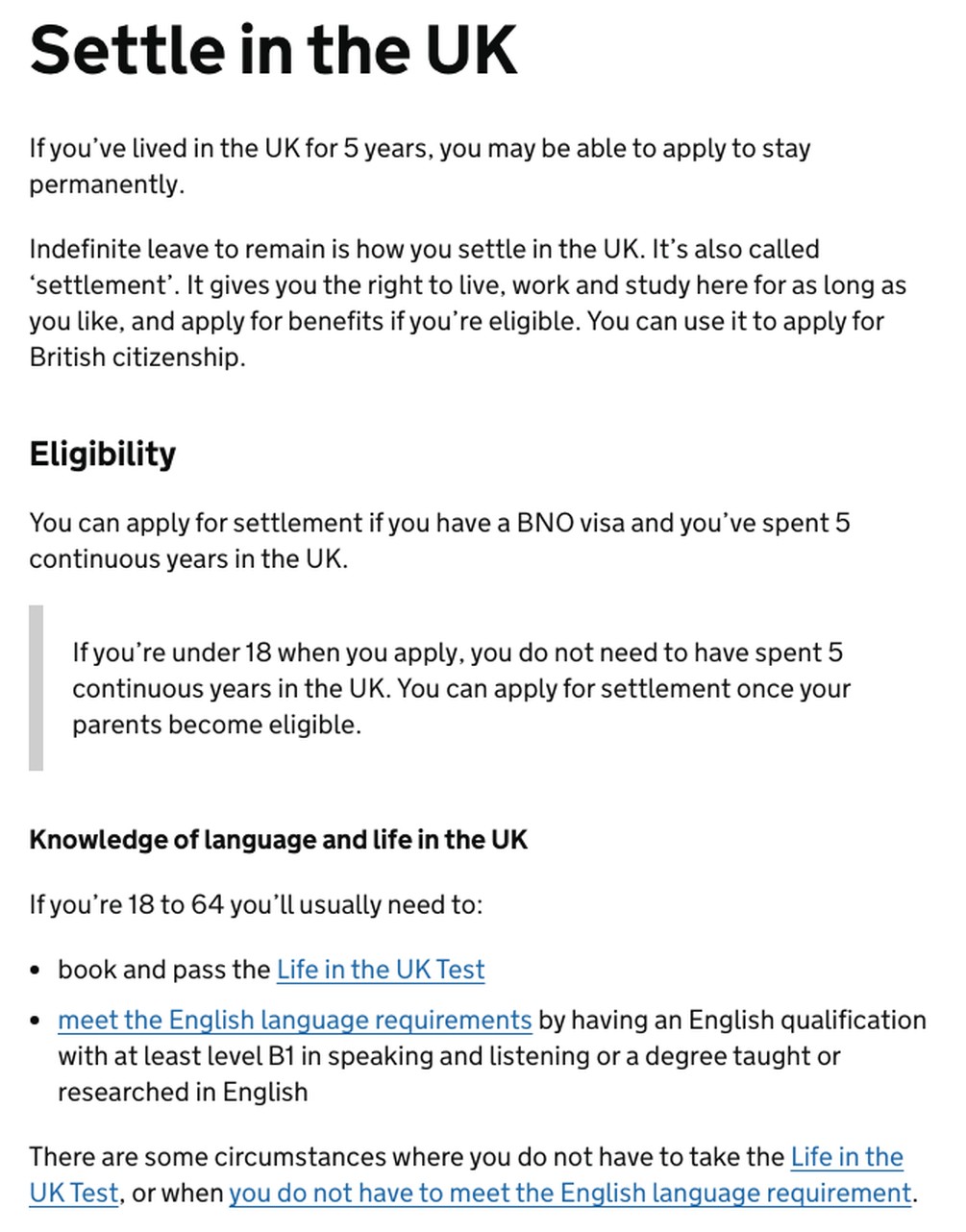
| English | Must meet B2; the current BN(O) page asks for B1 in speaking and listening | Response p.21, GOV.UK BN(O) page |
| Life in the UK Test | Currently required for ages 18 to 64; the test is retained | GOV.UK BN(O) page, response Chapter 3 |
| Income and National Insurance | Not yet set out for BN(O) item by item. The press release says anyone seeking settlement must first meet four conditions, including sustained National Insurance contributions | Response, press release |
| Government debt | Not yet set out for BN(O) item by item | Response |
| Public funds | The current BN(O) page says people who get access to benefits can still apply after 5 years; whether this changes is not yet stated | GOV.UK BN(O) page |
| When B2 applies | Not yet stated | — |
The current BN(O) settlement rules listed on GOV.UK (checked 3 November 2026): 5 continuous years in the UK; in most cases no more than 180 days outside the UK in any 12-month period; apply no earlier than 28 days before reaching 5 years; a fee of £3,226 per person; and a decision usually within 6 months. The government’s estimates show 117,000 BN(O) main applicants and 78,000 dependants expected to settle between 2026 and 2030.
How It Applies by Situation: Skilled Workers, Dependants, Care and Public Service Workers, Refugees
The table below follows the wording of the Home Office response:
| Situation | Years under the new system | What to check | Source |
|---|---|---|---|
| Skilled Worker | 10 by default; 5 with earnings of £50,271; 3 with £125,141 | Workers already on the route before April 2024 under the earlier salary transitional arrangements can extend on current terms until 2035 | Response Chapters 2 and 8 |
| Eligible health and education occupations | 5 years | The job must be on the Annex C list; people in national-pay-scale roles below RQF 6 (such as nursing auxiliaries and teaching assistants) who came before the May 2025 White Paper keep a 5-year path | Response Chapters 2 and 8 |
| Care workers | Entered or switched in before May 2025: 5 years if they meet the £25,000 salary, sponsorship and employment requirements; if not, one further 5-year Health and Care visa; later entrants use the 10-year path | From 1 February 2027, care workers whose sponsor loses its licence get up to 120 days to find a job and a further 60 days to resolve their status | Response Chapter 8, press release |
| Partners, parents and children of British citizens; UK Ancestry | 5 years | Mandatory requirements still apply | Response Chapter 2 |
| Partner dependants | Settle with the main applicant if they arrived together; a partner who joins later completes the same period | Only one partner may rely on the other’s income | Response Chapter 5 |
| Children under 18 | Settle with their parents | Exempt from income, debt, English and Life in the UK; suitability and criminality still apply | Response Chapter 5 |
| Children aged 18 to 24 | Can settle with the family while holding child-dependant status | Must meet adult mandatory requirements, but not the individual income requirement | Response Chapter 5 |
| Children aged 25 and over | If 25 or over when the family becomes eligible, must qualify independently or move to their own route | — | Response Chapter 5 |
| Refugees | 5 years via designated safe and legal routes; 20 years on Core Protection; 10 years on Protection Work and Study, counted from the move | An extra 10 years after illegal entry, except where Article 31 of the Refugee Convention applies | Response Chapter 7 |
Arrangements that stay outside the reforms include the EU Settlement Scheme, Afghan schemes, HM Armed Forces and their families, Windrush, and the existing provisions for bereaved partners and victims of domestic abuse. The government also says settled status will never be removed from anyone who already holds it.
Which Visas Will Not Count Towards Settlement
The 10-year Long Residence route will close, and only time on routes intended to lead to settlement will count. The government lists these routes as not counting:
- Visit
- Student
- Global Business Mobility
- Temporary Worker routes and Seasonal Worker
- Youth Mobility
- Overseas Domestic Worker
- Graduate and High Potential Individual
- Ukraine scheme routes
- Leave Outside the Rules
Time on protection or human rights routes also cannot be combined with time on work or family routes. When someone moves between these, the qualifying period for the new pathway starts from the move.
When Does It Start? What Is Announced and What Is Not
As of 3 November 2026, the official documents give no start date. The consultation outcome page says the next step is to turn the framework into detailed rules and operational arrangements, with technical guidance and a full impact assessment published before implementation; detail for vulnerable groups will follow in guidance next year. Free Movement reports that a Statement of Changes to the Immigration Rules is expected in December 2026, with changes taking effect through 2027. That is a media expectation, not an official date.
The only new measure in the response with a stated date is the job-search period for care workers whose sponsor loses its licence, which starts on 1 February 2027.
The Home Office, the oral statement and the press release all repeat one principle: unless transitional provisions are made, settlement applications are decided under the Immigration Rules in force at the time of the decision, not the rules in force on arrival. That is why the government estimates that over 500,000 people will become eligible later than under current arrangements.
What You Can Prepare Now
The rules are not yet in the Immigration Rules, but these steps follow from the conditions already published:
- Income records: keep evidence for each UK tax year, such as your P60 and payslips, so the best years can be worked out later. Partners should keep theirs too, for the household threshold.
- English: the current requirement is B1 and the new standard is B2. Check the approved English tests listed on GOV.UK and assess your level.
- Life in the UK Test: 24 questions in 45 minutes, based on the official handbook. It is already required, so it can be done early.
- Debts: make sure there are no unpaid NHS charges, tax or National Insurance.
- Visa status: apply to extend before your visa expires to avoid overstaying, since an adult immigration breach now leads straight to the 20-year path.
- Absences: BN(O) holders currently must not spend more than 180 days outside the UK in any 12 months, so keep travel records in order.
Common Misunderstandings About UK Earned Settlement
- “My years so far will be judged under the old rules”: the government says decisions follow the rules in force at the time of the decision. Apart from defined transitional groups such as care workers, people who have not yet applied will face the rules in force then. Tip: watch for the Statement of Changes, since no start date is set.
- “BN(O) is completely unaffected”: the 5 years stay, but the government says the new criminality rule and B2 English apply. Tip: the current GOV.UK page still says B1, so do not prepare to the old standard.
- “Student and Graduate time can add up to 10 years”: it can under the current Long Residence route, but that route will close and the time will no longer count.
- “Volunteering shortens the wait”: that was proposed in 2025 and dropped in the final framework. C1 English no longer shortens it either.
- “I must hit the income threshold every year”: earnings are assessed on best years, for example 5 of the 7 years before applying on the 10-year path.
Example Situations: Working Out Your Own Qualifying Period
Situation one: a BN(O) visa holder in London who arrived in 2022 and plans to apply in 2027. The 5-year period stays. They should check whether their English can reach B2 and whether the new rules will be in force when they apply; whether the income and public funds rules apply to BN(O) depends on the technical guidance. For now, keep absence and income records in order.
Situation two: a Skilled Worker engineer in Manchester earning £45,000 who arrived in 2023. That is below the £50,271 threshold, so the default would be 10 years. If they earn at least £50,271 in 3 of the last 5 years, the 5-year path opens. Their partner, who came with them, can settle at the same time but also needs to meet mandatory requirements such as B2 English.
Situation three: a graduate who moved from a Student visa to a Graduate visa and then to a Skilled Worker job. Student and Graduate time does not count, so the clock starts on the Skilled Worker route, and there will be no Long Residence route to make up that time.
UK Earned Settlement: FAQ
What is the fastest route under UK earned settlement?
Three years. It applies to people who earned at least £125,141 in 3 of the 4 years before applying, or who qualify through the Highest Talent Group. People earning at least £50,271, working in an eligible health or education occupation, or with a British connection are on a 5-year path; everyone else starts at 10 years. All must meet the mandatory requirements first.
Does UK earned settlement change the BN(O) route to 10 years?
No. The Home Office response says BN(O) keeps settlement after five years, and the oral statement and press release list BN(O) among the groups keeping their current pathway. The government also says BN(O) applicants must meet the new criminality requirement and B2 English, while the documents do not yet set out whether the income and public funds rules apply.
When will the new settlement rules start?
As of 3 November 2026, no start date has been announced. The government says it will publish technical guidance and a full impact assessment before implementation. Free Movement reports an expected Statement of Changes in December 2026 with changes through 2027, but that is a media expectation, not an official date.
Does this affect people who already have ILR?
No. The Home Office press release says settled status will never be removed from anyone who already holds it. The reforms affect people who have not yet settled and apply later, including those on a 5-year route who have not yet applied. Citizenship rules are not covered by this response.
My partner earns little. Will that lengthen our wait?
Couples can combine earnings to meet the minimum contribution requirement, with a household threshold of £25,142. One partner’s earnings can meet it alone, or both together, so a partner working fewer hours to care for children need not reach £12,571 individually. The government says combining applies to the minimum contribution; the documents do not say whether it applies to the 3 or 5-year thresholds.
Can I still settle if I have claimed UK benefits?
Yes, but the wait may be longer. On the 3, 5 and 10-year paths, applicants must not have accessed specified public funds in the 5 years before applying; otherwise they need 20 years on a qualifying route. The government says it will set out which benefits count before implementation.
Unsure How Long You Need to Settle in the UK? Ask Zagdim
If you are not sure how your visa, earnings and family situation fit the new tiers, Ask Zagdim to organise your questions before checking the official technical guidance.
Life abroad? Ask Zagdim.
Your first stop for international property and global living.
Research and insights. Know what’s changing. Understand what matters.
Newsletter for overseas updatesSubscribe →
Disclaimer
This article is general information and is not legal, immigration or other professional advice. It draws mainly on documents published by the Home Office and GOV.UK in 2025 and 2026. Earned settlement has not yet been written into the Immigration Rules, so details and timing may change, and individual cases depend on visa category, earnings and residence records. Check the latest UK government announcements and consult a qualified UK immigration adviser or solicitor where needed.
Rules and figures in this article are current as of 3 November 2026; refer to the latest Home Office announcements. Next update: when the Statement of Changes or technical guidance is published.
References
Home Office – A Fairer Pathway to Settlement: Government response to the consultation (November 2026) / GOV.UK – Earned settlement (consultation outcome) / Home Office – Home Secretary unveils new rules for migrants settling in the UK (2 November 2026) / Home Office – Home Secretary’s statement on earned settlement (2 November 2026) / Home Office – A Fairer Pathway to Settlement (November 2025 consultation) / GOV.UK – British National (Overseas) visa: Settle in the UK / GOV.UK – British National (Overseas) visa / GOV.UK – Indefinite leave to remain if you have lived in the UK for 10 years / GOV.UK – Life in the UK Test / Free Movement – Government publishes response to earned settlement consultation (2 November 2026) / Free Movement – Home Secretary’s statement reveals further details about ‘earned settlement’ (3 November 2026)