































Zagdim Overseas
Subscribe
  • Home
  • Real Estate & Economic News
    • All
    • Japan Market News
    • Other Market News
    • Thailand Market News
    • UK Market News
    • Vietnam Market News
    UK Regulator Finds 1 in 7 England Mortgages Linked to Some Flood-Risk Postcode

    UK Regulator Finds 1 in 7 England Mortgages Linked to Some Flood-Risk Postcode

    Greece Warns Golden Visa Holders: Hidden Rebates and Illegal Short-Term Rentals Can Cost You Your Residence Permit

    Greece Warns Golden Visa Holders: Hidden Rebates and Illegal Short-Term Rentals Can Cost You Your Residence Permit

    China's Tax Bureaus Issue Disclosure Orders as Offshore Trust Grace Period Expires

    China’s Tax Bureaus Issue Disclosure Orders as Offshore Trust Grace Period Expires

    South Korea's Presidential Office Leans Toward a Fourth Delay of Its 22% Crypto Tax, to 2029

    South Korea’s Presidential Office Leans Toward a Fourth Delay of Its 22% Crypto Tax, to 2029

    西聯匯款攜手Noah推USDPT穩定幣收款

    Western Union Will Pay Some Remittance Recipients in Its Own Stablecoin, Via a New Noah Partnership

    新加坡Westgate Tower成交跌12%

    Singapore Office Tower Trades 12% Below Its 2022 Price, a Data Point for Anyone Pricing Commercial Property There

    Trending Tags

  • Zagdim Insights
    • All
    • Market Trends Overview
    • Policy Interpretation
    • Zagdim Insights
    Automated immigration gates at Suvarnabhumi Airport

    Thailand’s Suvarnabhumi Auto Gates Expand to 33 Nationalities: Full List, Eligibility and TDAC Guide

    1960 archive photo of Queen Sirikit at a gala concert in The Hague, with Bank of Thailand specimens of the THB100 and THB500 commemorative notes

    Thailand’s commemorative banknotes return in October: where to exchange the THB100 and THB500 notes

    Bangkok Aerial — Chao Phraya dusk, illustrating Thailand Joins Global Minimum Tax Information Exchange: What Businesses and Individuals Need to Know

    Thailand joins the global minimum tax information exchange: which businesses need to pay attention, and are individuals affected?

    A 2025 file photo of Australian Home Affairs Minister Tony Burke at a meeting, alongside Zagdim’s analysis title on Australia’s migration reforms.

    Australia announces migration reforms targeting student families, visa switching and longer stays

    China’s Entry-Exit Agency Rules: What Your Business Needs to Prepare. Paper folders labelled Deadlines, Documents and Partners, with a calendar, Chinese gateway and flight route. AI-generated illustration.

    China’s New Entry-Exit Agency Rules: What Your Business Needs to Prepare

    City of London skyline at sunset, illustrating UK New-Build Rules in 2026: Safety Levy, Staircases and the New EPC

    Three UK New-Build Thresholds for 2026: The Building Safety Levy, Second Staircases and the New EPC

    Zagdim Research cover: investigator setting up cameras in an empty Japanese apartment - Japan Prices Death Into Its Housing Market, and Buyers Have Begun to Bite

    Japan Prices Death Into Its Housing Market — and Buyers Have Begun to Bite

    Thailand to Cancel 60-Day Visa Exemption: What Long-Stay Options Are Available for Foreigners?

    Thailand to Cancel 60-Day Visa Exemption: What Long-Stay Options Are Available for Foreigners?

    Thailand Cabinet Approves Cancellation of 60-Day Visa Exemption for 93 Countries; Official Effective Date Still Pending Royal Gazette Publication

    Thailand Cabinet Approves Cancellation of 60-Day Visa Exemption for 93 Countries; Official Effective Date Still Pending Royal Gazette Publication

    • Zagdim Insights
    • Market Trends Overview
    • Policy Interpretation
  • Global Reports
    Zagdim Featured CBRE Thailand Mid-Year Outlook 2026

    CBRE Thailand Mid-Year Outlook: What Is Changing Across Six Real Estate Sectors?

    More Firms, a Busier First Half, a Softer Q2: What Vietnam’s Property Data Show, and Where ‘Repositioning’ Is a Reading

    More Firms, a Busier First Half, a Softer Q2: What Vietnam’s Property Data Show, and Where ‘Repositioning’ Is a Reading

    The Headline Number and the Real One: Reading UK Home Values After Inflation

    The Headline Number and the Real One: Reading UK Home Values After Inflation

    Tokyo’s Property Boom: How to Read AMRO’s ‘Warning, Not a Crisis’

    Tokyo’s Property Boom: How to Read AMRO’s ‘Warning, Not a Crisis’

    A Soft Summer for US Housing: What the Data Show, and Where ‘Hurting’ Is CNBC’s Word

    A Soft Summer for US Housing: What the Data Show, and Where ‘Hurting’ Is CNBC’s Word

    Malaysia’s Property Market Is Getting Choosier — What \”Selective\” Does and Doesn’t Say

    Malaysia’s Property Market Is Getting Choosier — What \”Selective\” Does and Doesn’t Say

    72% at the Top: What Mainland Buyer-Share Data Say About Hong Kong Property — and What They Don’t

    72% at the Top: What Mainland Buyer-Share Data Say About Hong Kong Property — and What They Don’t

    Hong Kong Home Prices Are Up ~10% This Year — but Can the Rebound Last Without Local Owners?

    Hong Kong Home Prices Are Up ~10% This Year — but Can the Rebound Last Without Local Owners?

    193 Deals in Dubai, 94 in Hong Kong: Reading a Super-Prime Quarter Without Calling It a Cycle

    193 Deals in Dubai, 94 in Hong Kong: Reading a Super-Prime Quarter Without Calling It a Cycle

  • Buying & Immigration Guide
    • All
    • Expat Lifestyle Guide
    • International Property Buying Guide
    • Overseas Leasing & Long-Term Stay
    • Real Estate Law & Taxation
    • Relocation, Immigration & Visa
    Five things a first-time overseas buyer must settle before buying in London: entry (SDLT and the two surcharges), financing (interest relief capped at 20%), holding (NRLS and letting compliance), title (leasehold and building safety), exit (NRCGT and your treaty position)

    Is London property worth buying? Five things a first-time overseas buyer must settle first

    Night — Dotonbori canal at night with neon signs, illustrating Japan's 2026 Condominium Law Reform: What Overseas Owners Need to Know

    Japan’s Revised Condominium Ownership Act (2026): What Overseas Owners Need to Know About Voting Rights, Resolutions, and the New Domestic Manager Requirement

    Before You Buy Property in Vietnam: Eligible Assets, Prohibited Categories, and How Land Rights Actually Work for Overseas Buyers

    Before You Buy Property in Vietnam: Eligible Assets, Prohibited Categories, and How Land Rights Actually Work for Overseas Buyers

    Buying Property in London: Key Risks to Check Before You Exchange — Leasehold, Service Charges, Off-Plan Deposits, and Contracts

    Buying Property in London: Key Risks to Check Before You Exchange — Leasehold, Service Charges, Off-Plan Deposits, and Contracts

    Opening a UK Bank Account as an Overseas Resident: Identity, Address, and What to Check Before You Apply

    Opening a UK Bank Account as an Overseas Resident: Identity, Address, and What to Check Before You Apply

    Street lamp under a tree, illustrating Residential Mortgages for Foreign Buyers in the UK: What Lenders Check

    UK Residential Mortgage Readiness for Overseas Buyers: What Lenders Check on Income, Status, and Deposit

    How should overseas owners manage and rent out property in Japan after purchase?

    How should overseas owners manage and rent out property in Japan after purchase?

    The retirees who no longer want to renew their Thai visa every year

    The retirees who no longer want to renew their Thai visa every year

    Same retirement age, different Thailand residence choices: Retirement O, LTR, and Thailand Privilege

    Same retirement age, different Thailand residence choices: Retirement O, LTR, and Thailand Privilege

    Trending Tags

  • About
    • Ask Questions
    • Zagdim Research
    • Contact Us — LINE / WhatsApp
  • 中文 EN
No Result
View All Result
Zagdim
No Result
View All Result

Born Abroad to a Canadian Parent? How Canadian Citizenship by Descent Works After Bill C-3 and How to Get Proof

Home Canada
Born Abroad to a Canadian Parent? How Canadian Citizenship by Descent Works After Bill C-3 and How to Get Proof

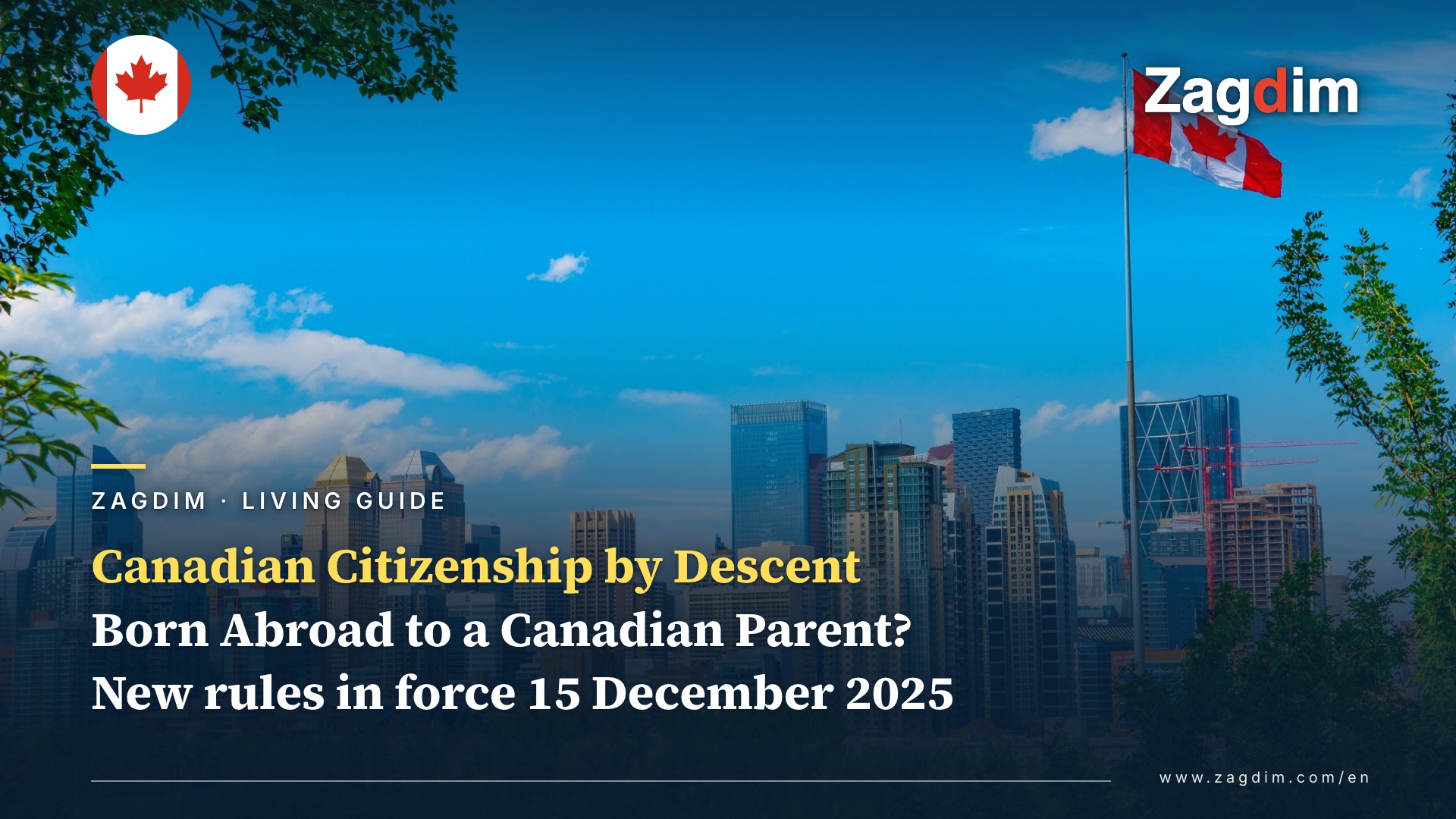
The Calgary skyline and the Canadian flag. Image: Zagdim photo library

October 27, 2026
in Canada, Living Abroad
Reading Time: 12 mins read

Canadian Citizenship by Descent Changed on 15 December 2025: Most People Born Abroad Before That Date Are Now Citizens, Later Births Depend on a 1,095-Day Test

According to Immigration, Refugees and Citizenship Canada (IRCC), Bill C-3 changed the first-generation limit on Canadian citizenship by descent on 15 December 2025, so most people born abroad before that date to a Canadian parent are now citizens. For the second generation or later born on or after that date, the Canadian parent must have spent at least 1,095 days in Canada before the birth.

On 25 October 2026, the immigration news site CIC News published a piece on what IRCC officers look for in citizenship by descent applications, including birth records for each generation, proof of the Canadian ancestor’s status and, for children born on or after 15 December 2025, evidence of the parent’s time in Canada. Applications for proof of citizenship have surged since the law changed, and many families whose parents once immigrated to Canada and later moved back to Asia are asking the same question: if I was born abroad, am I Canadian?

This guide starts from that question. It explains how the new law decides who is a citizen, how the 1,095 days are counted, and how to apply for a citizenship certificate to confirm your status.


Key Points

  • Who should pay attention: anyone born outside Canada to a Canadian parent, including families whose parents immigrated to Canada, became citizens and later returned to Hong Kong, Taiwan or elsewhere, and the children and grandchildren born abroad in those families.
  • If you were born abroad before 15 December 2025 to a Canadian parent, in most cases you are already a citizen. You do not apply to become one, but you need a citizenship certificate to prove it.
  • If you were born on or after 15 December 2025 and your Canadian parent was also born abroad, that parent must show 1,095 days of physical presence in Canada before your birth.
  • Proof of citizenship costs CAD 75 per person, and media reports citing IRCC figures put processing at close to three years, so families with travel or study plans should start early.

What Is Canadian Citizenship by Descent: First and Second Generation

Citizenship by descent is Canadian citizenship acquired through a parent when you are born outside Canada. IRCC explains it in generations:

  • First generation: born or adopted outside Canada to a Canadian citizen who was born in Canada or naturalized.
  • Second generation or later: born or adopted outside Canada to a parent who is themselves first generation, meaning that parent was also born abroad and is a citizen by descent.

From 17 April 2009, a first-generation limit applied: in general only the first generation born abroad could inherit citizenship, and it could not pass automatically to the second generation. In December 2023, the Ontario Superior Court of Justice ruled the limit unconstitutional for many people. IRCC introduced an interim measure, and Bill C-3 then amended the law.


How the New Canadian Citizenship by Descent Rules Work: The 15 December 2025 Line

Bill C-3, An Act to amend the Citizenship Act (2025), received Royal Assent on 20 November 2025 and came into force on 15 December 2025. The table below is based on IRCC’s “Changes to citizenship rules in 2025” page and section 3 of the amended Citizenship Act:

Your situation Date of birth (or adoption) Result under the new law
First generation (parent born in Canada or naturalized) Any date Already a citizen; not affected by the new law
Second generation or later (parent also born abroad) Born before 15 December 2025 In most cases, automatically a citizen
Second generation or later (parent also born abroad) Born on or after 15 December 2025 A citizen only if the Canadian parent spent at least 1,095 days in Canada before the birth
Second generation or later, adopted abroad Adopted before 15 December 2025 Can apply for a direct grant of citizenship
Second generation or later, adopted abroad Adopted on or after 15 December 2025 Can apply for a direct grant if the Canadian parent spent at least 1,095 days in Canada before the adoption

A few details are easy to miss:

  • If your parent became a citizen because of these changes, the “born before 15 December 2025” rule applies to you as well.
  • Anyone who was already a citizen before the law changed keeps that status.
  • According to IRCC, the law also extends citizenship to the remaining “Lost Canadians” and their descendants.
  • If you applied under the interim measure and your application is still in progress, IRCC will process it under the new rules. You do not need to apply again.
  • If the change made you a citizen automatically and you do not want to be one, you can apply to renounce. People born before 15 December 2025 who were not previously granted citizenship can use a simplified renunciation process.

How the 1,095-Day Substantial Connection Test Is Counted

The second generation or later born on or after 15 December 2025 must show a substantial connection to Canada. Under section 3(3) of the amended Citizenship Act, at least one citizen parent must have been physically present in Canada for at least 1,095 days before the child’s birth. IRCC describes this as cumulative physical presence, so the days do not need to be consecutive and can be added up across several stays.

The calculation uses IRCC form CIT 0555 (How to calculate physical presence in Canada for a Canadian parent): list the entry and exit dates of each stay in Canada, then add up the days. The guide used to say that partial days count as full days, but according to a CIC News report from August 2026, that sentence was removed in the 25 August 2026 form update and IRCC has not defined the point since. Families close to the threshold should take particular care.

According to IRCC’s document checklist (CIT 0014, August 2026 version, as summarised by CIC News), evidence of a parent’s time in Canada can include:

  • Employment and education records, such as T4 slips and school transcripts
  • Travel records, such as passports and entry and exit records
  • Residential records, such as leases, mortgages and insurance
  • Federal, provincial, territorial or municipal government records
  • Affidavits from religious institutions, unions, volunteer programs or other organizations
  • Affidavits from third parties who know about the parent’s time in Canada

Affidavits cannot come from family members, including parents, siblings, spouses, grandparents, aunts, uncles and cousins, even if the relative is a lawyer or notary.

Exceptions to the 1,095-Day Test

Under section 3(5) of the Citizenship Act, the 1,095-day requirement does not apply if a parent or grandparent was employed outside Canada with the Canadian Armed Forces, the federal public administration or a provincial public service (other than as a locally engaged person) at the relevant time. Proof of that employment must be included with the application.

The Toronto skyline at dusk reflected in the lake
The Toronto skyline at dusk reflected in the lake. Image: Zagdim photo library

How to Confirm Canadian Citizenship by Descent: Apply for Proof of Citizenship

If you believe you are a Canadian citizen by descent or because of Bill C-3, IRCC recommends applying for proof of citizenship (a citizenship certificate). IRCC reviews the application and, if you are a citizen, issues a certificate. You can use it to apply for a Canadian passport and to access government services, but the certificate itself is not a travel document.

The requirements below are based on IRCC’s proof of citizenship pages, the application package and the online instruction guide:

Item Details
Fee CAD 75 per person; non-refundable once processing has started
Main forms CIT 0001 application (adults and minors), CIT 0014 document checklist
Additional forms CIT 0555 if you were born on or after 15 December 2025 and your Canadian parent was born abroad; IMM 5476 if you use a representative
Identity documents Two valid IDs showing your name and date of birth, one with a photo; birth certificates, SIN cards, bank cards and old citizenship certificates do not count
Photo Online applications: one digital citizenship photo plus the photographer’s details
Generational documents Documents from the original issuing authority for you, your Canadian parent and, where needed, earlier ancestors, such as birth certificates naming the parents, Canadian citizenship certificates or naturalization certificates
Translations Documents not in English or French need a translation and a translator’s affidavit; translations by family members are not accepted
Format Clear, legible colour copies

Online or Paper Application

IRCC allows online applications if you were born on or after 15 February 1977 and were born abroad to a parent who was born in Canada on or after 15 February 1977, or who became a citizen on or after 17 April 2009. Otherwise you apply on paper, for example if your parent was naturalized before 17 April 2009, if you do not know details about your parents or grandparents, or if you are applying for four or more children. Paper applications go to the address set for your country or territory, and a tracked mail or courier service is recommended.

How Long Processing Takes

IRCC updates its processing times tool every month. Applications have surged since the law changed: according to media reports citing IRCC figures, processing for proof of citizenship was about 33 months in September 2026 and about 34 months in October 2026. IRCC also says that applications submitted through a Canadian embassy, high commission or consulate outside Canada and the US need an extra three to four months for mailing, and that minors outside Canada and the US who send their application directly to the Case Processing Centre in Sydney, Nova Scotia, should add six to eight months.

After You Receive the Certificate

IRCC’s suggested order is: get proof of citizenship, use it to apply for a Canadian passport, then enter Canada on that passport. IRCC says dual Canadian citizens cannot fly to or transit through Canada on a non-Canadian passport and need a valid Canadian passport to board (Canadian-American dual citizens have separate arrangements).


Common Misconceptions About Canadian Citizenship by Descent

  • “I was born in Hong Kong, so I am not Canadian.” Place of birth is not the only test. If your parent was a Canadian citizen when you were born, you are likely a first-generation citizen by descent. That was already true before the new law; you may simply never have applied for a certificate.
  • “I need to apply for citizenship now that the law has changed.” People born before 15 December 2025 who qualify became citizens automatically. What they need is proof of citizenship, not a grant of citizenship.
  • “I have to live in Canada for 1,095 days myself.” The requirement applies to the Canadian parent, counted before the child’s birth, not to the child.
  • “My parent lived in Canada for more than three years, so it is fine.” IRCC looks at days that can be proven. Each stay needs dates and supporting documents, and all information can be verified.
  • “With a citizenship certificate I can fly back to Canada.” The certificate is not a travel document; you need a Canadian passport to fly in.

Common Scenarios for Families in Hong Kong and Taiwan

Scenario 1: Your Parents Became Citizens in the 1990s and Moved Back; You Were Born in Hong Kong

Your parents immigrated to Canada in the 1990s, became citizens and later returned to Hong Kong, where you were born in 2000. You are a first-generation citizen by descent and were already a citizen before the new law. To confirm it, apply for proof of citizenship. Because your parents were naturalized before 17 April 2009, you will generally need to apply on paper, with your parents’ naturalization certificates and a birth certificate naming your parents.

Scenario 2: You Are First Generation and Your Child Was Born in Taiwan in 2020

You were born abroad and are a first-generation citizen by descent. Your child was born in Taiwan in 2020. Under the old rules the child, as second generation, could not inherit citizenship. Under the new law, because the child was born before 15 December 2025, the child is in most cases already a citizen. The application needs documents for your generation and for your Canadian parent to show each parent-child link.

Scenario 3: You Are First Generation and Your Child Was Born in Hong Kong in 2026

Because the child was born after 15 December 2025, you must show that you spent at least 1,095 days in Canada before the birth. If, for example, you studied for four years at a Canadian university and worked there for a while, list each stay on CIT 0555 and attach transcripts, T4 slips, leases and entry and exit records. If you fall short, the child may not be able to inherit citizenship by descent, and you should look at other options with a licensed immigration consultant or lawyer.


Canadian Citizenship by Descent and Proof of Citizenship: FAQ

When did the new Canadian citizenship by descent law take effect?

Bill C-3 (An Act to amend the Citizenship Act (2025)) received Royal Assent on 20 November 2025 and came into force on 15 December 2025. It changed the first-generation limit that had applied since 17 April 2009: most second-generation or later people born abroad before that date became citizens automatically, while those born after it depend on the Canadian parent’s 1,095 days in Canada.

If I have Canadian citizenship by descent, do I still need to apply for citizenship?

No. If you qualify, you are a citizen by law. What you apply for is proof of citizenship (a citizenship certificate), which confirms your status and lets you apply for a passport. It costs CAD 75 per person and is issued after IRCC reviews your file. Only people adopted abroad use the separate direct grant route.

When do the 1,095 days have to be completed, and can they be split up?

They must be completed before the child’s birth (or adoption), and they are the Canadian parent’s days, not the child’s. IRCC describes the test as cumulative physical presence, so the days do not need to be consecutive and can be added up across several stays on form CIT 0555. IRCC currently does not define how partial days are counted.

Is it enough if only one parent is Canadian?

Yes. Citizenship by descent only requires one parent to have been a Canadian citizen when you were born. For the second generation or later born on or after 15 December 2025, only one citizen parent needs to have spent 1,095 days in Canada before the birth.

How long does proof of citizenship take, and can it be sped up?

Processing times are updated monthly in IRCC’s tool. According to media reports citing IRCC figures, the estimate was about 34 months in October 2026, plus three to four months for mailing if you apply through an embassy outside Canada and the US. IRCC accepts urgent processing requests only in specific situations and decides each one, so check its current guidance before you travel.

What if I do not want to be a Canadian citizen?

If the new law made you a citizen automatically and you do not want to be one, you can apply to renounce. People born before 15 December 2025 who were not previously granted citizenship can use a simplified process. Before renouncing, also check the rules of any other nationality you hold.


Want to Confirm a Family Member’s Canadian Status? Ask Zagdim

If you are unsure which generation you or a family member falls into, or how to prepare the documents, tell us your situation at Ask Zagdim. For advice on an individual case, consult a licensed immigration consultant or a Canadian lawyer.

Life abroad? Ask Zagdim.

Your first stop for international property and global living.

Research and insights. Know what’s changing. Understand what matters.

Newsletter for overseas updatesSubscribe →


Important Disclaimer

This article is general information and does not constitute legal, immigration or tax advice. It is based mainly on 2025 and 2026 guidance, forms and instructions from Immigration, Refugees and Citizenship Canada (IRCC), the text of Canada’s Citizenship Act, and media reports from August to October 2026; processing times are as reported in the media citing IRCC figures. Different rules may apply to people born before 15 February 1977, people who renounced or had citizenship revoked, and cases involving adoption or government postings abroad. Check IRCC’s latest guidance for your case and consult a Regulated Canadian Immigration Consultant (RCIC) or a Canadian lawyer.

The rules and fees in this article are current as of 26 October 2026; check IRCC for the latest official updates.


References

Immigration, Refugees and Citizenship Canada – Bill C-3: An Act to amend the Citizenship Act (2025) comes into effect (15 December 2025) / Immigration, Refugees and Citizenship Canada – Changes to citizenship rules in 2025 / Immigration, Refugees and Citizenship Canada – Changes to citizenship rules in 2009 and 2015 / Department of Justice Canada – Citizenship Act (R.S.C., 1985, c. C-29) / Immigration, Refugees and Citizenship Canada – Proof of citizenship: About the document / Immigration, Refugees and Citizenship Canada – Proof of citizenship: How to apply / Immigration, Refugees and Citizenship Canada – Application for a citizenship certificate (CIT 0001) / Immigration, Refugees and Citizenship Canada – How to calculate physical presence in Canada for a Canadian parent (CIT 0555) / Immigration, Refugees and Citizenship Canada – Dual Canadian citizens: travel to Canada / CIC News – What an IRCC officer looks for in your citizenship by descent application (25 October 2026) / CIC News – Canada updates citizenship by descent forms, shares new information on physical presence requirement (26 August 2026) / Moving2Canada – Canadian Citizenship-by-Descent Processing Times Increase Again, Topping 34 Months (13 October 2026)


Zagdim AI
All content is researched, written, or authorized for publication by the @Zagdim Overseas team. Sharing and reposting are welcome, but please make sure to credit the source and include the original article link from this website. Any plagiarism or unauthorized use may result in legal action. For article submissions, please contact us via Facebook. Thank you for your support!

For article submissions, press release publication, or interview notices, please contact [email protected]. 

Zagdim Ask

Have a specific question about overseas living, property, visa, or practical arrangements?

Fill in your situation and key concerns through Zagdim Ask. Our team will review your message and get back to you by email where appropriate.

Submit your enquiry →

Similar Topics

Portugal Citizenship Under the New Nationality Law: Residence Years, Golden Visa and D7 Timelines, and How to Check Your Application
Living Abroad

Portugal Citizenship Under the New Nationality Law: Residence Years, Golden Visa and D7 Timelines, and How to Check Your Application

October 27, 2026
Dubai VAT Refund for Tourists: How to Use the Planet App, Minimum Spend, Fees and Tips
Dubai

Dubai VAT Refund for Tourists: How to Use the Planet App, Minimum Spend, Fees and Tips

October 27, 2026
Born Abroad to a Canadian Parent? How Canadian Citizenship by Descent Works After Bill C-3 and How to Get Proof
Canada

Born Abroad to a Canadian Parent? How Canadian Citizenship by Descent Works After Bill C-3 and How to Get Proof

October 27, 2026
Next Post
Dubai VAT Refund for Tourists: How to Use the Planet App, Minimum Spend, Fees and Tips

Dubai VAT Refund for Tourists: How to Use the Planet App, Minimum Spend, Fees and Tips

Portugal Citizenship Under the New Nationality Law: Residence Years, Golden Visa and D7 Timelines, and How to Check Your Application

Portugal Citizenship Under the New Nationality Law: Residence Years, Golden Visa and D7 Timelines, and How to Check Your Application

Facebook Twitter Youtube

About Us

Zagdim is a global knowledge platform focused on international property, global living, relocation, lifestyle, and location-based decision-making.

We provide insights on overseas real estate, market trends, regional analysis, economic developments, and practical relocation information. Through continuous market observation and on-the-ground research, Zagdim helps readers better understand a place before deciding where to live, invest, buy property, or establish a base abroad.

We currently follow markets including the UK, Japan, Thailand, Malaysia, Germany, Australia, the UAE, Greece, Portugal, and Spain, while continuing to track emerging lifestyle, relocation, and property trends worldwide.

Category

  • Australia
  • Buying & Immigration Guide
  • Cambodia
  • Canada
  • Costa Rica
  • Dubai
  • Encyclopedia
  • Europe
  • Expat Lifestyle Guide
  • Germany
  • Global Reports Analysis
  • Hong Kong
  • Human-Picked
  • Indonesia
  • International Property Buying Guide
  • Japan
  • Japan Market News
  • Kenya
  • Living Abroad
  • Malaysia
  • Mallorca
  • Market Trends Overview
  • News
  • Other Market News
  • Overseas Leasing & Long-Term Stay
  • Partner Content
  • Philippines
  • Policy Interpretation
  • Portugal
  • Property
  • Property Law & Tax
  • Real Estate & Economic News
  • Real Estate Law & Taxation
  • Relocation, Immigration & Visa
  • Singapore
  • South Korea
  • Spain
  • Switzerland
  • Thailand
  • Thailand Market News
  • UK Market News
  • United Kingdom
  • United States
  • Vietnam
  • Vietnam Market News
  • Visa & Immigration
  • Zagdim Insights
  • Zagdim Property Insights

Email:[email protected]


Add Friends


WhatsApp
Contact Us


Wechat:Zagdim

Work with Zagdim

For brand and content partnership enquiries, email [email protected].

©2026 Zagdim Overseas All Rights Reserved · Privacy Policy

No Result
View All Result
  • Home
  • Zagdim Property Insights
    • Market Trends Overview
    • Policy Interpretation
    • Forest
    • PLACEHOLDER sub-cate for Zagdim Property Insights
  • Global Reports Analysis
    • In-Depth Project Analysis
  • Real Estate & Economic News
    • Thailand Market News
    • UK Market News
    • Germany Market News
    • Japan Market News
  • Buying & Immigration Guide
    • Expat Lifestyle Guide
    • Real Estate Law & Taxation
    • Overseas Leasing & Long-Term Stay
    • Starting a Business & Company Setup
  • Zagdim Ask
  • 中文 EN

©2026 Zagdim Overseas All Rights Reserved · Privacy Policy