

































Portugal citizenship now takes 10 years of legal residence for applications filed from 19 May 2026, while earlier filings are still judged on the old five-year rule
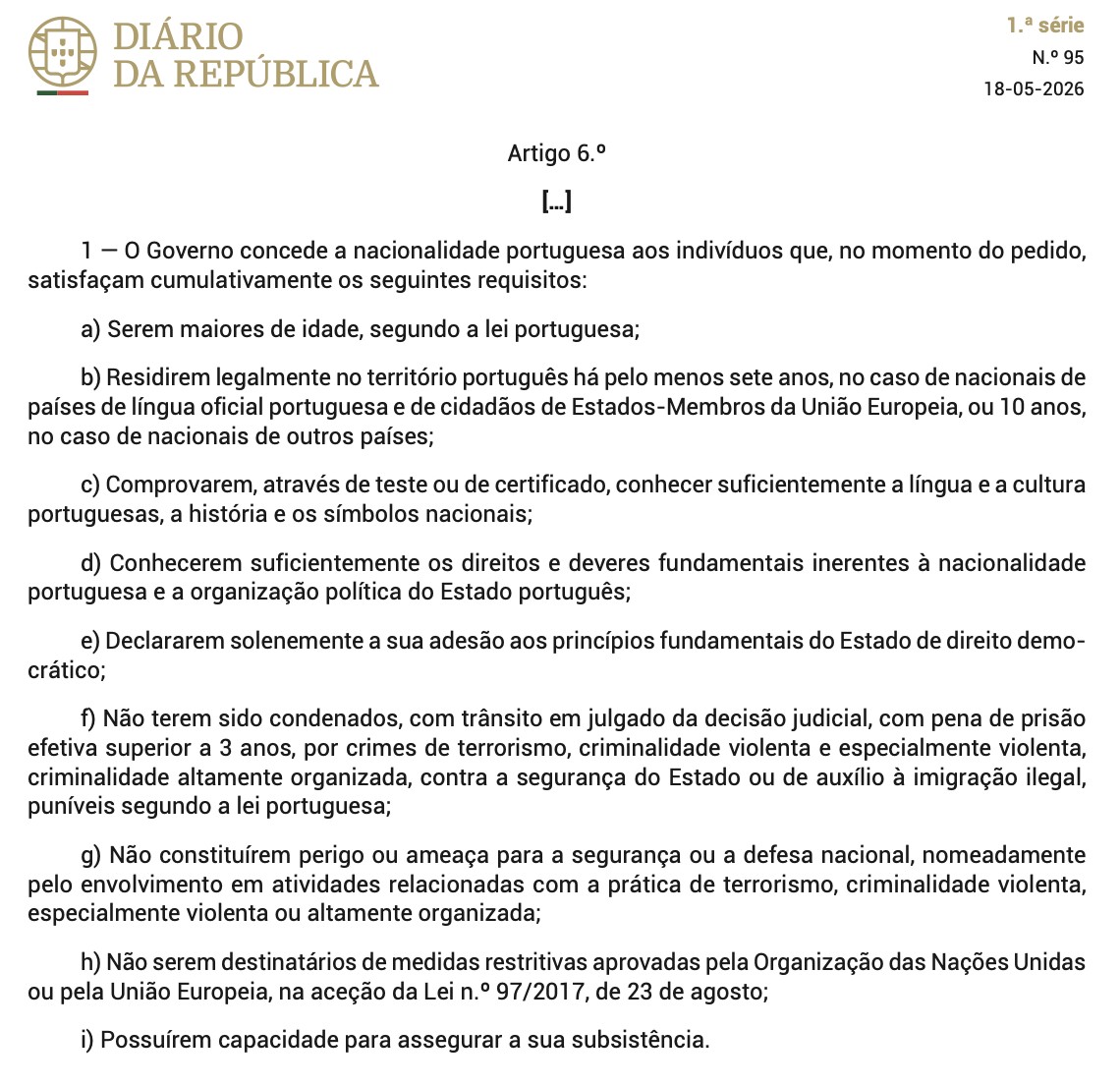
Under Organic Law No. 1/2026, in force since 19 May 2026, Portugal citizenship by naturalisation takes 10 years of legal residence for most nationals and seven for CPLP and EU citizens, while applications already in progress keep the old five-year rule. The law (Lei Orgânica n.º 1/2026) was published in Portugal’s official gazette, the Diário da República, on 18 May 2026.
On 21 October 2026, the Portuguese daily Público reported Ministry of Justice figures showing that the Institute of Registries and Notary (Instituto dos Registos e do Notariado, IRN), which handles nationality cases, had 690,480 nationality applications pending on 30 June 2026. On 26 October, The Portugal News published a piece on how the Golden Visa citizenship timeline has changed, and many Golden Visa and D7 holders are now recalculating when they can apply.
This guide uses those reports as a starting point to set out what the law now says, how pending cases are treated, how long each type of applicant must reside, and how to check an application’s progress on the official website.
Key Points
- Who should pay attention: foreign nationals in Portugal on a Golden Visa (investment residence permit), a D7 or another residence permit who plan to apply for citizenship, and applicants already waiting for a decision.
- The wait is longer: nationals of countries outside the Portuguese-speaking world and the EU, including Hong Kong, Taiwan, mainland China, Malaysia and Singapore, now need 10 years of legal residence, up from five.
- The filing date is the dividing line: applications already in progress when the law took effect on 19 May 2026 follow the old rules; people who had five years of residence but had not filed fall under the new law.
- The counting rule changed too: the old law let applicants count the time spent waiting for a residence permit to be granted; that provision has been repealed.
- Progress is tracked with an access code: IRN emails a code when the case is opened, and entering it on the Ministry of Justice website shows which of four stages the application is in. Checking is free.
Portugal Citizenship Old and New Rules Compared: Years, Counting and Language
The filing date decides which set of rules applies. The basis differs by row, so it is listed in the last column:
| Item | Old law (filed by 18 May 2026) | New law (filed from 19 May 2026) | Data basis |
|---|---|---|---|
| Non-CPLP, non-EU nationals | 5 years of legal residence | 10 years of legal residence | New Art. 6(1)(b); old rule as cited in Constitutional Court ruling 1133/2025 |
| CPLP and EU citizens | 5 years | 7 years | New Art. 6(1)(b) |
| Stateless people | 5 years | 4 years | New Art. 6(3) |
| Time waiting for a residence permit | For nationality applications filed from 1 April 2024, time from the temporary residence application to its approval counted | Provision repealed; no longer counts | Old Art. 15(4); new Art. 5 |
| Language and integration | Proof of Portuguese (commonly at A2 level in practice) | Test or certificate covering Portuguese language, culture, history and national symbols; knowledge of citizens’ rights and duties and the political system; a solemn declaration of commitment to democratic rule of law; means of subsistence | New Art. 6(1)(c)–(e), (i) |
| Descendants of Sephardic Jews | Dedicated route | Abolished | Ministry of Justice notice, May 2026 |
How Many Years You Need for Portugal Citizenship: Each Type of Applicant
The new law keeps several routes to citizenship; naturalisation through residence is only one of them. All of the following come from the Nationality Law as amended by Organic Law No. 1/2026:
| Applicant | Requirement under the new law |
|---|---|
| Nationals of Hong Kong, Taiwan, mainland China, Southeast Asia and other non-CPLP, non-EU countries | 10 years of legal residence |
| Nationals of Portuguese-speaking countries (such as Brazil and Angola) and EU member states | 7 years of legal residence |
| Stateless people | 4 years of legal residence |
| Spouses of Portuguese citizens | Declaration after more than three years of marriage; de facto partners after three years need a court recognition first |
| Great-grandchildren of Portuguese nationals of origin | 5 years of legal residence (exempt from the 7/10-year rule) |
| Children born in Portugal to foreign parents | May declare Portuguese nationality if one parent had five years of legal residence at the time of birth |
| Minors born in Portugal applying for naturalisation | One parent with five years of legal residence, and the child enrolled in and attending compulsory schooling |
Nationals of Portuguese-speaking countries are presumed to meet the language requirement, but the culture, history, national symbols and civic knowledge requirements still apply to them.
When Portugal Citizenship Residence Starts Counting: Waiting Time No Longer Counts, Breaks Can Be Added Up
The law defines legal residence as being in Portugal with a regularised status under any residence card, visa or permit provided for in the foreigners’ legislation (Article 15(1)).
From 1 April 2024, old Article 15(4) let applicants count the time between applying for a temporary residence permit and having it granted, as long as it was eventually approved. The idea was that delays at the immigration agency should not eat into an applicant’s residence time. Article 5 of the new law repeals that provision, so new applicants can no longer count the time spent waiting for a card. Most lawyers and media read this as counting from when the residence permit is obtained; in practice, IRN decides each case.
The new law also says residence periods can be continuous or added together after a break, but all of them must fall within a set window:
| Nationality | Residence required | Window for adding periods |
|---|---|---|
| Non-CPLP, non-EU nationals | 10 years | Within 12 years |
| CPLP and EU citizens | 7 years | Within 9 years |
| Stateless people | 4 years | Within 6 years |
This comes from Article 15(3) of the amended Nationality Law. In practice, a non-EU national needs 10 years of legal residence within a 12-year span. A gap when a permit lapsed does not count, but it does not wipe out the years before it.
How Portugal Citizenship Works for Golden Visa and D7 Holders
The Golden Visa is an investment residence permit (Autorização de Residência para Investimento, ARI), and the D7 is a residence visa for people with passive income or pensions. Both lead to a residence permit, and time on that permit is legal residence under the law. The new law sets no separate period for Golden Visa holders; holders from Hong Kong, Taiwan, mainland China and Southeast Asia face the same 10 years as other non-EU nationals.
The filing date is what matters:
- Citizenship application filed by 18 May 2026: assessed under the old five-year rule and unaffected by the new law.
- Five years of residence reached, but the application filed from 19 May: the new law applies, so 10 years are needed.
- Residence period not yet complete: the new law applies, counted from when the residence permit is obtained, with 10 years needed within a 12-year window.
The law does not set a minimum number of days per year that must be spent in Portugal. That point, and how the new test will work, should become clearer once the government amends the Portuguese Nationality Regulation (see the next section). Citizenship and permanent residence are also separate systems: this reform changed the Nationality Law, while permanent residence is governed by the Foreigners’ Law and was not part of it.
What Is Settled Under the New Nationality Law, and What Is Not
Settled (the law is in force):
- The 7/10-year residence requirement, the repeal of counting the permit-waiting time, and the 12-year window all took effect on 19 May 2026.
- The transition rule is in Article 7(2) of the new law: procedures pending when it took effect are governed by the Nationality Law as it stood before. The Ministry of Justice’s May notice also states that the new rules apply only to applications filed after entry into force.
- An earlier version of the bill was found partly unconstitutional by the Constitutional Court (Tribunal Constitucional) on 15 December 2025, with four provisions struck down, including the original transition clause. Parliament revised the bill and passed it again on 1 April 2026, and the President promulgated it on 3 May. The Court did not find the repeal of the waiting-time rule or the longer residence periods unconstitutional.
Not yet settled (awaiting implementing rules):
- The format, level and venue of the language and culture test: the law gave the government 90 days from publication to amend the Portuguese Nationality Regulation, but as of 27 October 2026 no amended regulation had been seen.
- How civic knowledge and means of subsistence will be proven also depends on the implementing rules.
- A separate bill making loss of nationality an additional criminal penalty was found partly unconstitutional on 8 May 2026. It has nothing to do with residence periods for naturalisation and does not change the rules above.
How to Check a Portugal Citizenship Application: Access Code, Four Stages and Waiting Times
IRN offers a free online status check on the Ministry of Justice portal, justica.gov.pt. According to the official service page (updated 26 October 2026):
- Find the access code (código de consulta): IRN emails it when the case is created. If a lawyer or solicitor filed for you, the code may have gone to them.
- Open the “Consultar estado do processo de nacionalidade” (check the status of a nationality application) page on justica.gov.pt and go to the online check.
- Enter the code in the “senha de acesso” (access password) field.
- Compare the result with the table below.
- Lost the code: request it at a Nationality Desk (Balcão da Nacionalidade) or call the Registry Line on +351 211 950 500 with your case number and identification details. Replacement is also free.
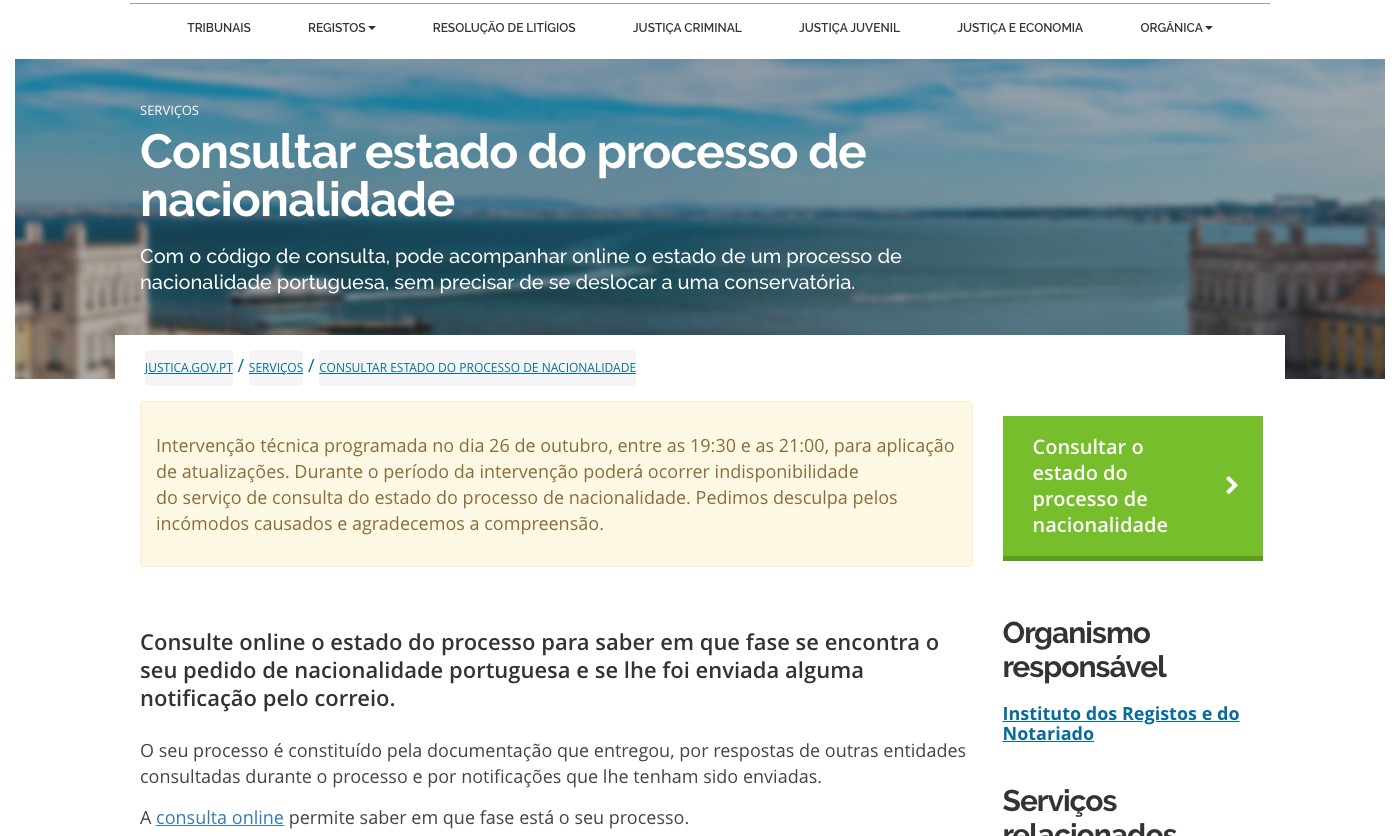
The four current stages and how they map to the old seven-step view all come from the same official page:
| Current stage | Meaning | Old stages |
|---|---|---|
| Submetido (submitted) | The application has reached a registry office that handles nationality and has been logged | 1 Receipt, 2 Registration |
| Em análise (under review) | Requirements, completeness and authenticity of documents are being checked, or a reply from another authority is awaited | 3 External consultation, 4 Document check, 5 Merit review |
| Para decisão (for decision) | A decision on granting nationality has been issued | 6 Decision |
| Concluído (completed) | Granted and registered as a citizen, or refused and archived | 7 Registration/Archive |
Some cases cannot be checked online, including nationality by registering a birth in the Portuguese civil registry (including at consulates), and late registrations of people born before 1962 in the former Portuguese State of India or before 1975 in Angola, Cape Verde, Guinea-Bissau, Mozambique, São Tomé and Príncipe and East Timor. These need a desk visit or a phone call.
There is no official standard processing time. Figures available so far:
- IRN reported 515,334 applications pending on 30 June 2025.
- Público reported on 21 October 2026 that 690,480 were pending on 30 June 2026.
- IRN president Blandina Soares said in a July 2026 interview that residence-based applications face a delay of about three years.
- According to the Ombudsman’s (Provedor de Justiça) annual report, the system that the immigration agency AIMA uses to certify applicants’ residence time was down for about a year, with knock-on delays expected to last.
Common Misconceptions About the New Portugal Citizenship Law
Misconception 1: Anyone with five years of residence before 19 May can use the old rules.
The transition rule looks at whether an application was already in progress, not whether the residence period was complete. People with five years who had not filed now need 10.
Misconception 2: Only the number of years changed, not how they are counted.
Some English-language coverage says this, but Article 5 of the new law repealed old Article 15(4), so time spent waiting for a residence card no longer counts. For people who waited a long time for their first card, the countable period may be shorter than they think.
Misconception 3: The official website still says five years, so the new law is not yet in effect.
The Ministry of Justice’s “Portuguese nationality” information page is marked as being updated, was last revised on 18 May 2026 and still mentions five years. The law published in the Diário da República and the Ministry’s 19 May notice take precedence.
Misconception 4: The Golden Visa has its own citizenship timeline.
The Golden Visa is just one way to obtain a residence permit. The citizenship timeline is the same as for other permits and depends on nationality, not on the visa used.
Misconception 5: Permanent residence means you can apply for citizenship.
Permanent residence and citizenship are separate systems run by different bodies (AIMA for residence, IRN for nationality), with different requirements and periods.
Example Scenarios: Three Portugal Citizenship Timelines
Scenario 1: A Hong Kong reader who got a Golden Visa in 2020 and filed in April 2026.
The application was already in progress when the new law took effect, so it is assessed under the old five-year rule. Keep the filing receipt, case number and access code, and check the status regularly. If the residence card expires during the wait, renew it as usual so the review is not affected.
Scenario 2: A Taiwanese reader who got a Golden Visa in September 2021 and planned to file in autumn 2026.
Without a filing by 18 May, the new law applies: 10 years of legal residence counted from when the permit was obtained, which points to roughly September 2031 or later. Each renewal needs to follow on without a gap, since gaps do not count. It is also worth watching for the implementing rules on the language and culture test.
Scenario 3: A Malaysian Chinese couple who retired to Portugal on a D7 in 2024.
Time on a D7 permit is legal residence, so the 10-year rule applies. They can start learning Portuguese now and keep every residence card, lease and tax record in order, then check which tests apply and how to prove means of subsistence once the implementing rules are out.
Portugal Citizenship New Law: Frequently Asked Questions
How many years do I need to live in Portugal for citizenship now?
For naturalisation applications filed from 19 May 2026, citizens of Portuguese-speaking countries and the EU need seven years of legal residence, stateless people four, and everyone else 10. Nationals of Hong Kong, Taiwan, mainland China, Malaysia and Singapore fall into the 10-year group. The old five-year rule applies only to applications filed by 18 May 2026.
Is Portugal citizenship faster for Golden Visa holders?
No. The Golden Visa leads to an investment residence permit, and time on it counts as legal residence in the same way as any other permit, so non-EU nationals still need 10 years. What really matters is whether an application was filed by 18 May 2026.
I filed before the new law took effect. Will my case be switched to the new rules?
Under Article 7(2) of the new law, procedures pending when it took effect are governed by the Nationality Law as it stood before, and the Ministry of Justice notice says the new rules apply only to applications filed afterwards. The earlier bill’s transition clause was struck down by the Constitutional Court; the version now in force is the revised text passed by Parliament.
From what date does residence count for Portugal citizenship?
The rule that let applicants count from the date they applied for a residence permit has been repealed, so the time spent waiting for the permit no longer counts. The law treats legal residence as time on a valid residence permit, and most lawyers and media read this as counting from when the permit is obtained. IRN makes the final assessment.
Do I need to pass a Portuguese test for Portugal citizenship?
Yes. The new law requires a test or certificate showing sufficient Portuguese and knowledge of Portuguese culture, history and national symbols, plus knowledge of citizens’ rights and duties and the political system. The test format depends on the amended Portuguese Nationality Regulation, which had not been seen as of 27 October 2026.
Does checking my Portugal citizenship status cost anything, and what if I lost the access code?
Checking is free, and so is getting the code again. The code is emailed when the case is created and may have gone to your lawyer if one filed for you. If it is lost, ask at a Nationality Desk or call the Registry Line on +351 211 950 500 with your case number and identification details.
How long does a Portugal citizenship decision take?
There is no official standard time. IRN’s president said in July 2026 that residence-based cases face a delay of about three years, and Público reported 690,480 pending applications. Actual times vary with the type of case and how complete the documents are.
Planning a Long Stay or Citizenship in Portugal? Ask Zagdim
If you want to check how your residence time is counted or whether the old or new law applies to you, tell us about your situation through Ask Zagdim.
Life abroad? Ask Zagdim.
Your first stop for international property and global living.
Research and insights. Know what’s changing. Understand what matters.
Newsletter for overseas updatesSubscribe →
Important Disclaimer
This article is general information and not legal, immigration or tax advice. It is based mainly on laws published in Portugal’s Diário da República in 2025 and 2026, notices from Portugal’s Ministry of Justice and IRN, Constitutional Court rulings, and media reports from July to October 2026. The implementing rules have not yet been published; how residence time is counted and which law applies in an individual case depends on IRN’s assessment and the latest official notices. Consult a qualified Portuguese lawyer where needed.
The rules and status-check steps in this article are current as of 27 October 2026; refer to the Diário da República and Portugal’s Ministry of Justice for the latest updates.
References
Diário da República – Lei Orgânica n.º 1/2026, de 18 de maio (Organic Law No. 1/2026) / Portugal Ministry of Justice – Lei da Nacionalidade: novas regras entram em vigor a 19 de maio / Portugal Ministry of Justice – Consultar estado do processo de nacionalidade / Portugal Ministry of Justice – Nacionalidade portuguesa / Constitutional Court of Portugal – Acórdão n.º 1133/2025 (15 December 2025) / Constitutional Court of Portugal – Acórdão n.º 409/2026 (8 May 2026) / 24noticias – Descendentes de judeus sefarditas representam quase um terço dos pedidos de nacionalidade pendentes (5 July 2025) / DN Brasil – Pedidos de nacionalidade portuguesa subiram 74% após anúncio de mudança na lei (10 July 2026) / DN Brasil – Provedoria: queixas sobre nacionalidade sobem 177% / The Portugal News – 9 Changes to Portugal’s Golden Visa Citizenship Timeline Explained (26 October 2026)