





























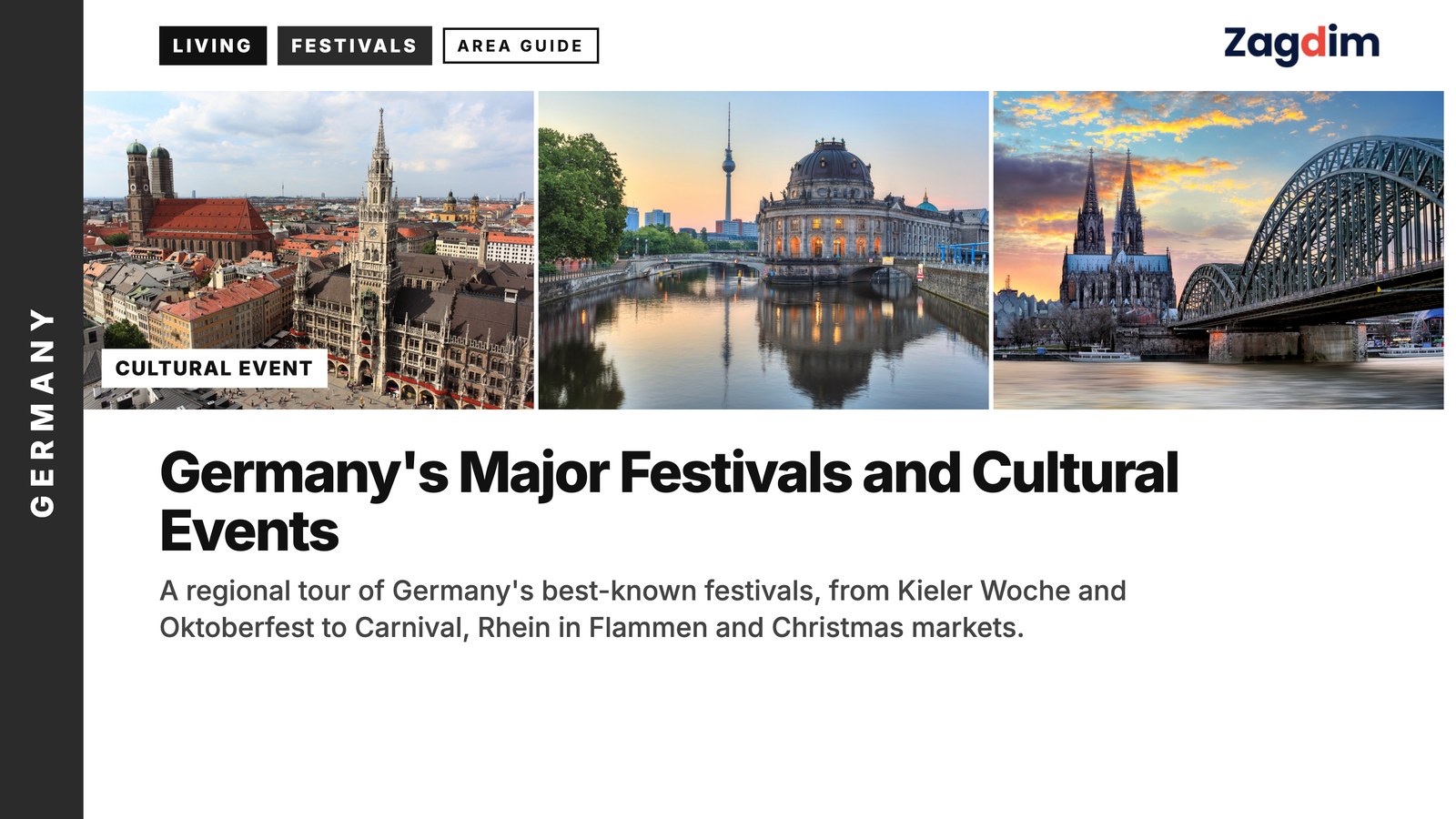
Having covered some economic topics, it is time to look at the highlights of the German calendar — the major festivals that draw large crowds. It would be impossible to list every cultural event and folk festival across Germany, since there are simply too many, and every region has its own. You will find many long-running beer and wine festivals. Coming together for major festivals is a typical part of German life, and parish fairs are also long-standing events found all over Germany. Here are a few festivals and events that are famous either in their own region or nationwide.
Starting in the north of Germany and moving south:
Germany has a long coastline along the North Sea and the Baltic Sea. Water sports are very popular, and beaches are packed in summer. One famous festival is “Kieler Woche” (Kiel Week), held mainly at the end of summer in September. You can see many famous ships and sailboats, and the harbor parties are very inviting. Every year, many people come to watch the parade of tall ships and enjoy the almost dreamlike atmosphere. Kiel is the capital of Schleswig-Holstein and has a long shipping tradition — a great event for anyone who loves the sea and seafood.
In Berlin, Germany’s capital, events begin early in the year. The “Grüne Woche” (Green Week) international agricultural fair takes place in January. This is Germany’s largest agricultural exhibition, showcasing everything German agriculture produces. At the same time it is also a great food fair, where you can sample all kinds of food and new products from exhibitors. The exhibition is a great experience for people of all ages.
A month later, in February, comes the famous “Berlinale” (Berlin International Film Festival). You can see many new films at the cinema, though tickets are usually hard to come by. Many famous films premiere in Berlin before going on to become popular worldwide. In May, you can visit Berlin’s “Karneval der Kulturen” (Carnival of Cultures), a mix of cultures and people — a street party where people dress up and meet all kinds of new faces. If you enjoy the exotic and the exuberant, this is the one to go for. 200 kilometers west of Berlin you will find Hanover, the capital of Lower Saxony — an interesting city, and the site of the largest traditional shooting festival around June/July. Traditional marksmen from all over Germany gather here for about two weeks to celebrate their event, with great food and lively parties every day.
Anyone who enjoys seeing old-style German tradition and uniforms will find the atmosphere here very relaxed. Carnival is a very important event in certain parts of Germany, centered on cities such as Cologne, Düsseldorf and Mainz, and along the Rhine as far as the Black Forest and Bavaria. It begins on 11 November and is typically celebrated for a week in February, culminating on the special day known as “Rosenmontag” (Rose Monday). You will see plenty of elaborate costumes and grand parades. People sing and dance in the streets, and businesses in the area often close for a week. The atmosphere is wild but also great fun — though experiencing it in person is really the best way to understand it. The Rhine is also where the spectacular “Rhein in Flammen” (Rhine in Flames) fireworks display marks the start of summer. In the evening, every town along the Rhine sets off fireworks, and you can see and enjoy the beautiful backdrop of castles and vineyards along the river. For many people, this is the highlight of their trip to Germany.
In southwest Germany you will find Stuttgart, capital of Baden-Württemberg. This region is home to Germany’s car industry, and locals there live pretty comfortably — but people also love a good festival.
In September/October comes the “Cannstatter Wasen” (Stuttgart Beer Festival). Cannstatt is a district of Stuttgart. Compared with Munich’s Oktoberfest, this festival runs for 17 days. There is partying and entertainment every day, and locals love going. This is a very traditional event that gives you a real feel for the local character — but be careful, since the wine and beer are quite strong, and the local dialect can be hard to follow at times. Still, locals will do their best to make you feel welcome. Munich’s own festival is world-famous — the “Münchner Oktoberfest” (Munich Beer Festival) is the most popular event of all. People come from all over the world to drink large steins of beer. The festive atmosphere runs for 14 days, with very traditional, large-scale parades. Enjoy it.
Finally, of course, winter should not be forgotten. Germany has a long tradition of Christmas markets. One of the most famous is in Nuremberg, in southeastern Germany. The city belongs to Bavaria, but locals there call themselves “Franconians” rather than Bavarians. They also speak their own particular dialect, with a rolled “R” sound. The famous “Christkindlesmarkt” (Christ Child Market) takes place in December, and it is a wonderful experience for people of all ages. Try the famous “Nürnberger Bratwürste” (Nuremberg sausages) and enjoy the special Christmas atmosphere. As mentioned earlier, you will find a great many events and cultural highlights across Germany throughout the year. I hope this information is helpful — go and enjoy the festivals and the festive atmosphere in Germany. I am sure you will love it.
Have a question about this guide? Leave a comment below, or ask Zagdim directly.
Your first stop for international property and global living.
Research and insights. Know what’s changing. Understand what matters.