Zagdim Overseas
Subscribe
  • News
    • Thailand
    • Japan
    • UK
    • Germany
    • Global Reports
  • Country Guides
    • Thailand
    • Japan
    • Malaysia
    • Vietnam
    • Philippines
    • Indonesia
  • Property Research
    • Zagdim Insights
  • Ask Zagdim
  • About
    • Zagdim Research
    • Expert Network
    • Contact Us — LINE / WhatsApp
  • 中文 EN
No Result
View All Result
Zagdim
No Result
View All Result

Jiko Bukken: Stigmatized Properties in Japan and How to Check Them

Home Japan
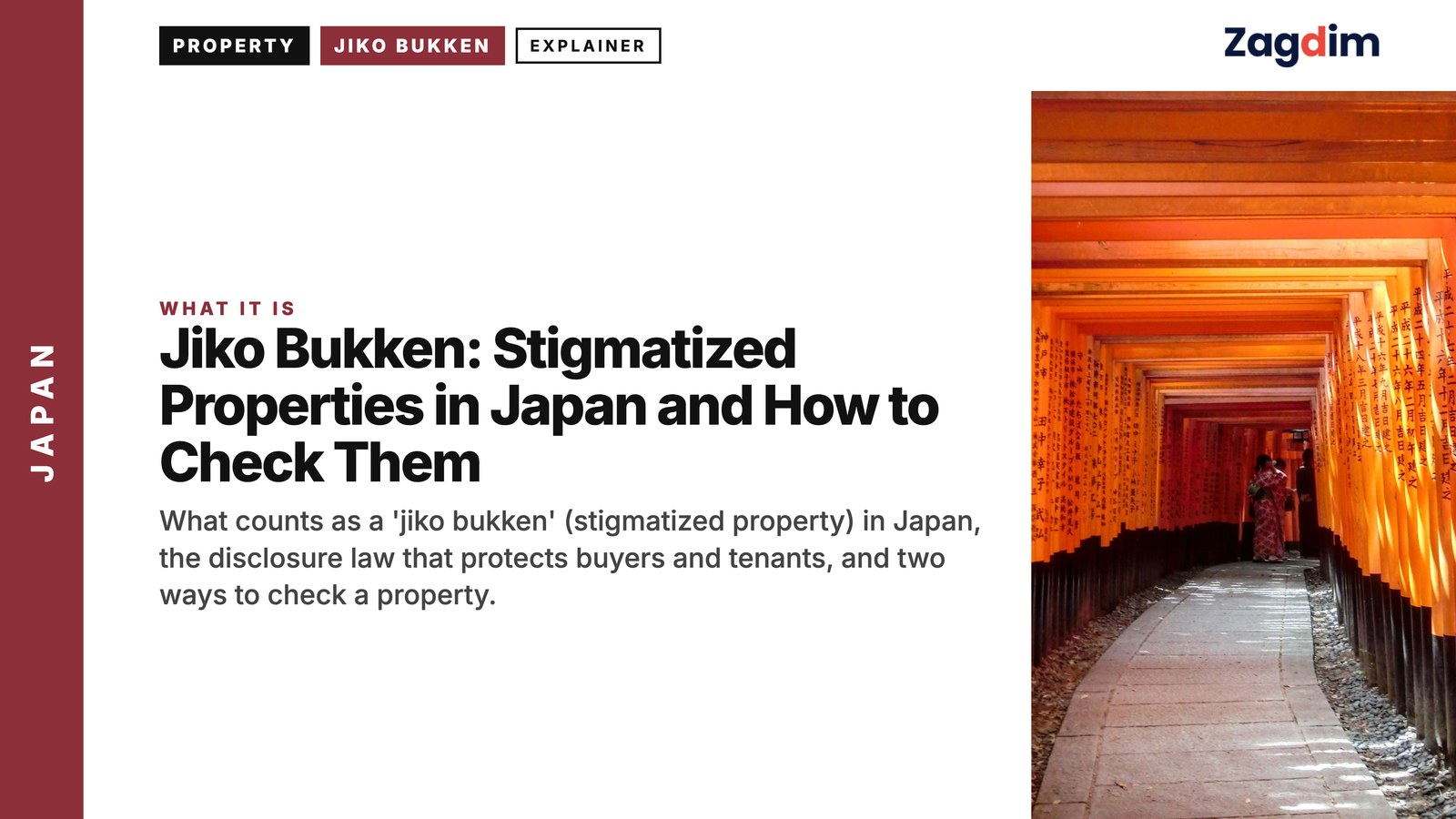
Temple — Fushimi Inari torii gate tunnel with person in kimono, illustrating Jiko Bukken: Stigmatized Properties in Japan and How to Check Them

Image: Zagdim

September 24, 2026
in Japan, Living Abroad, Property
Reading Time: 4 mins read
Tags: Buying Property

In Japan, a stigmatized property is called a “jiko bukken” (事故物件), one type of “kashi bukken” (瑕疵物件, a defective property) — specifically, a property with a psychological defect. A defective property directly affects value in Japan, but the Japanese property market also has a well-developed system to protect owners’ rights. This article explains what counts as a “jiko bukken,” the laws that protect buyers and tenants, and how to check whether a property in Japan is a jiko bukken.

What Counts as a “Jiko Bukken”?

At its core, this refers to a property where a resident has died inside the home. A jiko bukken generally involves murder, suicide, or an unusual accidental death. Natural death and ordinary daily-life accidents, such as a fall or choking, are explicitly excluded from the disclosure duty under the Ministry of Land, Infrastructure, Transport and Tourism’s 2021 guideline and are not treated the same as murder or suicide. For example, if someone died in a gruesome murder, the property will almost certainly be treated, at least for a time, as a jiko bukken. But if an elderly person living with family suddenly passes away from illness and is found right away, that death generally falls outside the disclosure duty, so it will not necessarily be classified as a jiko bukken.

In other words, it is not simply “a room where someone died = a jiko bukken.” Each case is judged on its own facts, weighed against ordinary negative reactions, to decide whether it counts as a jiko bukken — and in practice, that judgment call often falls to the real estate agent.

To protect residents from this kind of unwelcome surprise, the Act on Real Estate Brokerage Business allows operators to be penalized under what is known as “liability for latent defects” (瑕疵担保責任). This liability covers defects in the property, and a jiko bukken counts as a “psychological defect.” For example, suppose you unknowingly rent a Japanese property where a previous resident died by suicide. Under the 2021 guideline, a landlord generally no longer needs to disclose that death once about three years have passed since it became known; within that window, if you learn from another resident that an undisclosed suicide occurred, or you already know it was a suicide, you may be able to seek compensation from the landlord. To guard against this risk, the law also imposes a duty to disclose within that window.

How to Check for a “Jiko Bukken”

Before buying property in Japan, overseas investors can do their homework using two common methods to check whether a property is a jiko bukken.

Method 1: Search Online

The well-known incident-tracking site “Oshima Teru” is simple to use and built on top of Google Maps. Locations where an incident has occurred are marked on the map with a “yellow fireball” icon; clicking it opens an information box explaining when, where and how the incident happened, and the site even has a community feature where people can discuss the location or read others’ comments. Using it is straightforward — just enter an address to search for information on the relevant building. That said, the site’s content is not necessarily fully accurate, so anything found there should still be verified.

Method 2: Ask a Japanese Real Estate Agent

Under Japan’s Act on Real Estate Brokerage Business, if an incident or accident has occurred in a property, the owner or the real estate agent handling the transaction is obligated to disclose this to the buyer or tenant when signing a purchase or lease agreement. When buying property in Japan, the relevant parties will also carry out a property survey, most commonly producing a document called the “Important Matters Explanation” (重要事項説明書, also known as “juusetsu”). A licensed real estate transaction manager (takken shunin) must provide this document in writing and explain its contents. As noted above, the landlord or the property’s agent must clarify whether the property has been involved in, or the site of, a death.

Beyond these methods, as a general rule, if a sale price or rent is 50% to 40% below the market average, that is also worth treating as a red flag.

Related in this series:

  • Renting in Japan: Key Terms and What to Know Before You Sign
  • How to Rent Out Property in Japan: A Landlord's Step-by-Step Guide
  • Defective Properties in Japan: The 4 Types Buyers Should Know

Have a question about this guide? Leave a comment below, or ask Zagdim directly.

Life abroad? Ask Zagdim.

Your first stop for international property and global living.

Research and insights. Know what’s changing. Understand what matters.

Sources

  • Oshima Teru
  • Act on Real Estate Brokerage Business
Zagdim AI
All content is researched, written, or authorized for publication by the @Zagdim Overseas team. Sharing and reposting are welcome, but please make sure to credit the source and include the original article link from this website. Any plagiarism or unauthorized use may result in legal action. For article submissions, please contact us via Facebook. Thank you for your support!

For article submissions, press release publication, or interview notices, please contact [email protected]. 

Zagdim Ask

Have a specific question about overseas living, property, visa, or practical arrangements?

Fill in your situation and key concerns through Zagdim Ask. Our team will review your message and get back to you by email where appropriate.

Submit your enquiry →

Similar Topics

UK Landlords Told to Rethink Property Ownership as October Budget Tax Rise Could Wipe Out Profit for Some
News

UK Landlords Told to Rethink Property Ownership as October Budget Tax Rise Could Wipe Out Profit for Some

November 10, 2026
Greece's 15% Property Transfer Tax for Non-EU Tax Residents Is Now a Government Bill in Parliament
News

Greece’s 15% Property Transfer Tax for Non-EU Tax Residents Is Now a Government Bill in Parliament

November 10, 2026
Taiwan's Financial-Proof Thresholds for Naturalisation: NT$5 Million in Assets or Twice the Minimum Wage
News

Taiwan’s Financial-Proof Thresholds for Naturalisation: NT$5 Million in Assets or Twice the Minimum Wage

November 10, 2026
Next Post
Street — Dotonbori shopping street with tower in daytime, illustrating Defective Properties in Japan: The 4 Types Buyers Should Know

Defective Properties in Japan: The 4 Types Buyers Should Know

Night — Dotonbori canal at dusk with neon signs, illustrating Japan's Landlord-Tenant Law Explained: Shakuchi Shakuya Ho

Japan's Landlord-Tenant Law Explained: Shakuchi Shakuya Ho

Street — Shinsaibashi shopping street signage in Osaka, illustrating Real Estate Yield in Japan: Surface Yield vs Actual Yield Explained

Real Estate Yield in Japan: Surface Yield vs Actual Yield Explained

Facebook Twitter Youtube

About Us

Zagdim is a global knowledge platform focused on international property, global living, relocation, lifestyle, and location-based decision-making.

We provide insights on overseas real estate, market trends, regional analysis, economic developments, and practical relocation information. Through continuous market observation and on-the-ground research, Zagdim helps readers better understand a place before deciding where to live, invest, buy property, or establish a base abroad.

We currently follow markets including the UK, Japan, Thailand, Malaysia, Germany, Australia, the UAE, Greece, Portugal, and Spain, while continuing to track emerging lifestyle, relocation, and property trends worldwide.

Category

  • Australia
  • Buying & Immigration Guide
  • Cambodia
  • Canada
  • Costa Rica
  • Dubai
  • Encyclopedia
  • Europe
  • Expat Lifestyle Guide
  • Germany
  • Global Reports Analysis
  • Hong Kong
  • Human-Picked
  • Indonesia
  • International Property Buying Guide
  • Japan
  • Japan Market News
  • Kenya
  • Living Abroad
  • Malaysia
  • Mallorca
  • Market Trends Overview
  • News
  • Other Market News
  • Overseas Leasing & Long-Term Stay
  • Partner Content
  • Philippines
  • Policy Interpretation
  • Portugal
  • Property
  • Property Law & Tax
  • Real Estate & Economic News
  • Real Estate Law & Taxation
  • Relocation, Immigration & Visa
  • Singapore
  • South Korea
  • Spain
  • Switzerland
  • Thailand
  • Thailand Market News
  • UK Market News
  • United Kingdom
  • United States
  • Vietnam
  • Vietnam Market News
  • Visa & Immigration
  • Zagdim Insights
  • Zagdim Property Insights

Email:[email protected]


Add Friends


WhatsApp
Contact Us


Wechat:Zagdim

Work with Zagdim

For brand and content partnership enquiries, email [email protected].

©2026 Zagdim Overseas All Rights Reserved · Privacy Policy

No Result
View All Result
  • News
    • Thailand
    • Japan
    • UK
    • Germany
    • Global Reports
  • Country Guides
    • Thailand
    • Japan
    • Malaysia
    • Vietnam
    • Philippines
    • Indonesia
  • Property Research
    • Zagdim Insights
  • Ask Zagdim
  • About
    • Zagdim Research
    • Expert Network
    • Contact Us — LINE / WhatsApp
  • 中文 EN

©2026 Zagdim Overseas All Rights Reserved · Privacy Policy