































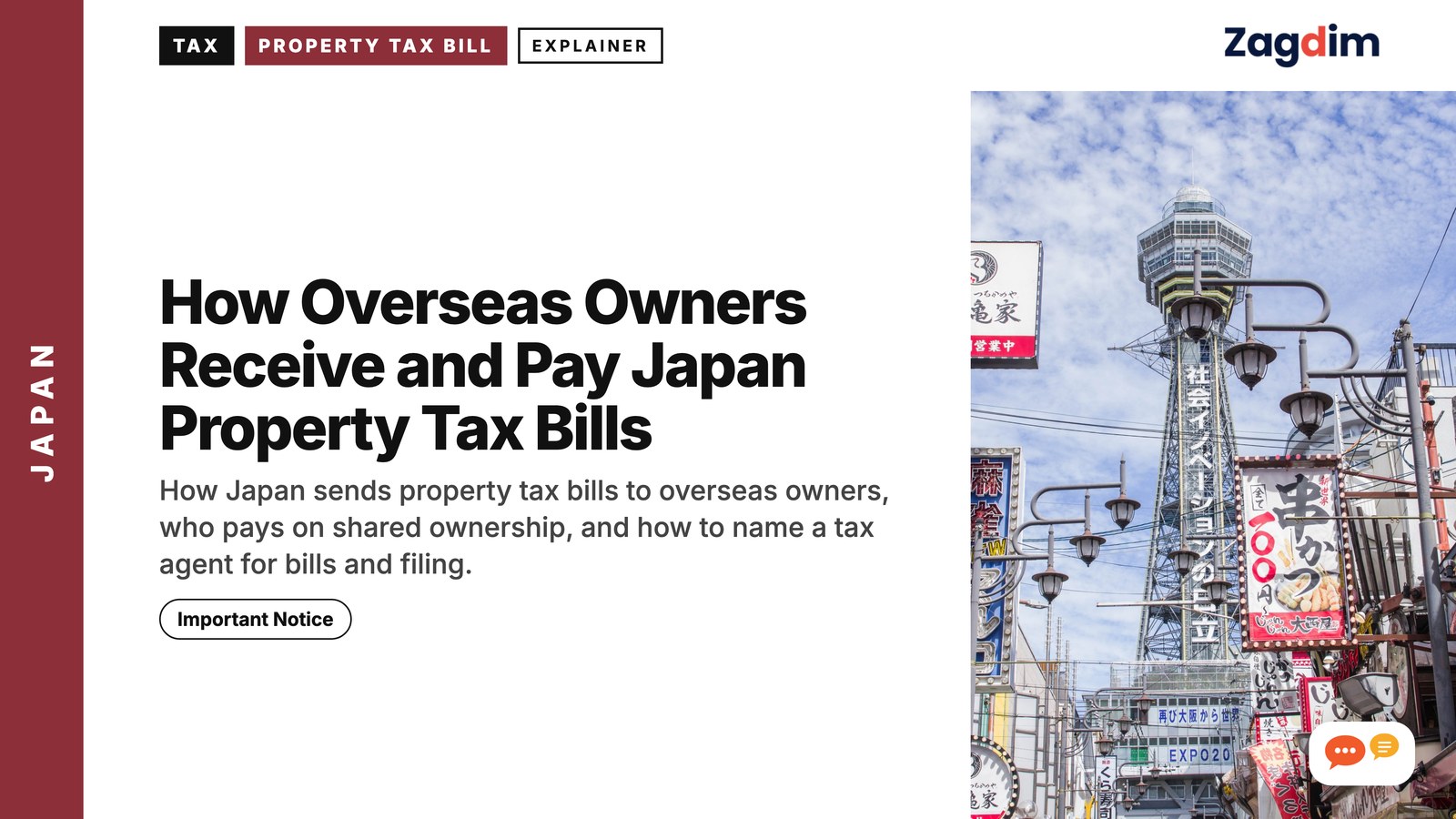
This article is part of Zagdim’s wiki series on holding property in Japan. Using the rules for Tokyo’s 23 wards and the city of Osaka as examples, it explains where the tax bill goes when an overseas owner holds property in Japan, and how to arrange payment. It is written for international readers who own or are considering buying property in Japan, wherever they live, including people with no residency status in Japan.
**Example used throughout this article** (illustrative only): Mr. Lin worked in Tokyo and bought a condominium in one of Tokyo’s 23 wards together with his family. On the registry, Mr. Lin is listed first. He later moved back to Taipei for an overseas transfer, and the condominium was converted to a rental.
Who Gets the Japan Property Tax Bill? What Happens With Co-Ownership or a Mid-Year Purchase?
In short: according to the Tokyo Metropolitan Government, whoever is registered as the owner on January 1 of a given year pays that year’s tax.
The person who owes the tax is legally called the “taxpayer” (納税義務人, *nozei gimusha*).
- Fixed asset tax: paid by whoever is listed as the owner on the fixed asset tax roll (固定資産課税台帳) as of January 1 each year. The tax roll is the register the tax authority keeps of who owns a given piece of land or building. Specifically, this is the person named as the land or building owner in the registry or the supplementary tax roll.
- City planning tax: also paid by whoever is listed as the land or building owner on the tax roll as of January 1.
In Tokyo’s 23 wards, three situations call for extra attention:
| Situation | Result |
|---|---|
| The property is registered under joint ownership | The bill is sent only to the person listed first in the registry (the first-ranked registrant). Other co-owners do not receive a separate bill. |
| The registered owner died (or similar) before January 1 | The person who actually owns the land or building on January 1 must pay the tax. This person may need to file a “report of current owner” (現所有者申告書) telling the tax authority who the current owner is. |
| The property was acquired on or after January 2 | January 1 is the date that determines who pays (賦課基準日, the assessment base date). So no tax bill is issued for that property in that year. |
Example: Mr. Lin is listed first in the registry, so the tax bill is sent to him; the family members registered together with him do not receive a separate bill.
Do You Still Pay Fixed Asset Tax While Living Overseas?
Using the city of Osaka as an example: yes, living abroad does not exempt you from the tax.
Osaka city states that when a foreign national or other person living overseas owns land or a building in Osaka, fixed asset tax and related taxes are not waived because of where the owner lives.
For the basic rules on fixed asset tax and city planning tax, Zagdim has a separate article covering what taxes you pay annually on Japan property, including fixed asset tax, city planning tax, and rental filing.
Where Does the Tax Bill Go If You Live Overseas, and Can You Name Someone to Receive It?
Yes, you can name someone. In Tokyo’s 23 wards, you need to decide who will receive your tax bill before you leave Japan.
This designated recipient is called a “tax agent” (納税管理人, *nozei kanrinin*): someone you appoint to receive your tax bill on your behalf while you are not in Japan.
Tokyo’s 23 wards
- If an owner moves out of Japan, for example because of an overseas transfer, they must submit a “tax agent report” (納税管理人申告書) to the Metropolitan Tax Office covering the ward where the property is located.
- Once this is filed, the tax bill is sent to the tax agent instead.
Osaka city
- An owner living overseas can name a tax agent who lives within Osaka city.
- If the owner wants to name someone who lives outside the city, separate approval is required.
- Only one tax agent can be named per ward.
- The report is filed with the municipal tax office covering the ward where the property is located, or it can be filed through eLTAX (Japan’s online system for local tax filings).
Example: before moving back to Taipei, Mr. Lin needs to file a tax agent report at the Metropolitan Tax Office covering the ward where his condominium is located. After that, the tax bill is sent to the tax agent.
When Is the Tax Bill Sent in Tokyo’s 23 Wards, and How Many Installments Are There?
The 2026 tax bill was sent out on June 1, 2026, with payment due in four installments.
This bill covers fixed asset tax and city planning tax. The payment deadlines for the 2026 tax year are:
| Installment | Payment Deadline |
|---|---|
| First | June 30, 2026 |
| Second | September 30, 2026 |
| Third | December 28, 2026 |
| Fourth | March 1, 2027 |
These dates apply only to the 2026 tax year; they are not fixed from year to year.
What If You Do Not Receive the Bill, or Your Address Changes?
In Tokyo’s 23 wards, if ten or more days have passed since the tax bill was sent and you still have not received it, you can contact the fixed asset tax section of the Metropolitan Tax Office covering the ward where the property is located.
If you move, note that updating your address on your resident registration (住民票, *juminhyo*, Japan’s system for registering where you live) does not automatically change where the tax bill is mailed.
In Tokyo’s 23 wards, changing the mailing address for the fixed asset tax and city planning tax notice requires a separate application:
- To have the following June’s tax bill sent to a new address, the application must be filed by the end of March.
- If filed in April or later, the owner also needs to use the post office’s mail forwarding service for that year.
How Do Overseas Owners Handle Income Tax Filing on Rental Income From Japan Property?
Rental income from a Japanese property falls into a category of income that must be reported for Japan income tax purposes. Whether you personally need to file depends on your individual circumstances and must be confirmed case by case.
According to Japan’s National Tax Agency:
- Rent from property located in Japan counts as “domestic-source income” for a non-resident. A non-resident, under Japanese tax law, is someone who is not treated as living in Japan; domestic-source income is income generated within Japan.
- This type of income is calculated under “aggregate taxation” (総合課税), meaning it is combined with other income, and the owner then files a “final tax return” (確定申告) by calculating their own annual income and reporting it to the tax office.
- Whether an individual must file, whether tax is withheld, and which tax treaties may apply all need to be checked case by case.
A non-resident who needs to file a Japan income tax final return must submit a “notification of appointment or dismissal of tax agent for income tax/consumption tax” (所得税・消費税納税管理人選任または解任申告) to the tax office that has jurisdiction over the place of taxation. This filing is used to appoint or remove a tax agent.
This is a separate procedure from the tax agent used for fixed asset tax described above:
| Tax | Filed With |
|---|---|
| Fixed asset tax | Metropolitan Tax Office (Tokyo’s 23 wards) or municipal tax office (Osaka city) |
| Income tax | The tax office with jurisdiction over the place of taxation |
The National Tax Agency’s explanation primarily uses the example of people working overseas (海外勤務者). Owners who have never lived in Japan should first confirm their own filing obligation and place of taxation.
Example: once Mr. Lin rents out his condominium, he needs to confirm whether he is required to file. If so, he also needs to submit a tax agent notification for income tax to the tax office separately.
For more on rental income and deductible expenses, Zagdim has a separate article on what taxes apply to renting out Japan property, covering rental income, deductible expenses, and filing.
FAQ
I live overseas and have not received my Japan property tax bill. What should I do?
In Tokyo’s 23 wards, if ten or more days have passed since the bill was sent and you still have not received it, contact the fixed asset tax section of the Metropolitan Tax Office covering the ward where the property is located.
If I update my resident registration address, will the tax bill follow automatically?
Not in Tokyo’s 23 wards. The mailing address for the tax bill needs a separate change request, and it must be filed by the end of March to take effect for that June’s bill.
Why does only one person receive the tax bill on a co-owned property?
In Tokyo’s 23 wards, the tax bill is sent only to the person listed first in the registry. Other co-owners do not receive a separate bill.
How many installments can the Tokyo 23 wards tax bill be paid in?
For the 2026 tax year, it is paid in four installments, due June 30, September 30, December 28, 2026, and March 1, 2027.
Notes on This Information
This article’s facts were checked as of October 21, 2026. Osaka city’s statement that fixed asset tax is not waived for overseas residents applies only to Osaka city; the original source refers only to overseas residents and does not distinguish by residency status. The rules on tax bill delivery, tax agents, and changing the delivery address for Tokyo’s 23 wards apply only to Tokyo’s 23 wards; rules for other parts of Japan are not covered in this article. The four installment deadlines for Tokyo’s 23 wards apply to the 2026 tax year only; deadlines for other years are not covered. The explanation of rental income tax is drawn from National Tax Agency reference No. 1926, which primarily uses the example of people working overseas; details such as the timing of departure, deductions, and filing deadlines in that reference should not be applied directly to owners who have never lived in Japan. Mr. Lin’s situation is used only as an illustrative example and does not represent a conclusion for any individual case.
Have a question about this guide? Leave a comment below, or ask Zagdim directly.
Your first stop for international property and global living.
Research and insights. Know what’s changing. Understand what matters.
References
- Tokyo Metropolitan Bureau of Taxation: Fixed Asset Tax and City Planning Tax (Land and Buildings)
- Osaka City Finance Bureau: Frequently Asked Questions (Land and Building Matters)
- National Tax Agency: No. 1926 Real Estate Income While Working Overseas
Important Notice
This article is a general information summary and does not constitute tax or legal advice for any individual case. Information was checked as of October 21, 2026. Rules in Japan and in your home country or jurisdiction may be updated; please refer to current official announcements from the relevant authorities, and consult a qualified professional for your individual case.