































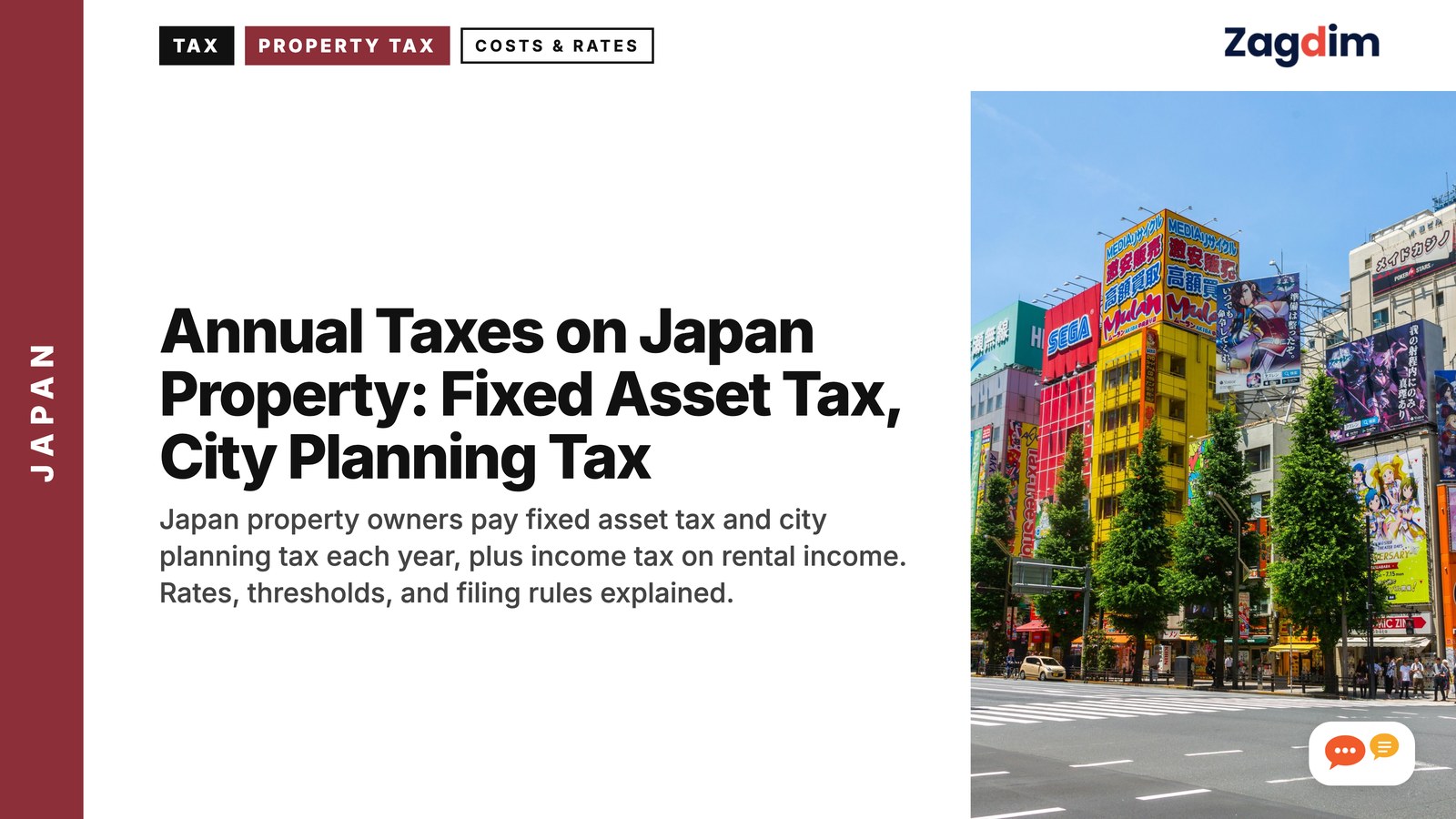
This article is part of the Zagdim wiki series on buying property in Japan. It lays out two things in plain language: what taxes property owners pay every year while holding Japanese real estate, and how rental income needs to be reported. It is written for international readers who are considering buying, or have already bought, property in Japan, including people who hold no residency status in Japan at all.
**Example (used throughout this article)**: Mr. Lin, who lives in Taipei, owns a condominium in one of Tokyo’s 23 wards and rents it out. Each section below applies the rules to Mr. Lin’s situation to make them easier to picture. This is only an example, not a real case.
What Taxes Do You Pay Each Year on Owning Property in Japan?
In short, there are two main taxes, and a rental property adds income tax on top.
- Fixed Asset Tax (固定資産税): a tax owed by anyone who holds land or a building.
- City Planning Tax (都市計画税): in Tokyo’s 23 wards, this is billed together with Fixed Asset Tax.
- If you rent it out: rental income generally counts as “real estate income” (不動産所得) and is subject to Japanese income tax.
That said, not every owner receives a tax bill. In Tokyo’s 23 wards, if the taxable base for land or a building falls below a threshold, no Fixed Asset Tax is charged on that category. The sections below explain each part one at a time.
What Is Fixed Asset Tax? Rate, Tax Base, and Owner Responsibility
In one line: whoever owns real estate as of January 1 each year pays Fixed Asset Tax for that fiscal year.
Who pays? Anyone registered as the owner of land, a building, or depreciable assets on the Fixed Asset Taxation Register (固定資産課税台帳) as of January 1 each year. Think of this register as the government’s property tax roll. Whoever is listed on it is the “taxpayer” (納税義務人), the person responsible for paying that year’s tax. So who owes a given fiscal year’s tax depends on who the register shows as the owner on January 1 of that year.
Who collects it? The municipality where the property is located, meaning Japan’s cities, towns, and villages. Tokyo’s 23 wards are a special case: the Tokyo Metropolitan Government collects the tax there instead.
How is it calculated?
- It is based on the assessed value the owner holds as of January 1 each year.
- The rate listed by the Tokyo Metropolitan Taxation Bureau is 1.4%.
- This figure applies to Tokyo; it cannot be assumed to apply directly to other municipalities.
Is there a reduction for residential land? According to Tokyo Metropolitan Government data, yes. For “small-scale residential land” of up to 200 square meters per household, the taxable base is the assessed value multiplied by one-sixth. The taxable base is the amount the tax rate is applied to. This reduction applies only once the land has been classified as residential land.
When is it due? For fiscal year 2026, Fixed Asset Tax and City Planning Tax in Tokyo’s 23 wards are billed in four installments:
| Installment | 2026 Fiscal Year Payment Deadline (Tokyo’s 23 Wards) |
|---|---|
| 1st | June 30, 2026 |
| 2nd | September 30, 2026 |
| 3rd | December 28, 2026 |
| 4th | March 1, 2027 |
These are the deadlines for fiscal year 2026 only; other years should not be assumed to follow the same dates.
Will you always get a bill? Not necessarily. In Tokyo’s 23 wards, if the same owner’s combined taxable base for fixed assets in the same ward is:
- Under 300,000 yen for land: no Fixed Asset Tax is charged on the land category.
- Under 200,000 yen for buildings: no Fixed Asset Tax is charged on the building category.
Points to note when checking the threshold:
- It is calculated per ward, per owner, with land and buildings counted separately.
- It is based on the taxable base, not the market price or sale price.
- Areas outside Tokyo’s 23 wards cannot be assumed to use the same thresholds.
Applied to Mr. Lin: His condominium is in one of Tokyo’s 23 wards, so the Tokyo Metropolitan Government collects the tax. If the register shows him as the owner as of January 1, 2026, he is responsible for the fiscal year 2026 tax. Whether he actually receives a bill depends on whether his land and building taxable bases in that ward reach the thresholds.
For more detail, see “What Is Japan’s Fixed Asset Tax? Tax Base, Payment Timing, and Owner Responsibility.”
What Is City Planning Tax? Which Properties Must Pay It?
In one line: City Planning Tax is an earmarked tax; in Tokyo’s 23 wards the rate is 0.3%, and it is billed together with Fixed Asset Tax.
- Purpose: it is a “purpose tax” (目的税), meaning the revenue raised can only be spent on specific uses, in this case city planning projects or land readjustment projects.
- Which properties are taxed: according to Tokyo Metropolitan Government data, it generally applies to land and buildings within “urbanization areas” (市街化区域) inside a city planning zone. An urbanization area is roughly land designated for urban development. Depreciable assets are not taxed.
- Who pays: according to Tokyo Metropolitan Government data, whoever is registered as the owner of the land or building on the Fixed Asset Taxation Register as of January 1 each year.
- Rate: 0.3% in Tokyo’s 23 wards; other areas cannot be assumed to use the same rate.
- How it is paid: according to Tokyo Metropolitan Government data, together with Fixed Asset Tax.
Although the two taxes are billed together, they should still be listed separately on your own annual cost sheet.
For more detail, see “What Is City Planning Tax? Which Japanese Properties Must Pay It?”
Do You Still Have to Pay These Taxes While Living Overseas?
Using Osaka City as an example: yes. Living overseas does not exempt you from Fixed Asset Tax.
Osaka City states that for foreign nationals and other overseas residents who own land or a building in Osaka City, Fixed Asset Tax and related taxes are not waived because of where the owner lives. For other cities, follow the rules of the municipality where the property is actually located.
Applied to Mr. Lin: His property is in Tokyo, so Tokyo’s own rules apply. Osaka City’s explanation cannot be used to draw a conclusion about his case.
For how tax bills are delivered and how payment is arranged, see “How Do Overseas Owners of Japanese Property Receive Tax Bills and Arrange Payment?”
How Is Rental Income From Japanese Property Taxed?
In one line: rental income generally counts as real estate income, calculated as rent collected minus related expenses.
- Exception: income classified as business income or transfer income does not count as real estate income.
- Formula: Real estate income = total revenue minus necessary expenses (必要経費).
- Necessary expenses: costs that can be deducted from revenue. For which specific items qualify, see this series’ article on rental filing.
Can the repair reserve fund payment be deducted in the year it is paid? Not automatically. A repair reserve fund (修繕積立金) is money condominium owners set aside each period for future repairs. For a rented condominium, this payment generally becomes a deductible necessary expense in the year the actual repair work is completed, based on the amount spent on that work, not in the year it was paid.
Does the tenant withhold tax in advance? Generally, yes.
- Who withholds: anyone who rents real estate located in Japan from a non-resident or foreign corporation, and pays the rent within Japan.
- When: in principle, 20.42% is withheld at the time of payment, with the remainder paid out.
- What is withheld: income tax and the special reconstruction income tax (復興特別所得税).
- From 2027: the description of tax items will also add the special defense income tax (防衛特別所得税).
Do you still need to file separately? This must be checked case by case. The National Tax Agency classifies rent from real estate located in Japan as a non-resident’s “domestic source income,” meaning income generated within Japan. This type of income is calculated under “aggregate taxation” (総合課税), meaning it is combined with other income that must be aggregated, and it also falls under the category requiring a “final tax return” (確定申告), where the taxpayer calculates the tax owed and files it with the Japanese tax authorities.
That said, whether filing is required in a specific case, how withholding is calculated, and whether a tax treaty applies must all be checked individually.
Applied to Mr. Lin: If he is a non-resident and the tenant pays rent within Japan, the tenant will generally withhold 20.42% before paying out the rest. Whether Mr. Lin needs to file separately must be checked case by case. He also cannot automatically deduct the condominium’s repair reserve fund payment as an expense in the year it is paid.
For more detail, see “What Taxes Apply to Renting Out Japanese Property? Rental Income, Management Fee Deductions, and Filing.”
What Are the Annual Holding Costs for Japanese Property? Management Fees, Repair Reserve Funds, and Insurance
In one line: taxes are not the only annual cost. The Ministry of Land, Infrastructure, Transport and Tourism’s housing cost list covers the items in the table below, and condominiums add a management fee and a repair reserve fund on top.
| Cost Item | Note |
|---|---|
| Mortgage | Only a holding cost if you borrowed to buy the property |
| Fixed Asset Tax | See above |
| City Planning Tax | See above |
| Repair costs | — |
| Fire insurance | — |
| Management fee (管理費) | Condominiums only; used to manage the building’s shared areas |
| Repair reserve fund | Condominiums only; set aside for future repairs to shared areas, with the amount set by the long-term repair plan (長期修繕計画) |
On the mortgage, two points are worth remembering:
- Not every owner has one; if you did not borrow money, you do not need to factor it in.
- When calculating rental income, loan interest and principal must be separated; the full mortgage payment cannot be listed as a necessary expense.
Applied to Mr. Lin: Since his property is a condominium, both the management fee and the repair reserve fund need to be included in his annual costs. Whether the mortgage is included depends on whether he borrowed money to buy it.
For more detail, see “Japan Property Annual Cost Table: Fixed Asset Tax, Management Fees, Repair Reserve Funds, and Insurance.”
Frequently Asked Questions
Will I always receive a Fixed Asset Tax bill for property I own in Japan?
Not necessarily. In Tokyo’s 23 wards, if the same owner’s combined taxable base for land in the same ward is under 300,000 yen, no Fixed Asset Tax is charged on the land category; if it is under 200,000 yen for buildings, no tax is charged on the building category either.
What are the Fixed Asset Tax and City Planning Tax rates in Tokyo’s 23 wards?
The Tokyo Metropolitan Taxation Bureau lists a Fixed Asset Tax rate of 1.4%, and the City Planning Tax rate in Tokyo’s 23 wards is 0.3%. These figures cannot be assumed to apply elsewhere.
Do I still have to pay Fixed Asset Tax if I live overseas?
Using Osaka City as an example, yes. Overseas residents who own land or a building in Osaka City are not exempted from Fixed Asset Tax because of where they live.
Do I need to declare income from renting out property in Japan?
The National Tax Agency classifies rent from real estate located in Japan as income that non-residents must calculate under aggregate taxation and file through a final tax return. Whether filing is required, how withholding is calculated, and whether a tax treaty applies must still be checked case by case.
Can the repair reserve fund be deducted in the year it is paid?
Not automatically. For a rented condominium, the repair reserve fund generally becomes a deductible necessary expense in the year the actual repair work is completed, based on the amount spent on that work.
About This Information
This article’s data was checked as of October 21, 2026. Details on what Fixed Asset Tax and City Planning Tax apply to, their rates, exemption thresholds, and payment deadlines are drawn from explanations published by the Tokyo Metropolitan Taxation Bureau; rates and thresholds for areas outside Tokyo’s 23 wards were not within the scope of this check. The payment deadlines listed for Tokyo’s 23 wards apply only to fiscal year 2026; other years should follow that year’s own published notice. Osaka City’s explanation that overseas residents are still taxed does not classify owners by residency status in the original source; this article is written based on that content and does not represent a check of every possible status. The explanation of non-resident rental income is drawn from a National Tax Agency page aimed mainly at people working overseas, and details such as departure timing, income deductions, and filing deadlines do not directly apply to owners who have never lived in Japan; whether filing is required, how withholding is calculated, and whether a tax treaty applies still need to be confirmed case by case against the relevant authority’s current rules. The specific items that can be listed as necessary expenses for rental income are explained in this series’ article on rental filing. Mr. Lin’s situation in this article is an example only. The original Japanese text was translated and compiled by Zagdim’s editorial team; where there is any discrepancy, the original Japanese text governs.
Have a question about this guide? Leave a comment below, or ask Zagdim directly.
Your first stop for international property and global living.
Research and insights. Know what’s changing. Understand what matters.
Sources
- Tokyo Metropolitan Taxation Bureau – Fixed Asset Tax and City Planning Tax (Land and Buildings)
- Osaka City Finance Bureau – Osaka City: Frequently Asked Questions (Land and Buildings)
- National Tax Agency – No. 1370: Receiving Real Estate Income (Real Estate Income)
- National Tax Agency – No. 2880: Paying Rent on Real Estate to Non-Residents, etc.
- National Tax Agency – No. 1926: When You Have Real Estate Income While Working Overseas
- National Tax Agency – Treatment of Repair Reserve Funds for Rental Condominiums
- Ministry of Land, Infrastructure, Transport and Tourism – What Costs Are Involved in Housing?
Important Notice
This article is a general informational summary and does not constitute tax or legal advice for any individual case. The data was checked as of October 21, 2026. Japan’s rules may be updated; check the current rules published by the relevant authorities, and consult a qualified professional for your specific situation.