
































Even Japan’s Cheapest Chain Is Raising Prices: What Saizeriya’s Move Says About Japan Restaurant Price Increases
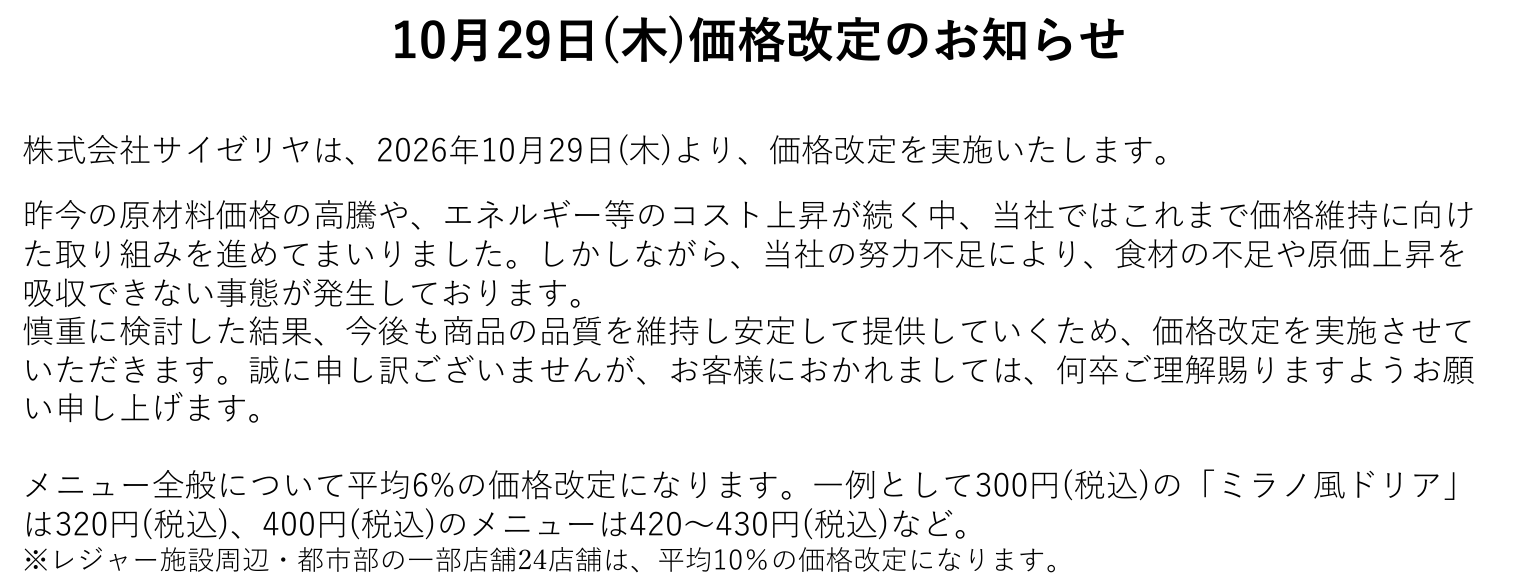
According to Saizeriya’s (サイゼリヤ) official announcement of 14 October 2026, menu prices rise by 6% on average from 29 October, and its signature Milan-style doria (ミラノ風ドリア) goes from ¥300 to ¥320, tax included, which shows that Japan restaurant price increases have now reached a chain known for keeping prices low for years.
Saizeriya is a Japanese chain of Italian-style family restaurants. Its notice says the company had worked to hold prices but, because of “insufficient efforts” on its part, could no longer absorb shortages of ingredients and rising costs; it apologised for the increase. Public broadcaster NHK reported the increase on 15 October. The company published its results for the fiscal year ended August 2026 (September 2025 to August 2026) the same day.
This guide uses the price rise as a starting point and asks two questions: why Saizeriya held prices for so long and why it could not this time, and what the cost pressures behind it mean for foreign residents and travellers budgeting for meals in Japan.
Key Points
- Who should pay attention: foreign residents, students and workers in Japan, travellers planning a trip, and anyone working out a living budget for Japan.
- What Saizeriya announced: menu prices rise about 6% on average from 29 October; lunch, morning-only items and its “fresh wine” do not change; 24 branches in tourist and urban districts rise about 10% on average; and 50 branches raise prices early, between 21 and 28 October.
- Two layers of explanation can be matched to official data: imported ingredient and energy costs pushed higher, and a higher minimum wage plus labour shortages pushing up staff costs. No official source says how much each layer contributes, so this guide does not rank them.
- Practical takeaway: menu prices in Japan must be shown tax-inclusive, and you can budget by testing a 6% and a 10% increase.
What Saizeriya Changed: 6% at Most Branches, 10% at 24 Tourist and Urban Branches, No Change to Lunch and Morning Items
All figures below come from Saizeriya’s official news releases of 14 and 19 October 2026. Prices include tax:
| Item | Before | Most branches, from 29 October | 24 “regional price” branches, from 29 October |
|---|---|---|---|
| Milan-style doria | ¥300 | ¥320 | ¥330 |
| A ¥400 menu item | ¥400 | ¥420 to ¥430 | ¥440 to ¥450 |
| Average increase across the menu | — | About 6% | About 10% |
The notice also says the price of fresh wine (フレッシュワイン), lunch (ランチ) and morning-only items (モーニング限定メニュー) does not change. The release does not list new prices for every item, so check the in-store menu for the rest.
Which 24 branches rise about 10%: the list published on 19 October has 1 branch in Maihama, Chiba Prefecture (home of the Tokyo Disney Resort), 17 in Tokyo (including districts such as Roppongi, Shibuya, Shinjuku, Akihabara, Ueno, Asakusa, Ginza, Ikebukuro, Kinshicho and Nakameguro), 2 in Yokohama (Kannai and Yokohama World Porters) and 4 in Osaka (Abeno, the Konohana ward area where Universal Studios Japan is located, Sennichimae and Umeda).
Not every branch waits until 29 October: the same release lists branches that raise prices early. 48 branches switch on 21 October (2 in Tokyo, 22 in Kanagawa, 21 in Osaka and 3 in Hyogo), 1 branch in Ibaraki on 25 October and 1 in Saitama on 28 October, 50 in total. Two of them, the Roppongi and Shinjuku City Hall branches, are also among the 24 branches that rise about 10%.
Why Saizeriya Held Prices for So Long: It Found the Savings Elsewhere
Saizeriya’s earnings summary (決算短信, 14 October 2026) states that, as ingredient and energy costs rose, the company’s policy had been to keep menu prices. Nikkei CNBC reports that this is the first price increase in about six years. A Toyo Keizai article from August 2020 notes that in July 2020 the signature doria went from ¥299 to ¥300 and every item was moved to 50-yen price steps, as one of the company’s responses to the pandemic.
The company’s published figures point to several ways it held prices:
- Supply chain: the earnings summary says its Australian subsidiary makes ingredients the company uses, and that in the fiscal year it reorganised product development, sourcing, processing, storage and logistics into one organisation with a global view.
- Digital ordering and store operations: ordering by QR code on customers’ phones reached all stores by the end of December 2025. Selling, general and administrative costs in the Japan business were 48.8% of sales, 2.4 percentage points lower than the 51.2% of the previous year.
- Customer numbers: domestic customer visits were about 236 million, about 15% more than the previous year (Zagdim’s calculation from the earnings presentation), and the average spend per customer was ¥860 (¥844 the year before).
The Fiscal 2026 Accounts: Cost Ratios Rose and Operating Profit Fell Short of the Company’s Own Budget
Everything in this table comes from Saizeriya’s earnings summary and earnings presentation for the fiscal year ended August 2026 (14 October 2026):
| Item | Fiscal year ended August 2026 | Previous year |
|---|---|---|
| Cost of sales ratio, Japan business (売上原価率) | 48.3% | 45.9% |
| Cost of sales ratio, group | 43.7% | 41.9% |
| Operating margin, group | 5.4% | 6.0% |
| Operating profit, group | ¥16.419 billion | ¥15.499 billion |
The company’s budget, announced on 8 April 2026, was ¥18.2 billion of operating profit, so the result was 90.2% of budget. Operating profit still rose 5.9% on the previous year. In the earnings presentation’s operating profit bridge, the domestic cost-of-sales item is about ¥4.47 billion negative and the domestic selling and administrative cost item is about ¥5.44 billion positive.
The company also changed its price policy. The earnings summary says it will keep improving sourcing and supply chains, but that menu price revisions, needed to maintain quality and stable supply, will be made “depending on circumstances”. Its forecast for the fiscal year ending August 2027 is operating profit of ¥21.2 billion, up 29.1%.
Two Layers Behind Japan Restaurant Price Increases: Imported Ingredients and Energy, Then Labour Costs
Saizeriya’s notice says it could not absorb the costs. Putting the company’s statements next to public statistics, two layers can be identified. No official source splits the effect on any single restaurant, so the table lists each set of data without presenting it as a fixed share of causes.
| Layer | Official or published data | What it means for eating out | Source |
|---|---|---|---|
| Ingredients and energy | In September 2026, domestic corporate goods prices rose 6.8% year on year and import prices in yen terms rose 24.5% | Upstream prices are high; the index covers all goods, not only food | Bank of Japan, Corporate Goods Price Index (preliminary, published 13 October 2026) |
| Ingredients and energy | 195 major food makers announced 3,153 price rises for October 2026; the 2026 total identified so far is 20,187 items, the second year in a row above 20,000 | Food prices are rising widely; the data covers food manufacturers, not restaurants | Teikoku Databank (TDB), survey of 30 September 2026 |
| Labour costs | The 2026 minimum wage averages ¥1,177 nationally, ¥56 (about 5.0%, Zagdim’s calculation) above the previous year | Restaurants are labour-intensive; the new rates take effect between 1 October and 2 December 2026 depending on the prefecture | Ministry of Health, Labour and Welfare, 3 September 2026 |
| Average spend at peers | In August 2026, average spend per customer across all eating out rose 2.3% year on year; for the “Western-style” family restaurant segment it rose 4.1% (excluding tax) | Peers’ average spend is rising too; average spend also reflects what customers order, so it is not the same as a simple price rise | Japan Foodservice Association, published 25 September 2026 |
Layer One: Imported Ingredient and Energy Costs Pushed Higher
TDB tallied the stated reasons behind food price rises up to the end of September 2026 (one item can have several reasons): raw material costs 91.3%, logistics 66.0%, energy 63.8%, packaging materials 63.7%, labour costs 51.1%, the Middle East situation 27.8% and the weak yen 8.1%. TDB says the Middle East situation pushed up crude oil and naphtha prices, and that a yen weaker than ¥150 to the dollar keeps import costs high, so it expects price rises to continue on and off into 2027.
Saizeriya’s own earnings summary also says that the weak yen, which has persisted since the year before last, has raised ingredient prices and that the Middle East situation has raised energy prices. One caution: TDB’s figures come from food manufacturers, and only 8.1% of the items list the weak yen as a reason, so the exchange rate is not the whole story. No official statistic separates how much of Saizeriya’s costs comes from the exchange rate.
Layer Two: A Higher Minimum Wage and Labour Shortages
On 3 September 2026 the Ministry of Health, Labour and Welfare announced that the 2026 regional minimum wage averages ¥1,177 nationally, ¥56 above last year’s ¥1,121. This is the second-largest increase since the guideline system began in fiscal 1978. Saizeriya’s earnings summary adds that the restaurant industry faces high food and resource prices and a rising trend in labour costs from labour shortages, and expects the difficult conditions to continue.
Taken together, the two layers form the background that the company’s statements and public data can support: upstream prices and labour costs are both high, and a chain that had absorbed costs through its supply chain and digitalisation still saw its cost ratios rise in the fiscal year ended August 2026. TDB’s 30 September 2026 survey also notes that price rises in eating out, daily goods, household consumables and leisure have spread since July.
Statistics Bureau data helps as a check. In August 2026, the national consumer price index for eating out rose 2.1% year on year, against 1.9% for all items and 1.7% excluding fresh food (2025 = 100). That is a national average, while Saizeriya’s figure is the average menu price rise at a single chain, so the two cannot be compared directly.
Budgeting for Eating Out After Japan Restaurant Price Increases
The table below is based on the two average increases in Saizeriya’s official announcement (6% at most branches, 10% at the 24 branches), calculated by Zagdim on the assumption that your order stays the same and all your spending is at branches that raise prices:
| Monthly eating-out spend | Extra cost at a 6% rise | Extra cost at a 10% rise |
|---|---|---|
| ¥20,000 | About ¥1,200 | About ¥2,000 |
| ¥30,000 | About ¥1,800 | About ¥3,000 |
| ¥50,000 | About ¥3,000 | About ¥5,000 |
Saizeriya’s average spend per customer in Japan was ¥860 (September 2025 to August 2026). If the order stays the same, a 6% rise would make that about ¥910 and a 10% rise about ¥946 (Zagdim’s calculation).
Practical steps:
- The menu price is the price you pay. The National Tax Agency says the current rules require tax-inclusive prices when a price is shown to consumers in advance, and Saizeriya’s notice states that its prices include tax.
- Eating in and taking out carry different tax rates. Under National Tax Agency material, meals served at a place with dining facilities are taxed at 10%, while takeout and delivery are taxed at 8%. A food tax cut bill submitted to the Diet on 9 October 2026 would keep eating in at 10%. As of 20 October 2026 it had not been enacted; see Zagdim’s guide to Japan’s consumption tax for details.
- If your budget is tight, start with items that are not changing. Saizeriya says lunch and morning-only items stay the same; at other chains, ask whether there is a lunch set or limited-time menu.
- Expect higher prices at branches in popular districts. Saizeriya’s 24 branches rising about 10% are concentrated in tourist and city-centre districts of Tokyo, Yokohama and Osaka.
- 29 October is not the cut-off for every branch. At the early-start branches the new prices may apply from 21 October, so check the branch name before you go.
- If you are paid by the hour, check the minimum wage date for your prefecture. The new rates take effect between 1 October and 2 December 2026, with increases of ¥54 to ¥65 depending on the prefecture.
Common Misunderstandings About Japan Restaurant Price Increases
- Misunderstanding: Saizeriya’s 6% means restaurant prices across Japan are up 6%. The 6% is the average menu increase at one chain; the Statistics Bureau’s national eating-out figure for August 2026 is 2.1% year on year. The two have different bases. Tip: look at the restaurants you actually use rather than a national average.
- Misunderstanding: Saizeriya will certainly charge the old price until 28 October. The official notice lists 50 early-start branches, 48 of which change on 21 October. Tip: check the branch name and date before you go.
- Misunderstanding: tax is added on top of the menu price. The current rules require tax-inclusive prices, and Saizeriya’s notice says its prices include tax. Tip: the total on the menu is what you pay; where eating in and takeout are taxed differently, follow what the restaurant displays.
- Misunderstanding: an apology for “insufficient efforts” means the company is losing money. Operating profit for the year ended August 2026 was ¥16.419 billion, up 5.9%, though below the company’s April budget, and the operating margin fell from 6.0% to 5.4%. Tip: the apology is the company’s wording, the accounts are a separate matter, so read both.
- Misunderstanding: Japan restaurant price increases are only about the weak yen. In TDB’s tally, 8.1% of price-rise items list the weak yen as a reason, while raw material costs, logistics, energy, packaging and labour costs all rank higher. Tip: the exchange rate is one factor among several.
Scenarios: Three Kinds of People Eating Out in Japan
Scenario one: a language-school student in Tokyo. They often eat lunch at Saizeriya and spend about ¥30,000 a month eating out. The notice says lunch prices do not change, but items ordered outside lunch will carry the new prices; if all of the spending is at branches that raise prices, the estimate is about ¥1,800 more a month.
Scenario two: a first-time visitor on a self-guided trip. The itinerary covers Shibuya, Asakusa and Umeda, districts where Saizeriya has branches among the 24 rising about 10%. The doria at those branches is ¥330, not ¥320. Leave a little more room in the budget, or move one meal to lunchtime.
Scenario three: a foreign part-time worker paid by the hour. The Ministry of Health, Labour and Welfare has announced prefectural increases of ¥54 to ¥65, taking effect between 1 October and 2 December 2026. Check the amount and the effective date for your prefecture. For eating out, estimate with the 6% figure first and adjust for the places you really use.
Japan Restaurant Price Increases and Saizeriya’s Price Rise: FAQ
Are Japan restaurant price increases across the board?
There is no single number. The Statistics Bureau’s national eating-out figure for August 2026 is up 2.1% year on year, Saizeriya announced about 6% on average, and about 10% at some district branches. TDB also notes that price rises in eating out, daily goods and leisure have spread since July. Each restaurant differs, so check the menu of the places you use.
How much is Saizeriya raising prices from 29 October?
The official notice says 6% on average across the menu. The Milan-style doria goes from ¥300 to ¥320 and a ¥400 item to ¥420 to ¥430, tax included. The 24 branches in busy districts rise about 10%, with the doria at ¥330. Fresh wine, lunch and morning-only items do not change.
Why did Saizeriya keep prices so low for so long?
According to its earnings summary, the company’s policy had been to keep menu prices, using better sourcing and supply chains, an Australian subsidiary that makes ingredients, QR ordering and store efficiency to absorb costs. Its cost ratios rose in the fiscal year ended August 2026, and it now says it will revise prices “depending on circumstances”.
What is behind Japan restaurant price increases?
Two layers can be matched to official data: ingredient and energy costs, for example import prices in yen terms up 24.5% in September 2026, and labour costs, for example the 2026 minimum wage averaging ¥1,177 nationally, up ¥56. No official source splits how much each layer contributes.
Are menu prices in Japan shown with tax?
Under National Tax Agency material, the current rules require tax-inclusive prices when a price is shown to consumers in advance, and Saizeriya’s notice also says its prices include tax. Eating in is taxed at 10% and takeout and delivery at 8%; the final bill follows what the restaurant displays.
How much extra should I budget for eating out in Japan?
You can estimate by percentage. At ¥30,000 of eating out a month, a 6% rise adds about ¥1,800 and a 10% rise about ¥3,000 (Zagdim’s calculation). For a short trip, multiply your meal budget by 1.06 to 1.10 and keep some flexibility.
Planning to Live in or Visit Japan? Ask Zagdim
To work out a living or travel budget for Japan, bring your situation to Ask Zagdim.
Life abroad? Ask Zagdim.
Your first stop for international property and global living.
Research and insights. Know what’s changing. Understand what matters.
Newsletter for overseas updatesSubscribe →
Important Disclaimer
This article is general information and not tax, financial or other professional advice. It is based mainly on official data published in September and October 2026 by Saizeriya, the Bank of Japan, the Ministry of Health, Labour and Welfare, the Statistics Bureau and the National Tax Agency, and on surveys by Teikoku Databank and the Japan Foodservice Association. Prices and statistics can change, so rely on the latest official announcements and consult a qualified professional where needed.
Prices and statistics in this article are current as of 20 October 2026, subject to the latest announcements from Saizeriya and the agencies concerned.
References
Saizeriya Co., Ltd. – Notice of price revision on Thursday, 29 October (14 October 2026) / Saizeriya Co., Ltd. – Notice of regional price branches (19 October 2026) / Saizeriya Co., Ltd. – Notice of branches starting the price revision early (19 October 2026) / Saizeriya Co., Ltd. – Earnings summary, fiscal year ended August 2026 / Saizeriya Co., Ltd. – Earnings presentation, fiscal year ended August 2026 / Bank of Japan – Corporate Goods Price Index, September 2026 (preliminary) / Ministry of Health, Labour and Welfare – Revised regional minimum wages recommended in all prefectures / Statistics Bureau of Japan – Consumer Price Index, national, August 2026 / National Tax Agency – Tax Answer No. 6102, the reduced consumption tax rate system / National Tax Agency – Pamphlet on the two-year consumption tax cut for food and beverages / Teikoku Databank – Price revision trends of 195 major food companies, October 2026 / Japan Foodservice Association – Foodservice industry market trends survey, August 2026 / NHK – Saizeriya raises prices by 6% on average (15 October 2026) / Nikkei CNBC – Saizeriya announces menu-wide price revision; first increase in about six years / Toyo Keizai Online – Saizeriya’s 50-yen price steps (5 August 2020) / Zagdim – Japan Consumption Tax: 8%, 10% and the Proposed 1% Food Rate Explained for Takeout, Dine-In and Alcohol / Zagdim – Cost of Living in Japan for Foreigners: A Full Budget Breakdown / Zagdim – Bank of Japan Lifts Policy Rate to 1.25%, a 31-Year High, as Two Board Members Dissent